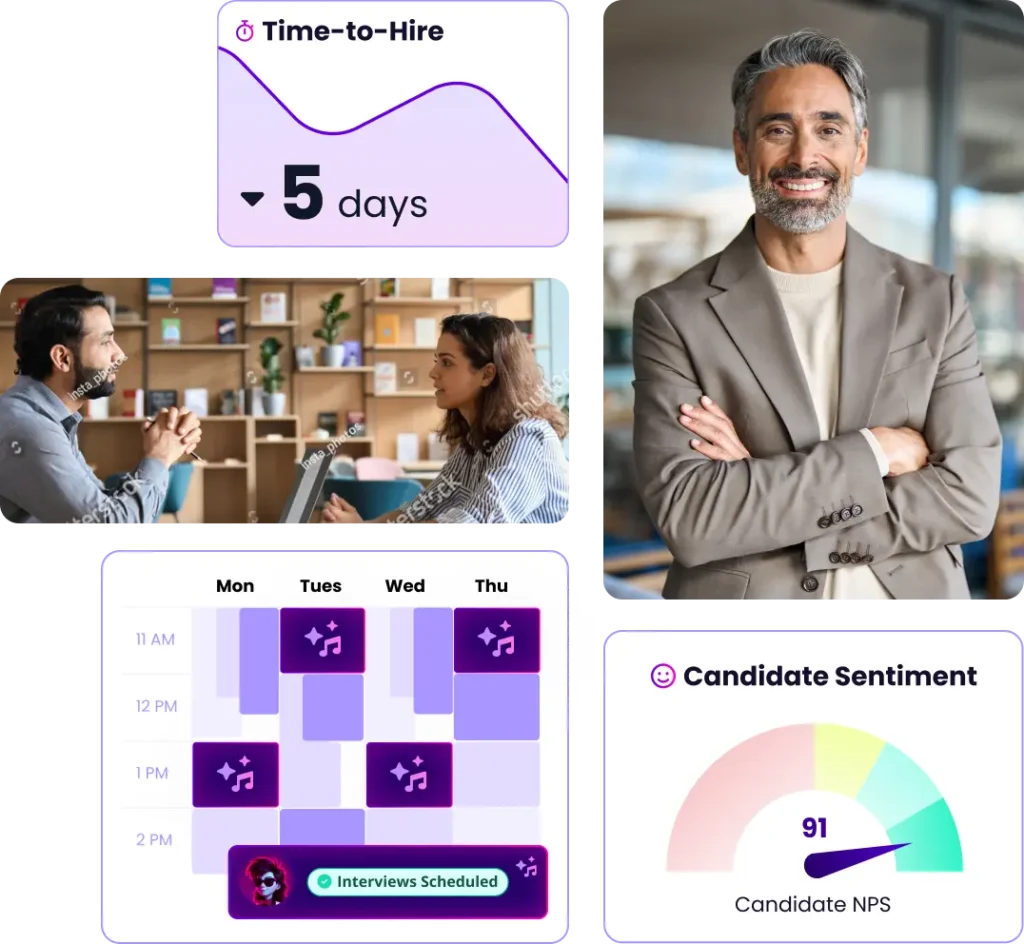
Hiring teams are being asked to do more with the same (or fewer) resources. Reducing manual work, especially around interview scheduling and coordination, is now a prerequisite for maintaining speed and consistency.
Today’s candidates expect fast movement, flexible scheduling, and transparent communication. Friction, delays, and uncertainty are the fastest ways to lose qualified talent.
AI is no longer experimental. When applied to analytics, scheduling, and workflow orchestration, it helps teams surface bottlenecks, reduce time-to-hire, and focus human effort where it matters most.
Simpler, more consistent processes reduce risk, improve signal quality, and create a more equitable experience for candidates and hiring teams alike.
To meet the challenges ahead, we recommend prioritizing three critical areas:
Double down on AI and automation.
Invest in AI-powered workflows that eliminate low-value coordination work and provide real-time insight into hiring performance—not just more tools, but better systems.
Modernize scheduling and communication
Treat scheduling as a strategic capability. Self-serve scheduling, centralized communication, and fewer handoffs directly improve speed, candidate engagement, and recruiter capacity.
Lead with insight, not intuition
Use analytics to identify friction early, monitor funnel health, and anchor decisions in quality of hire and downstream outcomes, not just volume or cost.
Head of Talent Acquisition (NL)
The HEINEKEN Company
Head of HR Strategy & Shared Services
S&P Global
Curator
Recruiting Brainfood
VP, Talent Acquisition & Mobility
HubSpot
VP of TA Operations and Workspaces
Toast
Global Director, Talent Acquisition
Remote
Co-Founder
BrightHire
Head of Talent Acquisition
Glovo
VP HR & Global Head of GTM Org Success & People Partners
Miro
Founder
Shelby Wolpa Consulting
Copyright © 2026. Built with ❤️ all over the world.