Efficiency
 Experience
 Intelligence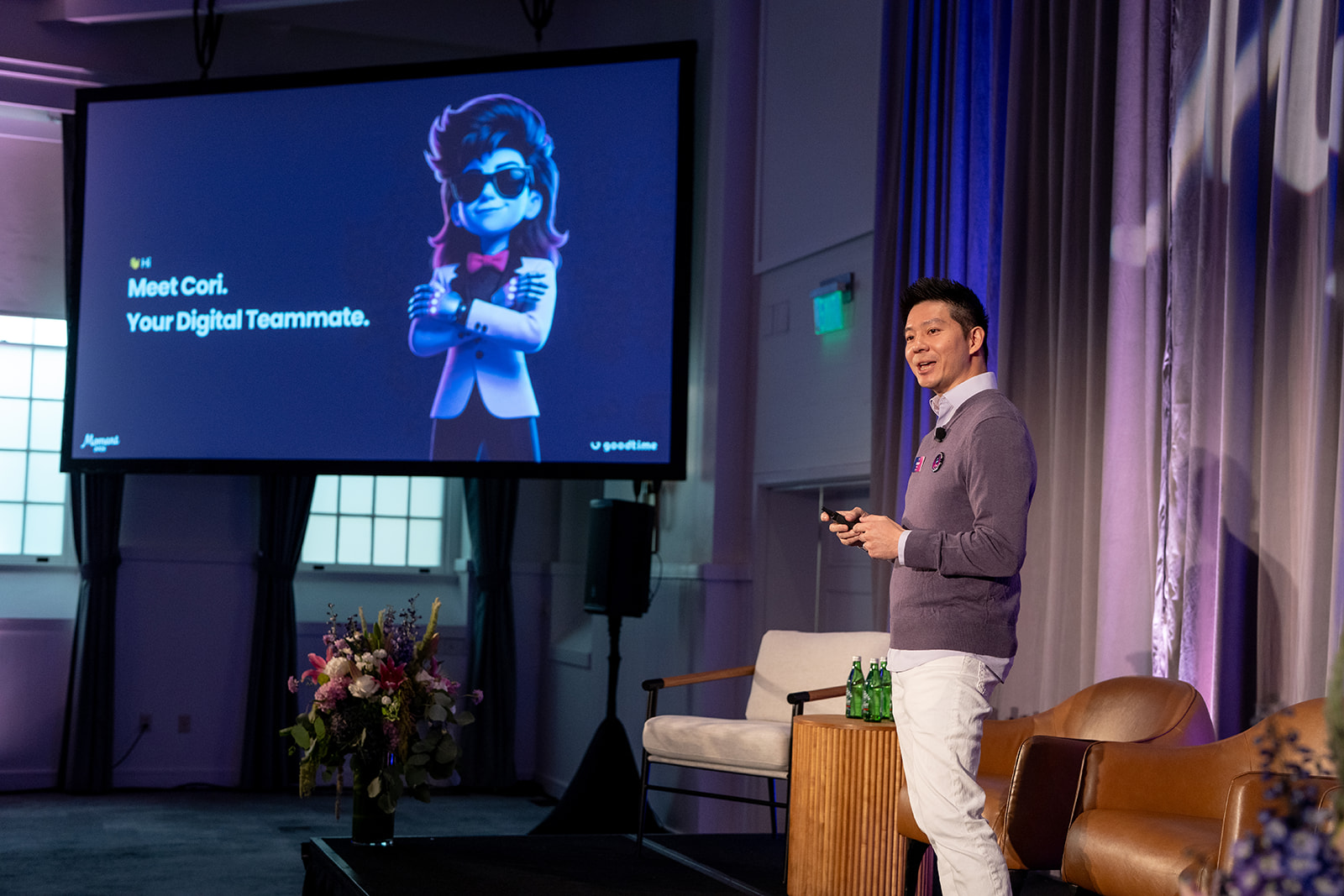
Table of Contents



Join 12,000 TA pros who stress less and crush their goals with our monthly expert-vetted tips and insights.
By submitting this form, you agree to be contacted and to receive the requested information, as well as occasional related insights from GoodTime about our products, services, and content. You may unsubscribe at any time. For details, view our Privacy Policy and Terms of Use.
The GoodTime product demo at Moment 2026 showed how persistent context controlled autonomy and human judgment can turn AI from a tool into a dependable recruiting teammate
The next generation of recruiting software will be judged by more than how quickly it completes a task. Agentic AI must understand the hiring process, retain context as work moves between systems and people, handle routine disruptions, and know when to stop for human judgment. It also has to make its reasoning visible and give talent leaders evidence that automation is improving the operation.
That was the larger argument behind GoodTime’s product demo at Moment 2026. Jasper Sone, Patrick Cole, and Tim Whelan followed one candidate from application through interviews and into the offer stage, using Cori as a continuous digital teammate. The individual capabilities were useful, but the more important idea was how they fit together. Cori did not appear as a separate chatbot at each step. She carried context through the process, acted when the next move was clear, surfaced evidence for review, and returned consequential decisions to people.
GoodTime’s vision offers a practical definition of agentic AI for talent acquisition. The goal is not a collection of isolated assistants or a new interface layered onto the same manual process. It is a hiring operation in which software can recognize what is happening, decide what needs attention, take approved actions, and keep people in control of the judgments that belong to them.
Watch the full keynote or continue scrolling to read the highlights
Note: Interview Recording is in Early Access. Some features may be subject to change.
Agentic AI should remove operational burden
Sone opened with an analogy to the safety elevator. Early elevators made existing buildings easier to navigate. Their greater impact came later, when architects stopped designing around the limitations of stairs. Recruiting technology has followed a similar path. Successive generations of software made manual workflows faster, but people still had to initiate the work, monitor it, and intervene when it stalled.
“We reduced the effort, but we didn’t ultimately take away the operational burden.”
Jasper Sone
Agentic AI creates a chance to redesign the work itself. In Sone’s definition, software should understand the situation, recognize what needs attention, and act while preserving human control. This shifts the product from a tool that waits for instructions to a teammate that helps maintain momentum.
The difference matters because recruiting operations are full of small handoffs. A recruiter advances a candidate, then remembers to send a scheduling link. An interviewer declines, then a coordinator notices the calendar change and starts a reschedule. A scorecard arrives, then someone moves the candidate into the next stage. Traditional automation can accelerate each task, but the human still owns the connective tissue between them. GoodTime is building Cori to own more of that continuity.
Key takeaway: The standard for agentic AI should be less human monitoring and fewer manual handoffs, not simply faster clicks inside an existing workflow.
A useful agent needs persistent context
The demo began with 538 applications for a software engineering role. Cori pulled in the live job post, accepted updated requirements from the recruiter, and reduced the pool to nine recommended candidates. New applicants continued to be evaluated automatically, which meant the 539th application could still rise to the top rather than disappear behind the first several hundred resumes.
The conversational layer showed why context matters. The recruiter asked for recommended candidates with at least seven years of experience, narrowed the answer by salary expectations, and then asked who had startup experience. Cori retained the earlier constraints and interpreted the final question against each candidate’s work history. The recruiter did not have to rebuild the query or explain the job again.
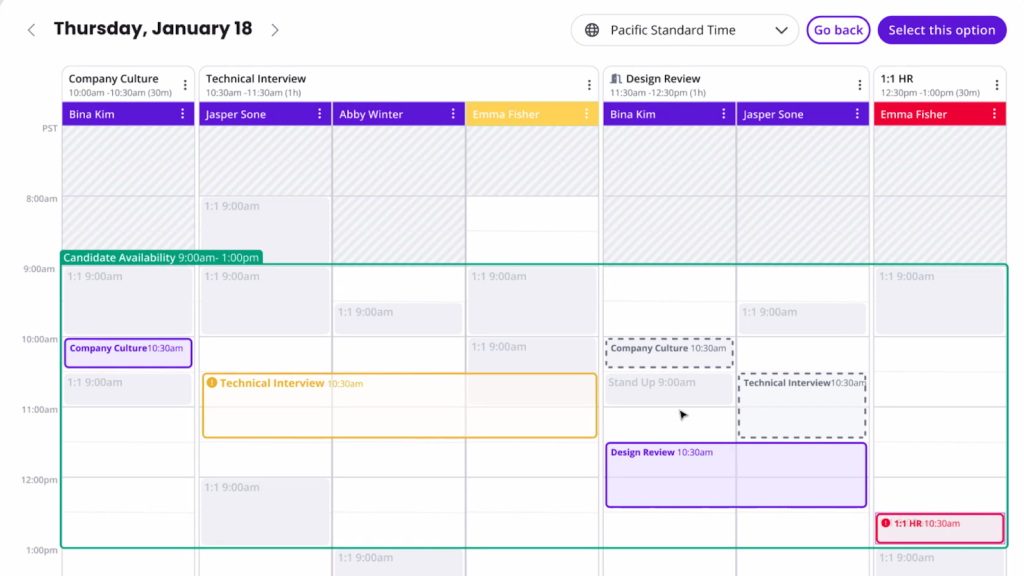
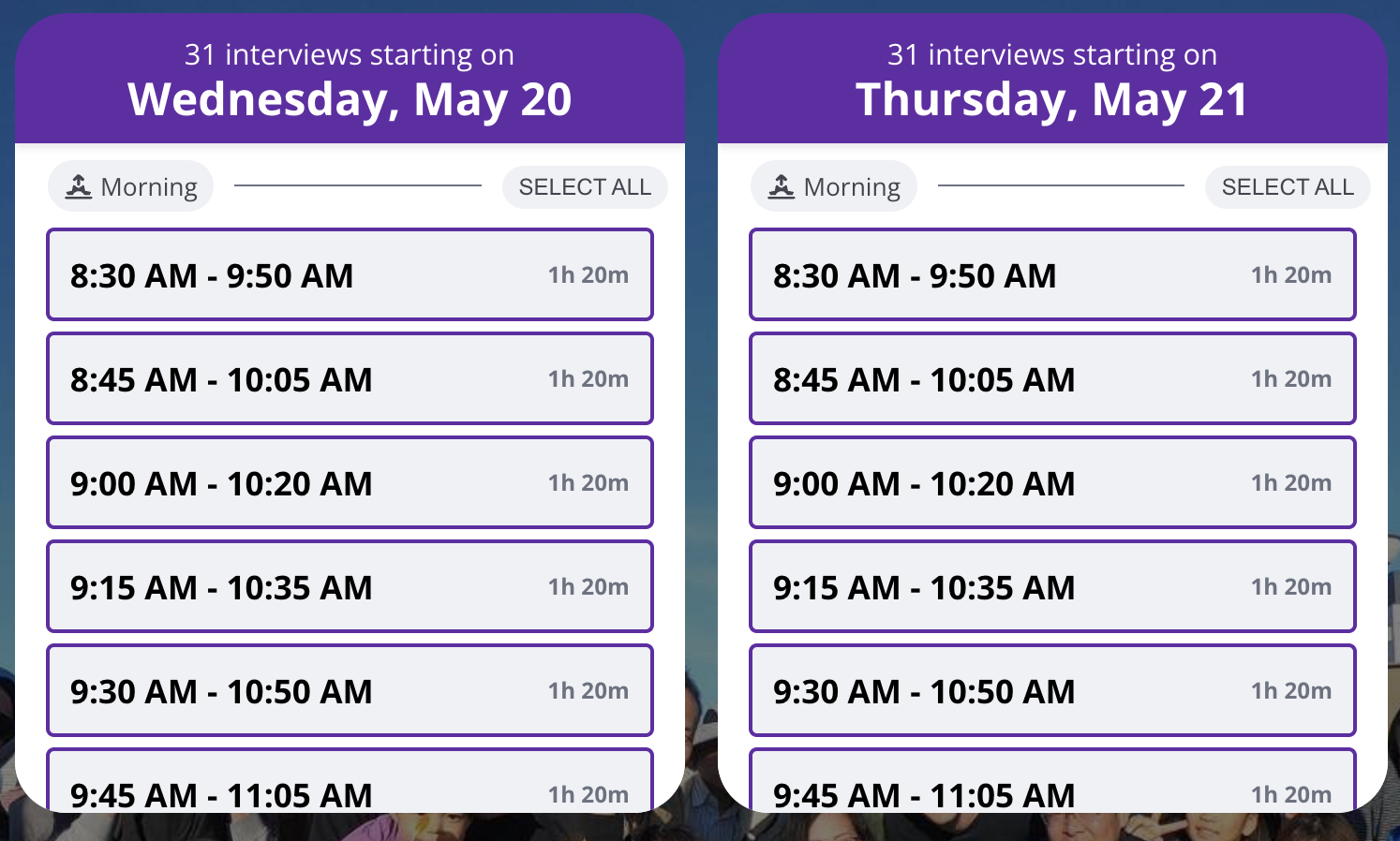
That context continued after the candidate moved forward. Cori understood the interview stage, the required interviewer, the candidate’s prior availability, and the hiring manager’s calendar. When the hiring manager declined on the morning of the interview, Cori recognized that no substitute would satisfy that particular stage, found another time, sought approval in Slack, and prepared the candidate communication.
The same thread carried into interview preparation and recording. The interviewer received the job summary, preparation guide, resume, LinkedIn profile, and scorecard in the order needed. During the interview, Cori tracked the rubric and produced a live transcript. Afterward, she drafted the open-ended scorecard responses from the conversation. When the scorecard was submitted, she understood that a positive hiring-manager recommendation meant the candidate could progress to the team interview.
“Cori has been part of this interview since the candidate applied.”
Tim Whelan
This is a more meaningful design principle than adding chat to every page. A dependable agent needs a shared memory of the job, candidate, interview plan, decisions, and exceptions. Without it, each assistant becomes another silo and the user remains responsible for stitching the process together.
Key takeaway: Context should accumulate across the hiring journey so the agent can coordinate the next step without forcing people to restate what the organization already knows.
Trust requires visible reasoning
Speed alone would make the system hard to trust. The demo repeatedly showed how users could inspect the basis for an action. In candidate review, Cori separated strong matches, partial matches that needed human review, and candidates who did not meet the stated requirements. For each criterion, the recruiter could see the specific resume or application evidence behind the recommendation and open the original source.
“We wanted to make sure that you could see firsthand how she’s evaluating.”
Patrick Cole
The same principle appeared in interview recording. The live transcript gave the interviewer immediate confirmation that the conversation was being captured. The completed scorecard could be compared with the recording and searched transcript. AI reduced the effort of documenting the interview, but the evidence remained available for review.
That approach is especially important in talent acquisition, where an opaque recommendation can affect a person’s livelihood and expose an employer to bias, compliance, and consistency risks. An agent should distinguish what it inferred from what the source actually said. It should also make correction easy. Showing the work turns oversight into part of the normal workflow rather than a separate audit after the decision has already been made.
Key takeaway: Every material recommendation should be traceable to source evidence that a recruiter or interviewer can inspect and correct.
Autonomy should match the risk of the action
One of the demo’s clearest principles was that autonomy is not a single setting. Some actions are reversible, routine, and governed by known rules. Others affect the candidate experience or require subjective judgment. A well-designed agent should treat them differently.
Cori could automatically evaluate new applications, trigger the next scheduling step, or replace a declined interviewer when an approved substitute was available. For a same-day reschedule that changed the candidate’s calendar, the agent completed the research and drafted the communication but asked the recruiter to approve the action. At the end of the interview, Cori filled the factual, open-ended scorecard responses while leaving the candidate ratings and overall recommendation blank for the interviewer.
“She has set me up for success with all the information I need to make the correct judgment, but I make that judgment.”
Tim Whelan
The later panel-scheduling example made the same boundary concrete. Cori found an available qualified interviewer when the hiring manager’s preferred person was out of office. Patrick overrode the faster option because the preferred interviewer was a senior engineer who could better sell the opportunity to a candidate with other offers. The agent solved the logistical problem, but a person supplied business context that was not yet represented in the data.
This graduated model gives enterprises a better path to adoption than choosing between full automation and manual control. Teams can grant autonomy by action type, confidence, reversibility, and consequence. As performance becomes measurable and trust grows, the approved scope can expand without surrendering the decisions that require accountable human judgment.
Key takeaway: Let agents act automatically on bounded routine work and require approval when an action changes the candidate experience or depends on subjective judgment.
The real test is exception handling
Standard workflows are the easy part of recruiting. The work becomes expensive when calendars change, interviewers become unavailable, a priority candidate has unusual constraints, or the fastest solution conflicts with the best experience. Sone argued that these exceptions are where recruiting teams are pulled back into operational detail.
The demo showed Cori responding to several of those moments: a hiring manager declined on the day of the interview, a required interviewer was unavailable for a week, and a candidate was moving quickly in other processes. In each case, the agent combined process rules with live calendar and candidate context, proposed a path, and escalated only the decision that needed a person.
That is a higher bar than automating a happy path. An agentic system should monitor work after launch, detect when reality breaks the plan, and recover without asking a coordinator to reconstruct the entire situation. The best measure of maturity may be how many ordinary exceptions the system can resolve safely, not how many tasks appear on a feature list.
“The hardest parts of recruiting usually aren’t the standard workflows. They’re really the exceptions.”
Jasper Sone
Key takeaway: Evaluate agentic AI by how safely it handles real-world disruptions and how selectively it asks people to intervene.
AI performance has to be measurable
Enterprise adoption will stall if leaders cannot connect automation to capacity, speed, quality, or cost. GoodTime used the demo to introduce an AI and automation report that shows how much of the hiring process is automated, how performance changes over time, and how an organization compares with peers. The calculations draw on GoodTime’s data across more than 10 million interviews while allowing customers to monitor their own process in real time.
The more important design choice was transparency. The report breaks automation down by part of the process so a leader can see where work has changed and where additional opportunity remains. This makes the dashboard useful for operating decisions, not simply for defending a technology purchase.
GoodTime also demonstrated its Model Context Protocol connection, which makes GoodTime data available inside tools such as Claude. A talent leader asked what was slowing product-management hiring and what to do about it. The model analyzed the funnel, identified screening capacity as the bottleneck, and also noted that candidate experience scores were strong after candidates reached an interview. The leader received a prioritized operating insight without having to identify the reports or metrics first.
This points toward a more open future for enterprise AI. The recruiting platform remains the trusted source of process context, but its intelligence does not have to be trapped inside one interface. People should be able to ask business questions where they already work, with approved agents drawing on governed GoodTime data and returning answers that can be examined.
Key takeaway: Measure what the agent automates and what operational result changes, then make governed recruiting context available in the tools where leaders already make decisions.
GoodTime is building a recruiting operating layer
GoodTime’s leadership in this shift comes from connecting the parts of recruiting that point solutions usually separate. The demo followed one candidate through application review, scheduling, disruption management, interview preparation, recording, scorecard completion, panel scheduling, and funnel analysis. Cori’s value increased because each step added context for the next one.
That continuity reflects GoodTime’s decade of experience with complex interview scheduling, where the difference between a workflow and a real hiring process has always been the exceptions. The company is extending that foundation into candidate evaluation, interviewer support, analytics, and external AI tools while keeping the controls talent teams need: source evidence, approval boundaries, systems integration, and measurable performance.
The larger opportunity is to give recruiters and coordinators more capacity for the work that improves hiring outcomes. When the agent monitors handoffs, recovers from calendar changes, assembles evidence, and documents interviews, people can spend more time aligning with hiring managers, engaging candidates, and making better decisions.
“What would your team do differently if they had more time to think and more time to focus?”
Jasper Sone
That question is the right endpoint for agentic AI in talent acquisition. The goal is not autonomy for its own sake. It is a recruiting operation that keeps moving without constant human supervision and becomes more thoughtful when people step in. The Moment 2026 demo showed that GoodTime is already delivering the building blocks of that future and designing them around the realities of enterprise hiring.
Principles for talent leaders
- Choose agents that retain context across the hiring process instead of creating another isolated assistant.
- Require traceable evidence for candidate recommendations and AI-generated interview feedback.
- Set autonomy by action and risk rather than using one automation policy for the entire workflow.
- Test exception handling with real calendar changes, unavailable interviewers, and priority candidates.
- Measure operational outcomes such as automation coverage, time returned, bottlenecks, and candidate experience.
- Keep governed recruiting data portable so approved AI tools can use it without creating new systems of record.