Efficiency
 Experience
 Intelligence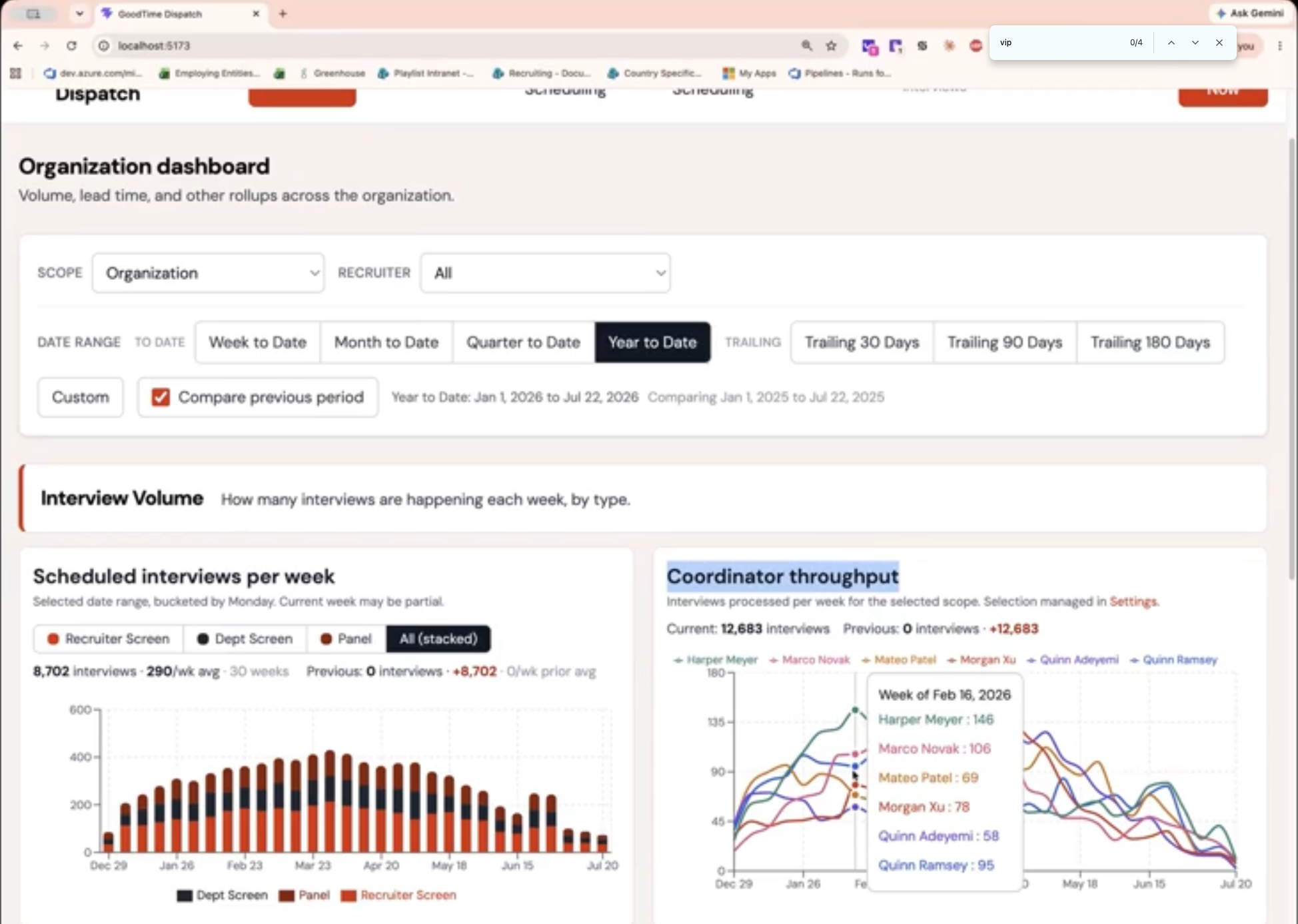
Table of Contents


Join 12,000 TA pros who stress less and crush their goals with our monthly expert-vetted tips and insights.
By submitting this form, you agree to be contacted and to receive the requested information, as well as occasional related insights from GoodTime about our products, services, and content. You may unsubscribe at any time. For details, view our Privacy Policy and Terms of Use.
Playlist’s recruiting operations team used AI and GoodTime data to build Dispatch—a custom command center for the questions standard reports couldn’t answer. Here’s what they learned about vibe coding, metric validation, security, and turning data into action.
Recruiting teams have more data than ever. The harder problem is turning it into an answer while there is still time to act.
That was the challenge facing Playlist, the company behind brands including Mindbody and ClassPass. Its recruiting operation spans roughly 30 countries, multiple brands, both Google and Outlook environments, and a high volume of hiring activity. In the year to date, the team had scheduled about 30,000 interviews through GoodTime.
But when leaders asked questions specific to Playlist’s business, the answers were often scattered across systems or required manual analysis. The team could report on activity. What it needed was a command center that could expose bottlenecks, highlight risks, and help recruiting operations decide what to do next.
So Kory Wood, Senior Manager of People Operations, built one.
In a recent GoodTime webinar with Senior Product Manager Patrick Cole, Wood demonstrated GoodTime Dispatch, an internally hosted application that blends data from GoodTime and Greenhouse into a single, custom recruiting operations dashboard. He built it with an AI coding assistant, open APIs, and close partnership with Playlist’s engineering and security teams—without becoming a traditional software engineer first.
The result offers a practical glimpse at what becomes possible when recruiting expertise, trustworthy operational data, and AI come together.
Watch the full webinar: Beyond Data: How Playlist Vibe Coded a Custom Rec Ops Dashboard with GoodTime’s MCP
The project started with one problem—not a grand AI strategy
Playlist was pursuing an aggressive hiring plan with a lean, globally distributed recruiting operations team. Wood was fielding questions from business leaders and recruiters, but the insights they needed were difficult to retrieve quickly from standard reporting.
The specific problem that started Dispatch was even simpler: employee referrals were falling through the cracks.
Playlist receives a significant number of referrals, but the team lacked an easy way to see whether each one was moving forward, awaiting a response, or genuinely stalled. Wood began with a dashboard focused on that workflow. Only after proving its value did he expand it.
That order matters. Vibe coding can make it tempting to start with a sprawling vision of everything an app might eventually do. Playlist took the opposite approach: identify a recurring operational problem, build the highest-impact feature first, and let feedback guide the roadmap.
Wood’s advice to other recruiting operations leaders was direct:
“It might feel somewhat technical, but you’re not meant to be the master of software engineering. Just be the master of solving the problem.”
For recruiting operations teams, good starting points are often already hiding in the work:
- A report someone rebuilds manually every week
- A question leaders ask repeatedly
- A workflow that falls between two systems
- A bottleneck the team can sense but cannot easily quantify
- Data that exists but cannot be viewed in the context needed to make a decision
AI did not define the business problem for Playlist. Recruiting operations did. AI made it faster to turn that expertise into a working application.
From reporting dashboard to recruiting command center
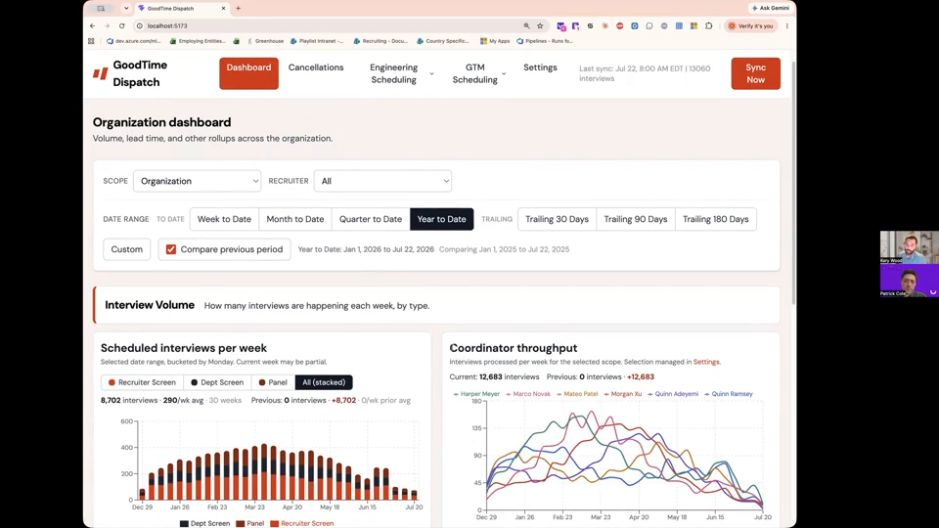
Dispatch brings GoodTime interview data and Greenhouse recruiting data together in one interface. Instead of forcing users to reconcile separate reports, it connects scheduling activity to the broader candidate journey.
The dashboard gives Playlist a consolidated view of:
- Interview volume and coordinator workload
- Scheduling lead time
- Time in stage
- Same-day cancellations and likely no-shows
- Interviewer capacity
- Stalled candidates and referrals
- VIP candidates
- Year-over-year and seasonal trends
That combined view changes the questions the team can answer.
For example, Wood can quickly compare interview volume across coordinators and spot when one person is consistently carrying too much of the load. The team can redistribute work in the short term and see when sustained demand may justify additional resources.
Playlist also uses Dispatch to anticipate interviewer-capacity constraints. If an engineering interview pool is running out of availability, the team can train more interviewers before the shortage slows hiring.
For referrals, Dispatch acts almost like a delivery tracker. It shows where a candidate is in the process, what should happen next, and whether recent activity indicates the candidate is moving. The dashboard combines interview information from GoodTime with candidate status, recruiter notes, and outreach activity from Greenhouse.
That last detail came directly from user feedback. An early version marked candidates as stalled after a fixed period. Recruiters pointed out that a candidate might simply have stopped responding after outreach. Dispatch was updated to detect email activity in Greenhouse so it could distinguish inaction from a recruiter waiting on the candidate.
The lesson: a technically functional dashboard is only a prototype. It becomes operationally useful through iteration with the people who will rely on it.
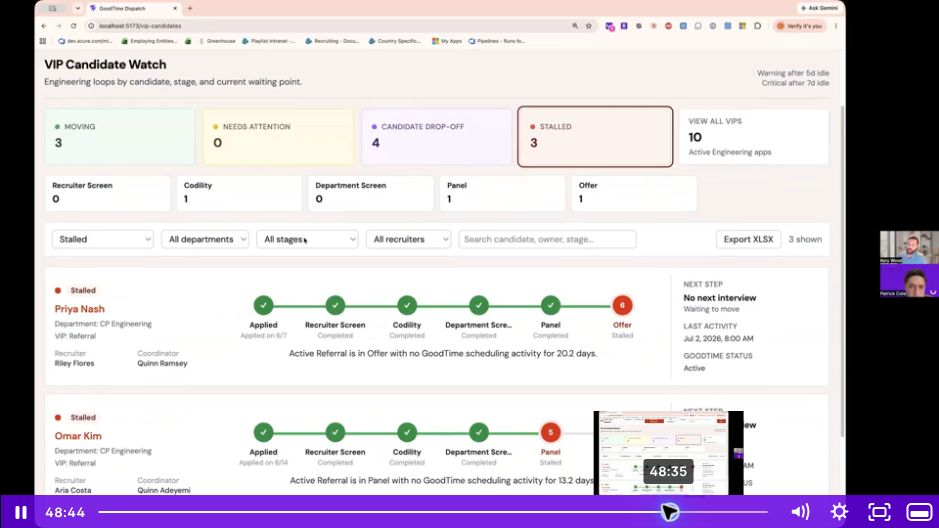
AI can make a beautiful dashboard. That does not make the data true.
One of the clearest lessons from Playlist’s experience was also one of the most important: AI-generated software can look convincing long before it is reliable.
Wood found that if he did not explicitly define a recruiting metric, the AI coding assistant would infer a calculation—and that calculation was not always correct.
“You have to define every single metric and how it needs to calculate it.”
For a dashboard that will influence staffing, process changes, or candidate-experience decisions, “close enough” is not enough. Definitions need to be explicit. Teams must specify which dates, stages, statuses, exclusions, and source fields belong in every calculation.
Playlist also designed Dispatch so users could inspect the records behind a metric. If the dashboard reports an average time in stage, a user can drill into the candidates included in that calculation and, in the production application, move directly to their Greenhouse records.
As Wood explained:
“I want to see all of the data that went into that metric and be able to export it so I can look at it myself manually.”
That “show your work” principle is essential for trustworthy AI-assisted analytics. It helps teams validate calculations, investigate outliers, and build confidence in the dashboard rather than treating its output as a black box.
The architecture matters—especially with candidate data
Vibe coding made it possible for Wood to shape the application using natural language, but moving from a mockup to a production-grade internal tool still required technical and cross-functional partnership.
Playlist’s engineering team helped provide a secure environment for the application, including secrets management, hosting infrastructure, and access controls. Rather than loading the full history from GoodTime and Greenhouse every time someone opened the dashboard, Dispatch stores two years of data and runs incremental syncs approximately every 10 minutes.
That made the application faster and more usable. More importantly, the architecture was designed around the sensitivity of global candidate and employee information.
For any recruiting team exploring a similar project, security cannot be a final review item. Legal, engineering, IT, privacy, and security partners should be involved early to address:
- Where candidate and interview data will be stored
- Who can access the application and underlying records
- How API credentials will be protected
- Which retention and deletion rules apply
- Whether regional requirements such as GDPR affect the design
- How calculations and outputs will be tested before people act on them
The AI coding tool can help produce software. It cannot assume accountability for the organization’s privacy, compliance, or data-governance decisions.
GoodTime’s MCP can make recruiting data more accessible to AI
Playlist originally built Dispatch by connecting directly to GoodTime’s and Greenhouse’s open APIs. That required Wood to understand the available data, provide API documentation to the AI coding assistant, and work through the technical details of retrieving and storing it.
GoodTime’s Model Context Protocol (MCP) server is designed to make that interaction more approachable. MCP gives AI tools a structured way to understand and work with GoodTime data, so a user could ask a natural-language question such as, “Show me cancellations from the last 30 days and flag any unusual spikes,” without first translating the request into an API integration.
That opens two complementary paths for recruiting operations teams:
- Ask and explore. Use GoodTime’s MCP with an AI assistant to investigate a question, create an analysis, or visualize a trend quickly.
- Build and operationalize. Turn a recurring, validated use case into a persistent internal application like Dispatch.
The second path takes more work, but it can also create a durable operating tool. Dispatch no longer needs an AI model to generate each answer. AI helped Wood build it; the tested application now runs like other internal software.
“AI helped build this app, but now I can basically set it and forget it because it’s been built, it’s been tested, it’s been validated.”
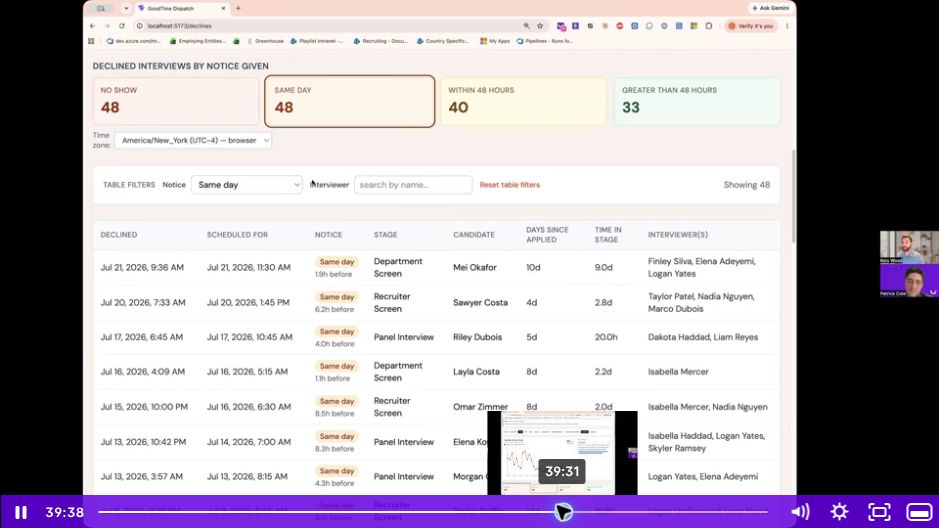
Better visibility creates earlier intervention
Dispatch has already helped Playlist surface both strengths and risks.
The dashboard confirmed that the scheduling team was moving quickly and consistently—evidence Wood could use to recognize the team’s performance. It also showed that candidates were spending longer in parts of the hiring process than expected, putting a spotlight on an opportunity to improve overall speed.
Cancellation analysis helped the team identify preventable issues, including interviewers not following calendar-sync instructions. Capacity reporting showed where a shortage of calibrated interviewers could create a future bottleneck. Workload views made it easier to balance coordinators before overload became a larger problem.
The dashboard does not automatically resolve every issue it finds. Its value is that it directs attention while the team can still intervene.
“This doesn’t solve the problem, but this helps me know where to look.”
That may be the most useful definition of a recruiting operations command center. It does not merely describe what happened last quarter. It helps the team recognize what is happening now, understand why, and decide where to act.
A practical blueprint for AI-powered rec ops
Playlist’s experience offers a straightforward playbook for teams that want to build with AI:
- Start with a recurring operational problem. Do not build an AI project simply to demonstrate AI.
- Prioritize one high-impact use case. A focused first release is easier to validate and improve.
- Use systems of record as the foundation. Bring together the data required to understand the full workflow.
- Define every metric. Never let the model quietly invent business logic.
- Make the underlying records inspectable. Give users receipts for every important number.
- Bring engineering, security, privacy, and legal in early. Candidate data requires production-grade controls.
- Test with real users. Their feedback will expose missing context that the initial builder cannot see.
- Operationalize what proves valuable. A one-time AI analysis can become a durable tool once the use case and calculations are trusted.
The opportunity is not to replace recruiting operations expertise with AI. It is to let that expertise travel further.
When teams can connect AI to trustworthy GoodTime data, they are no longer limited to the reports a software vendor anticipated in advance. They can investigate the questions unique to their business—and, as Playlist did, turn the most valuable answers into tools their entire organization can use.
Watch the full webinar: Beyond Data: How Playlist Vibe Coded a Custom Rec Ops Dashboard with GoodTime’s MCP