Efficiency
 Experience
 Intelligence
Table of Contents



Join 12,000 TA pros who stress less and crush their goals with our monthly expert-vetted tips and insights.
By submitting this form, you agree to be contacted and to receive the requested information, as well as occasional related insights from GoodTime about our products, services, and content. You may unsubscribe at any time. For details, view our Privacy Policy and Terms of Use.
Complex interview scheduling involves coordinating three or more interview rounds, multiple interviewers, cross-time-zone panels, multi-day interview loops, or some combination of these requirements.
It differs from simple 1:1 scheduling in several important ways:
- Each interview may require a specific combination of skills, roles, or trained interviewers.
- Multiple calendars, time zones, working hours, and candidate preferences must align.
- Interviews may need to happen in a particular order or within a defined timeframe.
- One decline or reschedule can disrupt an entire interview loop.
- Interviewer workloads must be balanced across many candidates and open roles.
- Every change must be communicated and reflected across calendars, the ATS, and other hiring systems.
A basic scheduling link can find an open time between two people. Complex interview scheduling requires a system that can manage dependencies, make decisions, recover from changes, and keep the entire process moving.
What is an AI scheduling agent?
An AI scheduling agent is a system that automatically interprets interview requirements, evaluates calendars and constraints, selects qualified interviewers, schedules or reschedules interviews, communicates updates, and resolves routine conflicts without recruiter involvement.
Unlike a static scheduling tool, an AI agent can take action as conditions change and bring the recruiting team in when human judgment is required.
This is the distinction that matters for enterprise talent acquisition teams. The problem is no longer simply finding an open calendar slot. It is coordinating people, rules, systems, and communications at scale without turning recruiters and recruiting coordinators into the bottleneck.
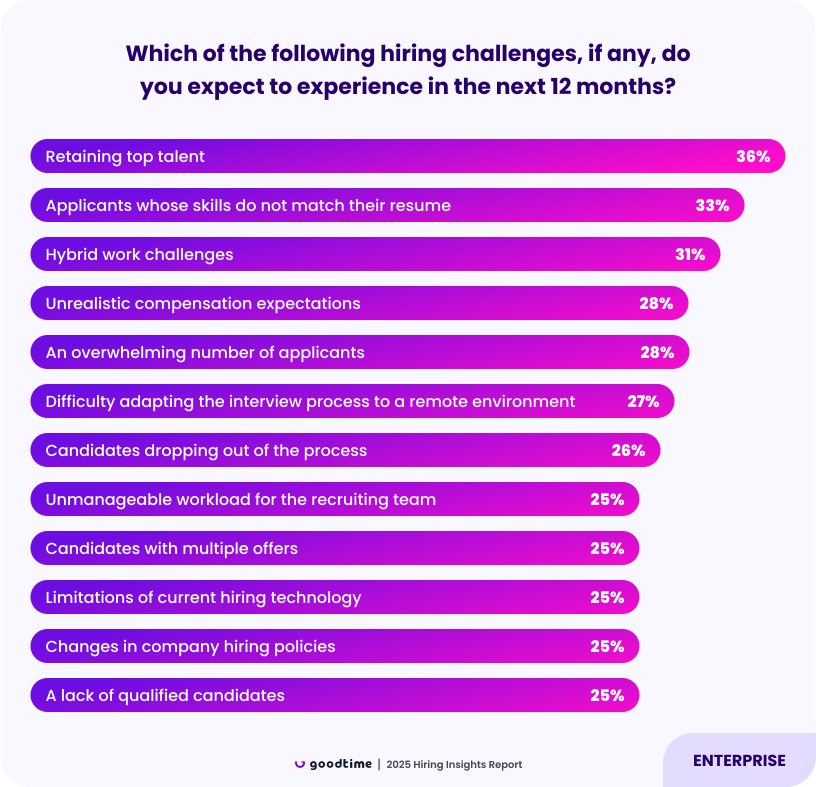
GoodTime’s 2026 Hiring Insights Report explores the operational pressures affecting today’s talent teams, including scheduling delays, limited interviewer availability, and interview cancellations and reschedules.

Unlock 2026’s top hiring strategies: Insights from 500+ TA leaders
Be the first to uncover deep hiring insights specific to your sector — straight from the highest-performing TA teams.
Simple scheduling tools vs. AI coordination platforms
Simple scheduling tools are effective for straightforward meetings. But they are not designed to manage the interconnected requirements of enterprise interviewing.
| Capability | Simple scheduling tools | AI coordination platforms |
|---|---|---|
| Primary purpose | Find a mutually available time | Coordinate the complete interview process |
| Best-fit scenario | One candidate and one interviewer | Multi-round, panel, high-volume, or multi-day interviews |
| Interviewer selection | Usually selected manually | Identifies qualified interviewers based on role, training, availability, and workload |
| Time-zone coordination | Displays converted availability | Evaluates working hours and preferences across multiple regions |
| Interview sequencing | Limited or manual | Preserves interview order, duration, dependencies, and required breaks |
| Candidate preferences | Candidate selects from available slots | Candidate preferences are balanced against all other scheduling constraints |
| Declines and cancellations | Recruiter must intervene | Detects the change and initiates a replacement or reschedule |
| Interviewer replacement | Manual search for a backup | Selects an eligible replacement based on defined rules |
| Communications | Sends standard confirmations | Sends confirmations, reminders, updates, and follow-ups based on the situation |
| System updates | May update a calendar | Keeps calendars, workflows, and connected hiring systems aligned |
| Monitoring | Waits for user action | Continuously watches for conflicts, delays, and incomplete steps |
| Human involvement | Required when anything changes | Reserved for exceptions and decisions requiring judgment |
The difference is not simply “more automation.” It is the ability to coordinate a dynamic process in which one decision affects several people and every downstream step.
Why traditional interview scheduling tools break down
When interview scheduling is simple—a 1:1 phone screen with clear availability on both sides—nearly any scheduling tool will do. Many applicant tracking systems offer basic self-scheduling links that work well for these situations.
The limitations appear as soon as the process introduces volume, panels, sequencing, or multiple time zones.
1. They depend on ideal conditions
Basic scheduling tools rely on rigid workflows. They assume interviewers remain available, candidates respond promptly, and confirmed meetings do not change.
Real hiring is rarely that predictable. Interviewers decline. Candidates request different times. Hiring priorities shift. A tool that only completes the initial booking leaves the recruiting team responsible for everything that follows.
2. They automate tasks without managing dependencies
Calendar integrations, templates, and scheduling links reduce individual steps. But they generally do not understand how those steps relate to one another.
If the first interview in a multi-stage loop moves, later sessions may also need to change. If a required interviewer becomes unavailable, the system must identify someone with the correct qualifications—not simply anyone with an open calendar.
3. Recruiters become the coordination layer
Without adaptive automation, recruiters and recruiting coordinators remain in the middle of every exchange. They search calendars, identify backups, send reminders, update invitations, and ensure each change is reflected across the hiring process.
At enterprise volume, that work quickly becomes a full-time operational burden.
4. Candidate experience becomes inconsistent
Candidates notice when scheduling takes days, updates arrive late, or different systems send conflicting information.
Complexity may be unavoidable behind the scenes, but it should not become the candidate’s problem. The candidate experience should remain fast, clear, and consistent even when the underlying schedule changes.
What makes enterprise interview scheduling complex?
Interview complexity is not limited to executive or highly specialized roles. It appears anywhere a hiring process involves interdependent calendars, rules, or workflows.
GoodTime’s 2026 Hiring Insights Report illustrates how challenges such as interviewer availability, scheduling delays, and process complexity affect talent teams across industries.
Cross-time-zone interview panels
Consider a candidate in London, a hiring manager in San Francisco, and two technical interviewers in Bangalore. Finding an open time is only the beginning.
The schedule must also account for local working hours, interviewer preferences, required participants, meeting duration, and the candidate’s experience. Solving those requirements manually can take hours of calendar comparison and back-and-forth communication.
Multi-day interview loops
Technical, leadership, and cross-functional roles often require candidates to meet several stakeholders over multiple days. Some conversations may be virtual while others are on-site.
These interviews may need to follow a defined sequence. When one participant becomes unavailable, changing that meeting can affect every session that follows.
Interviewer qualifications and workloads
Not every available interviewer is an appropriate interviewer. Some sessions require particular subject-matter expertise, role alignment, training completion, or shadowing status.
Teams also need to distribute interviews fairly. Repeatedly selecting the same people creates burnout, while underusing qualified interviewers limits available capacity.
High-volume hiring spikes
Seasonal hiring, a new location, a return to growth, or a large customer commitment can create an abrupt increase in interview volume.
When scheduling remains manual, the constraint moves from candidate sourcing to coordination. Candidates may be ready to proceed, but the recruiting team cannot move them through the process quickly enough.
Declines, reschedules, and no-shows
A schedule is not complete once the invitation is sent. Enterprise teams must continuously manage interviewer declines, candidate reschedule requests, calendar conflicts, reminders, and no-shows.
Every change creates another set of decisions and communications. Without an intelligent coordination layer, those exceptions return directly to the recruiting team.
How AI agents handle complex scheduling
AI scheduling agents manage complex interviews as a sequence of discrete decisions and actions:
- Interpret the interview plan.
The agent reads the required interview stages, durations, formats, sequence, service-level targets, and interviewer qualifications. - Collect availability and preferences.
It evaluates candidate availability alongside interviewer calendars, time zones, working hours, location requirements, and scheduling preferences. - Identify eligible interviewers.
The agent filters the interviewer pool using role requirements, subject-matter expertise, training status, regional rules, and any other configured criteria. - Evaluate possible schedules.
It compares potential combinations rather than searching for a single open slot. This includes preserving interview order, required breaks, panel composition, and multi-day dependencies. - Optimize the selection.
The agent selects the option that best balances candidate preferences, speed, interviewer workload, process rules, and the likelihood that the full loop can be completed successfully. - Book the complete interview plan.
It creates the meetings, reserves interviewers, sends invitations, and updates the connected hiring systems. - Communicate with everyone involved.
Candidates and interviewers receive the appropriate confirmations, instructions, reminders, and updates through the team’s established communication channels. - Monitor for changes.
After booking, the agent continues to monitor for delays and bottlenecks, including declines, conflicts, incomplete responses, and other signals that the schedule may be at risk. - Resolve routine disruptions.
If an interviewer declines, the agent can identify a qualified replacement. If a candidate needs to reschedule, it can reevaluate the full set of constraints and produce a new plan. - Escalate true exceptions.
When a situation falls outside the team’s rules or requires human judgment, the agent surfaces the issue with the relevant context so the recruiting team can decide how to proceed.
The result is a workflow that keeps adapting after the initial booking instead of returning every exception to a recruiter.
Why adaptability matters
No two roles follow exactly the same hiring path.
A high-volume support role may require dozens of same-day screens. A senior engineering role may involve a week of interviews across several time zones. A leadership candidate may need a carefully sequenced combination of virtual and on-site conversations.
Rigid scheduling systems force teams to work around the tool. AI coordination platforms adapt to the shape of the hiring process.
That can include:
- Single-day and multi-day interviews
- Sequential or concurrent sessions
- Cross-time-zone panels
- Bulk scheduling
- Interviewer load balancing
- Automatic interviewer replacement
- Candidate-selected availability
- Virtual, hybrid, and on-site formats
- Different workflows by role, region, or business unit
The team defines the process and guardrails. The system handles the coordination required to execute them.
GoodTime’s AI agent, Cori, applies this approach across scheduling and hiring coordination. She identifies what needs to happen, takes action within the team’s workflows, and keeps recruiters, interviewers, hiring managers, and candidates aligned as conditions change.
Complex scheduling in action: How HubSpot scaled global hiring
HubSpot’s hiring operation spans more than 8,500 employees across 15 countries. The company needed to coordinate interviews at global scale without sacrificing speed, consistency, or its human-first values.
Before GoodTime, interview coordination was slow, manual, and prone to errors. Frequent reschedules created additional work for recruiters and coordinators while delaying the hiring process.
By standardizing and automating interview scheduling, interviewer training, and related workflows with GoodTime, HubSpot created a more scalable global hiring engine. The company reported:
- 75% higher team productivity
- 30% faster interview scheduling
- 152% growth in its active interviewer pool
The impact extended beyond operational efficiency. Faster coordination gave the talent team more room to focus on candidates and the moments that require empathy and human judgment.
“We need automation, but also empathy. We want to be where those two things meet,” said Jennifer Walker, Global Talent Acquisition Coordination Manager at HubSpot.
HubSpot also maintained local flexibility within its global process. Teams could account for regional differences in language, time zones, interview formats, and workflows while operating from a more consistent framework.
As Walker explained, “GoodTime tools like block scheduling, multi-day scheduling, and varying between teams allow us to meet our business locations where their needs are.”
Read the full HubSpot customer story.
What to look for in a complex interview scheduling platform
Not every tool described as “AI scheduling” can manage enterprise interview coordination. When evaluating a platform, look beyond whether it can generate available times.
A complex scheduling platform should be able to:
- Coordinate multi-stage and multi-day interview plans
- Evaluate multiple calendars and time zones simultaneously
- Select interviewers using qualifications and training status
- Balance workloads across the interviewer pool
- Preserve sequencing and panel requirements
- Detect and resolve interviewer declines
- Support candidate-led scheduling and rescheduling
- Send confirmations, reminders, and change notifications
- Integrate with the ATS, calendars, video platforms, and communication tools
- Apply different rules across roles, regions, and business units
- Show the actions the system has taken
- Escalate exceptions without requiring humans to manage every routine step
- Provide analytics on scheduling speed, delays, interviewer utilization, and process bottlenecks
The right system should reduce manual coordination while keeping the talent team informed and in control.
Enterprise hiring needs more than a scheduling link
Enterprise interview scheduling is a dynamic coordination problem. Each candidate, interviewer, calendar, workflow, and communication creates another dependency that must remain aligned.
A scheduling link can help two people book a meeting. It cannot run a complex interview process.
AI scheduling agents close that gap by interpreting requirements, comparing constraints, taking action, monitoring for changes, and resolving routine disruptions. Recruiters and coordinators no longer need to personally manage every calendar exchange, but they remain in control when a decision requires their input.
That is the real opportunity: not removing people from hiring, but removing the logistical work that keeps them from candidates, conversations, and decisions.
See how Cori handles complex hiring coordination.