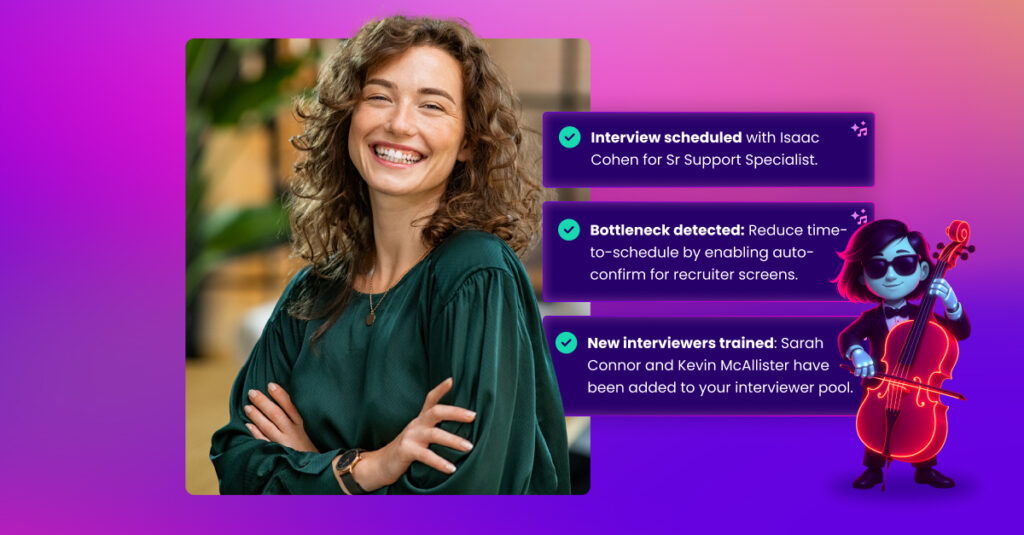
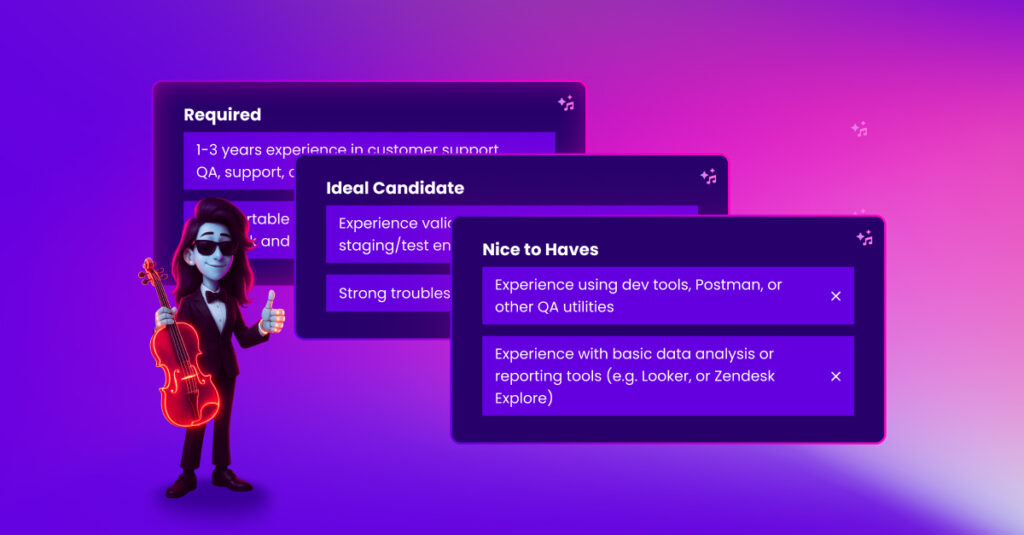
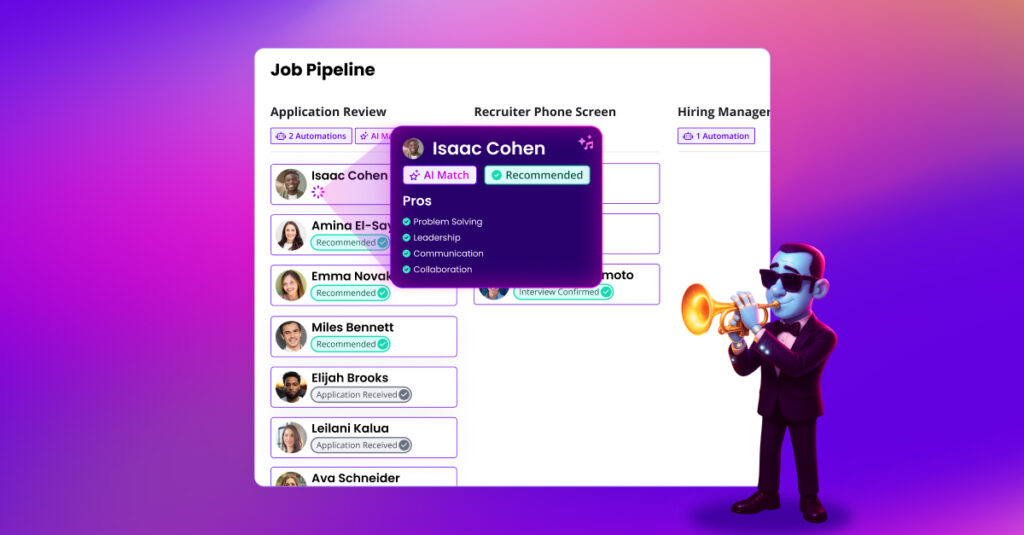
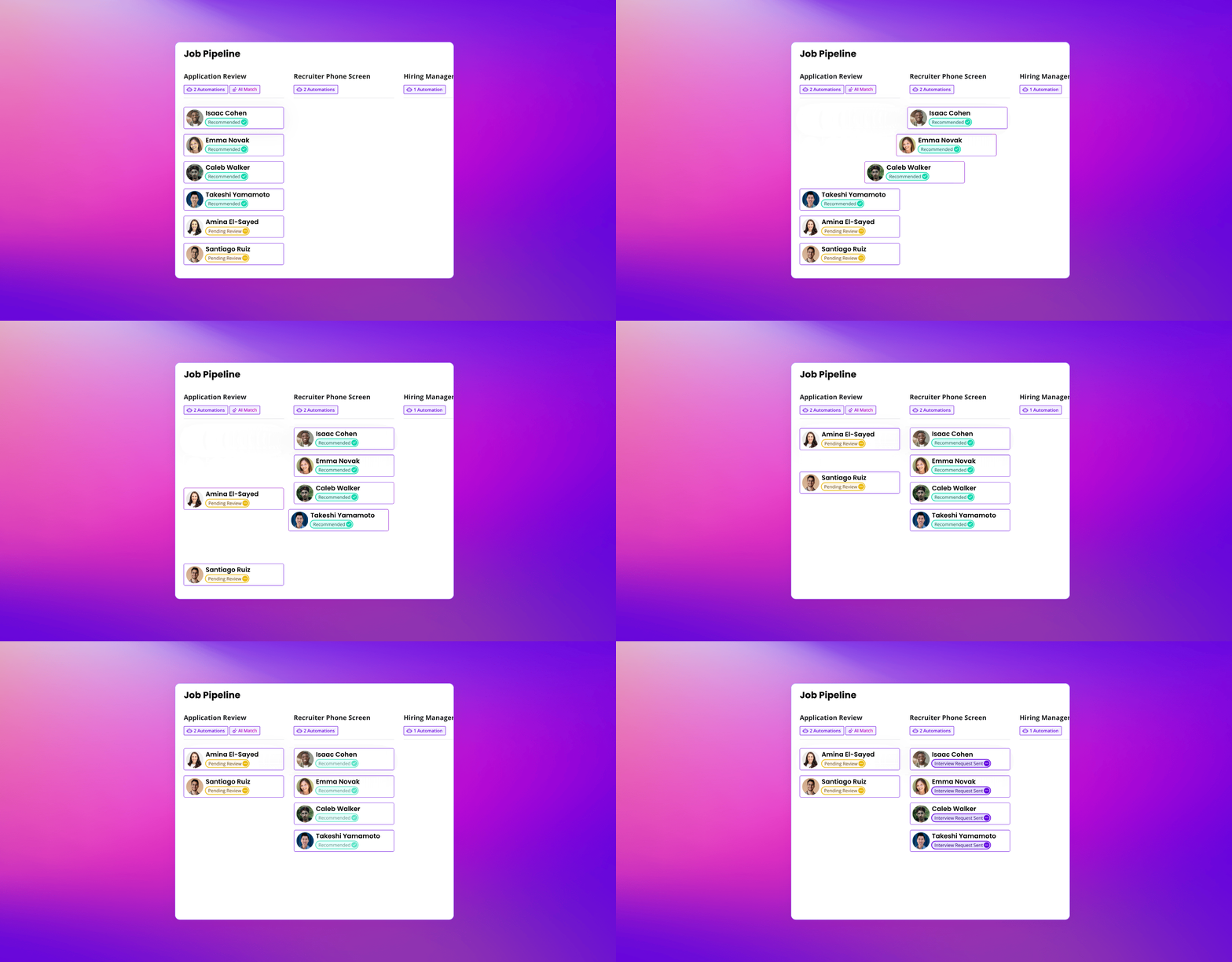
You’ve got a mission-critical role open. Resumes are coming in, the hiring manager is eager, and interviews are underway. Then — quietly — the momentum stalls. A candidate’s feedback is delayed. A scheduler is out sick. A manager sits on approvals for a week. Suddenly, your “ready-to-offer” candidate accepts somewhere else, and you’re back at square one.
It’s the hidden cost of hiring bottlenecks — and it’s bigger than missed deadlines. In today’s market, where top talent is gone in days, pipeline slowdowns are silent killers of hiring velocity, candidate experience, and recruiter morale.
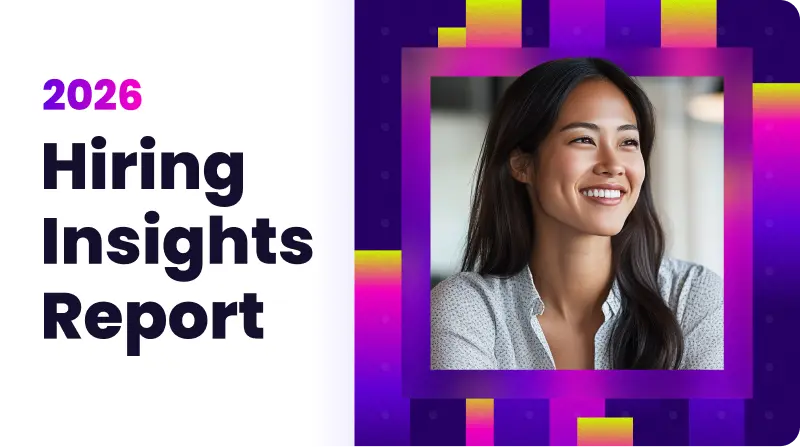
Unlock 2026’s top hiring strategies: Insights from 500+ TA leaders
Be the first to uncover deep hiring insights specific to your sector — straight from the highest-performing TA teams.
Bottlenecks don’t just waste time — they erode trust and opportunity. Every extra day in the pipeline increases the risk of losing top talent to faster-moving competitors. Candidates interpret delays as a sign of disorganization and disengage, sometimes disappearing altogether.
Inside the organization, slowdowns pile extra stress on recruiters and coordinators, forcing them to juggle follow-ups, reschedules, and stakeholder updates instead of building relationships. Hiring managers, frustrated by the lack of progress, may deprioritize their involvement, which in turn slows decision-making further. And beyond the hiring team, there’s a wider business impact: delayed product launches, postponed revenue growth, and teams operating under constant strain because critical roles remain unfilled.
Why bottlenecks often go undetected in traditional systems
One reason bottlenecks are so damaging is that they’re often invisible until it’s too late. Most hiring systems are built to report on what has already happened, not what’s happening right now.
Applicant tracking systems can tell you how many candidates are in each stage, but rarely highlight where or why the process is slowing. Reports surface problems days or weeks after the fact, when the damage has already been done. Finding the root cause often means someone in talent operations manually combing through spreadsheets, chasing updates from multiple stakeholders, and trying to piece together a story from fragmented data.
By the time the slowdown is detected, it has already cost valuable time and, more often than not, one or more top-choice candidates.
The shift toward real-time monitoring with AI agents for bottleneck detection
The most effective talent acquisition teams aren’t waiting for quarterly retrospectives to diagnose problems — they’re building real-time monitoring into their hiring stack. AI agents now play a critical role in this shift.
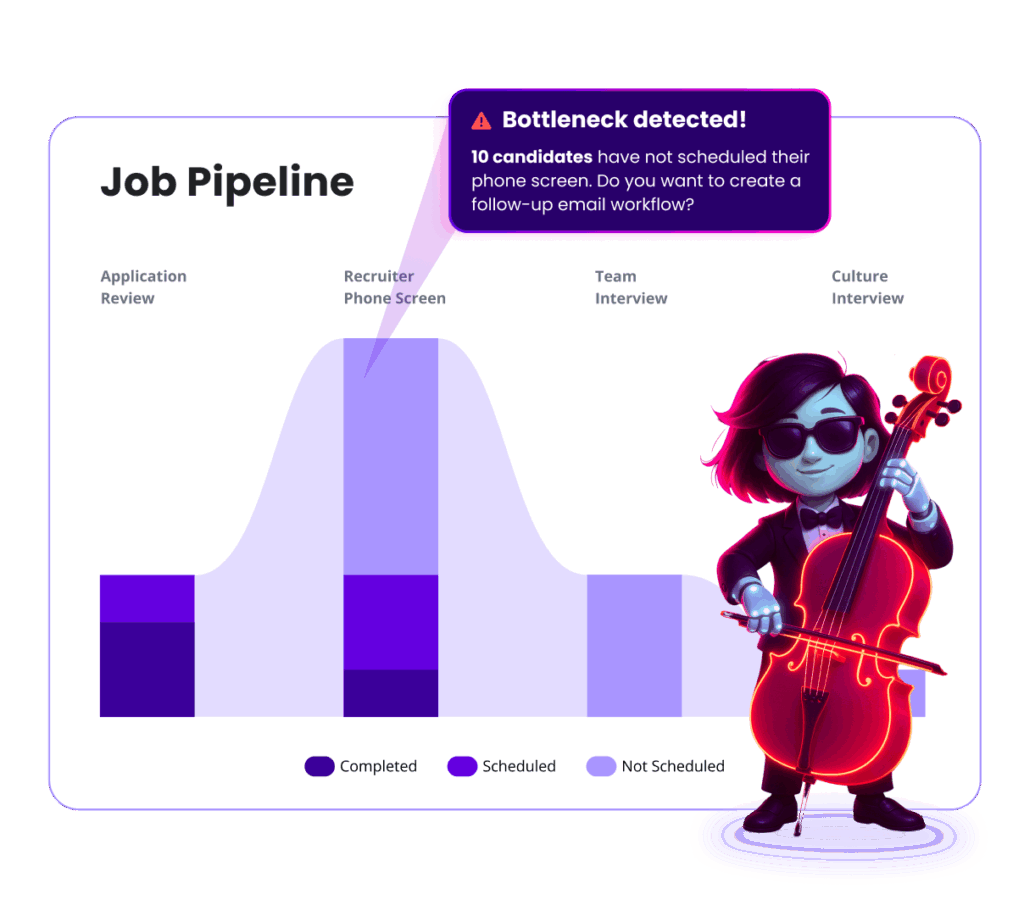
Instead of relying on lagging reports, AI agents monitor the pipeline continuously, scanning for signs of trouble. They track how quickly candidates move from stage to stage, identify unusual delays, and determine the source of the slowdown — whether it’s unreturned scorecards, unavailable interviewers, or a missing approval. The moment a risk emerges, they alert the team and recommend corrective action.
This proactive approach changes the game. Instead of hearing “we lost the candidate” after the fact, teams hear “your onsite-to-offer time is slipping; here’s how to fix it” while the candidate is still engaged. In a competitive market, that difference in timing is often the difference between a filled role and a lost opportunity.
From reactive to proactive — how AI agents power high-performing TA orgs
Shifting from firefighting to foresight requires a new operating rhythm. High-performing talent acquisition organizations use AI agents not only to detect problems, but to make micro-adjustments before those problems become visible to candidates or hiring managers.
They treat pipeline health as a shared responsibility, with recruiters, hiring managers, and operations teams all working from the same real-time hiring data. That transparency makes it easier to take swift, coordinated action. These organizations also build adaptability into their processes so they can absorb sudden hiring surges or shifting business priorities without the system breaking down.
The result isn’t just faster hiring; it’s a more resilient process. Delays will always be a risk, but with AI-driven detection and proactive management, those delays become small bumps instead of full-blown breakdowns.
AI agents, like those in GoodTime’s Orchestra, proactively monitor your key metrics and flag bottlenecks before they become a problem.
Modern AI orchestration: an example in action
This proactive approach to hiring orchestration isn’t theoretical — leading organizations are already using AI agents to keep their pipelines in motion. HubSpot, the global customer platform with over 8,500 employees across 15 countries, is one example.
For Becky McCullough, HubSpot’s Vice President of Talent Acquisition and Mobility, the mission is clear: “At every stage of our candidate life cycle, we need to be really thoughtful about how to drive a great experience for candidates, interviewers, and hiring managers, while also making sure that it is efficient, fast, and driving better outcomes. AI is going to play a key role in automating a lot of those repetitive tasks that can oftentimes slow down a talent acquisition team.”
Before implementing GoodTime’s Orchestra, interview scheduling at HubSpot was slow, manual, and error-prone, often leading to frequent reschedules and burned-out coordinators. By adopting Orchestra, HubSpot standardized and automated its scheduling processes globally, allowing AI agents to detect and address bottlenecks — whether that meant auto-replacing an unavailable interviewer or prompting overdue scorecards — before those slowdowns impacted candidates.
The results have been dramatic: a 75% increase in team productivity, 30% faster scheduling, and a 152% increase in active interviewers. As Becky puts it, “After implementing GoodTime, we’ve not only seen faster interview scheduling — we’ve seen happier candidates, happier interviewers, and a happier coordination team. It’s been the rising tide that has lifted all boats.”
What makes this success sustainable is alignment in AI philosophy. “What stood out to me about GoodTime was how much their AI philosophy aligns with ours,” Becky said. “They are intentional about using AI and automation to eliminate repetitive, mundane tasks. That way, our recruiters, coordinators, and interviewers can spend time building relationships with candidates and connecting with them when and where it matters most.”
HubSpot’s story shows that modern AI orchestration isn’t just about speed — it’s about creating a hiring process that flows seamlessly at a global scale without sacrificing the human connections that make top candidates say “yes.”
The mindset shift TA leaders need to make now
Too many leaders still think of bottlenecks as occasional glitches rather than a constant operational risk. In reality, slowdowns are an ongoing threat, and managing them should be treated as a core TA competency.
Ask yourself: if a bottleneck formed in your process today, how quickly would you know? Would you have the context to act before a candidate felt the lag? Could your team fix it without dropping everything else?
If your answer isn’t a confident yes, it may be time to rethink your approach. Building resilience into your hiring pipeline requires more than better dashboards — it requires systems and AI agents that are watching 24/7, ready to act when early warning signs appear.
Keep your pipeline in flow — not in recovery
The difference between a process that flows and one that fails often comes down to visibility and timing. Bottlenecks are inevitable, but losing candidates, time, and momentum to them is not.
Today’s most competitive talent teams are moving beyond reactive reporting and embracing intelligent orchestration — tools and AI agents that detect, act, and optimize before delays can break the process. Because in hiring, the real cost of a bottleneck isn’t the open role on your requisition list; it’s the opportunities you didn’t seize because your process was too busy fixing itself.
On one hand, it promises relief from never-ending admin work, complex scheduling puzzles, and the chaos that can come with hiring at a high volume across the globe. On the other, it raises a deeply rooted fear: If we automate too much, what are we giving up? Will we lose visibility into our hiring process? Will decisions get made without context? Will we wake up one day and realize we’ve handed over the wheel?
It’s a fair concern. Especially in high-stakes, high-volume recruiting environments, control and oversight aren’t just preferences — they’re necessities.
But here’s the truth: Full automation through AI doesn’t mean losing control. In fact, when it’s done right, automation gives you more of it.
More visibility into where things stand. More consistency across workflows. More time to focus on the parts of hiring that actually require human judgment — like relationship-building, interviewing, and strategic decisions. It’s not about letting go. It’s about getting out from under the chaos so you can lead from a place of clarity.
In this article, we’ll explore the common misconceptions about automation in hiring, show how the best teams are designing human-first workflows that increase transparency (not reduce it), and unpack what it really means to stay in control — even when most of the heavy lifting is handled for you.
Unlock 2026’s top hiring strategies: Insights from 500+ TA leaders
Be the first to uncover deep hiring insights specific to your sector — straight from the highest-performing TA teams.
The misconceptions that stall progress and AI adoption
AI and automation in hiring sometimes get a bad rap — and not because TA leaders don’t value efficiency. Quite the opposite. Most talent teams are actively craving faster workflows, more consistency, and fewer hours lost to manual coordination.
What holds them back isn’t the idea of automation. It’s the misunderstanding of what automation really looks like in a modern, enterprise-grade talent environment.
Let’s unpack three of the most common misconceptions.
Misconception #1: Automation is a black box
Many teams worry that once automation is turned on, their visibility turns off. They imagine a system that runs in the background, making decisions without surfacing rationale or providing opportunities for intervention. And in some cases — especially with legacy systems or narrowly scoped tools — that concern is valid.
But the best automation doesn’t hide the work. It surfaces it.
Modern solutions designed for enterprise hiring log every action, provide real-time updates, and offer configurable checkpoints so teams can review, revise, or override at any point. Automation doesn’t take you out of the loop — it just clears out the clutter so you can actually see what’s happening.
Misconception #2: Automation replaces human judgment
This is one of the most persistent myths. When we talk about automating interview scheduling, candidate screening, or feedback analysis, some hear “decisions will be made without us.”
In reality, automation isn’t about replacing your expertise — it’s about empowering it.
You set the strategy. You define what a “top candidate” looks like. You establish the guardrails. The automation then executes within that framework, freeing your team to focus on the nuanced, human decisions where your expertise matters most.
Misconception #3: Manual control equals better control
For many talent teams, control has historically meant touching every step: manually sending invites, manually reviewing resumes, manually checking calendar conflicts.
It feels safe. But it’s not scalable — and it’s not actually the best way to maintain oversight.
True control is about designing systems that reflect your hiring philosophy, then trusting those systems to execute with consistency, transparency, and accountability. The more manual your process, the more you’re relying on individual interpretation and memory. AI and automation don’t remove control — it codifies it.
In short: These fears are real, but they’re not rooted in today’s reality. Next, we’ll explore what automation actually looks like when it’s built for the needs of global, complex, and highly strategic talent acquisition teams.
Visibility, configurability, and oversight: What enterprise-grade AI agents actually deliver
The old image of automation in hiring — faceless systems making hidden decisions — doesn’t hold up anymore. Today, enterprise-ready AI isn’t about hiding actions. It’s about making them more visible, more configurable, and more aligned with how top talent teams work.
That’s especially true when we talk about AI agents in talent acquisition: autonomous systems designed to take specific actions across the hiring process — scheduling interviews, screening candidates, surfacing bottlenecks — all while keeping your team in control.
1. Visibility: Every action is surfaced, not hidden
With traditional automation, teams often worry about what’s happening behind the scenes. But AI agents designed for enterprise workflows don’t operate in the dark — they surface everything they do.
Want to know which candidates were prioritized and why? See it. Curious who got scheduled and when? It’s there. Need to review the exact message a candidate received? Logged and visible.
In platforms like GoodTime’s Orchestra, every action an AI agent takes — from replacing a canceled interviewer to rescheduling a panel — is immediately accessible to your team. There’s no guessing. Just clarity.
2. Configurability: You set the rules, and the agents execute
Enterprise hiring is never one-size-fits-all. A scheduling approach that works for engineering roles in San Francisco won’t necessarily work for customer success hires in EMEA. That’s why leading AI platforms let you customize how agents behave — by job type, hiring stage, or team preferences.
You can configure:
When agents take full action vs. when they flag for human review
What criteria define a top candidate match
How communications are personalized for candidates
Guardrails around things like reschedules, auto-confirmation, or interviewer selection
Think of AI agents not as decision-makers, but as skilled executors of your strategy — able to handle volume and complexity, but always within your framework.
3. Oversight: Proactive intelligence that supports better decisions
The best part about AI agents isn’t just what they automate — it’s what they notice. Agents don’t just wait for instructions. They monitor your hiring flow, detect issues, and surface insights in real time.
If candidate drop-off is spiking after the second interview, your agents will flag it. If interview load is uneven across teams, they’ll recommend redistributing. If an offer is delayed due to feedback gaps, they’ll escalate it before it becomes a bottleneck.
And none of this happens in a vacuum. You see the data, the recommendation, and the rationale — and you decide what to do. Oversight isn’t sacrificed — it’s elevated.
When AI agents are designed to support, not replace, human decision-makers, you don’t lose control. You codify it. You go from manually enforcing best practices to embedding them into your systems — with the added bonus of speed, consistency, and insight.
“What stood out to me about GoodTime was how much their AI philosophy aligns with ours. They are intentional about using AI and automation to eliminate repetitive, mundane tasks. That way, our recruiters, coordinators, and interviewers can spend time building relationships with candidates and connecting with them when and where it matters most.” -Becky McCullough, VP of Talent Acquisition and Mobility, HubSpot
AI agents in practice: Examples of modern hiring workflows
It’s one thing to talk about control and clarity in theory. But what does it actually look like when AI agents are embedded into your hiring workflows?
Here are a few real-world examples of how AI-led automation and human oversight can work together — seamlessly.
AI agents can handle interview coordination across time zones, teams, and panel formats — no spreadsheets, no endless back-and-forth. Agents find the right time, assign interviewers based on skills and availability, and send invites automatically.
But recruiters aren’t left out of the loop. They see:
Who was scheduled, when, and with whom
Why certain times or interviewers were selected
Options to intervene, approve, or reschedule with a single click
Whether it’s one phone screen or a multi-day panel, your team maintains visibility and control — while letting agents do the coordination legwork.
Candidate screening — intelligent prioritization with built-in transparency
When AI agents screen candidates, they’re not just applying a mysterious score behind the scenes. They analyze resumes based on your defined criteria, match candidates to open roles, and surface the rationale for their decisions.
Recruiters can review:
Which job requirements the candidate met
How they compare to other applicants
The logic behind automated ranking or advancement
Rather than spending hours triaging resumes, your team gets a head start — with insights they can trust, adjust, or override.
Bottleneck detection — insights before issues escalate
Instead of waiting until your hiring stalls out, AI agents continuously monitor pipeline health. They detect patterns that humans might miss, like:
A specific interviewer consistently causing scheduling delays
A stage where candidate drop-off increases
Scorecards that are missing or conflicting
But they don’t just diagnose — they suggest. Agents might recommend adding interviewer coverage, nudging candidates, or adjusting timelines. Every suggestion is actionable and backed by data, and your team decides how to respond.
Candidate communication — always-on, never opaque
AI agents can engage candidates through email, SMS, WhatsApp, and portals — answering questions, sending reminders, and coordinating logistics 24/7. But crucially, they log every interaction.
Recruiters can see:
What the candidate was told
When it was sent
Whether it was opened or replied to
Even better? If a candidate asks a sensitive question — like salary expectations or visa sponsorship — the agent flags it for a human to handle directly. Smart escalation ensures automation never replaces personal connection where it matters.
Together, these examples demonstrate a powerful truth: AI agents don’t have to operate independently to be effective. When built for visibility and collaboration, they actually enhance your ability to lead — by giving you clearer context, faster feedback, and real-time levers to pull.
Introducing Orchestra: A digital workforce designed for clarity and control
At GoodTime, we’ve taken this philosophy to heart. That’s why we built Orchestra — our coordinated system of AI agents designed to support talent teams across every stage of the hiring journey.
Orchestra isn’t a chatbot. It’s not a bolt-on. It’s an always-on digital workforce that:
Screens and matches candidates to roles based on your specs
Auto-schedules interviews, even across complex panels and time zones
Flags bottlenecks before they impact hiring velocity
Keeps candidates warm, informed, and engaged throughout
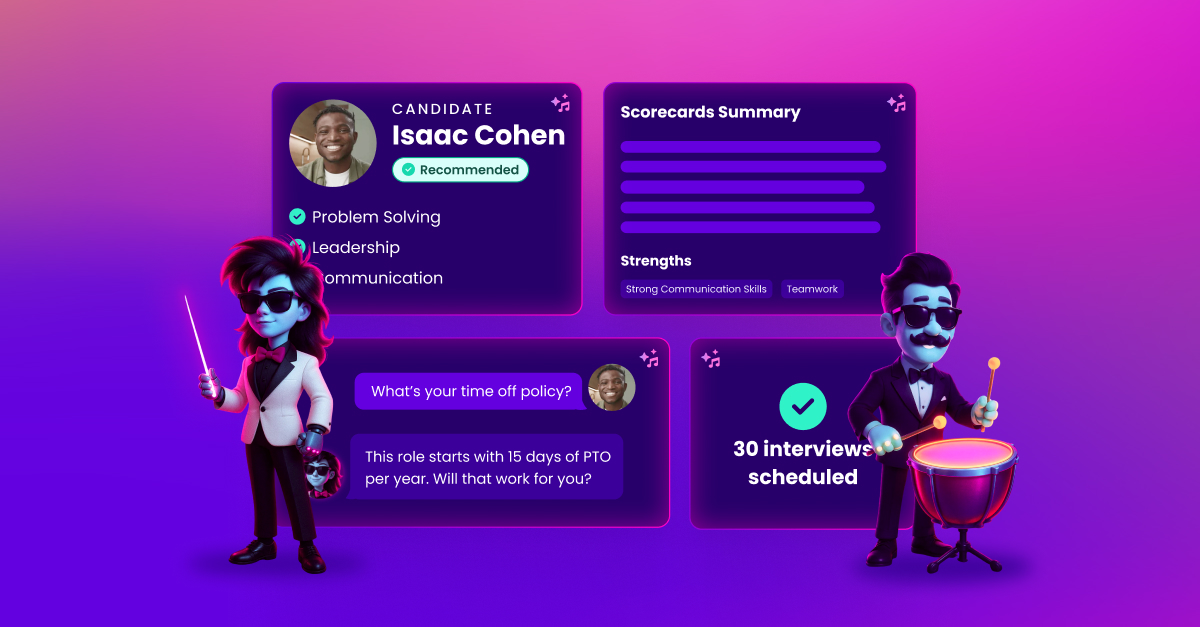
Summarizes scorecards and provides insights to support faster decisions
But what makes Orchestra different is how it does these things: every action an agent takes is logged, explainable, and adjustable. Recruiters stay in the loop at all times — and can step in or modify any workflow as needed.
It’s full automation, with full transparency.
It’s AI that acts, not just chats.
And above all, it’s designed to keep hiring fast, human, and in sync — not by replacing your team, but by backing them up every step of the way.
“Prior to GoodTime, we were sitting at approximately 60 days to fill a position on the salary side. Since implementing GoodTime, that number has dropped to about 45 days time to fill.” -Joe Albano, Director of Talent Acquisition, HelloFresh
The real benefit: More time for what matters
At the heart of every high-performing talent team is a simple truth: what drives hiring success isn’t the mechanics — it’s the moments.
It’s the honest conversations that build alignment with a hiring manager. The thoughtful outreach that turns a passive candidate into a must-have hire. The calibration, collaboration, and context-sharing that elevates not just who you hire, but how you hire.
But those moments only happen when your team isn’t buried in busywork.
That’s where AI agents shine. By automating the repeatable tasks — scheduling, screening, reminders, follow-ups — they give recruiters back their most precious resource: time.
Time to:
Build stronger hiring manager partnerships
Personalize candidate experiences Strategize across business units and geographies
Improve processes instead of just managing them
And because every action taken by an AI agent is visible and adjustable, your team doesn’t lose control — they gain it. They get to lead the hiring journey, not get lost in it.
With AI agents like those in GoodTime’s Orchestra, teams are transforming chaos into clarity — not by letting go, but by stepping up. They’re reclaiming time, sharpening their focus, and leading hiring with confidence, precision, and humanity.
Because when automation is human-first, control isn’t lost, it’s multiplied.
We’re excited to roll out a powerful set of updates across GoodTime — all designed to give your team more visibility, control, and automation where it counts.
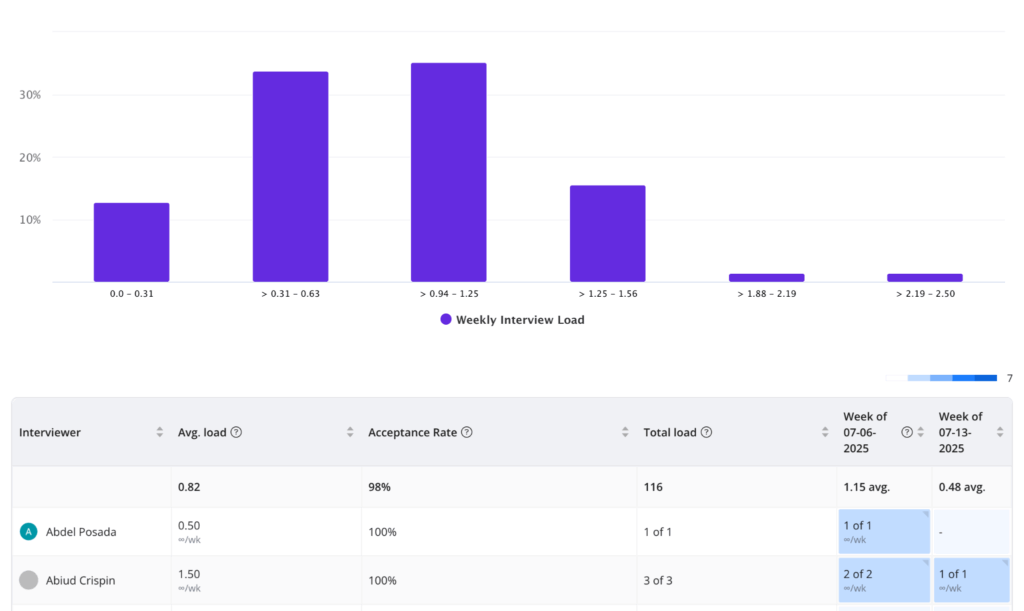
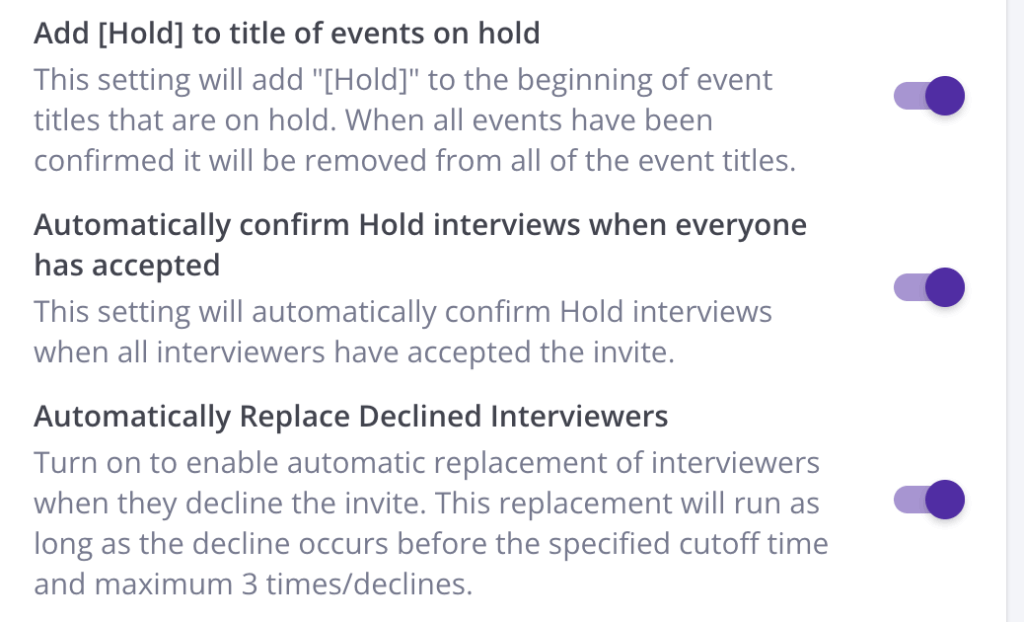
Load Balance Reporting has been completely reimagined to deliver faster insights, visualized distribution, and new context for edge cases like packed calendars and decline patterns. Capacity Planning now includes real-time updates, custom availability windows, and downloadable views. Auto Replace gets smarter with custom cutoff settings and failure analysis. And HOLD interviews can now auto-confirm when all interviewers are in — saving your team even more time.
On the Candidate AI side, you’ll now see full conversation visibility in Messenger, get real-time escalation alerts via email or Slack, and assign agents by job for more targeted support.
Let’s dive into what’s new.
Watch the full July 2025 GoodTime product updates webinar or keep scrolling for highlights
New Load Balance Report
The traditional Load Balance Report has been completely revamped. It loads more data, faster than ever, adds graph representation and detailed context such as calendar availability, decline rates & interviewer pick determination.
Why this is awesome: True load balance analysis requires larger datasets and more context than just interview statistics. This update enables just that.
Capacity Planning Updates
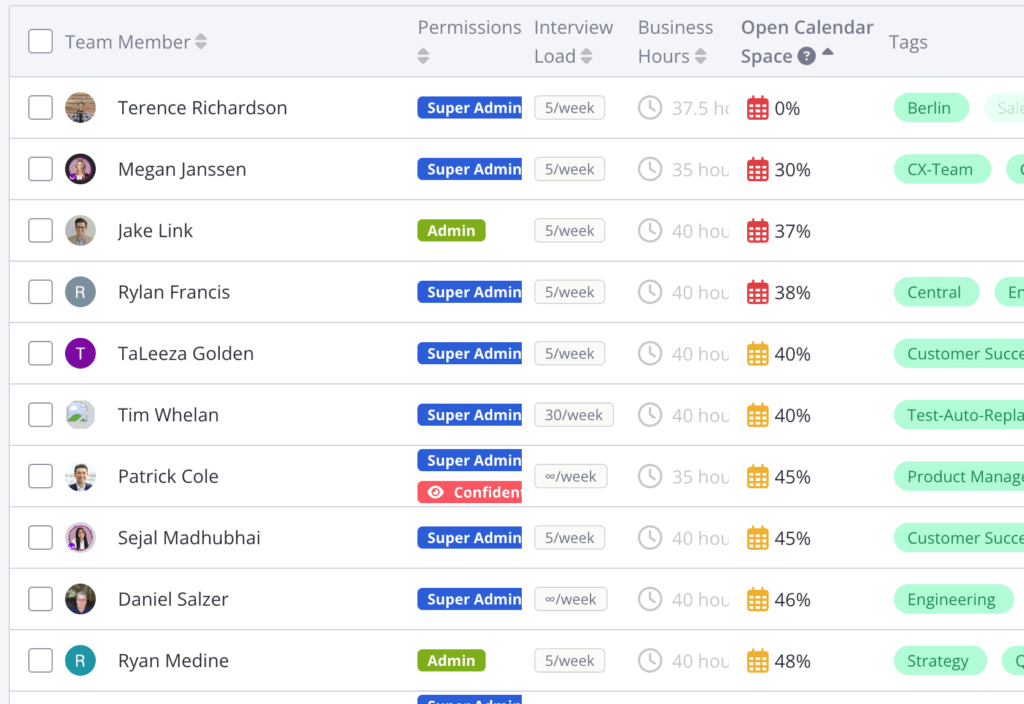
GoodTime’s new Capacity Planning has been enhanced with custom availability window, click in calendars, CSV downloads and real time updates to templates & tags.
Why this is awesome: All these enhancements make it easier to find bottlenecks in your hiring process as well as plan & justify to the business what’s needed to reach critical hiring goals.
Auto Replace Updates
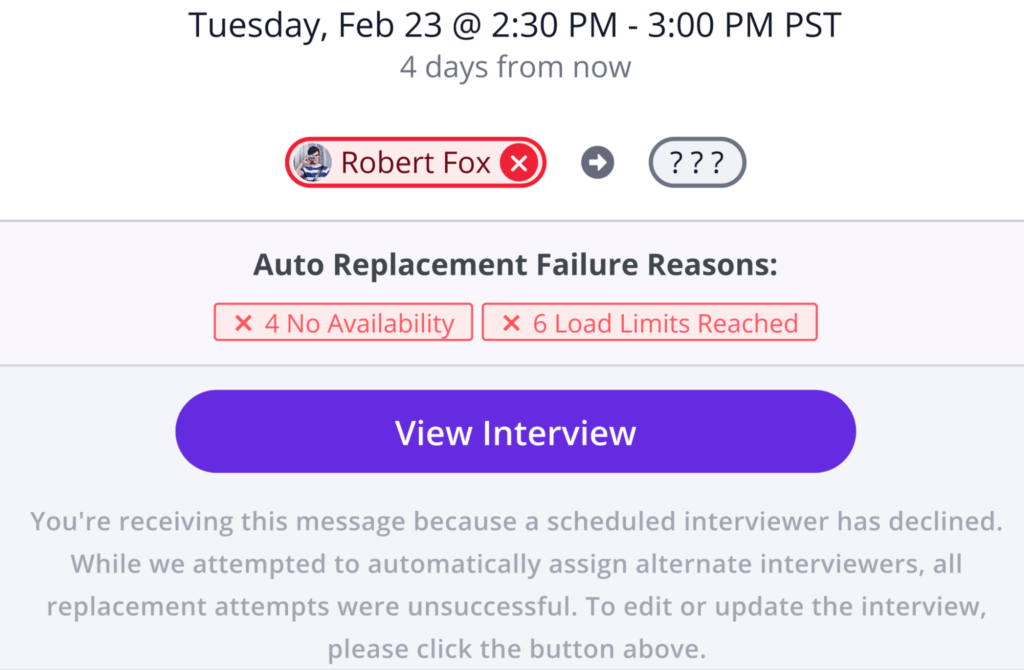
Auto Replace now lets you set your own custom cutoff window and easily understand the reason why when a replacement is not possible.
Why this is awesome: Get more automated replacements and let the data help you avoid replacement failures in the future..
Auto Confirm Interviews
GoodTime’s latest automation will move your HOLD interviews to CONFIRMED when all required interviewers have accepted.
Why this is awesome: Coordinators spend less time manually confirming interviews and fewer interviews get “left behind”.
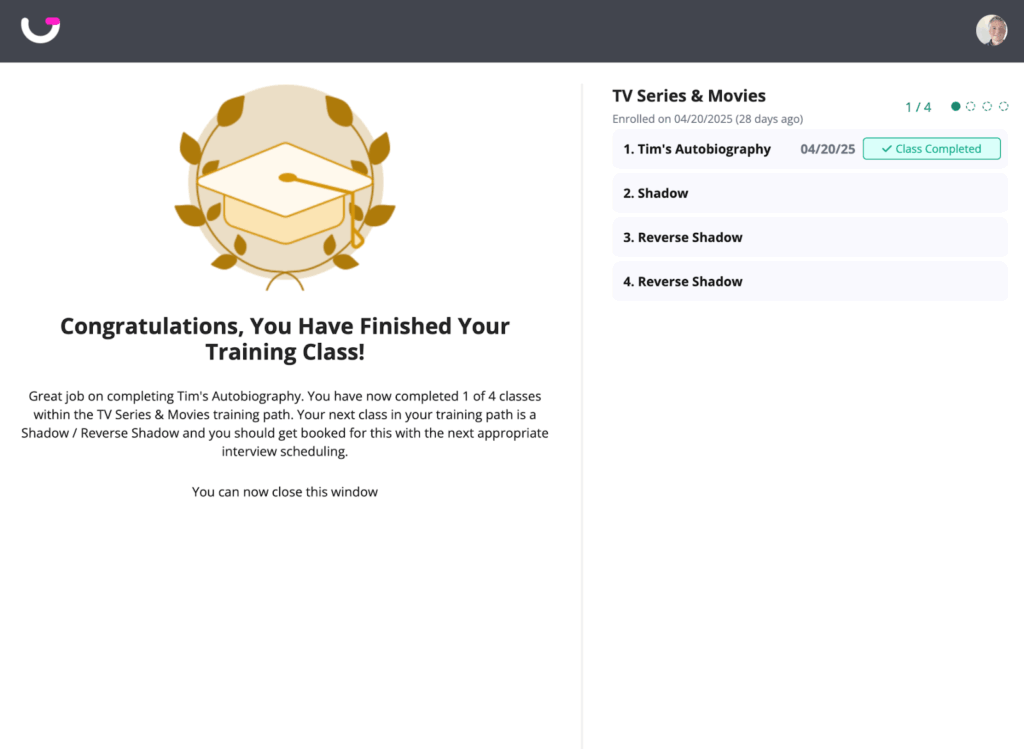
New Interviewer & Trainee Confirmation Email
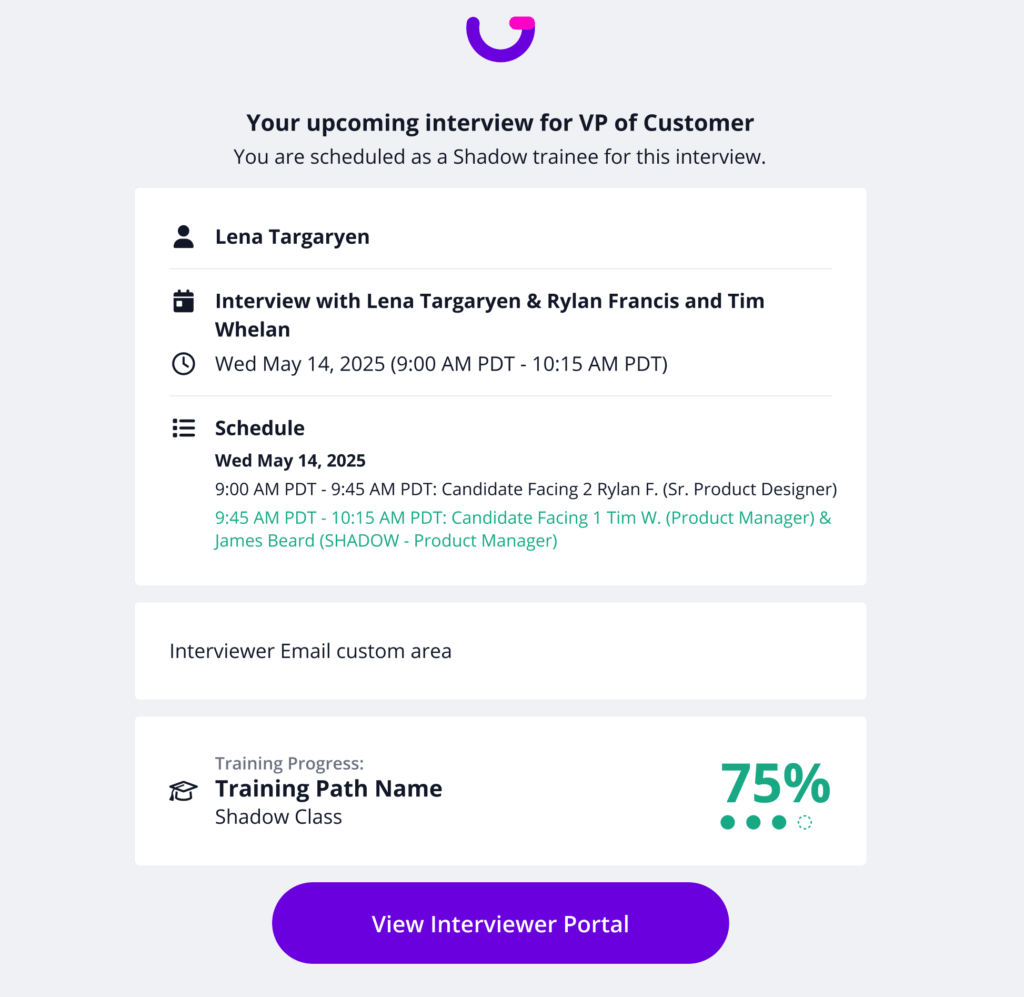
We’ve updated the way the confirmation email to interviewers & trainees looks like. It’s easier to read, contains more information about relevant Training Path progress and makes it easier for Experience+ customers to access the Interviewer Portal.
Why this is awesome: This small but mighty update makes interviewing easier for every participant of every interview.
AI Message Visibility
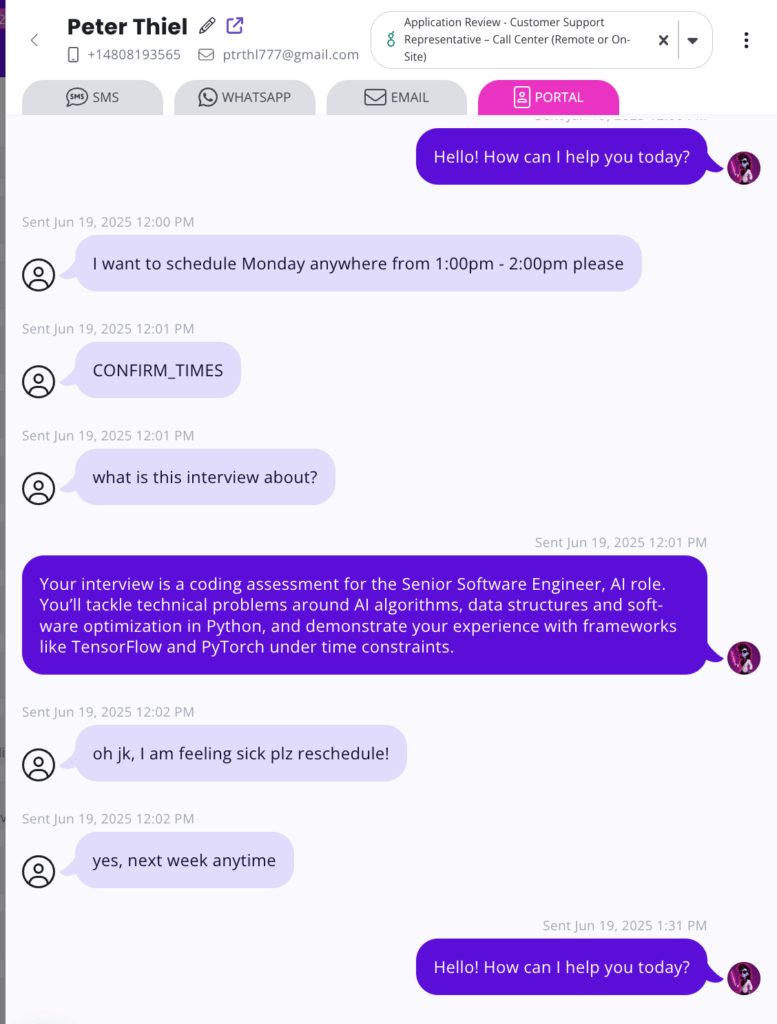
All candidate-AI conversations are now fully visible in the Candidate Messenger, with every message tracked. Recruiters and coordinators can jump in and respond directly when needed.
Why this is awesome: Gives your team full transparency and control to step in at the right moment.
Escalation Notification Alerts
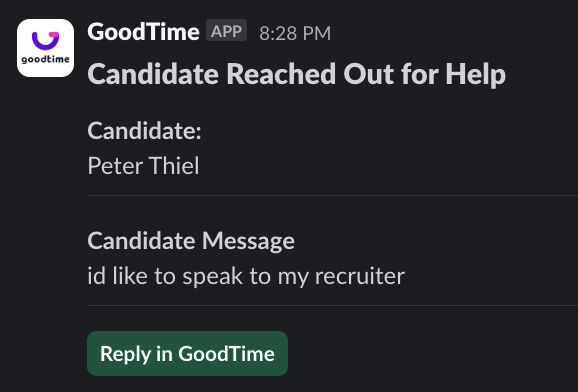
When a candidate asks to speak with a recruiter or coordinator, your team is immediately notified via email or Slack—ensuring no request for human help goes unnoticed.
Why this is awesome: Provide a world-class candidate experience by quickly connecting them with a real person when needed.
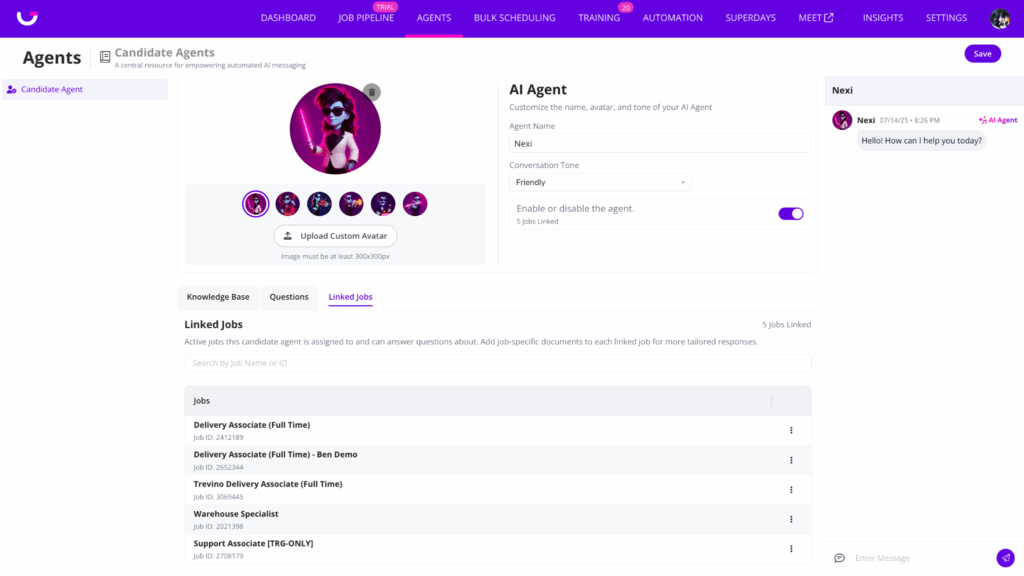
Job-Based Agent Assignment
You can now turn on the AI Agent for specific jobs only—perfect for piloting usage with a few roles or tailoring support by department (like sales or engineering).
Why this is awesome: Roll out the agent gradually and strategically, with more control over where it’s deployed.
Start using the latest GoodTime features!
We want to help you evolve and take full advantage of the latest upgrades and improvements to our platform. Check out the GoodTime support center for tutorials and tips to help you stress less and get more done!
This month, we rolled out new features that make it even easier to automate busywork, unlock insights, and move top talent through your pipeline — all with less lift from your team.
Here’s what’s new: In June, we introduced several updates that help your team move faster, stay in sync, and deliver better candidate experiences with less effort. From smarter reminders and deeper feedback filtering to enhanced scheduling capabilities and next-level AI automation, these updates are all about one thing: helping your team focus on people, not busywork.
Whether you’re looking to speed up training, understand candidate sentiment, or put a branded AI Agent to work 24/7, our latest features — powered by Orchestra, our digital workforce of AI agents — are here to keep hiring fast, human, and in flow.
If you missed the live session, you can catch the full webinar or review the recap below to get up to speed.
First, watch highlights from Orchestra, our workforce of AI agents
Our latest update reveals significant enhancements aimed at improving the recruitment process. These agents can now automatically advance qualified candidates and trigger interview requests, ensuring a more efficient workflow. They facilitate personalized rejections to avoid leaving candidates in the dark and engage in natural conversations to assist with scheduling interviews. Additionally, the agents gather and summarize candidate sentiment, providing valuable insights for hiring teams.
Watch the full June 2025 GoodTime product updates webinar or keep scrolling for highlights
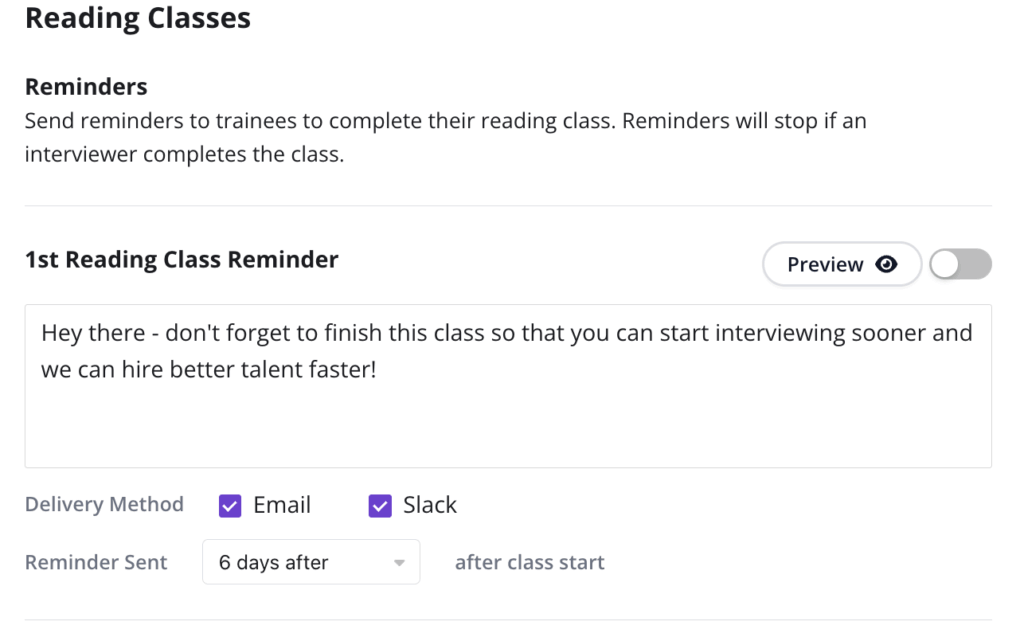
Reminders for Reading Classes & Trainee Feedback
Thanks to great feedback from our valued partners, GoodTime has built out Email & Slack reminders for missing trainee feedback and reading class completion.
Why this is awesome: By automating reminders, trainees graduate faster while requiring less work from your team.
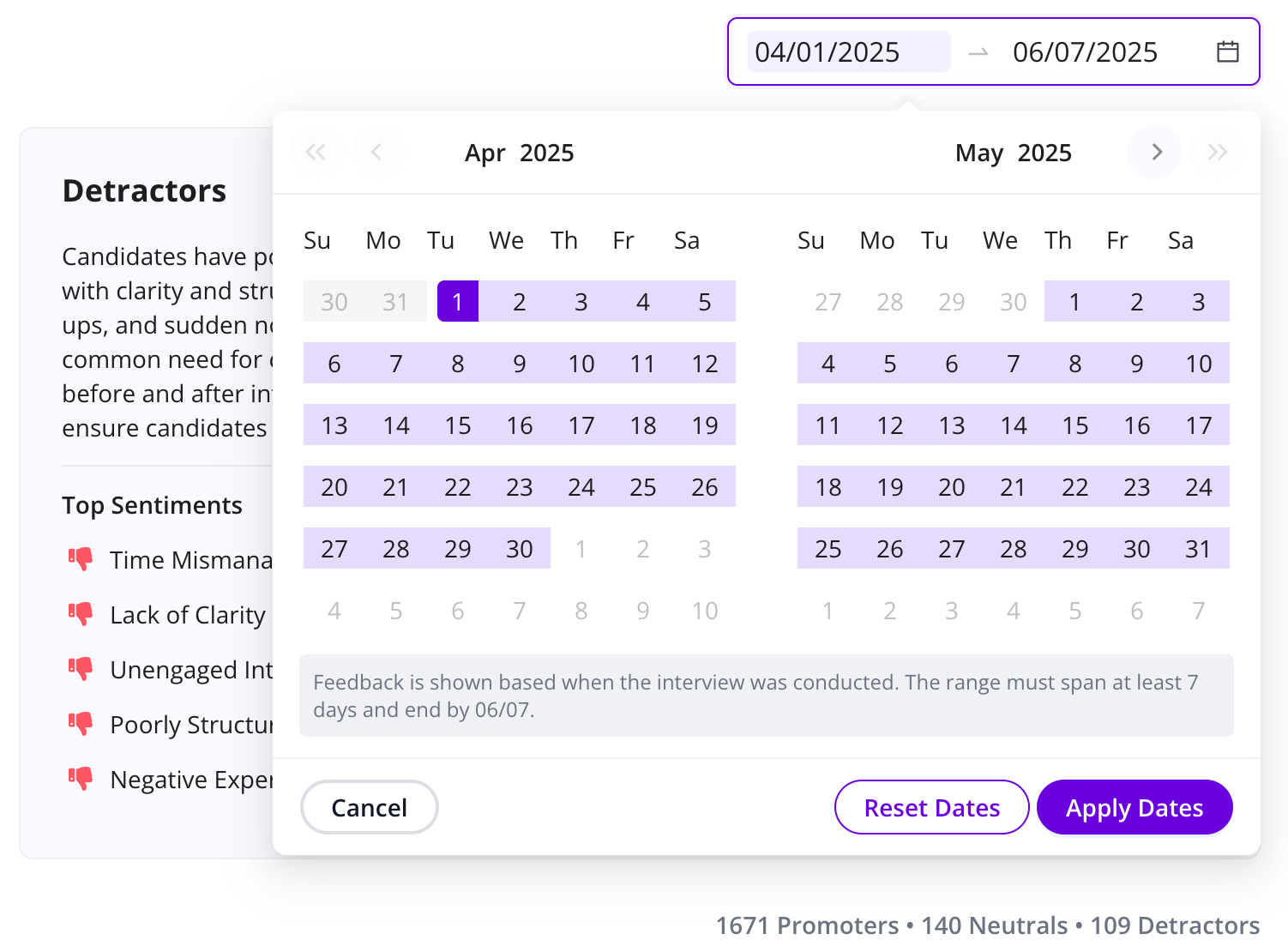
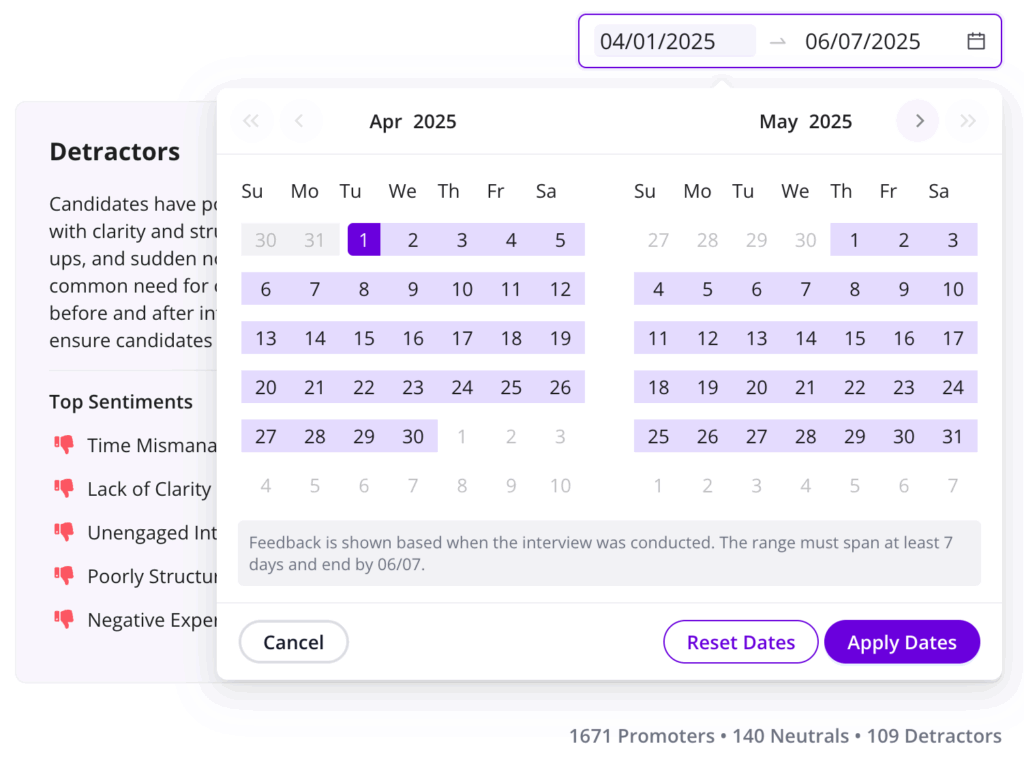
cNPS Feedback Report Filters
Last month, we announced the all-new AI cNPS Feedback report, which has now been updated with date pickers and department filters so that you can see how sentiments evolve over time and in different areas of your organization.
Why this is awesome: Data like cNPS is designed to tell you where to make changes, and filters like these enable you to see if those changes improve your candidate experience.
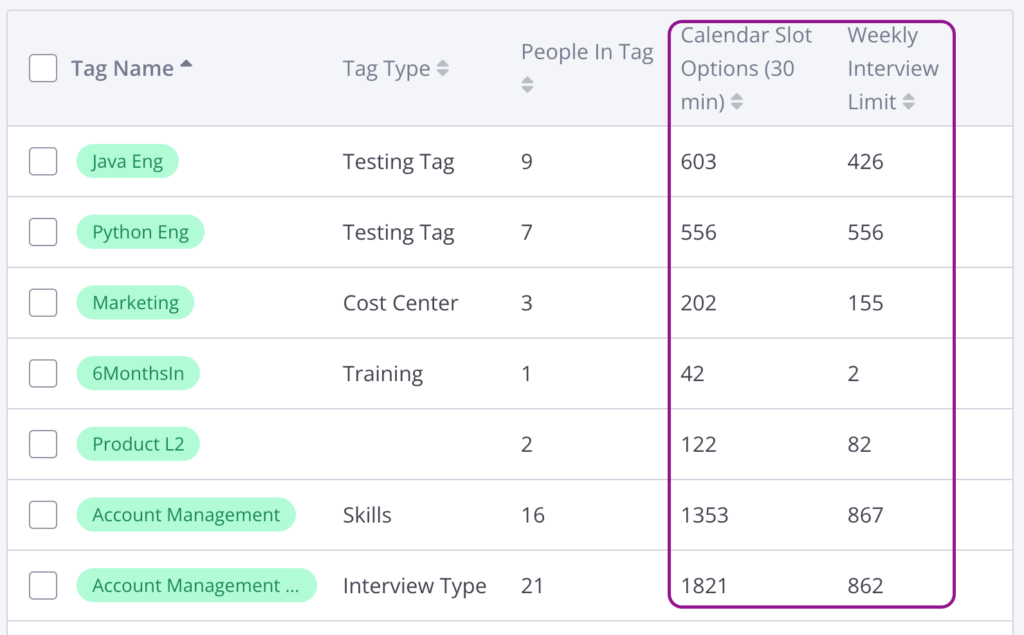
Calendar Availability Analysis
GoodTime now scans & stores the availability for all your interviewers and creates automatic team, tag & interview template capacity analysis.
Why this is awesome: Your interview capabilities are only as capable as your most restricted point in the chain. Calendar Availability Analysis helps find bottlenecks and enables capacity planning required to reach hiring goals.
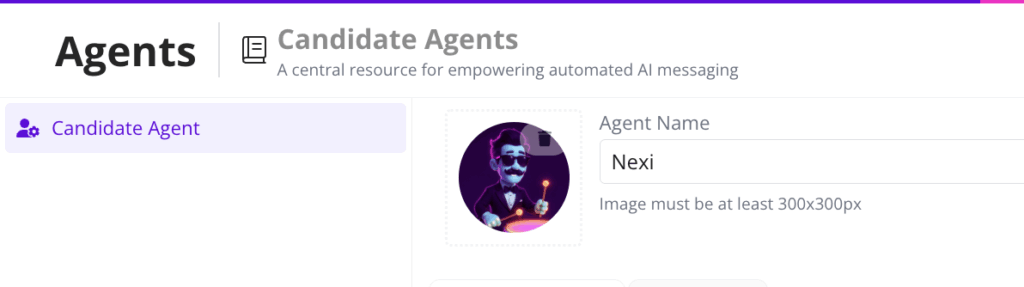
Candidate-facing AI Agent
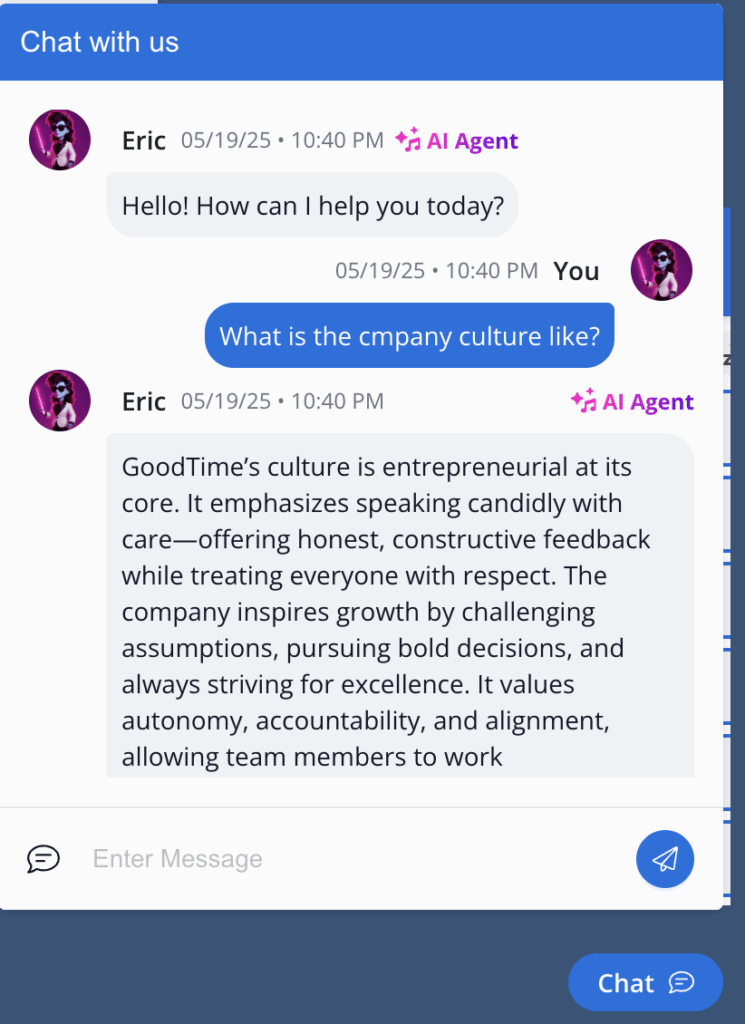
Fully configure a candidate-facing AI Agent —tailored with a custom name, avatar, and tone of voice. Admins can upload PDFs, DOCs, websites, and FAQ data to train the bot, making it an extension of your brand.
Why this is awesome: Answer candidates 24/7 while reducing recruiter workload.
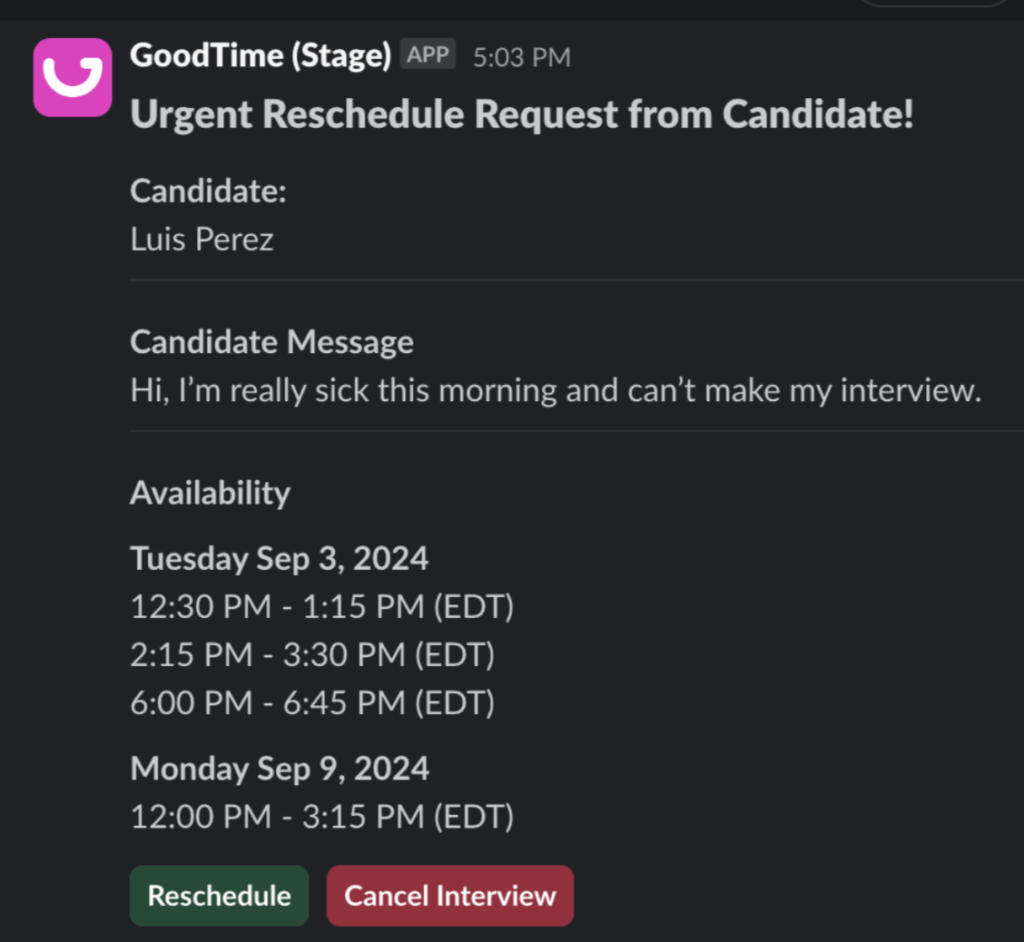
Scheduling Assistance
Candidates can now reschedule, share availability, and escalate urgent issues directly through AI chat—no human needed unless it’s critical.
Why this is awesome: Remove back-and-forth emails to speed up scheduling and rescheduling requests.
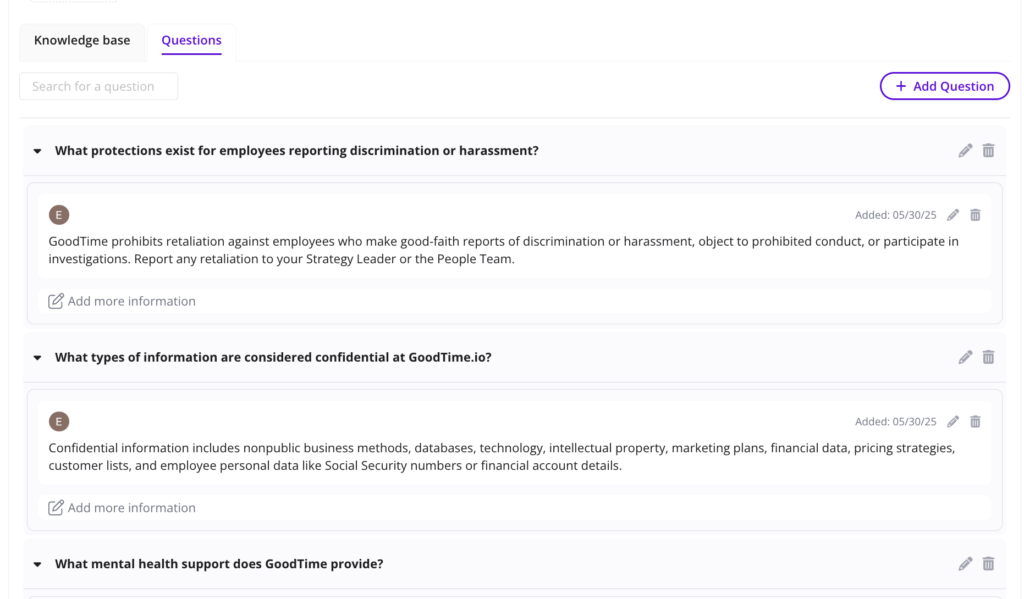
Customized Knowledge Base
Every job post now powers an instant, AI-ready knowledge base—complete with interview prep, role expectations, and FAQs. Recruiters can also inject custom information to reduce repetitive questions.
Why this is awesome: Your AI Agent is available 24/7 to guide candidates with accurate, on-brand answers.
Start using the latest GoodTime features!
We want to help you evolve and take full advantage of the latest upgrades and improvements to our platform. Check out the GoodTime support center for tutorials and tips to help you stress less and get more done!
This month, we unveiled a game-changing leap forward in hiring orchestration — and we’re just getting started. From powerful upgrades inside GoodTime Hire to the official launch of Orchestra, our digital workforce of AI agents, this release is all about elevating every moment of your hiring journey.
Here’s what’s new: We expanded our Experience+ capabilities with a refreshed training module that now includes Reading Classes, Training Path KPIs, and custom interviewer prep right inside the Interviewer Portal. You can now also customize reminder emails, delete outdated Training Paths, and tap into updated external API endpoints for better integration.
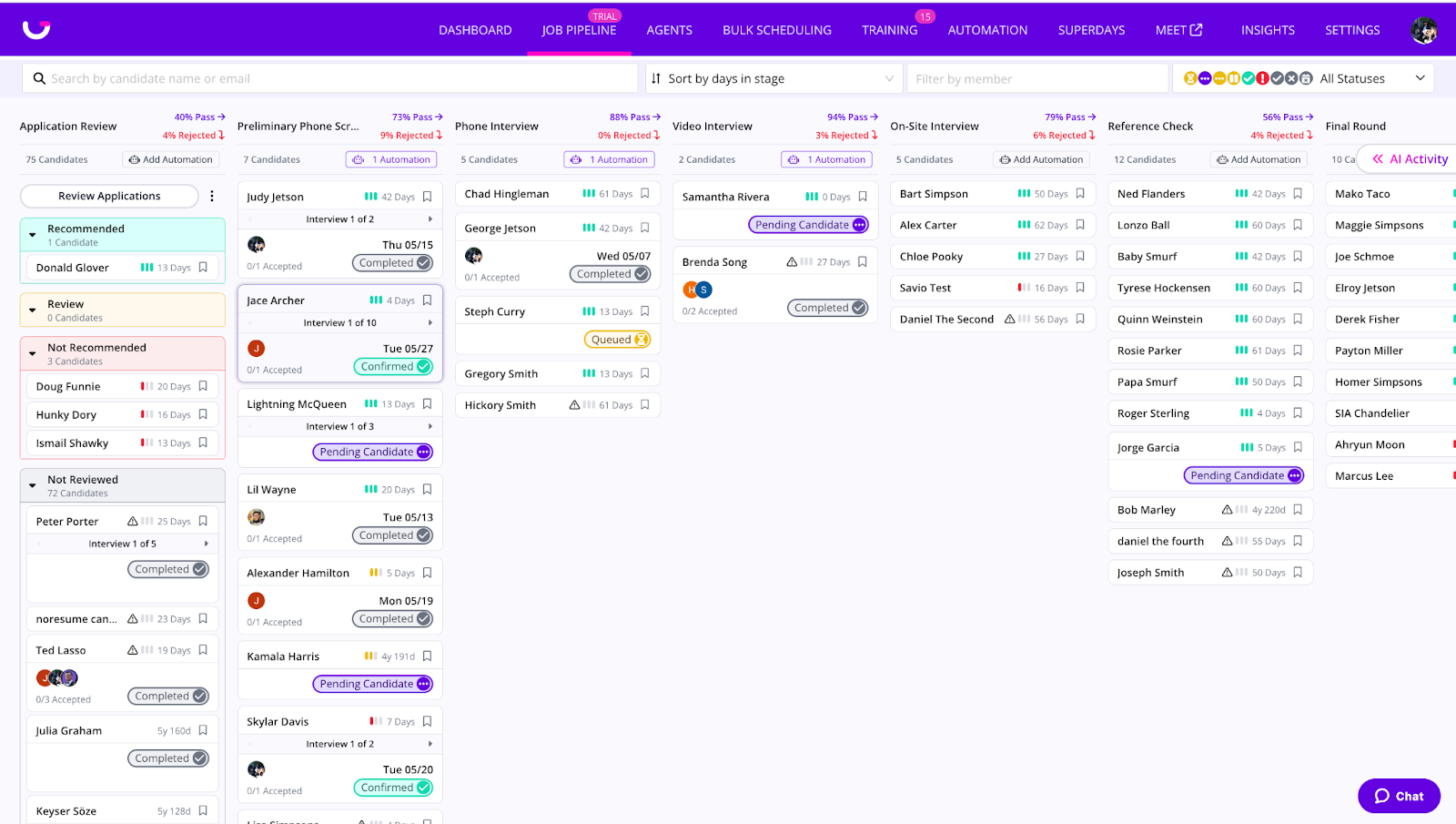
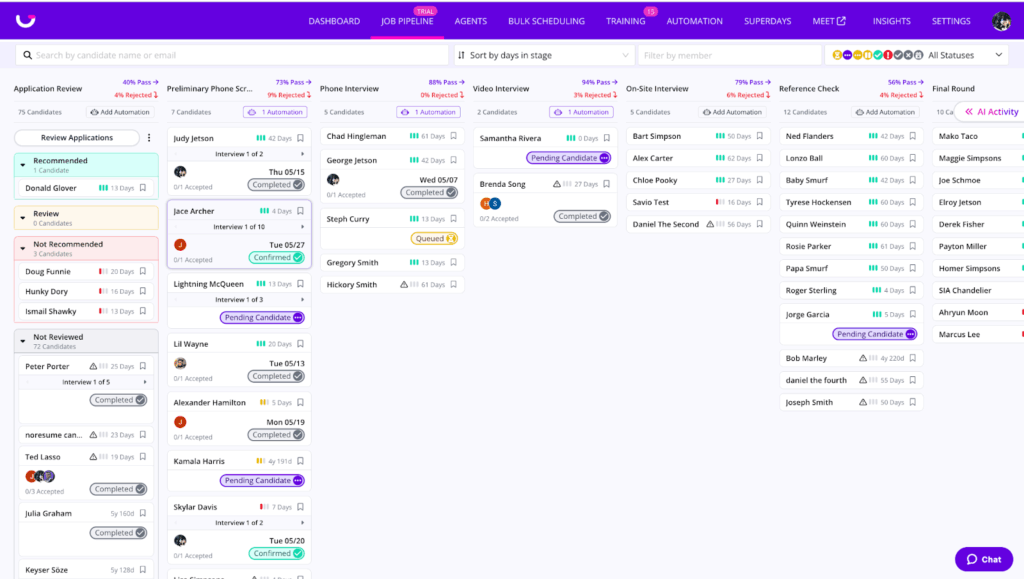
And then came Orchestra. This bold new layer of human-centric AI brings a smarter, faster, more connected hiring experience — starting with the launch of our Recruiter Agent, offering real-time visibility into activity across the updated Job Pipeline. We also gave a sneak peek at our upcoming 24/7 Candidate Agent, and dropped a long-awaited feature: the candidate Net Promoter Score (cNPS) Sentiment AI Report, which surfaces the hidden insights behind your candidate feedback.
Missed the session? No worries. Keep reading for a full recap of everything we launched — and why this is the most powerful version of GoodTime yet.
Introducing Orchestra
Orchestra is GoodTime’s new identity for our intelligent, always-on digital workforce — a coordinated team of AI agents built to act, not just react. These agents work across the hiring journey to handle tasks like screening, scheduling, updating candidates, and flagging bottlenecks — all while keeping your team in control. Unlike traditional automation, Orchestra agents work in harmony, stepping in at the right moments so your recruiting team can focus on what really matters: building relationships and making confident hiring decisions.
This update marks the official launch of our Recruiter Agent, which now streams live activity directly into the Job Pipeline, giving you unprecedented visibility into what’s happening and why. We also gave a sneak peek at our upcoming Candidate Agent — a 24/7 AI-powered assistant that answers candidate questions, schedules interviews, and keeps them warm and informed without adding work for your team. With Orchestra, we’re not just layering on automation. We’re orchestrating a smarter, more human hiring experience — and this is just the beginning.
Reading classes
The Training Module now has a brand new Class Type for LMS-style Interviewer Training that lets you build out written training material as a part of your Training Paths.
Why this is awesome: Managing interviewer training in one place increases automation, reduces mistakes, and ultimately graduates more interviewers faster,so you can hire better candidates.
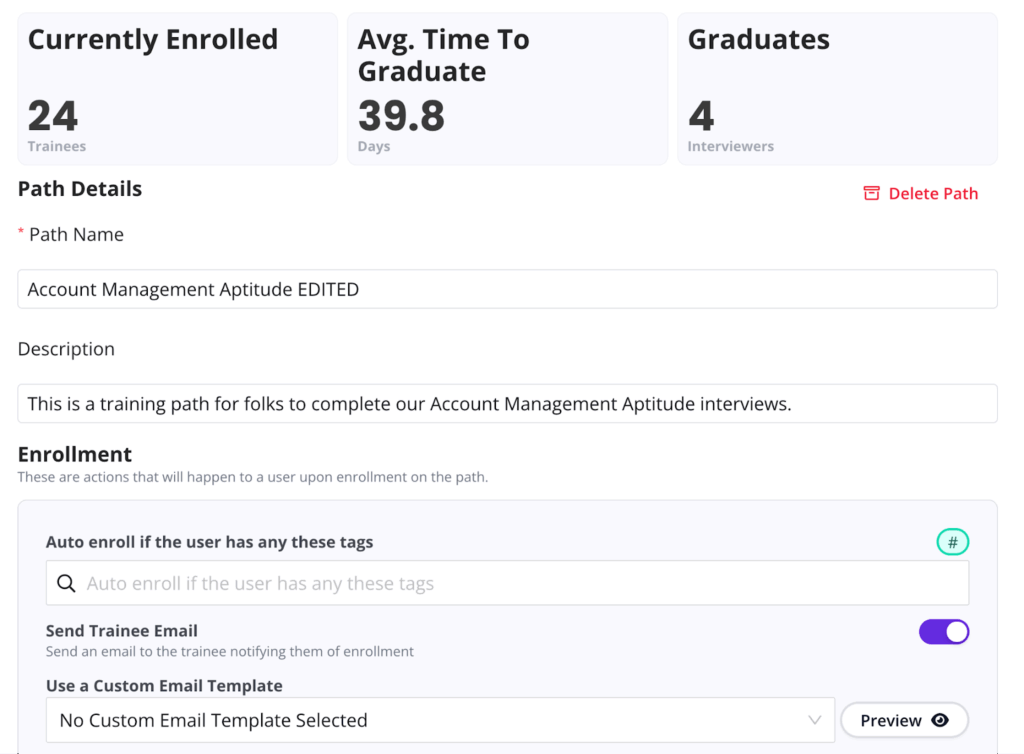
Training path KPIs
The most important KPI’s for each Training Path are now highlighted at the top of your Path so you can quickly track its progress and drill down into the numbers behind the stat.
Why this is awesome: You instantly see the progress and performance of your path without applying filters and loading reports, all while saving time with clickable shortcuts to the root data.
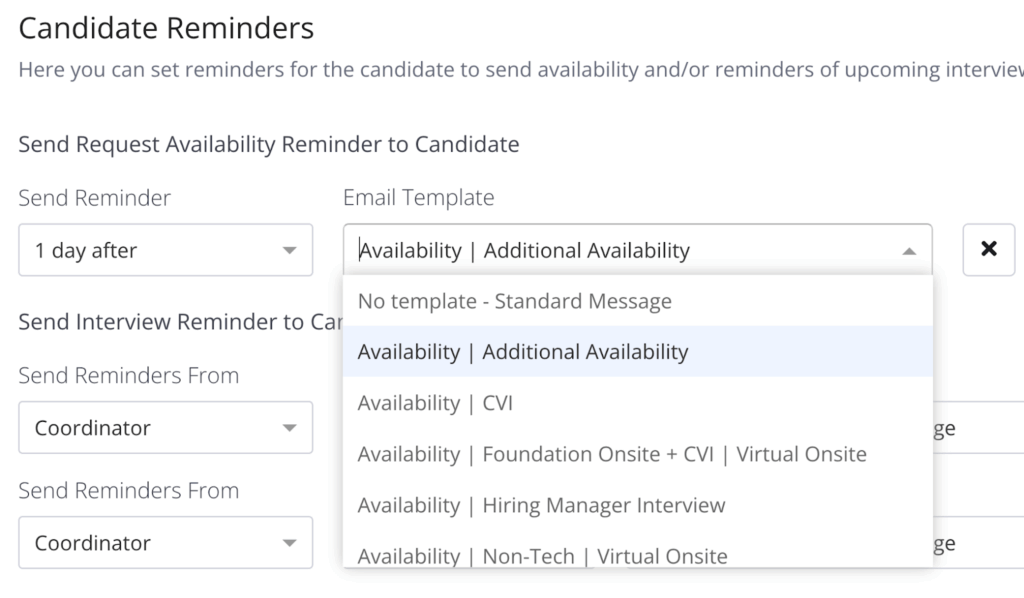
Custom reminder emails
Now you can use email templates to customize the reminder emails that candidates receive for confirmed interviews and availability requests.
Why this is awesome: Users can benefit from including certain preparational information or just adding the specific language and touch that your organization stands for!
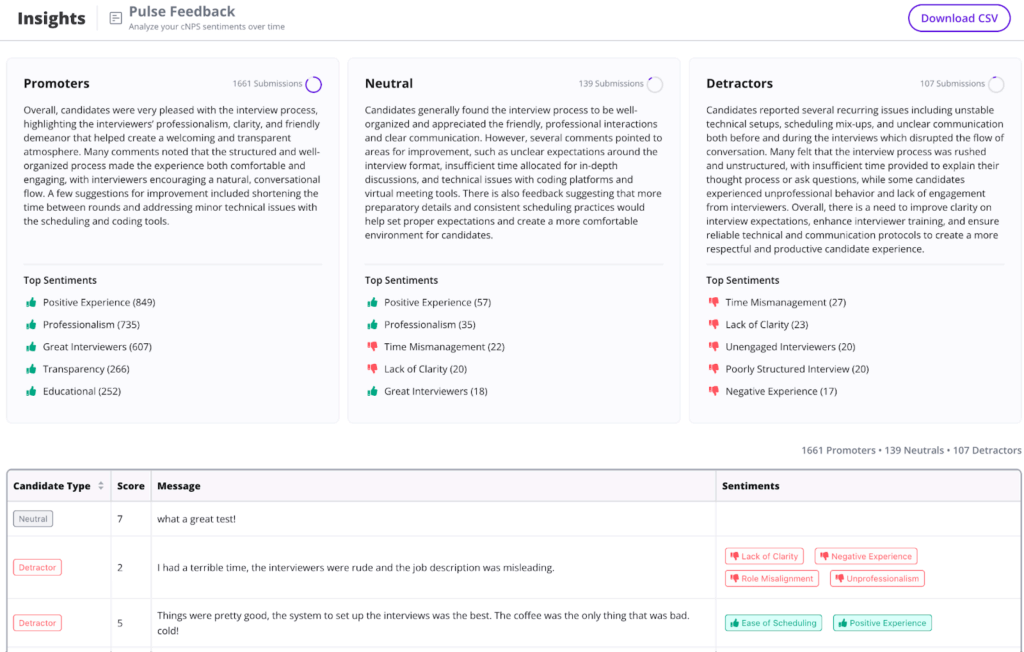
cNPS sentiment AI report
Easily and quickly analyze the Candidate feedback submitted along with Pulse score. AI will not only summarize the feedback, but also categorize it through clickable categories so you can go from summary to detail in a split second.
Why this is awesome: Reading thousands of messages would take hours. Categorizing & quantifying them would take even longer. Now it’s instant & automated, so you can spend your time taking action instead of analyzing.
Job Pipeline is now real time
See candidates move through stages, live evaluation scores, and track interview logistics in real time—including when interview requests are sent, accepted, declined, and confirmed.
Why this is awesome: Get a live, accurate view of your candidate pipeline without refreshing—saving time and reducing confusion.
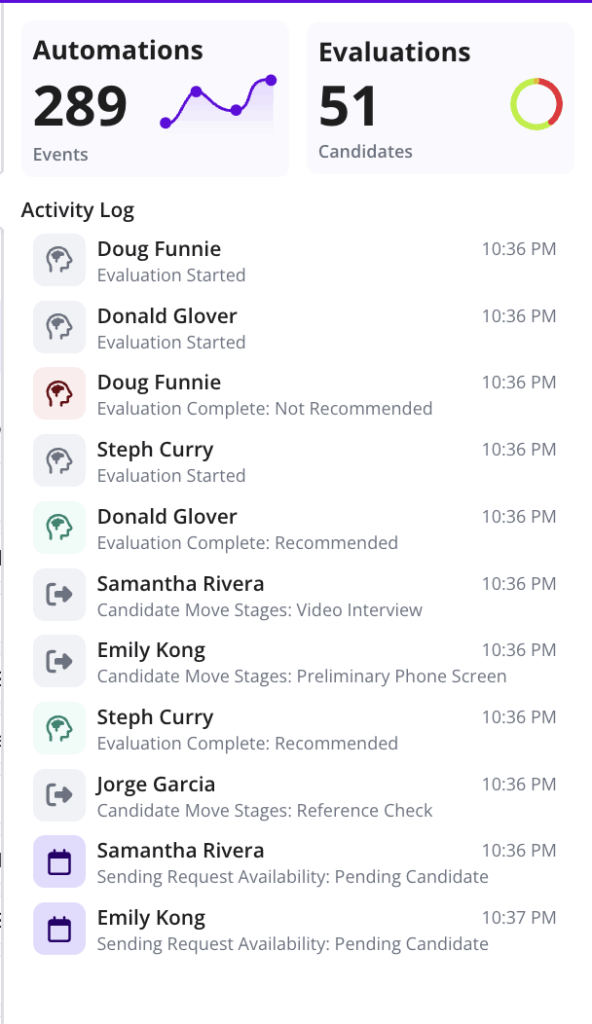
AI activity feed
View a complete timeline of key AI-driven events: when candidates are evaluated, their scores, and every step of the interview coordination process. You can finally see what’s happening and when, all in one place.
Why this is awesome: Full transparency and audit trail of AI activity—making it easier to build trust and understand impact.
Sneak peek at our Candidate Agent
The AI Candidate Agent can help candidates schedule, reschedule, answer questions about the job or company, and guide them through the hiring process—all without recruiter involvement.
Why this is awesome: Saves recruiters hours of repetitive work while giving candidates fast, accurate help—anytime, day or night.
Start using the latest GoodTime features!
We want to help you evolve and take full advantage of the latest upgrades and improvements to our platform. Check out the GoodTime support center for tutorials and tips to help you stress less and get more done!
Today, GoodTime, a leader in human-centric AI for hiring, introduces Orchestra, a coordinated digital workforce of AI agents working behind the scenes to eliminate delays, reduce manual work, and transform the way companies hire.
The hiring landscape has changed dramatically in the last few years, but most recruiting processes haven’t kept up. Manual tasks, slow follow-ups, and scattered systems continue to drag teams down and create poor hiring experiences. That’s the challenge GoodTime solves with Orchestra.
More than a singular feature or product, Orchestra is the intelligent AI layer woven across the GoodTime experience — a digital workforce of proactive, autonomous agents that work in sync to handle hiring’s most time-consuming tasks. From resume screening and candidate matching to interview scheduling, real-time updates, and more, Orchestra keeps hiring fast, smooth, and human.
“The hiring process is overdue for a reset — and Orchestra is our answer,” said Ahryun Moon, Co-Founder and CEO of GoodTime. “We’re not building simple bots that follow scripts. We’re building AI that works like a team — constantly learning, coordinating, and making hiring smoother for everyone involved. This isn’t automation for automation’s sake. It’s AI-powered orchestration for a more human hiring experience.”
From application to offer — faster than ever before
GoodTime’s intelligent agents don’t just wait for instructions. They act. They scan resumes. They schedule interviews. They keep candidates informed and engaged. They surface insights, flag bottlenecks, and ensure every step of the hiring process runs in perfect sync.
Built for the demands of modern TA teams, Orchestra delivers:
Faster hires, fewer handoffs — Agents move the most qualified candidates forward instantly, reducing time-to-fill and helping you win top talent before competitors do.
Smarter hiring decisions — With insights and feedback summaries delivered automatically, hiring teams always have a clear view of what matters most.
A better candidate experience — Always-on support and real-time updates keep candidates engaged from start to finish.
More time for people-focused work — Agents handle the busywork so TA teams can focus on high-impact moments.
Intelligent support that works in sync with the talent team
“Orchestra isn’t here to replace recruiters — it’s here to back them up,” said Charles Mah, Chief Operating Officer at GoodTime. “We built Orchestra to give talent teams their time back. With AI agents handling the heavy lifting, hiring teams can focus on what they do best: building real relationships and making great hires.”
Orchestra agents support talent teams at every step, eliminating the operational drag that slows hiring down, while keeping people at the center of every interaction. They work in concert with recruiters, coordinators, hiring managers, and candidates to keep everyone supported through each step of the hiring journey.
Orchestra brings speed, clarity, and consistency to every step of the hiring journey:
Instantly screen applicants and match them to roles based on custom job criteria, and automatically prioritize top candidates
Build, categorize, and refine job specifications using AI-powered suggestions
Book and reschedule interviews based on real-time availability — no back-and-forth required
Keep candidates warm, informed, and engaged with timely, personalized messages
Deliver answers to candidate FAQs using company-specific documentation
Summarize interview scorecards and consolidate team feedback for faster, clearer decisions
Monitor hiring pipelines for bottlenecks and recommend fixes before issues escalate
Everything happens automatically — but never out of sight. Every action is visible, traceable, and designed to keep the talent team in control. When agents and people work together — each doing what they do best — the result is faster hires, smarter decisions, and a more human experience for everyone involved.
This is AI designed to elevate the human side of hiring, not erase it.
GoodTime transforms the way companies hire — with human-centric AI that orchestrates every step of the journey. From screening to scheduling to candidate communications and more, our AI agents eliminate delays, reduce manual work, and keep hiring moving fast. They take action at the right moments, surfacing insights, advancing top talent, and keeping your team in the loop every step of the way. Trusted by global teams at Priceline, Lyft, and Hubspot to power people-first hiring at scale, GoodTime delivers faster hires, smarter decisions, and standout candidate experiences.
Learn more at goodtime.io.
Media Contact
For more information or to arrange an interview with Ahryun Moon, please contact:
This month, we’re bringing smarter workflows, sharper insights, and a more seamless candidate experience to GoodTime Hire. From real-time AI candidate matching in your job pipeline to automated workflows and new benchmarking data, these updates are designed to make your team faster, smarter, and more candidate-centric than ever. Whether you’re training new talent, reviewing feedback, or connecting with candidates, it’s all about reducing friction and accelerating great hiring decisions.
Let’s dive into what’s new.
Watch the April 2025 GoodTime product updates webinar or keep scrolling for highlights
Trainee Feedback
The Training Module continues to grow with the newest addition of automating and collecting feedback on Trainee performance, including automated make-up classes & deadline expiration.
Why this is awesome: Graduating a trainee who isn’t ready & allowing them to conduct interviews is bad for everyone. Quality controlling their performance is now both easy and automated so that you can increase quality and save time.
cNPS Benchmarking & Leaderboards
The Recently revamped cNPS Report has been expanded with a Job & Department Leaderboard and Industry Benchmarking data.
Why this is awesome: Leaderboards help you immediately see where your org is thriving and where it needs attention. The Industry Benchmark provides metrics on how you perform compared to industry leaders only found on GoodTime.
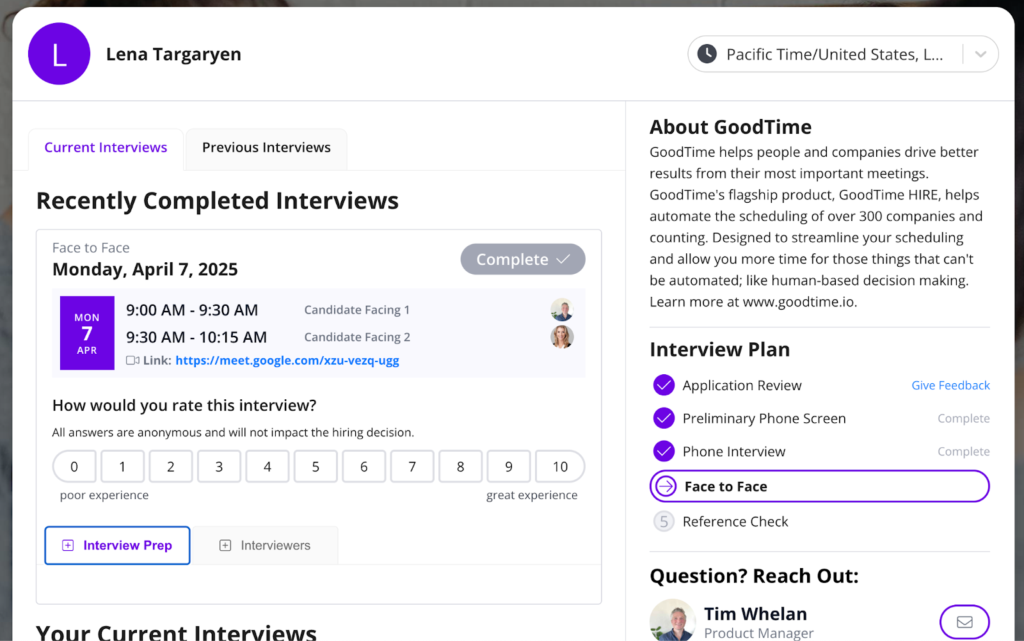
Redesigned Candidate Portal
As the Candidate Portal has grown tremendously in popularity, we have been getting buckets of amazing feedback that has been combined to refresh the Candidate Portal to its greatest version yet!
Why this is awesome: Your organization is now better represented than ever to your candidates, while they can understand and prepare for their interview with total ease and confidence.
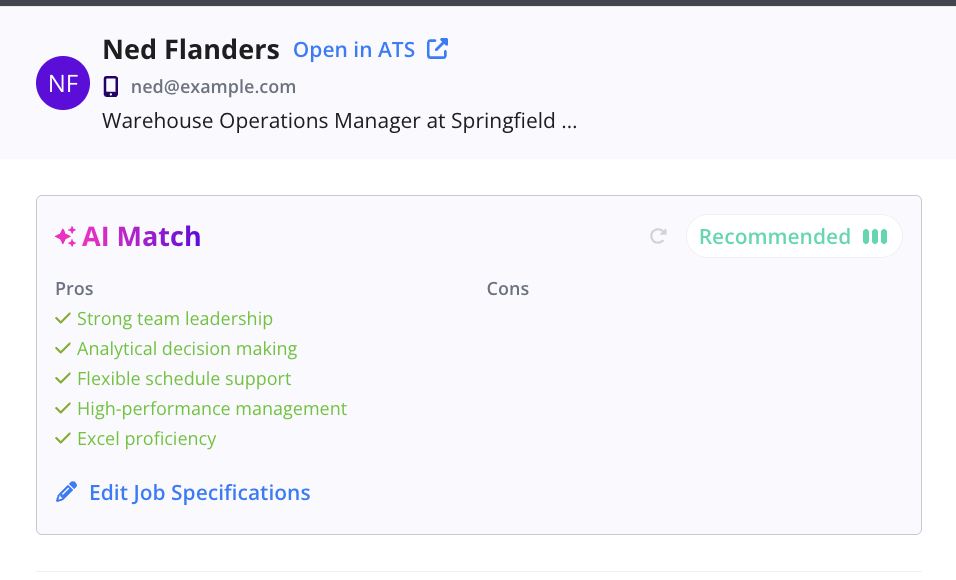
Real-Time Matching in Job Pipeline
Our AI matching now evaluates every candidate when they apply, and highly recommended candidates are brought right to the top.
Why this is awesome: Save hours in screening resumes every day to focus on the top candidates in your pipeline! Learn more.
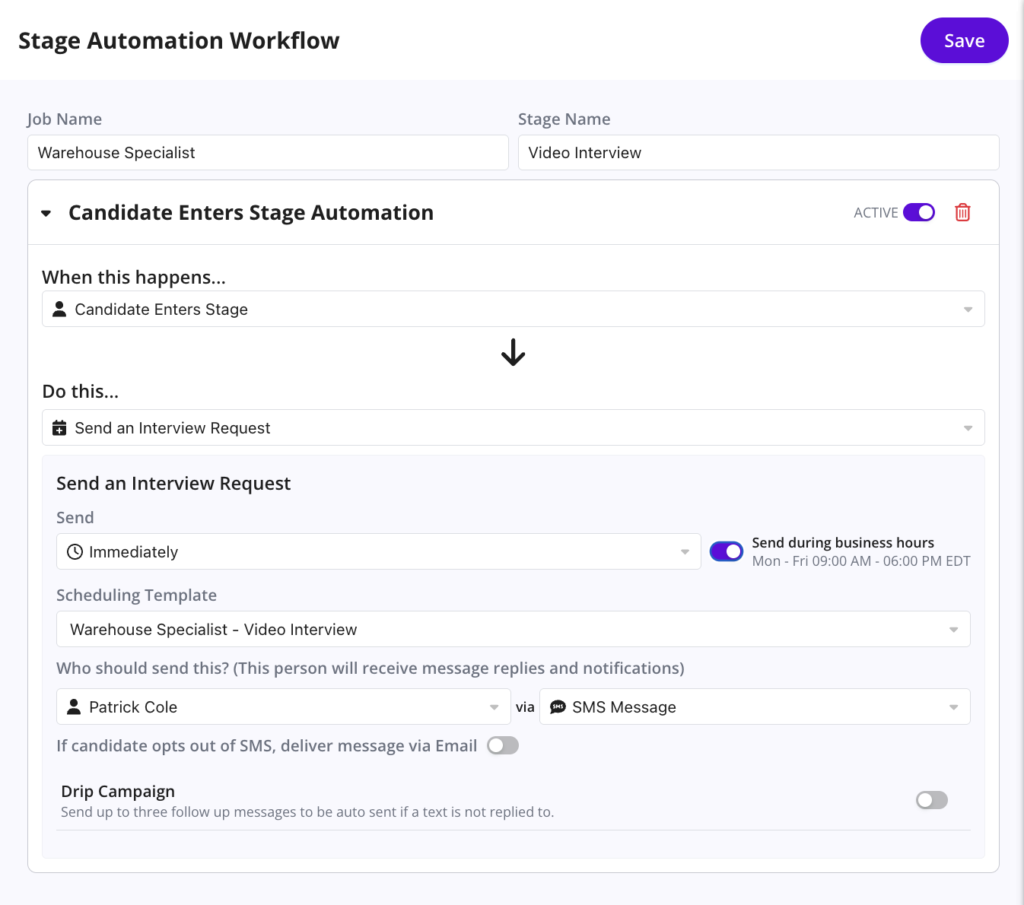
Automated Workflows
You can now configure workflow automations inside of Job Pipeline for every stage of the funnel!
Why this is awesome: Auto-progress candidates, send interview scheduling requests, or messages to candidates, all customizable and configurable inside Job Pipeline!
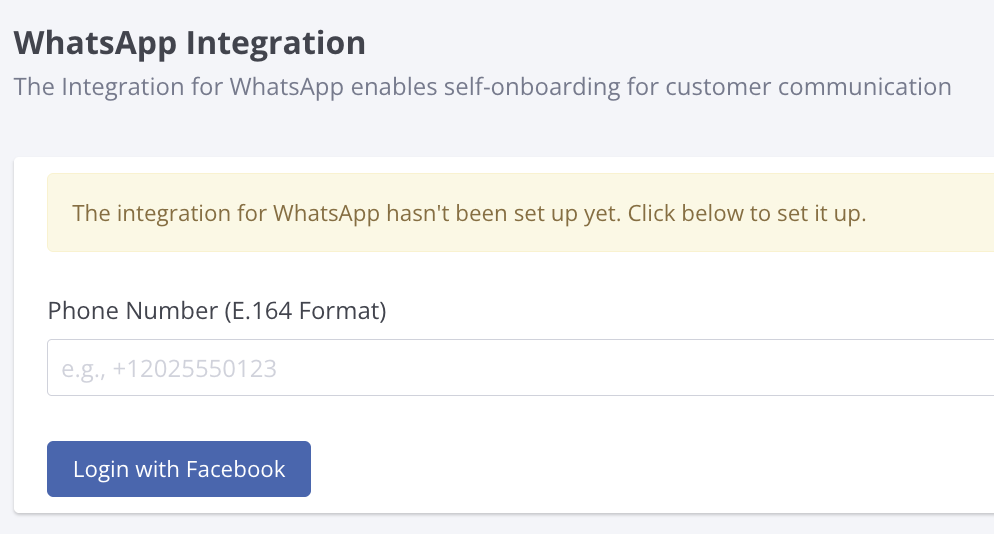
WhatsApp Integration updates
We’ve added WhatsApp to our Company Setting! Now integrating is as easy as clicking a button.
Why this is awesome: Full control over your WhatsApp integration. Set it up or disconnect without needing to reach out to our Customer Support team.
Start using the latest GoodTime features!
We want to help you evolve and take full advantage of the latest upgrades and improvements to our platform. Check out the GoodTime support center for tutorials and tips to help you stress less and get more done!
Let’s be honest: talent acquisition has never been more complex—or more critical. The pressure to fill roles faster, personalize every candidate touchpoint, and keep recruiters from burning out isn’t letting up. And all of this is happening as teams face shrinking headcounts and tighter budgets.
But something new is quietly transforming how work gets done in talent acquisition. A different kind of teammate has joined the ranks—not another recruiter or coordinator, but intelligent software. AI tools that schedule interviews. Digital agents that send personalized reminders. AI and automation that eliminates hours of manual work. This is digital labor.
Digital labor, sometimes referred to as a “digital workforce,” represents a class of software-driven assistants that can handle many of the tedious, repetitive tasks traditionally performed by people. Think of them as ultra-efficient interns: fast, tireless, and accurate—but still in need of guidance and guardrails. And when implemented strategically, they can free up your human team to focus on what truly drives great hiring: relationships, judgment, and creativity.
In this article, we’ll break down what digital labor really means in the context of talent acquisition. We’ll look at where it’s already delivering results, how forward-thinking teams are putting it to work, and what it takes to adopt it successfully. You’ll also hear examples of how tools like GoodTime are being used—not as a replacement for recruiters, but as force multipliers that enable them to do their best work.
Because when digital labor is done right, it doesn’t make recruiting less human. It makes it more human.
Unlock 2026’s top hiring strategies: Insights from 500+ TA leaders
Be the first to uncover deep hiring insights specific to your sector — straight from the highest-performing TA teams.
A new kind of teammate: The rise of digital labor in recruiting
If you’ve worked in talent acquisition long enough, you’ve seen the evolution firsthand. From spreadsheets to applicant tracking systems. From faxed resumes to AI-powered sourcing. Each wave of innovation promised to make hiring faster, better, and easier.
Now we’re entering a new phase—one that doesn’t just upgrade your tools but introduces entirely new types of “workers” to your team.
This is the rise of digital labor: software-based agents that take on real work once performed exclusively by people. They don’t punch timecards or show up to team meetings, but they’re deeply embedded in your processes—scheduling interviews, messaging candidates, syncing calendars, and even nudging hiring managers to submit feedback. And they do it all with remarkable speed, accuracy, and consistency.
The idea isn’t hypothetical. As Salesforce CEO Marc Benioff stated at the World Economic Forum in Davos, “We are really moving into a world now of managing humans and agents together.” In many talent teams, that shift has already started. And not in the flashy, sci-fi way people tend to imagine—but in practical, behind-the-scenes ways that are quietly changing how hiring happens.
Digital labor is showing up everywhere:
A scheduling assistant that finds time for a multi-round panel faster than any human could
A chatbot that answers candidate questions at 11 p.m. on a Sunday
A workflow that texts reminders before interviews and captures feedback after
An AI-powered system that flags bottlenecks in your hiring funnel before they become problems
This isn’t about gimmicks. It’s about performance. At a time when most enterprise TA teams are expected to do more with less, digital labor offers a way to scale without sacrificing experience or control.
“We are really moving into a world now of managing humans and agents together.” -Marc Benioff, CEO, Salesforce
Take GoodTime, for example. Enterprise teams use its agentic AI to fully automate complex interview scheduling—across time zones, teams, and roles. Instead of relying on recruiters to juggle calendars manually, the AI finds optimal times, selects interviewers, and even reschedules automatically when someone drops out. That’s not a hypothetical use case—it’s happening every day in companies like Salesforce and DoorDash.
But GoodTime is just one example in a broader movement. Across the TA landscape, digital labor is helping teams reclaim hours of lost time and redirect that energy toward more strategic, human-centered work. What’s important to understand is that this shift isn’t coming—it’s already here. The only question is how you’ll choose to engage with it.
What digital labor really is (and isn’t)
When people hear the term digital labor, it often conjures up images of humanoid robots or sci-fi depictions of AI run amok. But the reality is far less cinematic—and far more practical.
Digital labor in talent acquisition is about intelligent software systems that perform tasks previously handled by humans. These digital “workers” or AI agents for talent acquisition aren’t physical machines; they’re software agents living inside your hiring tech stack. They schedule interviews, answer candidate questions, generate job descriptions, and route data—all with minimal human input.
Think of them as the world’s most diligent interns: fast, reliable, and not prone to burnout. But like any intern, they don’t just show up ready to roll. They require setup, training, and oversight. You need to define their workflows, feed them clean data, and monitor their performance over time.
That’s the key distinction: digital labor doesn’t replace process ownership. It follows the processes we create and amplifies them.
Let’s break it down. A well-configured AI scheduling assistant, for example, will:
Parse calendars and time zones faster than a human coordinator ever could
Suggest the best interviewer panel based on skill tags and availability
Auto-reschedule if someone drops out
Notify candidates through branded emails or text messaging, instantly
But it won’t decide why a particular interviewer is needed for a specific role. It won’t know when to overrule its own logic to preserve a candidate relationship. That’s still human territory.
GoodTime’s approach to this balance is a strong example. The platform enables TA teams to configure how much automation they want in their scheduling process. Want full auto-confirmation for high-volume roles? Done. Prefer a manual check for executive interviews? You’re in control. The AI doesn’t dictate process—it supports it.
That’s what makes digital labor so powerful. It scales your thinking. When used intentionally, it executes your recruiting strategies with speed and consistency, without forcing you to sacrifice personalization or judgment.
And let’s be clear about what digital labor isn’t. It’s not a chatbot trying to replace your sourcers. It’s not a black-box algorithm deciding who gets hired. And it’s definitely not about cutting your recruiting headcount in half to “let the AI take over.”
What it is—at its best—is a new kind of team member. One that never sleeps, never misses a task, and makes your human team better by freeing them to focus on what they do best.
Where digital labor is making the biggest impact
If you’re wondering where to start with digital labor, look no further than the bottlenecks your team encounters regularly. The most successful TA leaders don’t begin with sweeping transformations—they start with the repeatable, time-consuming tasks that hinder great recruiting.
Here are five areas where digital labor is already making a tangible difference inside large enterprise recruiting teams:
1. Interview scheduling and coordination
It’s the classic time sink: back-and-forth emails, calendar conflicts, last-minute changes. For many recruiting coordinators, this consumes a significant portion of their week.
Digital labor alleviates this burden.
Platforms like GoodTime utilize AI-driven interview scheduling agents that manage the entire coordination process—from finding optimal times across multiple calendars and time zones to automatically replacing interviewers who cancel. This automation has led companies to experience up to a 50% reduction in time-to-hire and a significant decrease in manual rescheduling efforts.
2. Candidate engagement and communication
Candidates today expect prompt, transparent communication, and ghosting has become a dealbreaker. Digital labor helps bridge this gap.
Hilton, for instance, implemented an AI-powered chatbot named “Connie” to handle routine candidate inquiries, provide updates on application statuses, and guide applicants through the process. This not only enhanced candidate engagement but also allowed HR teams to focus on more complex tasks.
Additionally, Hilton’s use of AI in recruitment led to a reduction in time-to-hire from 43 days to just 5, demonstrating the efficiency of automated candidate communications.
3. Sourcing and screening at scale
Manual resume reviews are time-consuming and often inconsistent. Digital labor standardizes and accelerates this step without compromising quality.
Unilever revamped its recruitment process by incorporating AI-driven assessments and video interviews. This transformation resulted in a 75% reduction in hiring time and over £1 million in annual cost savings. Moreover, it improved candidate diversity and experience.
4. Data hygiene and process tracking
An ATS full of inconsistencies or outdated information can hinder the recruiting process. Digital labor addresses this by keeping systems synchronized.
AI-powered tools can automatically update candidate statuses, log interactions, and ensure that data across platforms remains consistent and up-to-date. This leads to more accurate reporting and better decision-making.
5. Compliance, consistency, and personalization at scale
Digital labor enforces process consistency across various roles and locations, ensuring that each candidate interaction aligns with company standards.
For example, AI-driven platforms can send personalized messages to candidates, reflecting company branding and maintaining a consistent tone. This balance of automation and personalization enhances the candidate experience while upholding compliance standards.
The takeaway is clear: digital labor is not confined to one aspect of recruiting. It permeates every stage of the funnel, offering efficiency and scalability without diminishing the human touch in hiring.
Why it’s not about replacing recruiters — it’s about freeing them
Let’s address the elephant in the room: fear.
For many recruiting teams, the rise of AI in hiring brings a quiet but persistent worry—what happens to my role when a bot can schedule interviews faster than I can? It’s a fair question. But the most successful TA leaders today aren’t treating digital labor as a threat. They’re treating it as a teammate.
Digital labor, when implemented thoughtfully, doesn’t reduce the need for recruiters. It reduces the burden on them. It removes the tedious, manual, high-volume work that eats up hours every week—so they can focus on the work that actually requires human intelligence: building relationships, advising hiring managers, storytelling around employer brand, and guiding candidates through big career decisions.
Let’s bring in the data. In GoodTime’s Hiring Insights Report, 99% of TA teams reported using some form of automation or AI in the past year. But what’s more telling is how they’re using it. The top use cases? Interview scheduling, screening, candidate communication, and data tracking—exactly the kinds of repetitive tasks that digital labor handles best.
When Hilton implemented its AI chatbot to support candidate engagement, it wasn’t to replace its talent team. It was to give them breathing room. Recruiters were able to step away from answering routine questions and instead focus on creating more meaningful candidate conversations. That’s what digital labor enables: deeper impact, not fewer jobs.
Same goes for companies using tools like GoodTime. Their agentic AI coordinates complex interviews, fills last-minute gaps, and handles time zone headaches—often automating up to 90% of scheduling tasks. But the result isn’t a leaner team. It’s a more strategic one. Recruiters get time back to refine their sourcing strategies, improve pass-through rates, or deliver high-touch moments that can’t be automated.
It’s what GoodTime calls a human-centric AI philosophy: the idea that technology should serve people, not replace them. “We believe in using AI to really augment humans, not to replace them,” says CEO Ahryun Moon. “The goal is to offload the mundane and give people more time for the work that matters.”
This “human-in-the-loop” model—where digital labor handles the heavy lifting and defers to humans for judgment calls—is quickly becoming the gold standard. AI sends the reminders, confirms the logistics, flags the anomalies. Humans guide the strategy, make the tough decisions, and build the trust that ultimately lands great hires.
The irony of digital labor is that it doesn’t dehumanize recruiting. Done well, it makes it more human. It gives your team space to be curious, creative, and connected. It lets recruiters be what they were always meant to be: talent advisors, not task managers.
What successful adoption looks like in enterprise TA teams
Let’s face it: it’s easy to get swept up in the AI hype. But when it comes to digital labor, success isn’t about having the flashiest chatbot or the most futuristic dashboard—it’s about solving real problems, saving time, and unlocking your team’s potential.
So, what does it actually look like to roll out digital labor in a way that sticks?
Start with a pain point, not a platform
The most effective enterprise teams don’t begin with tech for tech’s sake. They start with a clear bottleneck.
Maybe it’s interview scheduling, where recruiters are losing full days to back-and-forth emails. Maybe it’s candidate ghosting, where slow follow-up is tanking your funnel. Maybe it’s data inconsistencies between your ATS and calendar systems.
The key is to anchor your automation strategy to a visible, measurable challenge. That’s how you build momentum—and secure executive buy-in.
Pilot with purpose
Once you’ve picked the right use case, start small and intentional.
A focused pilot lets you test the tech, gather baseline data, and involve your team early—before change management becomes an uphill battle. Choose one region, one department, or one hiring stage to roll out digital labor.
For example, many companies implement GoodTime initially to tackle high-volume interview coordination for specific roles or events, like Superdays. In doing so, they can quickly quantify impact (e.g. scheduling time cut by 80%, interview no-shows down 30%) and generate internal champions who’ll advocate for broader adoption.
Bring your recruiters along for the ride
This part is non-negotiable.
If recruiters feel like automation is happening to them, not for them, resistance will follow. But when they’re looped in early—helping shape workflows, giving feedback, and seeing how digital labor reduces their busywork—they become powerful allies.
In fact, several enterprise TA leaders featured in the Hiring Insights Report said their teams were more engaged after implementing digital assistants. Why? Because they finally had time to focus on the high-impact, human parts of recruiting.
Measure what matters
Digital labor should lead to real outcomes—not just “feels faster.”
Top-performing enterprise teams track metrics like:
Time-to-schedule and time-to-hire
Interviewer utilization and load balancing
Candidate no-show rates
Scheduling error rates
Recruiter capacity (reqs per head)
And yes, they track adoption rates too—because no AI is helpful if no one’s using it.
Even as you scale automation, build in guardrails for nuance and oversight.
GoodTime, for instance, allows teams to choose how much control they want—whether that’s full auto-confirmation for high-volume roles or manual approvals for executive hires. The best implementations strike that balance: giving AI the wheel for the routine, and routing edge cases to human hands.
That’s how you ensure your digital workforce complements, not complicates, your human one.
Done right, digital labor doesn’t just “cut time”—it transforms how your team operates. It empowers people to spend less energy on admin and more energy on impact.
And when that happens, hiring gets faster, candidates feel seen, and your TA team gets the credit it deserves.
Embracing digital labor as a strategic advantage
We’re not talking about the future of recruiting anymore. We’re living it.
Digital labor has arrived—and it’s already reshaping how enterprise talent teams operate. It’s not just about speed or scale (though you’ll absolutely get both). It’s about building a recruiting function that’s more resilient, more strategic, and more human.
In the last few years, we’ve seen the pressure mount: tighter teams, higher req loads, rising candidate expectations, and relentless demands for efficiency. And yet, TA leaders have responded not just by coping—but by evolving. They’ve turned to automation, AI, and intelligent systems to carry the operational weight. They’ve embraced a new kind of teammate: one that never sleeps, never forgets a reminder, and never flakes on a calendar hold.
The results speak for themselves.
Faster time-to-hire
Better candidate experiences
More consistent data and process
Recruiters with time to focus on what matters most
And crucially, this evolution isn’t about cutting corners or headcount. It’s about elevating your team. Digital labor doesn’t replace people—it releases them. From the spreadsheet hell. From the reschedule ping-pong. From the friction that slows hiring and exhausts your staff.
Tools like GoodTime, Hilton’s chatbots, Unilever’s AI screening platform, and others are proof: when digital labor is done right, it frees people to be more human, not less.
So if you’re leading a talent acquisition team right now, here’s the call to action:
Identify your team’s friction points
Look for low-risk, high-reward areas to introduce automation
Choose platforms that align with your values and give you control
Involve your recruiters, measure outcomes, and iterate fast
Most importantly, adopt the mindset that digital labor isn’t a threat—it’s an opportunity. An opportunity to do the same job you’ve always done: build great teams. Just with better tools, less stress, and more time to focus on what actually drives hiring success.
Because in the end, hiring is about people. Digital labor just gives you the bandwidth to treat them like it.
Talent acquisition leaders today face intense pressure to do more with less – to fill roles faster, improve candidate quality, and elevate the hiring experience, all with leaner teams and tighter budgets. In this context, agentic AI has emerged as a game-changer that can transform how recruiting functions operate.
Unlike traditional automation or simple chatbots, AI agents behave like a virtual team member with the agency to act on your behalf. It’s already being applied in forward-thinking TA organizations to coordinate complex interview schedules, engage candidates 24/7, screen talent at scale, and much more.
This article explores what agentic AI really means in talent acquisition, how it’s driving real-world results today, and what emerging trends TA leaders should have on their radar.
Unlock 2026’s top hiring strategies: Insights from 500+ TA leaders
Be the first to uncover deep hiring insights specific to your sector — straight from the highest-performing TA teams.
Adoption of AI in HR is accelerating rapidly. According to Gartner, 81% of HR leaders have explored or implemented AI solutions to improve processes. Why? Because the benefits are tangible.
HelloFresh, for example, saved 73% of their time spent scheduling using GoodTime’s AI-powered interview scheduling. And an HBR study found that companies using AI in hiring are 46% more likely to achieve successful hires (better quality of hire).
WATCH: How HelloFresh cut time-to-fill by more than two weeks with GoodTime
These aren’t just efficiency gains; they translate into strategic advantages in competing for talent. Agentic AI takes these benefits a step further by not only analyzing or recommending, but actually taking action in the recruiting process. Before diving into use cases, let’s clarify what agentic AI means in practical terms for talent acquisition.
What are AI agents in talent acquisition?
At the core, AI agents, or agentic AI, refer to AI systems that have the “agency” to autonomously execute tasks and make decisions within defined parameters to achieve goals. In other words, an AI agent doesn’t just provide insights or chat – it acts on your behalf. In talent acquisition, think of AI agents specialized in tasks like scheduling, scoring, sourcing, or candidate outreach that work collaboratively to drive the hiring process forward.
Each agent is oriented toward a specific function (for example, an interview scheduling agent or a candidate screening agent), and they can even communicate with one another in a connected ecosystem to deliver smarter outcomes.
An example of AI agents in action
To make this concrete, consider a typical scenario: coordinating a panel interview for a candidate. Traditionally, a coordinator would email back-and-forth with the candidate and multiple interviewers to find a suitable time, a process that can take days. An agentic AI scheduling assistant can handle this in minutes – it checks everyone’s calendars, proposes optimal slots, sends out invites, and even reschedules automatically if conflicts arise, all without human intervention. The AI isn’t just recommending times; it’s actually booking the meeting.
Another example: an AI sourcing agent could continuously scour databases or LinkedIn for candidates who match a role, then proactively reach out and pre-screen them, only alerting a recruiter when an interested, qualified candidate is ready to move forward. In essence, agentic AI behaves like a diligent, tireless team member that takes care of the heavy lifting in the background.
What AI agents mean for recruiting
This is a big shift from earlier recruiting AI tools that were mostly predictive (e.g. algorithms that rank resumes) or assistive (chatbots that answered FAQs but didn’t drive the process). Agentic AI is about ownership of tasks. It’s like a digital workforce. As GoodTime’s team describes it on a recent episode of the Transformation Realness podcast from Aptitude Research, “Think of it as AI agents – each specialized in tasks like scheduling, sourcing or internal mobility – working together and talking to each other to deliver smarter, more connected outcomes.”
Instead of siloed tools, you have an intelligent orchestra of agents coordinating across the talent lifecycle. The result is a recruiting function that operates with far greater speed, efficiency, and personalization – while your human team focuses on strategy and the personal touches that no machine can replace.
AI agents in action: Real-world use cases driving real results
Agentic AI may sound futuristic, but it’s already here, delivering value in real organizations. Let’s explore some of the most impactful use cases in talent acquisition today – and the outcomes TA leaders are seeing.
1. Automating complex interview coordination
One of the clearest wins for agentic AI in TA is automating interview scheduling and coordination – historically one of the most labor-intensive and chaotic parts of hiring. This is where GoodTime shines as a pioneering example. GoodTime’s platform uses human-centric AI to orchestrate the entire interview process with minimal manual effort. In fact, GoodTime customers are able to intelligently automate up to 90% of interview management tasks through AI, drastically reducing the back-and-forth emails and phone tags that bog down recruiting teams.
Upgrade your hiring journey with AI
GoodTime’s AI agents orchestrate the entire hiring journey — screening, scheduling, messaging, and more — so talent teams hire faster with a better candidate experience.
How does it work in practice? GoodTime’s agents act like an expert recruiting coordinator that never sleeps. It finds optimal interview times across multiple calendars (handling single interviews, multi-round panels, all-day “super days”, across time zones – whatever your process requires) and schedules them in seconds. No matter how complex the scenario, the AI can juggle it. As GoodTime touts, their AI is powerful enough to find slots for even the trickiest multi-day and panel interviews that basic tools can’t handle.
GoodTime considers interviewer availability, time zone differences, and even rules you set (like ensuring a diverse interview panel or including a required hiring manager), then it sends calendar invites and confirms with candidates automatically.
Importantly, GoodTime’s approach is human-centric – meaning the AI is designed to make the experience better for all people involved, not to replace them. Candidates get a smooth, responsive scheduling experience (no waiting days for a follow-up), and recruiters and hiring managers get their time back. For instance, candidates can even self-schedule via a branded portal, pick a convenient slot from the available options the AI agent identified. And if an interviewer cancels last-minute, GoodTime’s AI can automatically find a qualified replacement from your interviewer pool to keep the process on track.
The impact is profound: organizations using GoodTime have cut time-to-hire by as much as 50% thanks to faster coordination. Recruiters save countless hours of admin work – our Hiring Insights Report found that talent teams spend on average about one-third of their time on scheduling tasks when scheduling is done manually.
And GoodTime doesn’t stop at scheduling. It leverages agentic AI in other parts of interview logistics, too. For example, the platform provides intelligent interviewer selection, automatically recommending the most appropriate interviewers for a given role and ensuring every interviewer is prepared with the right context. It can automate routine communications, sending personalized SMS or WhatsApp messages to candidates for reminders and updates. GoodTime essentially orchestrates interviews from end to end, as CEO Ahryun Moon explains, “It’s an AI platform that manages the entire experience for every stakeholder – candidates, interviewers, recruiters, and hiring managers.”
By turning raw scheduling and feedback data into actionable insights and recommendations, GoodTime’s AI even advises TA teams on how to improve their process (for instance, suggesting ways to reduce bottlenecks or improve interviewer training).
The end result is a dramatically streamlined operation: enterprise TA teams have used GoodTime to shorten hiring timelines, halve their time-to-hire, and significantly reduce candidate drop-off, all while creating a more engaging experience for candidates and interviewers.
2. Enhancing candidate engagement and experience
Another arena where agentic AI is making waves is candidate engagement – ensuring applicants feel heard, informed, and valued throughout the process. In today’s competitive market, a poor candidate experience can kill your hiring results; top talent won’t wait around if communication lags. AI agents can dramatically improve this by serving as a 24/7 concierge for your candidates.
Consider AI-powered chatbots and texting assistants that many TA teams now deploy. These aren’t the clunky bots you might have played with years ago, but sophisticated conversational agents that can interact with candidates in natural language. They can answer candidates’ common questions instantly (about the role, next steps, company culture), guide them through application steps, and crucially, take action like scheduling interviews or collecting additional information.
For example, an AI assistant might reach out to a promising applicant minutes after they apply – via SMS or chat – to ask a few screening questions, then seamlessly schedule their initial interview on the recruiter’s calendar by the next day. By the time a human recruiter gets involved, the candidate is already engaged and moving forward. This kind of always-on engagement ensures no candidate falls through the cracks and nobody is left waiting in limbo.
Platforms like GoodTime can send automated, personalized messages over email, text, or WhatsApp to keep candidates warm. For instance, once an interview is scheduled, the candidate might automatically get a text: “Looking forward to your interview with Acme Corp on Tues at 10am! Here’s a prep guide. Let us know if you have any questions.” This level of attentiveness is usually impossible for busy teams to maintain manually, especially at scale.
The payoff is a significantly improved candidate experience, which has downstream benefits for your hiring success. Candidates feel respected and informed, which makes them more likely to stay in the process and accept offers.
Candidates themselves are increasingly comfortable with AI-driven interactions in early stages. A recent survey by Allegis found that 58% of job seekers are comfortable interacting with AI chatbots for routine questions and scheduling in the initial application process. In other words, a well-designed AI agent isn’t viewed as a turn-off – it’s often seen as a helpful guide.
And for TA leaders, improved candidate experience is not just a “nice-to-have” – it directly ties to your ability to hire quality talent. Agentic AI gives you the leverage to provide white-glove treatment to every candidate at scale. It’s the difference between a candidate feeling like they sent their resume into a black hole versus feeling like the company is enthusiastic and on-the-ball. And when 95% of recruiters believe AI can improve the application experience for candidates, it’s clear that leveraging these tools is fast becoming a best practice to stay competitive.
WATCH: How Canva used AI to accelerate and elevate the hiring experience at the same time
3. Intelligent screening and assessment for better quality hires
Upstream from interviews and engagement, agentic AI is also transforming how organizations screen and assess candidates, with a keen eye on improving the quality of hire. Traditional screening – manually sifting hundreds of resumes or conducting one-to-one phone screens – is not only time-consuming, it’s also prone to human bias and fatigue. AI offers a way to automate initial screening objectively and efficiently, surfacing the best candidates that might otherwise be overlooked.
Agentic AI in screening might take the form of an algorithm that evaluates resumes/applications against job requirements and ranks or shortlists candidates for recruiter review. Or it could be an AI that administers and scores preliminary assessments (like skill tests or even one-way video interviews). Crucially, an agentic system doesn’t just passively score – it can decide which candidates move forward to the next stage based on defined criteria, and trigger the next steps (e.g. invite a candidate to schedule an interview, or send a polite rejection email), all without waiting on a recruiter’s manual input.
Large enterprises have reported stunning results using AI-driven screening and assessment. Hilton’s talent acquisition team leveraged AI to evaluate candidates (likely through AI assessments and scoring) and reported that their hiring rate improved by 40% while the time to fill positions decreased by 90%.
That means not only were they hiring much faster, they were getting better hires out of it – a powerful one-two punch. This was achieved by letting AI handle the heavy lifting of identifying which candidates had the highest probability of success, so recruiters only spent time on the cream of the crop.
Of course, the human touch remains vital. The recruiter and hiring manager still make the final call and conduct the nuanced assessments of culture fit, etc. But by the time they engage, AI agents have done the groundwork – the pile of 500 resumes is now a curated list of 50 highly-qualified leads, plus rich insights on each. This blend of AI efficiency and human judgment leads to better hires overall. As one Harvard Business Review study put it, companies using AI in hiring see more successful hires and more diverse, high-performing teams as a result.
4. Data-driven decision-making and process optimization
Beyond direct hiring tasks, agentic AI can also function as an ever-vigilant analyst and advisor, monitoring your recruiting data and proactively suggesting improvements. Many talent acquisition leaders struggle with questions like: Where are our bottlenecks? What’s the best source of hire for a certain role? How can we improve our interviewer training or reduce bias? Traditionally, answering these requires manual data crunching or intuition. Now, AI agents can continuously analyze your pipelines and outcomes to surface actionable recommendations.
For example, GoodTime’s platform not only coordinates interviews, it also provides AI-driven insights and recommendations on your hiring process. It might detect that interviews for engineering roles are consistently taking too long to schedule and suggest adding more interviewers or adjusting calendar settings to fix the bottleneck. Or it may notice that one team’s candidates have a lower offer acceptance rate and prompt you to investigate or adjust your candidate experience for that team. These are like having a data-savvy consultant on staff who points out where you can tweak the system for better results.
From a strategic standpoint, TA leaders can leverage these AI-generated insights to continuously refine their approach. It transforms talent acquisition into a more agile, metrics-driven function, where improvements aren’t just yearly or quarterly – they’re happening in real-time, guided by an always-on intelligence. The end results include faster cycle times (with many companies seeing 30–50% reductions in time-to-fill through AI optimization, lower cost per hire, and higher stakeholder satisfaction.
Emerging trends: Toward a fully AI-assisted TA function
Agentic AI in talent acquisition is evolving fast. What we see in leading organizations today is likely just the beginning of an AI transformation in TA. As you consider the next 12–24 months, a few emerging trends stand out:
Multi-Agent Ecosystems: Rather than single-point solutions, we’re moving toward interconnected AI agents across the hiring lifecycle. GoodTime’s partnership with Workday, for instance, hints at a future where a scheduling agent, a sourcing agent, and an internal mobility agent all talk to each other. In such an ecosystem, your ATS or HRIS becomes an intelligent hub where agents share information and coordinate action. Imagine an internal mobility AI agent identifying a great internal candidate, then pinging the scheduling agent to set up an interview, all automatically. This kind of seamless integration could dramatically improve efficiency and outcomes across HR functions.
Natural Language Interfaces: AI is becoming more conversational and easier to direct. We’ll see recruiters and hiring managers interacting with AI agents through simple natural language – “AI, find and schedule interviews with five qualified data engineer candidates in the next two weeks” could be a single command that triggers a chain of AI-driven events. Part of GoodTime’s vision, for example, is to evolve into the ultimate scheduling agent that can engage with natural language to schedule even the most complex interviews. This means less time learning software and more just telling the AI what you need in plain English (or any language), and letting it figure out the rest.
Generative AI for Personalization: The rise of GPT-4o and similar technologies is enabling AI to generate highly personalized communications and content. For TA, this trend will amplify agentic AI’s impact on candidate experience. We’re already seeing tools that auto-generate tailored outreach emails or craft personalized interview agendas. Soon, your AI assistant might create a custom interview kit for each candidate (based on their resume and the role) to help interviewers ask relevant questions – again, work that happens behind the scenes to make humans more effective. The key is these generative capabilities will be integrated into agent workflows, so the AI not only decides an email needs to be sent, it also writes a compelling version of it for you.
AI Decision Support (Not Replacement): A persuasive message for senior TA leaders is that agentic AI is there to augment your team, not replace it. We expect emerging best practices to emphasize a “human-in-the-loop” approach for critical decisions. AI might autonomously schedule and screen, but when it comes to final interviews and offers, it provides recommendations and insights to empower human decision-makers. The trend is toward AI handling the drudgery and providing data-driven counsel, while recruiters make the empathetic, nuanced judgments. AI should make hiring more human, not less – by freeing up your people to focus on relationship-building, candidate coaching, and strategic planning.
In summary, the future of talent acquisition points to a model where AI agents function as an integrated digital workforce, collaborating with your human team. Those agents will get smarter, more connected, and more capable of complex decision-making as the technology advances. For TA leaders, that means now is the time to start embracing agentic AI – not as a shiny toy, but as a core strategy to transform your talent function.
Final thoughts: Gaining a competitive edge with AI agents for hiring
Agentic AI is no longer a theory or buzzword; it’s a practical toolkit that is delivering real results in talent acquisition today. From automating the grunt work of interview scheduling to engaging candidates in a personalized way, screening talent with greater accuracy, and continuously optimizing the hiring process, AI agents are helping recruiting teams achieve what was previously impossible. And they’re doing it at scale: global organizations like Unilever, Hilton, Vodafone, and many others have already proven that AI can save tens of thousands of hours and dramatically improve key metrics like time-to-fill, quality of hire, and candidate satisfaction.
For talent leaders in large enterprises, the message is clear: those who leverage agentic AI effectively will gain a competitive edge in attracting and hiring the best talent. When your recruiters have AI assistants coordinating interviews and screening candidates, they become exponentially more productive – able to focus on building relationships and strategic initiatives instead of chasing schedules and paperwork. When your candidates get fast, thoughtful engagement through AI, they are more likely to choose your offer over a slower-moving competitor’s. And when your hiring decisions are augmented by AI insights, you assemble higher-performing teams that drive business success.
Crucially, adopting agentic AI is about empowering your people, not sidelining them. It’s about letting machines do what they do best (speed, data-crunching, routine tasks) so that humans can do what we do best – connect, persuade, judge nuance, and create. As one TA leader put it, accept that AI will change our work, but see it as an enabler – a co-pilot – for the future of talent acquisition.
Now is the time for TA leaders to lean into agentic AI. The technology has matured, the use cases are proven, and the ROI can be immediate. Start with a high-impact area (like interview scheduling or candidate outreach) and let the wins accumulate. Engage your team in the change, highlight how it will elevate their roles, and ensure you maintain a human touch where it counts. With each successful AI-driven hire, you’ll be building momentum for a recruiting organization that is not just keeping up with the times, but actively defining the cutting edge of talent acquisition. In the war for talent, an AI-augmented team is a strategic advantage – one that forward-thinking leaders are already leveraging to pull ahead.
As we kick off 2025, GoodTime is bringing even more innovation to hiring teams looking to streamline their workflows and create standout candidate experiences. This month, we’re rolling out powerful updates designed to boost efficiency, enhance collaboration, and make every hire more strategic.
Candidate Facing Event Titles are now easier than ever to write up and adjust.
Recruiting & Interviewer Leaderboards, Lead Time Report & Turnaround Time Reports can now all drill down to individual interviews.
Interviewer Portal has been enhanced with an Interviewer Prep Area for Experience+ users
Add Logic to your Scheduling Request Forms to create dynamic questions and answers
And that’s not all, so let’s get into it! As always you can watch our full product updates webinar below or scroll for the TL;DR.
Watch the February 2025 GoodTime product updates webinar or keep scrolling for highlights
Improved Interface for Event Topics
We have made it easier than ever to add or adjust the candidate-facing event titles (aka $event.topic) in your interview templates.
Why this is awesome: Event Topics are used in Request Availability, Candidate Portal, candidate itineraries and calendar events. Setting them up helps candidates have the best experience possible.
Interview Level Detail on Core Reports
Last month we introduced the ability to drill down the Cancelation & Reschedule Reasons Report to each specific interview and immediately it was requested for other reports in Data & Insights. Today we can announce it’s available in all core reports!
Why this is awesome: Being able to see the exact interviews that build up the data helps to both explain the aggregate sums at a macro level, but also improve issues on a micro level.
Enhanced Interview Links Access
The interview drawer has been updated to include an easy access link to the Interviewer Portal as well as improved handling of the Request Availability & Candidate Portal links.
Why this is awesome: This simple but effective update makes it saves you time in accessing crucial information and increases your ability to quality check what your candidates and interviewers are experiencing.
Logic to Request Forms
Create sections to display different sets of questions based on previously answered questions.
Why this is awesome: Add advanced logic to your scheduling request forms. This allows you to have a robust form that changes questions/answers based on the inputs from recruiters!
Start using the latest GoodTime features!
We want to help you evolve and take full advantage of the latest upgrades and improvements to our platform. Check out the GoodTime support center for tutorials and tips to help you stress less and get more done!

 Efficiency
 Experience
 Intelligence