Efficiency
 Experience
 Intelligence

Table of Contents



Join 12,000 TA pros who stress less and crush their goals with our monthly expert-vetted tips and insights.
By submitting this form, you agree to be contacted and to receive the requested information, as well as occasional related insights from GoodTime about our products, services, and content. You may unsubscribe at any time. For details, view our Privacy Policy and Terms of Use.
When hiring volume spikes, the interviews are rarely the problem. The calendar is.
One coordinator can only book so many panels, chase so many reschedules, and send so many reminders before something slips. In GoodTime’s 2026 Hiring Insights Report, recruiting teams spent 38% of their time scheduling interviews, more than any other operational task measured. During a surge, that number only grows.

The reflex is to hire another coordinator. But the teams that hit their goals did the opposite. Top-performing TA teams were less likely to grow headcount than everyone else, and they still hit their numbers at a higher rate.
This guide is for the coordinator who’s already underwater and the TA leader who’s been told there’s no budget for another req. Here’s how to handle more interviews with the team you have.
What is high volume recruiting and why does it overwhelm coordinators?
High volume recruiting is hiring many people, often for the same or similar roles, in a compressed window. Think seasonal retail and warehouse hiring, contact center ramps, campus recruiting cycles, or a business unit that needs to double in a quarter.
There’s no universal threshold for “high volume.” A more useful test is operational. You’re doing high volume recruiting when:
- Applicants per role reach the hundreds, and screening can’t keep pace by hand
- Coordinators book dozens of interviews a day instead of a handful
- The same interview loop runs over and over for one job family
- A single cancellation creates a backlog that takes days to clear
- Candidates start dropping out because they waited too long to hear back
Volume overwhelms coordinators because scheduling work scales linearly. Every new candidate means more calendar checks, more confirmations, more reminders, and more chances for a reschedule. The 2026 report found the most-cited hiring bottlenecks were all coordination problems: scheduling delays (35%), a limited interviewer pool (35%), cancellations and reschedules (32%), and hiring manager availability (31%).

“Recruiters aren’t slow—scheduling is. Until companies adopt systems that absorb complexity instead of pushing it onto humans, scheduling will remain the single biggest bottleneck in hiring.”
— Shelby Wolpa, Founder, Shelby Wolpa Consulting, in the 2026 Hiring Insights Report
The coordinator capacity problem: why adding headcount isn’t the answer
Coordinator capacity is the number of interviews your team can schedule, confirm, and manage in a given period without errors or delays. When demand exceeds it, the first instinct is to add people. Here’s why that rarely fixes the problem.
New hires inherit the old process. A second coordinator doubles the number of people doing manual scheduling. It doesn’t change how much manual scheduling each interview requires.
Headcount is slow. By the time you’ve opened a req, hired, and ramped a coordinator, the surge that justified it may be over.
The data points the other way. In the 2026 report, 60% of underperforming teams grew TA headcount over the past year. Fewer than half of top performers did. Instead, top performers were far more likely to keep headcount stable while reorganizing roles, and they were 20% more likely to use AI agents for interview scheduling.

“We’re not just missing hiring goals — we’re misusing talent. AI should handle at least 75% of the operational work so TA can focus on what humans do best.”
— Kobi Ampoma, Head of Talent Acquisition (NL), The HEINEKEN Company
Shrink the volume before it reaches the calendar
Not every applicant needs an interview. Upstream applicant screening with knockout questions for must-haves like work authorization, location, and certifications cuts the number of interviews coordinators have to manage at all. For enterprise teams running high-volume hiring across many departments, see how GoodTime supports corporate hiring.
And no, tech can’t replace coordinators
The goal isn’t fewer coordinators. It’s coordinators who spend their time on work that needs a person: calming a nervous candidate, coaching a hiring manager, fixing the exception a rule can’t anticipate.
“Everything we do behind the scenes as recruiting coordinators is about hiring the best talent. Our role is crucial because we directly impact the efficiency and effectiveness of the hiring process.”
— Jennifer Walker, Global Recruiting Coordination Manager, HubSpot
10 high volume recruiting strategies to scale interview throughput
These strategies fall into three layers: standardize the process, automate the repetitive work, and measure what’s happening. Each layer makes the next one work better.
Standardize the process
1. Build interview templates for every repeatable loop. Define the stages, interview types, durations, and order once. When a job family runs the same loop 200 times, nobody should be designing it from scratch each time.
2. Create interviewer pools instead of named interviewers. Tag qualified interviewers by role, skill, and stage. Pools let the system pick whoever is available instead of waiting on one specific person, which directly attacks the “limited interviewer pool” bottleneck.
3. Set standardized availability windows. Ask interviewers to block recurring interview time each week. Predictable supply makes booking faster and cuts last-minute reschedules.
4. Use bulk scheduling and hiring events for true surges. When you need to interview 50 candidates for the same role, run group sessions or hiring events instead of 50 separate scheduling threads.
Automate the repetitive work
5. Let candidates self-schedule. Send a link with real availability and let candidates pick. In the 2026 report, top performers were 18% more likely to offer automated scheduling options directly to candidates.
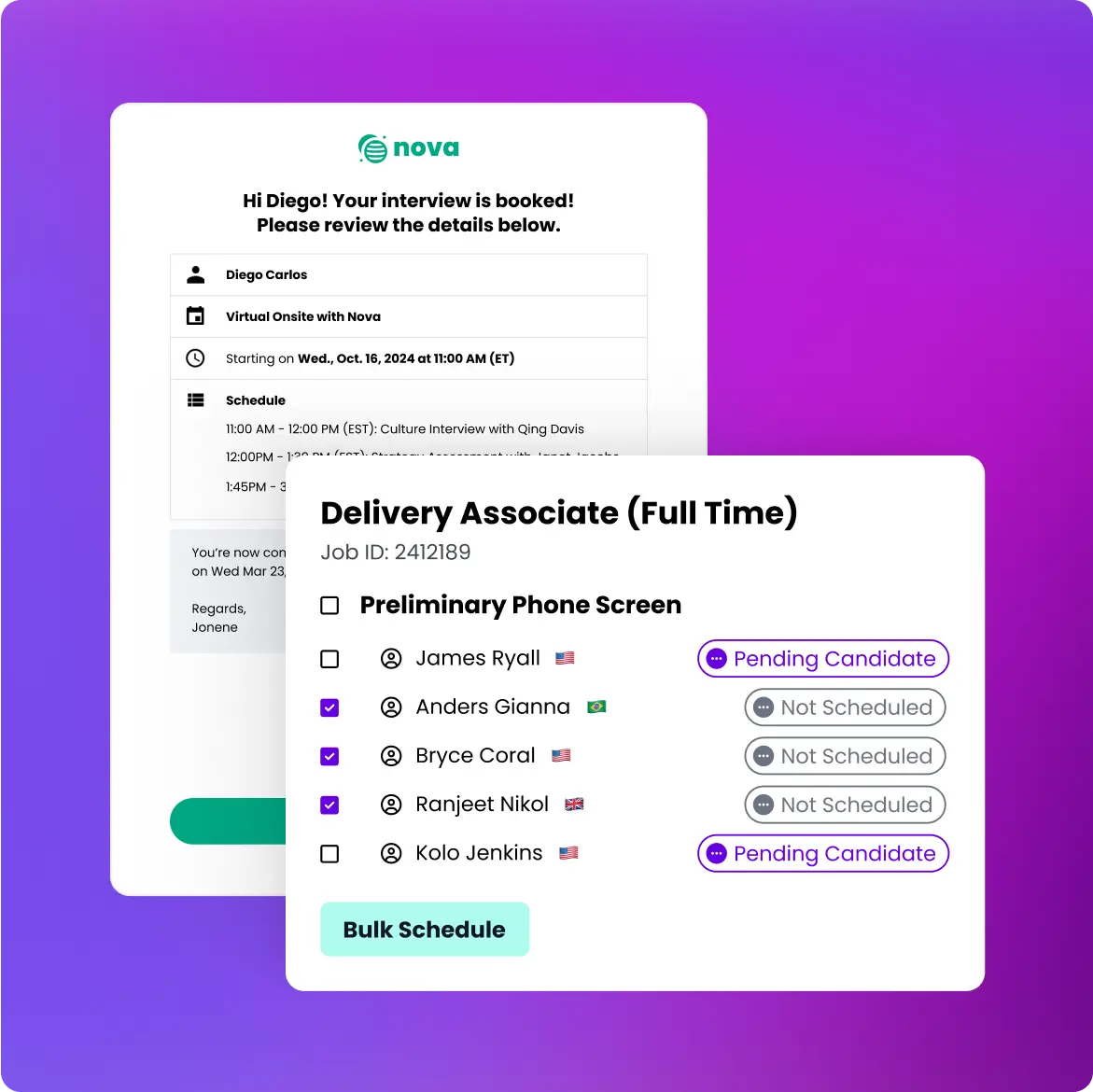
6. Automate reschedules and interviewer replacement. In high volume, cancellations are guaranteed. Automation that finds the next qualified interviewer keeps one dropout from turning into a multi-day delay.
7. Move candidate communication to text. Hourly and frontline candidates often live on their phones. Top performers were 58% more likely to use a centralized texting platform, and centralized SMS and WhatsApp messaging keeps every message trackable instead of buried in personal phones.

8. Automate confirmations and reminders. Reminders before every interview cut no-shows, and no-shows are expensive when every slot is full.
GoodTime’s recruiting automation handles single-day, multi-day, panel, and bulk interview scheduling with rules you set once. And because volume can’t come at the cost of the candidate, GoodTime’s candidate experience tools keep self-scheduling, updates, and the candidate portal branded and consistent.
Measure what’s happening
9. Track throughput per coordinator. Interviews scheduled per coordinator is the clearest signal of whether you’re scaling the process or just scaling effort.
10. Review bottlenecks weekly during surges. Look at where candidates are waiting longest: scheduling, feedback, or decisions. Fix the biggest gap first, then the next.
How interview scheduling automation drives hiring efficiency
Hiring efficiency is how much hiring output your team produces for the time and resources it puts in. Scheduling automation improves it more than almost any other lever, because scheduling is where most coordinator time goes.
Companies using automated or AI-driven scheduling were 1.6 times more likely to achieve near-perfect hiring goal attainment in the 2026 report. The customer results tell the same story:
| Company | Result |
|---|---|
| Miro | Recruitment coordinators became 3 to 4 times more productive, each scheduling 1,500+ interviews a year |
| HelloFresh | 73% less time spent scheduling and a 15-day reduction in time to fill |
| Glovo | 73% faster time to schedule and 62% fewer admin errors |
| S&P Global | Scheduling time cut from 30 minutes to five |
Miro’s coordinators handle global volume with a small team.
“We have a small team of recruitment coordinators, and they’re able to maintain global coverage between Australia, Japan, the US, and Europe. They are scheduling more than 7,000 unique candidates a year, which is insane. That’s something we wouldn’t be able to do without GoodTime.”
— Rico Habraken, Talent Operations Manager, Miro
At HelloFresh, the change was felt immediately.
“The difference in the level of effort required is absolutely insane. Now, we can easily get candidates into our pipeline and start connecting with them as soon as possible to find the right fit for each role.”
— Natalia Howard, Senior Associate for Talent Operations, HelloFresh
Measuring success: key metrics for high volume recruiting teams
In high volume recruiting, small inefficiencies multiply fast, so measure each stage, not just the outcome. These are the metrics worth tracking:
| Metric | What it tells you |
|---|---|
| Interviews scheduled per coordinator | Whether capacity is growing without headcount |
| Time to schedule | How quickly candidates move from “advance” to a confirmed interview |
| Cancellation and reschedule rate | How much rework your process creates |
| No-show rate | Whether reminders and communication are working |
| Application completion rate | Where candidates drop off before they ever reach you |
| Interviewer load and utilization | Whether a few interviewers are carrying the whole pool |
| Time to hire | The outcome leadership cares about most |
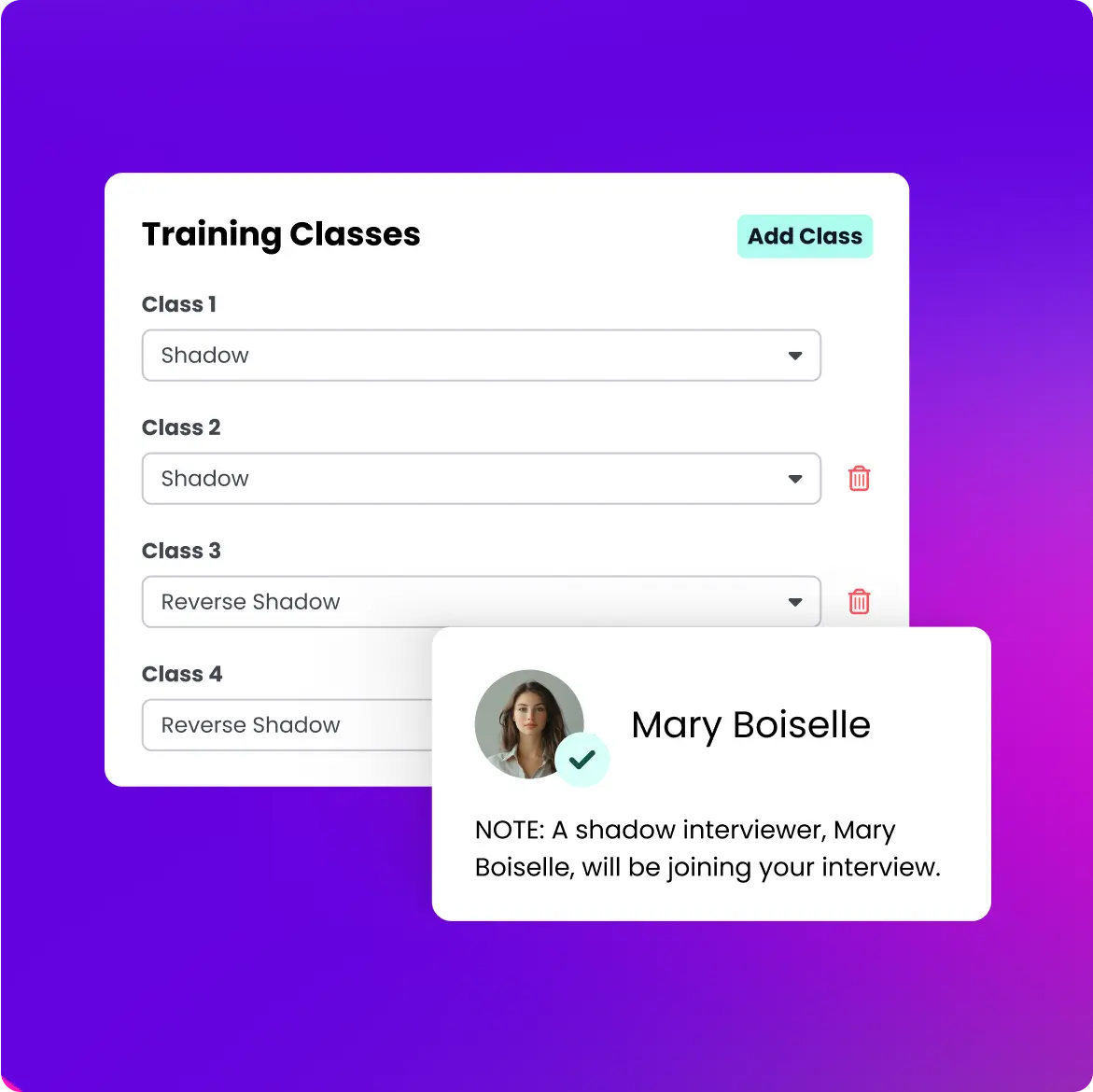
Two of these deserve special attention. Top performers in the 2026 report were 23% more likely to measure application completion rate, because it reveals friction before volume ever reaches recruiters. And interviewer utilization matters because an untrained or overbooked interviewer pool caps your throughput no matter how good your scheduling is. GoodTime’s interviewer training uses custom training paths and automated shadowing to grow qualified pools faster.
Scale your interview capacity with GoodTime
GoodTime is built for the scheduling complexity that breaks high volume hiring. It books high-volume 1:1s, bulk sessions, and multi-day panels across time zones, replaces interviewers automatically when someone drops, and keeps candidates updated by email, SMS, and WhatsApp. Applicant screening with knockout questions filters volume before it reaches the calendar, and real-time analytics show exactly where candidates are waiting.
At the center is Cori, GoodTime’s AI agent, which runs the coordination layer of hiring so your coordinators can focus on candidates. It all works on top of the ATS you already use.
See it in action in the GoodTime product tour.
Frequently asked questions
What is high-volume recruiting?
High-volume recruiting is hiring a large number of people, often for the same or similar roles, in a short period. Common examples include seasonal retail and warehouse hiring, contact center ramps, and campus recruiting. It requires standardized processes and automation because manual scheduling can’t keep pace.
What are the biggest challenges of high-volume recruiting?
The biggest challenges are scheduling capacity, screening large applicant pools, keeping candidates engaged, maintaining quality, and preventing coordinator burnout. In GoodTime’s 2026 report, the top hiring bottlenecks were scheduling delays, a limited interviewer pool, cancellations and reschedules, and hiring manager availability.
How can recruiting teams handle more interviews without adding headcount?
Standardize interview loops, build interviewer pools, let candidates self-schedule, and automate reminders, reschedules, and interviewer replacement. Screen applicants upstream so fewer unqualified candidates reach the calendar. Top-performing teams in GoodTime’s 2026 report were less likely to grow headcount and more likely to use AI agents for scheduling.
Which recruiting tasks should be automated in a high-volume hiring process?
Start with interview scheduling, then automate applicant screening and knockout questions, confirmations and reminders, rescheduling and interviewer replacement, and candidate status updates. These tasks are repetitive and rules-based, which makes them ideal for automation.
How can companies reduce candidate drop-off during high-volume hiring?
Move fast and stay in touch. Let candidates self-schedule, communicate by text where candidates prefer it, send automated status updates, and shorten the time between stages. Track application completion rate to find where candidates drop off early.
How do you balance speed and quality in high-volume recruiting?
Cut waiting time, not evaluation time. Automate scheduling and communication, but keep structured interviews and consistent scorecards. Standardized interview templates help on both fronts: they speed up scheduling and make evaluation more consistent.
Which metrics should recruiting teams track to measure high-volume hiring efficiency?
Track interviews scheduled per coordinator, time to schedule, cancellation and reschedule rates, no-show rate, application completion rate, interviewer utilization, and time to hire. Together they show whether you’re scaling the process or just scaling effort.