Efficiency
 Experience
 Intelligence
Table of Contents



Join 12,000 TA pros who stress less and crush their goals with our monthly expert-vetted tips and insights.
By submitting this form, you agree to be contacted and to receive the requested information, as well as occasional related insights from GoodTime about our products, services, and content. You may unsubscribe at any time. For details, view our Privacy Policy and Terms of Use.
January 27, 2026 — SAN FRANCISCO
Today, GoodTime released its fifth annual Hiring Insights Report, a comprehensive analysis based on an independent study of more than 500 U.S. talent acquisition (TA) leaders. The report reveals a hiring market under unprecedented strain.
90% of companies failed to meet their hiring goals, but a small group of top-performing organizations has pulled ahead by embracing AI to scale hiring without adding or reducing headcount. Instead, they are scaling through automation, AI-driven scheduling, and standardized workflows, achieving better outcomes with the same or fewer resources.
Key findings from the 2026 Hiring Insights Report include:
- A hiring system under strain: 90% of companies missed their hiring goals, and 1 in 3 missed by a wide margin.
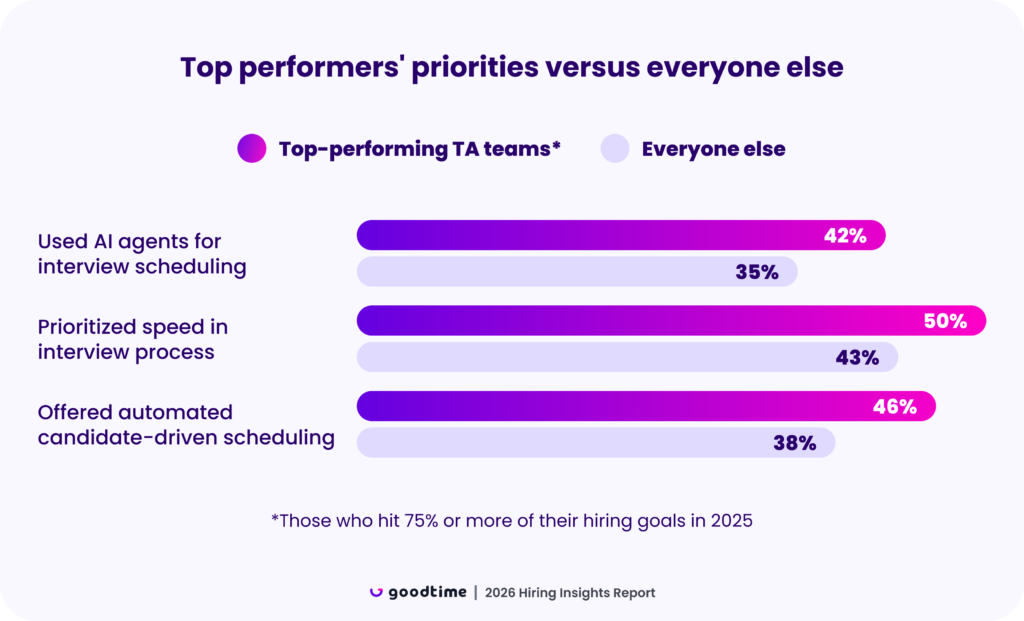
- Top performers scale without headcount growth: High-performing TA teams (those who achieved 75% goal attainment or more) are significantly less likely to increase headcount, relying instead on automation and AI-orchestrated workflows to improve efficiency.
- Scheduling is breaking hiring: Recruiters spend 38% of their time scheduling interviews—the single biggest operational tax measured.
- AI is no longer optional: 99.8% of TA teams use, pilot, or plan to use AI agents, making AI effectively mandatory.
- Time-to-hire continues to worsen: 60% of organizations saw time-to-hire increase, while only 1 in 9 managed to hire faster.
- Fraud becomes the top threat: Fraudulent or AI-assisted candidates are now the #1 anticipated hiring challenge in 2026, surpassing lack of qualified talent.
Talent leaders confront a new reality in 2026
“The hiring challenge in 2026 isn’t about adding more people or cutting teams. It’s about redesigning how hiring work gets done,” said Ahryun Moon, CEO and Co-Founder of GoodTime. “The teams that are outperforming everyone else aren’t increasing or reducing headcount. They’ve restructured their organizations around an AI-enabled future, where automation handles coordination and complexity so humans keep their focus on judgment, relationships, and the moments that truly require a human touch.”
The report shows that while nearly all TA teams have adopted AI, how AI is used (not whether it’s used) is what separates top performers from everyone else. Leading teams have reorganized roles and workflows around AI-powered scheduling, analytics, and orchestration, rather than adding recruiters or relying on top-of-funnel automation. This approach allows them to move faster, surface better signals, protect candidate experience, and improve quality-of-hire—without growing their teams.
How top-performing teams are adapting for 2026
The 2026 Hiring Insights Report highlights several strategies top-performing TA teams are using to succeed despite mounting pressure:
Redesigning roles around an AI-enabled operating model
Rather than adding recruiters or coordinators, leaders are reorganizing responsibilities so AI handles coordination, scheduling, and operational complexity—freeing humans to focus on judgment, candidate relationships, and hiring decisions that require context and nuance.
Replacing manual coordination with automated scheduling
Scheduling remains the single biggest operational bottleneck in hiring. Teams using automated or AI-driven interview scheduling are 1.6 times more likely to achieve near-perfect hiring goal attainment, directly tying scheduling modernization to measurable performance gains.
Using AI for insight—not just automation
Top performers prioritize AI-powered analytics and reporting to identify bottlenecks, monitor funnel health, and guide decision-making. This shift from task automation to workflow intelligence enables faster, more consistent execution without increasing team size.
Standardizing communication to protect candidate experience
High-performing teams have also centralized candidate communication and provide self-scheduling and self-rescheduling, reducing delays while delivering the speed, transparency, and flexibility candidates now expect.
A fragmented hiring market and a clearer path forward
The report finds that TA leaders are divided on whether hiring conditions will become more or less competitive in 2026, reflecting a fragmented market shaped by role-specific demand and uneven adoption of modern hiring infrastructure.
But one conclusion is consistent: teams that rely on manual coordination (and attempt to keep pace with growth by adding hiring headcount) are falling behind, while those that redesign hiring around AI-enabled systems are pulling ahead. The path forward is clear: build scalable, disciplined hiring operations where AI absorbs coordination and complexity, automates execution, surfaces insight, and enables humans to focus on judgment, relationships, and high-value decision-making.
The 2026 Hiring Insights Report offers in-depth analysis and actionable guidance for talent leaders navigating this new era of AI-driven hiring, rising fraud risk, and persistent operational strain. The full report is available at goodtime.io.
About GoodTime
GoodTime is the leader in complex interview scheduling automation for enterprise talent teams. Built for scale, our platform handles the complexity others can’t—automating every type of interview, from multi-day panels across time zones to high-volume hiring events, with unmatched speed and precision. Behind every seamless schedule is our digital workforce of AI agents that eliminate delays, surface insights, and keep hiring teams perfectly in sync. Leaders at companies like Databricks, Aon, HubSpot, and HelloFresh trust GoodTime to orchestrate smarter, faster, people-first hiring experiences for their candidates, interviewers, and talent teams.
GoodTime.io
Media Contact
For more information or to arrange an interview with Ahryun Moon, please contact:
Jake Link
press@goodtime.io