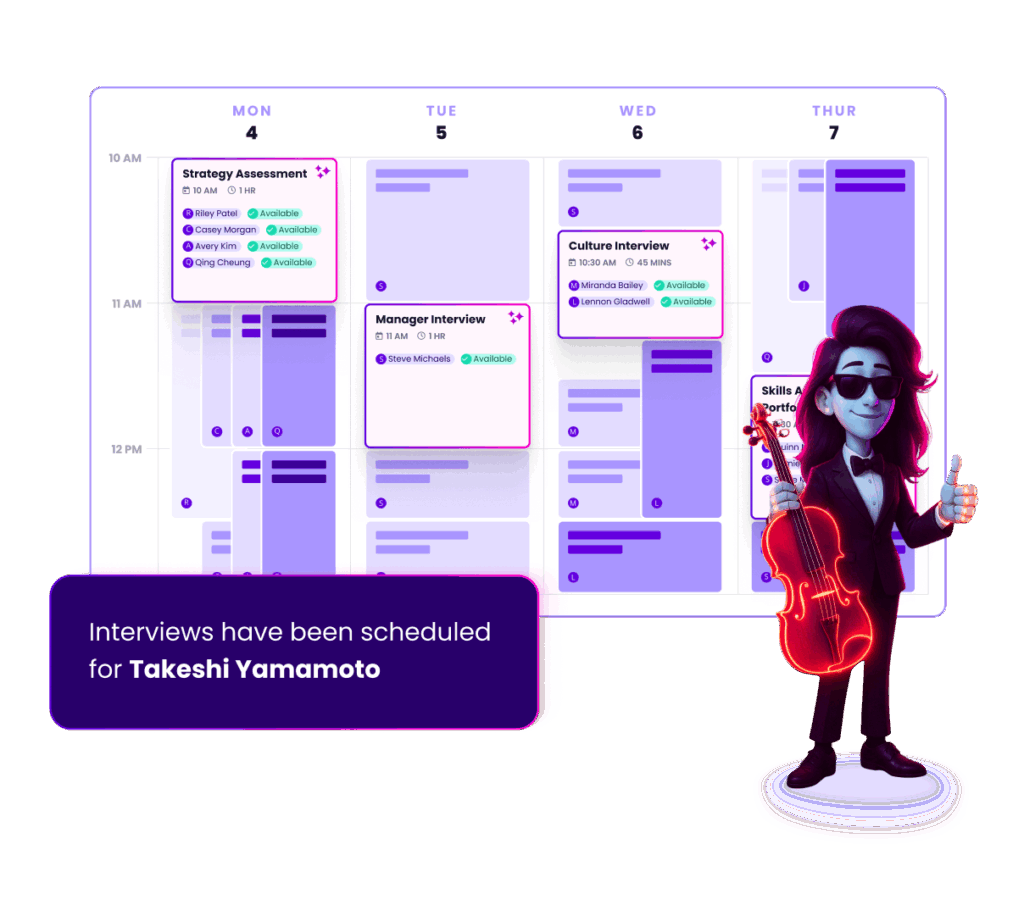
April brought a new set of product updates focused on improving efficiency, visibility, and AI-driven coordination across the hiring process. From enhanced training paths and smarter dashboard filtering to real-time AI assistant recommendations and continued stability improvements, these updates are designed to help teams move faster — with greater precision and reliability.
Whether you’re scaling interviewer training with more flexible paths, quickly filtering performance data across teams, improving scheduling accuracy with real-time AI recommendations, or relying on AI to manage queued interviews and streamline handoffs, these enhancements help reduce friction and keep hiring running smoothly.
Let’s dive into what’s new — and why it matters.
Watch the full April 2026 GoodTime product updates webinar or keep scrolling for highlights
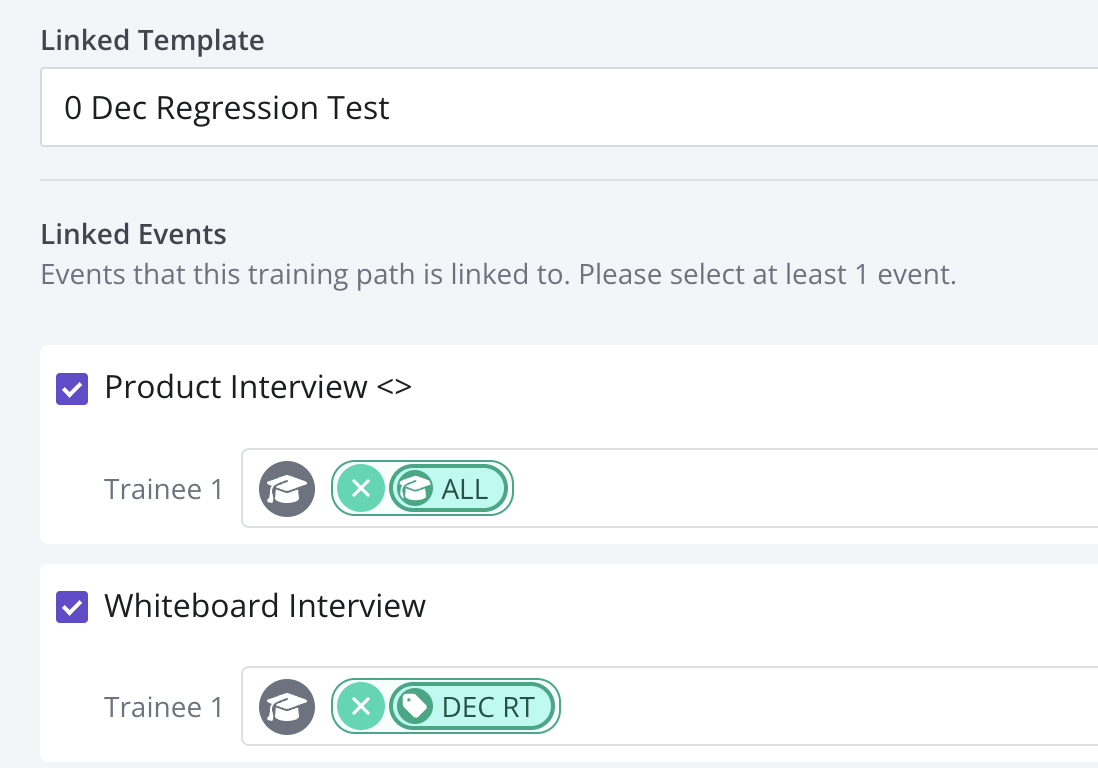
Training Path Tag Assignment
The Training Module is enhanced with fewer clicks and more automation so that when you create or edit a path, you can immediately specify which tags to pull trainees in from, straight from the path.
Why this is awesome: Less clicks, fewer tabs open, and automated tag suggestions → more trainees graduating faster!
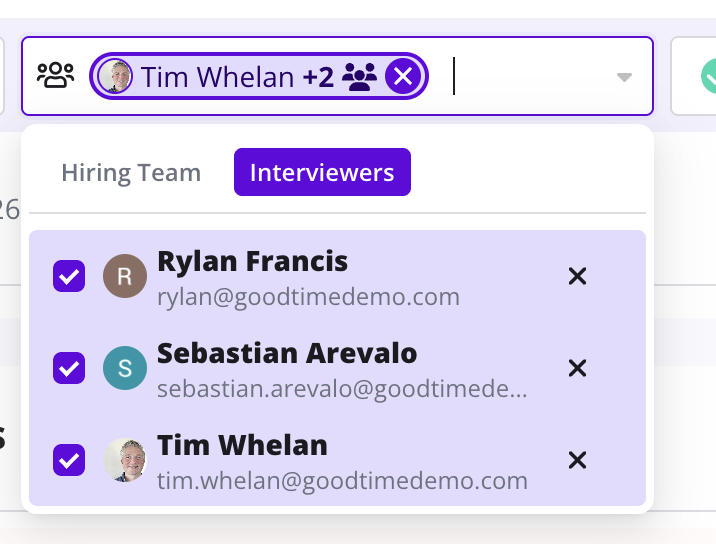
Improved Dashboard Filtering
Filtering on the Dashboard has been empowered with a new and improved UI that also lets you filter by specific interviewer(s).
Why this is awesome: The ability to combine interviewer and hiring team filtering makes it all the possible to narrow down more granular interview lists and find specific interviews faster than ever.
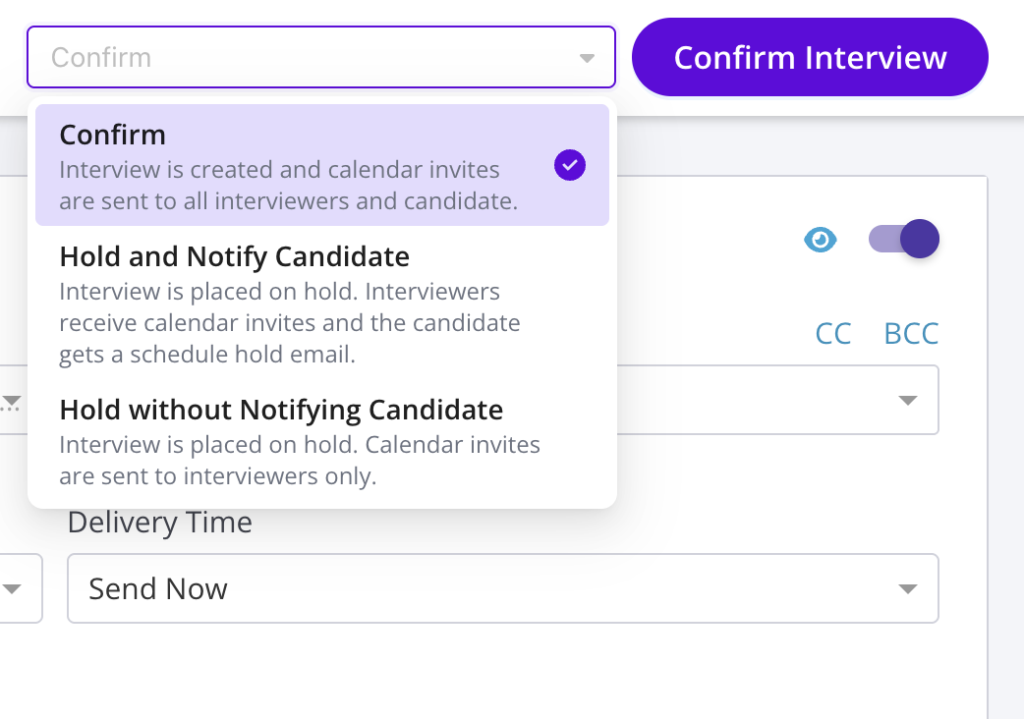
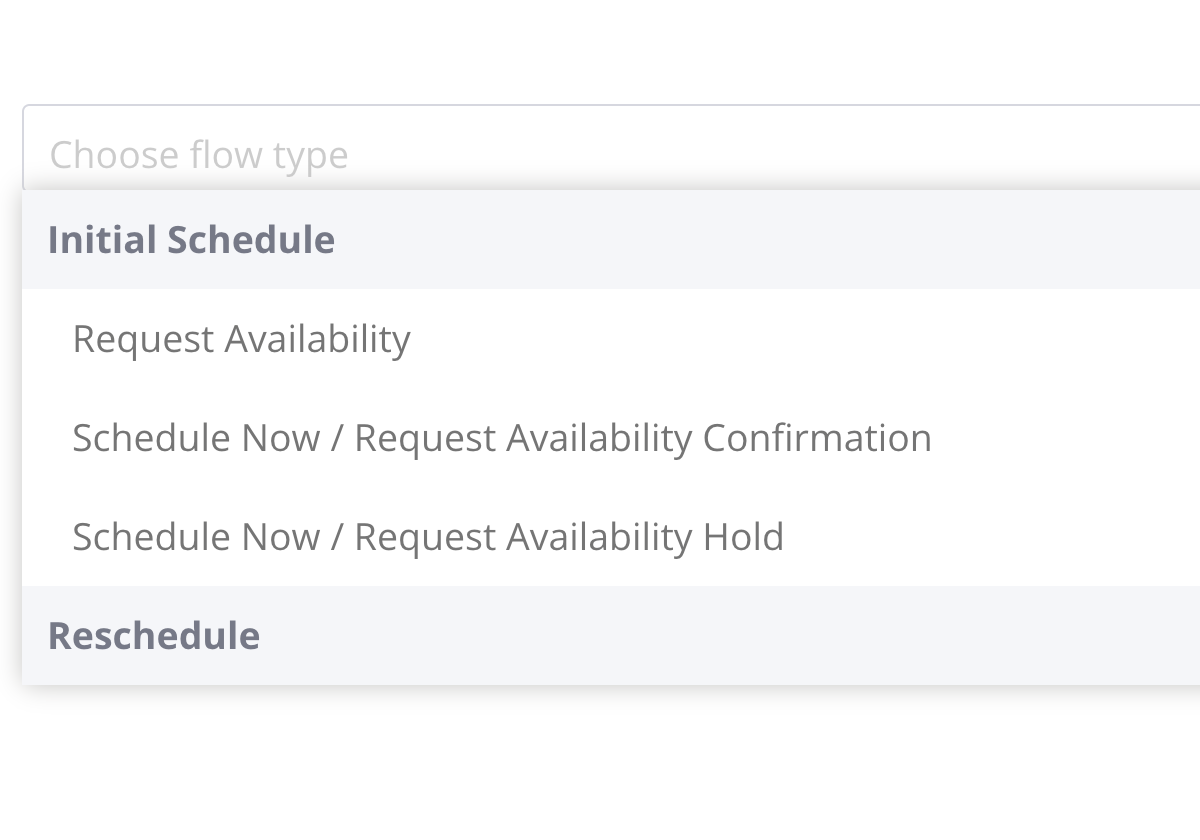
Optimized Confirmation Flow
The Confirmation Page for confirming & holding interviews has been refreshed to support all respective email types. This new flow also makes it more clear and controlable what email is sent to candidates and when.
Why this is awesome: This further enhances automation and preconfigured templates so that fewer alterations have to be made and quality is better controlled..
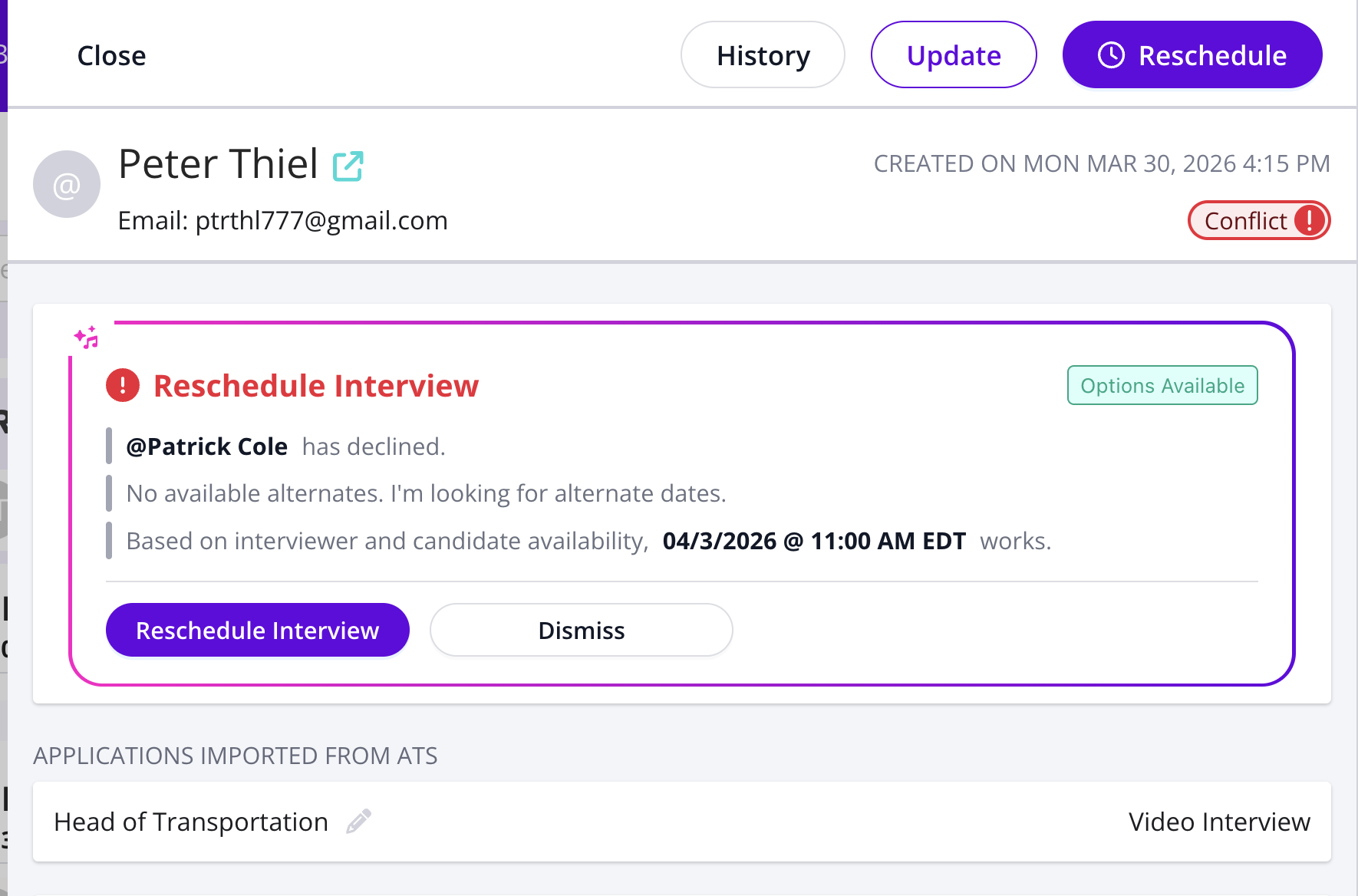
AI Recommendations in Scheduling Workflow
Get real-time recommendations directly inside the scheduling flow, so you can act instantly without switching context.
Why this is awesome: Resolve issues and take action faster with guidance exactly where you’re already working.
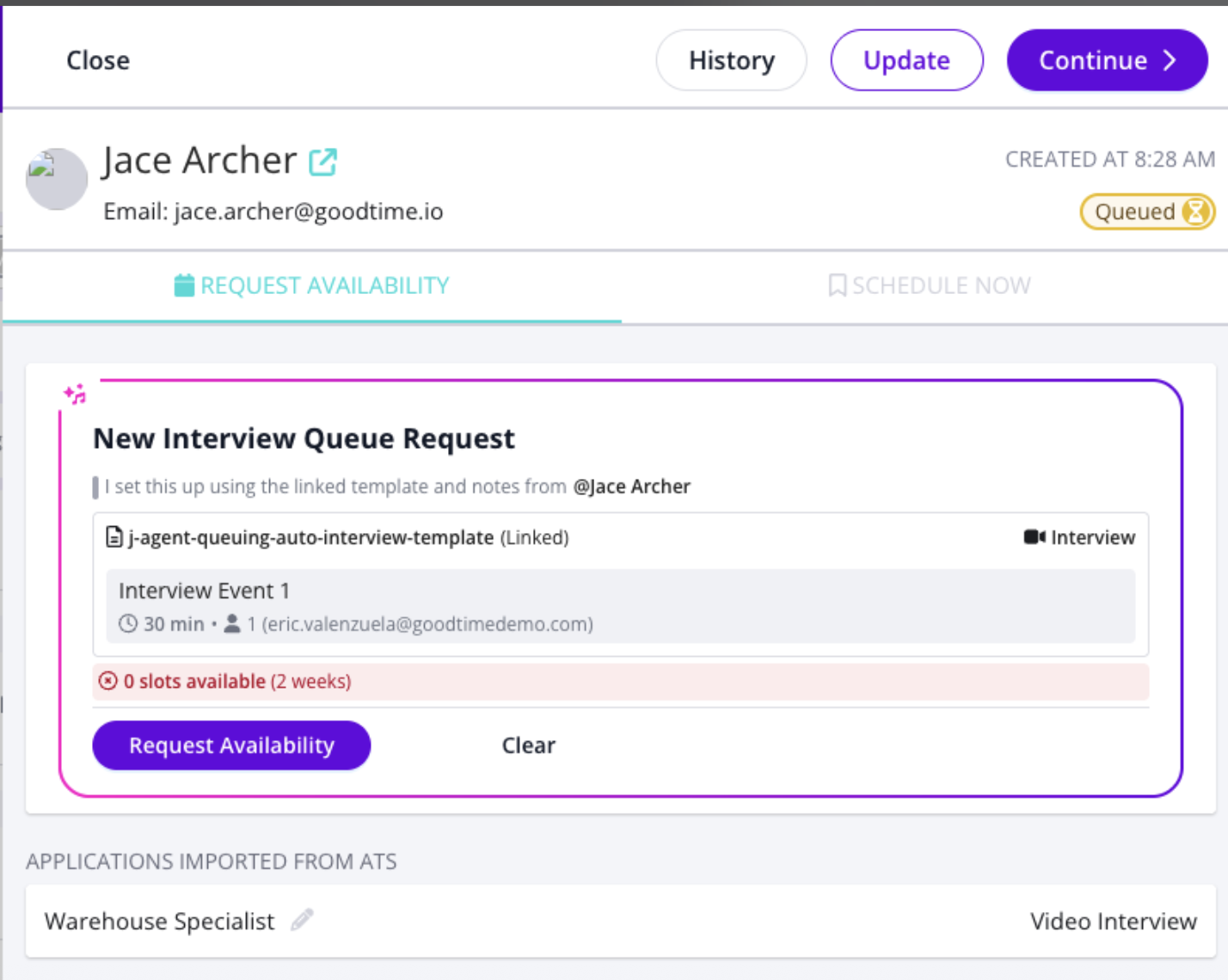
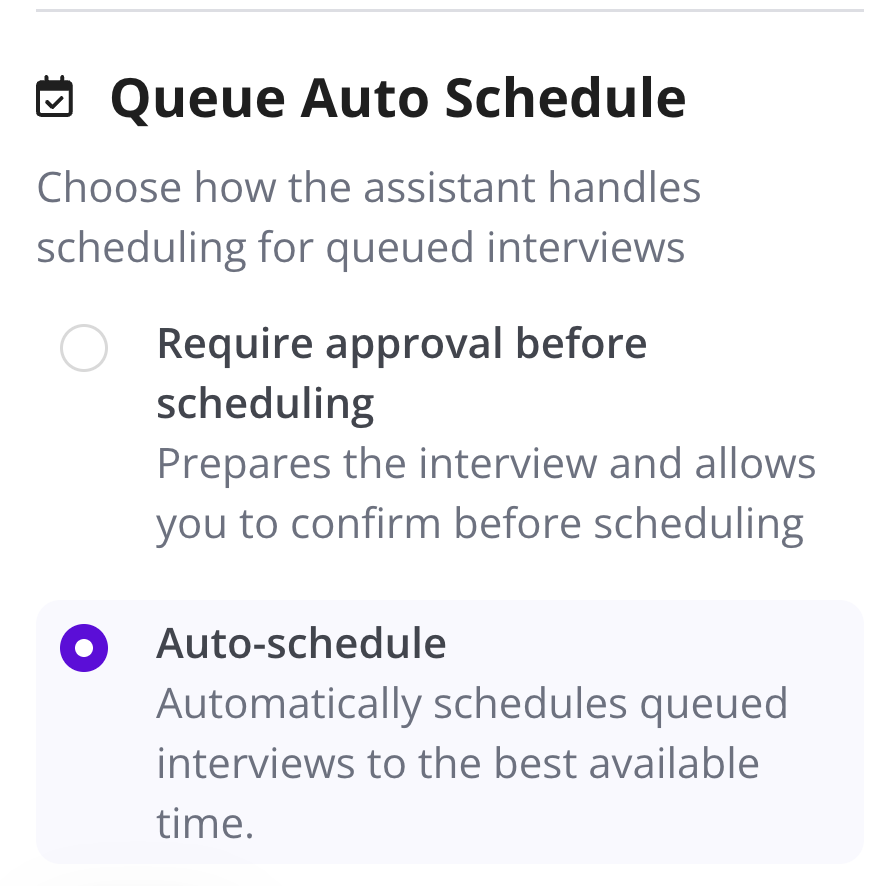
AI Interview Prep from Handoff Notes
Turn messy recruiter notes and scheduling requests into structured, ready-to-schedule interviews.
Why this is awesome: Eliminate manual cleanup and guesswork. Everything is prepared for you before you even start scheduling.
Why this is awesome: Go from queue -> confirmed in seconds, even when handoffs are incomplete or messy.
Start using the latest GoodTime features!
We want to help you evolve and take full advantage of the latest upgrades and improvements to our platform. Check out the GoodTime support center for tutorials and tips to help you stress less and get more done!
March brought a focused set of product updates designed to give talent teams more control, better visibility, and smarter AI-driven coordination across the interview process. From enhanced interview logs and more flexible prep workflows to improved AI assistant rescheduling and greater transparency into AI actions, these updates are all about helping teams move faster — with more clarity and confidence.
Whether you’re tracking interview activity with deeper logs and communication visibility, standardizing interviewer and candidate prep through reusable templates, giving interviewers more control over how they’re notified, or relying on AI to intelligently reschedule interviews and clearly explain its decisions, these enhancements are built to reduce friction, increase trust, and keep hiring running smoothly.
Let’s dive into what’s new — and why it matters.
Watch the full March 2026 GoodTime product updates webinar or keep scrolling for highlights
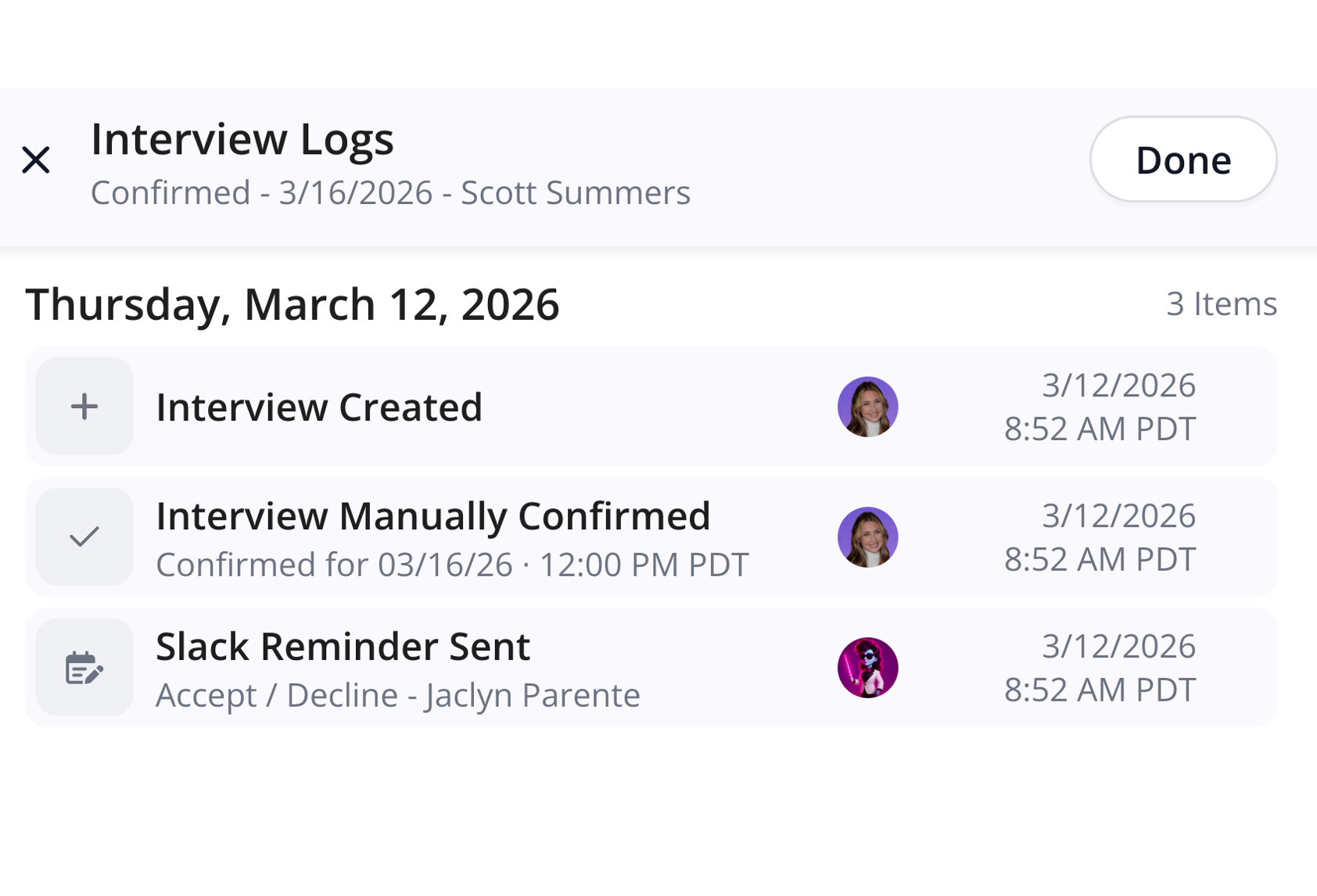
Chat Reminders in Interview Logs
Interview History has been enhanced to show logs of Slack & Teams reminders.
Why this is awesome: These logs help understand when and if interviewers have been reminded to add context on whether or not they have replied or the reminders are configured optimally for your interviews.
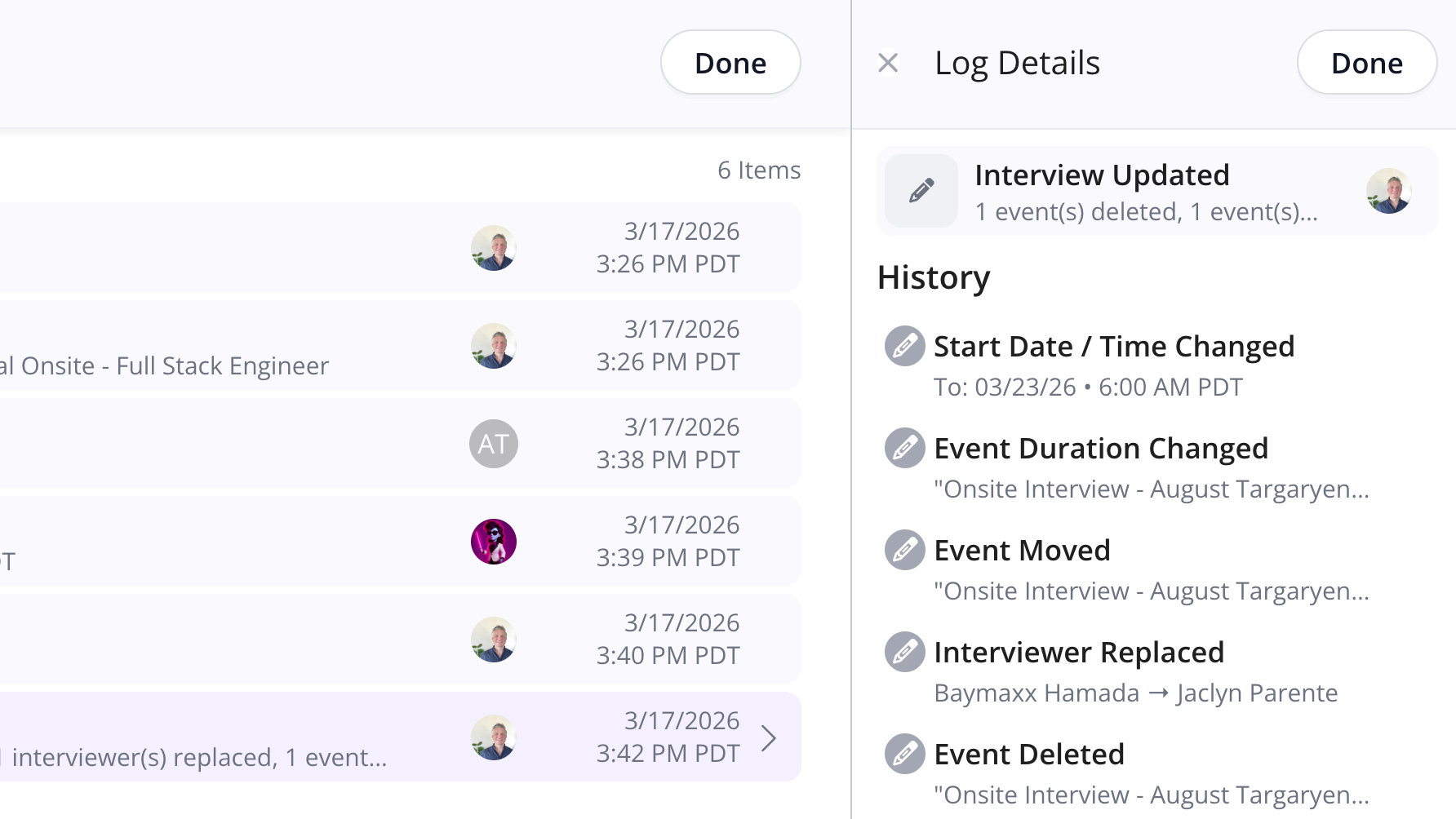
Additional Details for Interview Update Logs
Interview Logs now have an “Additional Details” drawer for Interview Updates that lays out the full details.
Why this is awesome: Interview updates can be comprehensive and many things can be changed at once. The additional details helps coordinators understand exactly what all the changes were and who made them, instantly.
Teams Chat Notification Settings
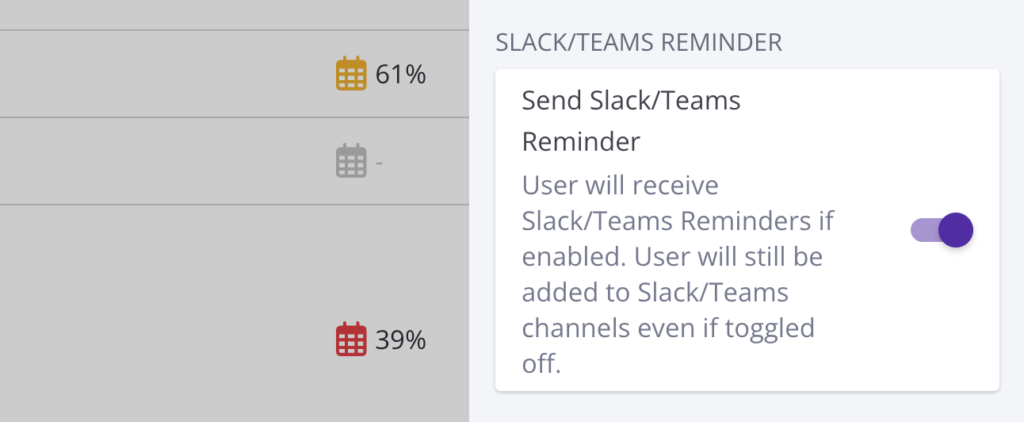
Whether or not to receive MS Teams Chat reminders can now be toggled on or off for individual users on the Company Teams page.
Why this is awesome: This allows for a more customized experience and lets your diligent interviewers who don’t need reminders opt out. It also makes it possible roll out chat reminders for just a part of your company.
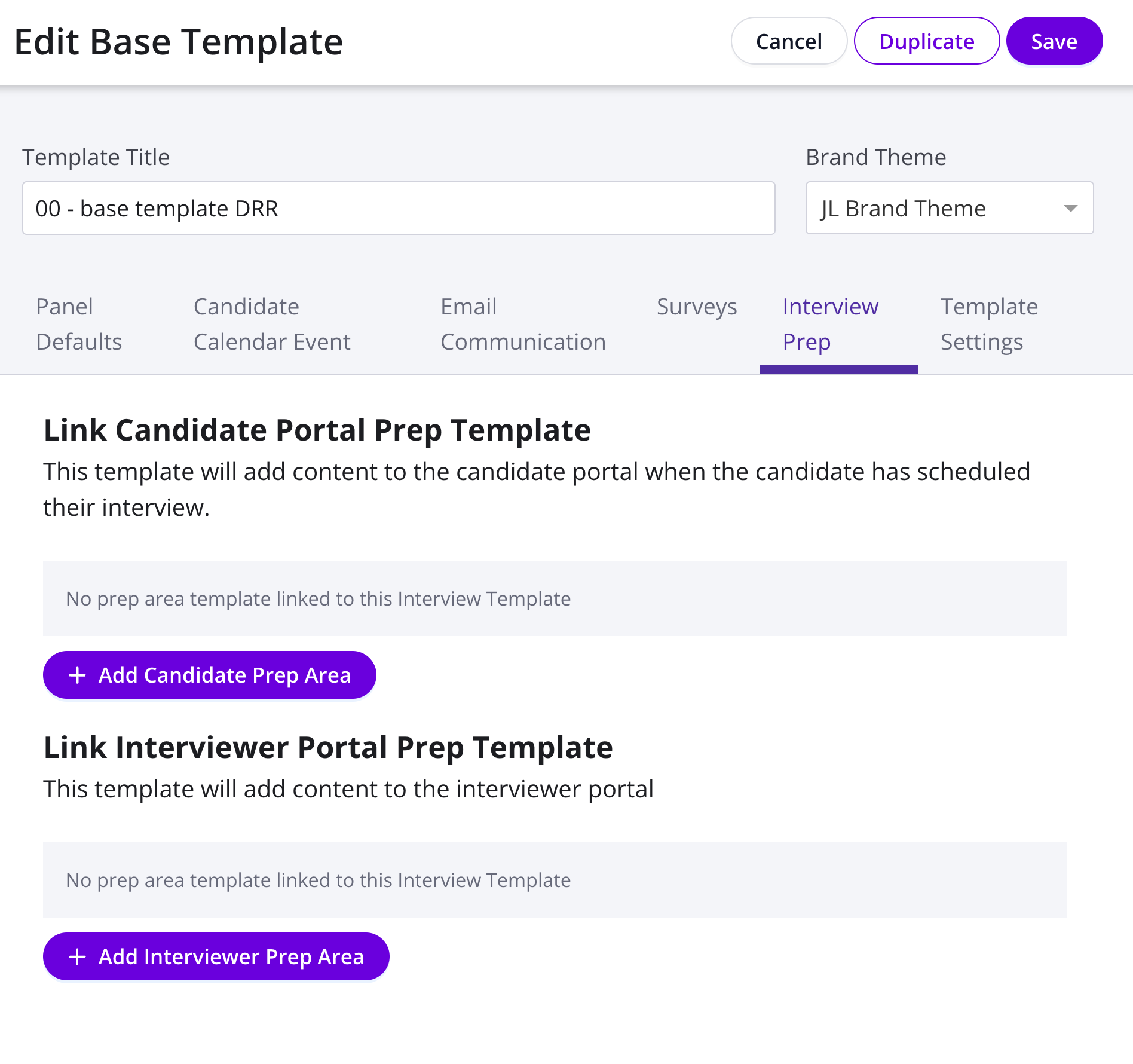
Interview Prep On Bases Templates
Interviewer & Candidate Prep forms can now be configured on the Base Template level.
Why this is awesome: This enables fast implementation of new prep forms on a truly large scale – Roll out new forms across your orgs in a matter of a few clicks!
Enhanced Customization for Scorecard Integrations
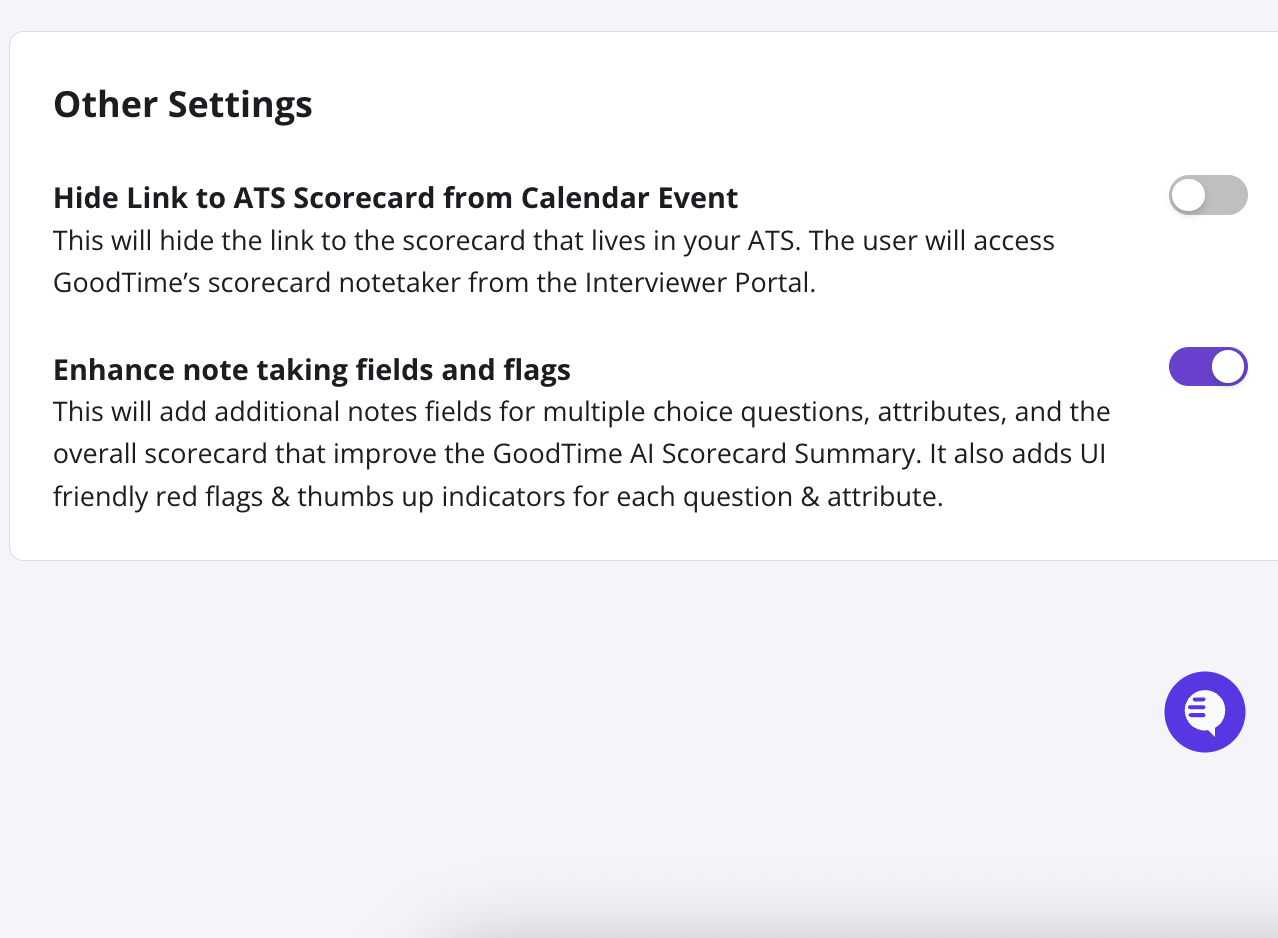
A new toggle is now available for two-way scorecard integrations to control whether the Scorecard Notetaker has the enhanced note-taking fields and attributes or not.
Why this is awesome: This feature gives increased control so that you have the choice between enhancing note taking capabilities or matching the ATS experience closer than ever before.
Start using the latest GoodTime features!
We want to help you evolve and take full advantage of the latest upgrades and improvements to our platform. Check out the GoodTime support center for tutorials and tips to help you stress less and get more done!
February brings a powerful new set of GoodTime product updates designed to give talent teams more transparency, automation, and control across the interview process. From detailed Interview Logs and smarter email handling to enhanced Assistant Hub capabilities that keep interviews on track, these updates focus on reducing manual work, preventing errors, and improving coordination at every step.
Whether you’re looking for clearer visibility into what’s happening behind the scenes of each interview, streamlining communication when plans change, automating template management, or quickly securing confirmed interviewer replacements in Slack, these enhancements are built to help hiring teams move faster — with fewer mistakes and a better experience for everyone involved.
Let’s dive into what’s new — and why it matters.
Watch the full February 2026 GoodTime product updates webinar or keep scrolling for highlights
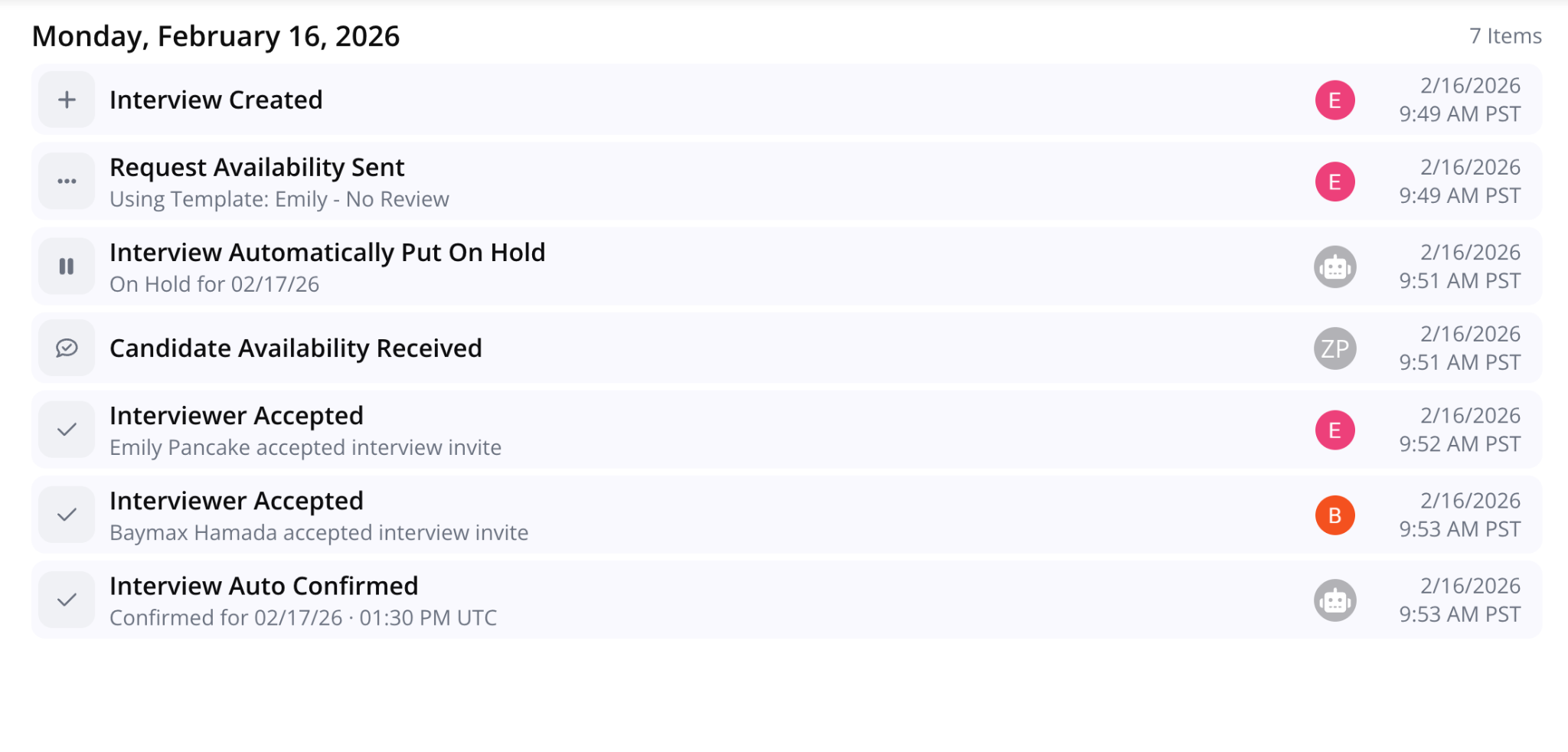
Interview Logs
GoodTime now provides detailed Interview Logs with each interview so you can enjoy full transparency in what happened as well as who did what & when!
Why this is awesome: Immediately understanding the journey of an interview allows things to move faster and reduces mistakes & confusion. The result is less work and a better experience for both interviewers and candidates.
“Hold” Email Type
Instead of making manual adjustments to confirmation email templates, you can now create and assign specific email templates for when interviews are put on hold, manually or automatically.
Why this is awesome: This new email type increases automation and reduces risk for errors.
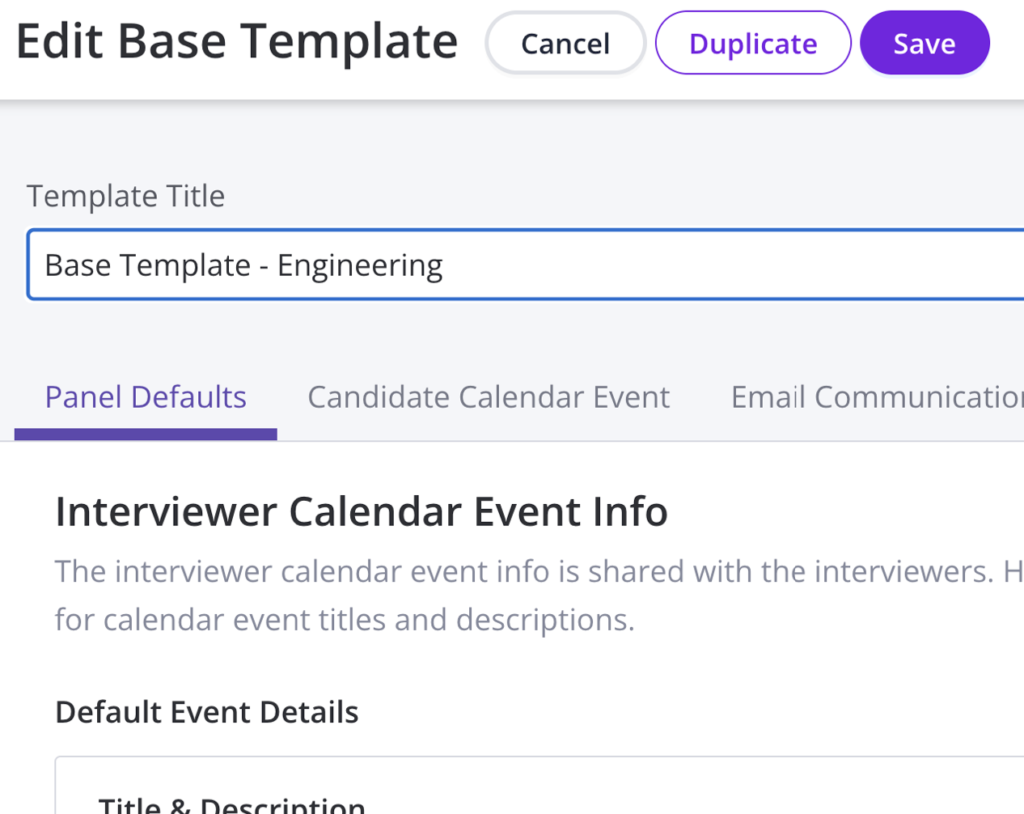
Duplicate Base Template
The ability to duplicate interview templates has now been extended to base templates as well.
Why this is awesome: Auto-duplicating templates not only saves time but it also reduces the risk of mistakes being made when doing so manually.
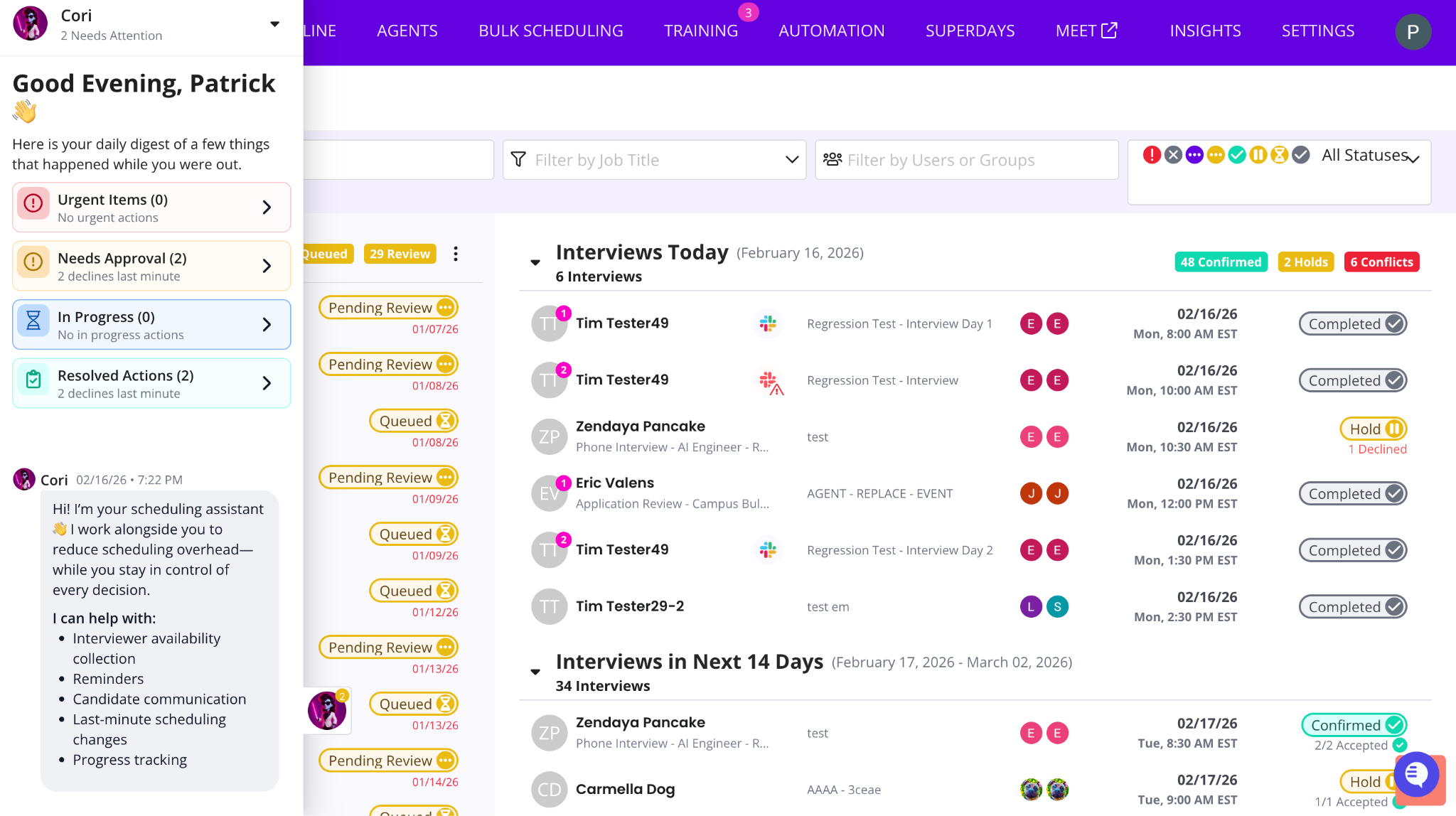
Assistant Hub
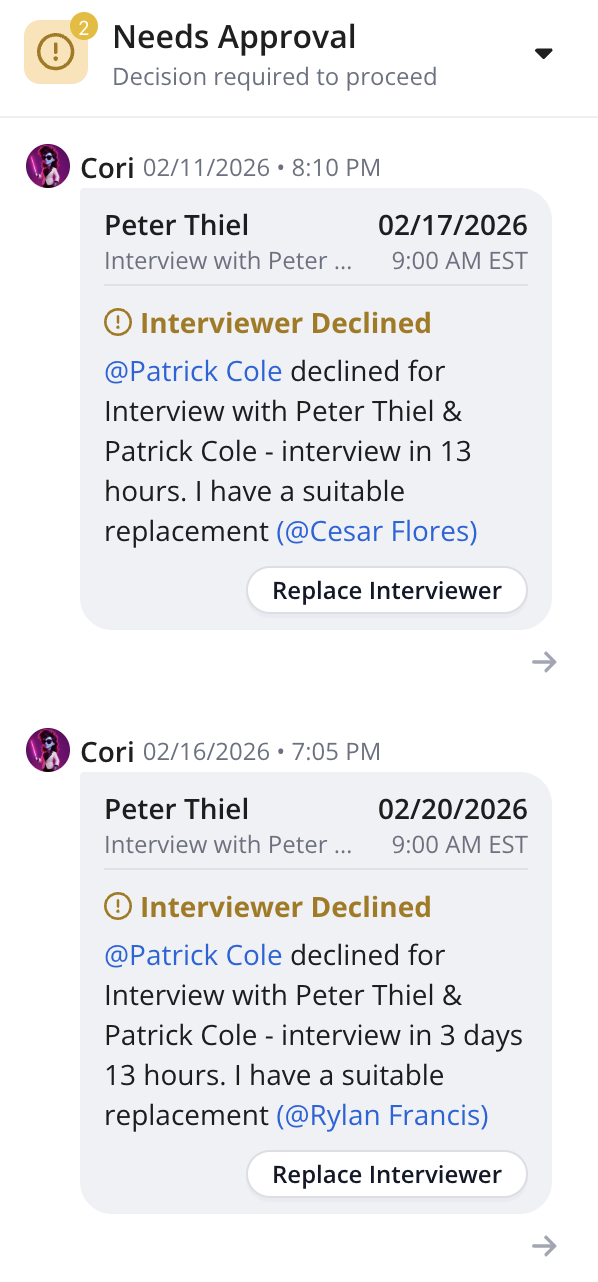
See everything GoodTime is handling in the background in one place. Items that need review or approval are surfaced at the top so you can quickly step in when needed.
Why this is awesome: You stay in control without having to chase activity, dig through emails, or monitor every workflow manually.
Identify and Automatically Replace Declined Interviewers
GoodTime now helps you quickly find the best replacement interviewer based on load limits, calendar availability, and interviewer pools — so interviews stay on track even when plans change.
Why this is awesome: Reduce last-minute scrambling and keep interviews moving forward with confident, data-driven replacements.
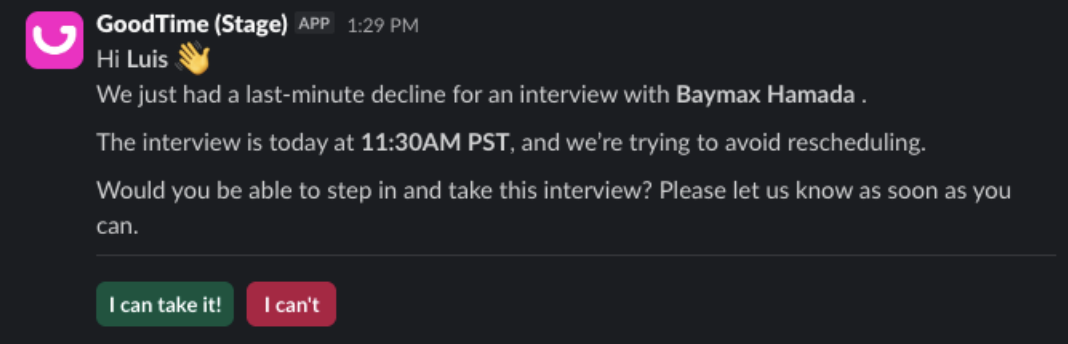
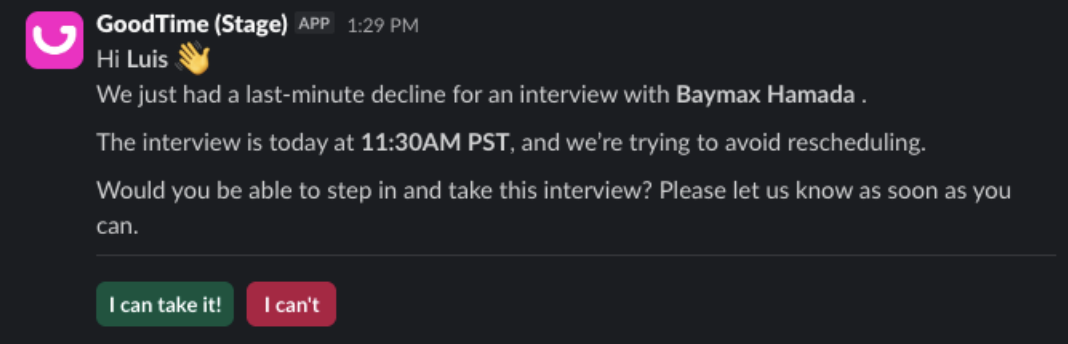
Confirm Availability with Interviewers Over Slack
GoodTime reaches out to potential replacement interviewers in Slack to confirm they can attend, then shares the response so you know swaps will stick.
Why this is awesome: No more guessing if replacements will accept, you get confirmation upfront and avoid unnecessary rescheduling.
Start using the latest GoodTime features!
We want to help you evolve and take full advantage of the latest upgrades and improvements to our platform. Check out the GoodTime support center for tutorials and tips to help you stress less and get more done!
Recruiting never stands still. The past year has seen generative AI, evolving pay‑transparency laws and the shift to hybrid work radically reshape the way organizations hire.
Staying ahead requires more than reading headlines. Talent acquisition professionals need to hear how peers are adapting to new challenges, share ideas, and adopt new tools. A well‑curated conference can provide the boost your team needs to innovate and thrive.
Below you’ll find on‑demand content you can consume at your convenience, followed by a month‑by‑month guide to the best recruiting conferences throughout 2026. We only feature events that stand out for thoughtful programming, top‑tier speakers and actionable insights.
Unlock 2026’s top hiring strategies: Insights from 500+ TA leaders
Be the first to uncover deep hiring insights specific to your sector — straight from the highest-performing TA teams.
If you’re a recruiter or a talent acquisition leader, you already know about 2026’s hiring statistics. And you don’t have to navigate them alone. Attending a recruiting conference can quickly pay dividends for your team.
Stay current on trends. Learn about topics like AI‑assisted hiring, pay transparency and skills‑based sourcing from the practitioners who are pushing the industry forward.
Expand your network. Connect with recruiters, hiring managers and people‑ops leaders facing similar challenges to exchange ideas and form lasting partnerships.
Get inspired. Hear success stories and case studies that help you reimagine the possibilities for your organization.
Learn from experts. Access workshops and keynotes delivered by seasoned CHROs, data scientists, talent ops leaders, and other specialists.
Earn professional credits. Many events offer PDCs or other continuing‑education credits to support your certification or career‑development goals.
Topics to watch for at the 2026 recruiting conferences
There are going to be a lot of sessions to choose from. Here are some of the hottest topics the recruiters we talk to are most interested in hearing about:
The current state of talent operations — and how TA ops leaders are solving key challenges
How teams deal with worker shortages in industries like manufacturing and healthcare
On-demand talent acquisition conference recaps, webinars, and seminars
There’s no need to wait to get up-to-date on the latest in talent acquisition. Check out these sessions you can watch or read about right now.
Unlocking Efficiency in Tech Recruitment: Do More with Less
Date: On-demand
Location: Virtual Webinar
Price: Free
This one’s for all the tech recruiting folks out there. GoodTime teamed up with Coderpad for a webinar dedicated to unlocking efficiency and scaling processes in tech recruitment. Our expert panelists shared proven strategies and techniques to save time, reduce costs, and hire the very best tech talent for your organization.
Exec Roundtable: How to Run Resilient Tech TA in Tight Times
Date: On-demand
Location: Online
Price: Free
Navigating the tech TA and recruitment whirlwind in recent years has felt like riding on a giant yo-yo. We’ve experienced everything from the frantic pace of explosive growth to the unpredictability of the great reshuffle. Now, it’s become a balancing act of maintaining leaner TA teams, managing surges of candidates, and ensuring every hire is a perfect strategic fit.
Join TA leaders from ClickUp and OLX for a frank discussion on real, proven, practical things hiring teams can do to hit their goals in a lean economy. This is not just another generic webinar, but an exclusive gathering of thought leaders ready to share, learn, and chart the path forward.
Exec Roundtable: Healthcare Recruitment in the Face of Labor Shortages
Date: On-demand
Location: Online
Price: Free
Healthcare TA leaders are grappling with a long-brewing labor shortage that has accelerated in the last 3 years. Healthcare recruiting pros are invited to watch our executive roundtable discussion to hear how other TA leaders are shifting strategies and adopting new tactics to hit their goals, even amidst a growing healthcare labor shortage.
This is not your typical webinar; it is a unique opportunity for industry leaders to share experience-based advice on critical focus areas for 2024, tools they use to keep high-volume roles filled continuously, and how they’re slashing time-to-hire without compromising on quality. And now it’s available for you to stream anytime, on-demand.
Exec Roundtable: Manufacturing Recruitment in the Face of Labor Shortages
TA leaders in the manufacturing industry must grapple with a growing labor shortage, further exacerbated by a high turnover rate in the sector. As of March 2023, there were approximately 700,000 open manufacturing jobs in the United States, and on average, manufacturing companies are achieving only 44% of their hiring goals. A GoodTime survey shows that time-to-hire has emerged as the top area of concern for manufacturing TA leaders.
Get an on-demand recording of our executive roundtable session where industry leaders converged to discuss strategies and innovative approaches to overcome the manufacturing labor shortage.
This two‑day summit convenes HR and talent leaders to explore how AI, data and people‑centric strategies are transforming the workforce. Early bird tickets save $1,000 off the standard delegate rate, and the agenda pairs keynotes with interactive workshops and networking.
Date: February 2–5, 2026 Location: San Diego, CA Price: From $1,395 (two‑day conference pass)
TA Week combines three conferences—Social Recruiting Strategies, Talent Sourcing Strategies and Employer Branding—under one roof. The main conference runs Feb 3–4 with pre‑ and post‑conference workshops on Feb 2 and Feb 5. Networking receptions and a seaside venue make this a favorite for recruiting leaders looking to sharpen sourcing skills and share branding tactics.
Date: February 26–27, 2026 Location: Toronto, Canada & Virtual Price: Prices vary; early‑bird and virtual passes available
Canada’s only national conference dedicated exclusively to healthcare HR returns for its fourth year. Expect peer‑to‑peer learning, case studies and discussions on innovations in health‑care HR, workforce shortages, legal considerations and workplace violence. Networking receptions and interactive sessions encourage rich collaboration among HR decision‑makers.
Date: March 17–19, 2026 Location: Las Vegas, NV Price: Pricing tiers vary
Billed as the “International Festival of HR,” UNLEASH America brings together HR technology vendors, practitioners and analysts for inspiring keynotes and deep‑dive case studies. The 2026 edition promises visionary speakers and an expansive expo hall at the Caesars Forum. It’s ideal for leaders seeking the latest tech solutions and global networking opportunities.
Date: March 23–25, 2026 Location: Wynn Las Vegas, NV Price: $1,495 early‑bird / $2,795 standard
Transform gathers people‑ops executives, founders and investors for three immersive days of hands‑on workshops, small‑group discussions and over 350 speakers. Attendees enjoy unlimited one‑to‑one meetings, breakfast and lunch, receptions and a closing after‑party. It’s the conference for those who want to shape the future of work and build a people‑first strategy.
Date: April 19–22, 2026 Location: Dallas, TX Price: Packages available for individuals and teams
SHRM’s premier talent‑acquisition conference dives deep into skills‑based hiring, AI governance, workforce planning and culture. Attendees can choose from multiple tracks—AI‑Powered Talent Transformation, Career Agility, Skills‑Based Workforce Planning and more. Expect data‑driven insights, networking with like‑minded peers and 30‑day on‑demand access to sessions.
Date: April 27–30, 2026 Location: Orlando, FL Price: $1,095 early‑bird / $2,195 standard
Workhuman Live bills itself as the “best HR conference of 2026,” focusing on recognition, rewards and building human‑centered workplaces. Attendees can join a Women of Workhuman pre‑conference summit, enjoy a late‑night party at Universal Orlando, and hear from inspirational speakers. The early‑bird rate ends on September 28, 2025.
Date: May 27–28, 2026 Location: Boston, MA Price: Registration packages vary Bullhorn’s flagship U.S. conference for staffing and recruiting professionals offers two days of industry insights, tactical product training, and plenty of one‑to‑one networking. With more than 1,000 attendees and sessions on technology innovation and future‑of‑staffing strategies, Engage is the place to connect with agency peers and Bullhorn experts.
Date: June 16–19, 2026 Location: Orlando, FL Price: $2,095 individual / $1,885.50 per person for teams
As one of the largest HR conferences in the world, SHRM26 brings together more than 400 speakers across nine content tracks and offers over 28 professional development credits. Topics range from artificial intelligence and pay transparency to leadership, security, and compliance. Early registration guarantees the best rates and access to popular sessions.
Date: July 2, 2026 Location: Hertfordshire, UK Price: See site for tiers
The world’s largest talent‑acquisition festival returns to Knebworth Park for a day of outdoor stages, live music and inspirational speakers. Expect specialist tracks like Tech Hiring, Diversity & Inclusion and Early Careers, as well as exhibitions, food stalls and a festival atmosphere.
Date: July 14–17, 2026 Location: Milwaukee, WI Price: Pricing TBD
The National Association for Health Care Recruitment’s annual conference carries the theme “Fresh Perspectives: Pouring New Life into Health Care Recruitment”. Developed by practicing healthcare recruiters, the program delivers real‑world strategies for tackling workforce shortages, embracing innovation, and enhancing candidate engagement. Attendees can explore a vibrant exhibit hall and network with peers while leaving with actionable tools.
Date: October 20–22, 2026 Location: Las Vegas, NV Price: Expo‑only and all‑access passes available starting at $1,895
The 2026 edition of HR Tech builds on its reputation as the premier event for HR innovation. You’ll find an even larger expo hall, expanded Women in HR Tech and HR Executive Strategy Summits, and sessions that tackle AI adoption, talent intelligence, and employee experience. If you can only attend one HR tech event next year, this is it.
Several events highlighted in previous years have not yet published 2026 details. Check their sites for updates:
LinkedIn Talent Connect 2026: LinkedIn hasn’t announced dates or location for 2026. Learn more
Workday Rising 2026 (US & EMEA): Workday’s 2026 events are not yet scheduled; watch the Workday Rising site for announcements. Learn more
Indeed FutureWorks 2026: FutureWorks hasn’t released 2026 information yet; follow the event page for updates. Learn more
HR Healthcare 2026: Dates and location for the 2026 edition of HR Healthcare have not been announced. Learn more
Talent Success Conference: ClearCompany’s Talent Success Conference typically runs in the fall; 2026 details are forthcoming. Learn more
Stay ahead of the curve on recruiting technology
To get the most out of these conferences, make sure your team is prepared to act on what they learn. GoodTime’s AI‑powered interview scheduling and hiring platform can help you automate manual tasks, deliver a delightful candidate experience, and capture analytics to drive continuous improvement. Explore GoodTime today to see how AI agents can transform your recruiting process
Upgrade your hiring journey with AI
GoodTime’s AI agents orchestrate the entire hiring journey — screening, scheduling, messaging, and more — so talent teams hire faster with a better candidate experience.
If you’re a talent acquisition (TA) leader, you’ve probably felt the whiplash of the past few years. The hiring landscape has swung from frenzied job growth in 2021 to hiring freezes and layoffs in 2023—only to rebound yet again in 2024. Now, as we enter 2026, one thing is clear: recruiting has never been more complex.
So, what should TA leaders expect this year? To answer that, we turn to insights from GoodTime’s 2026 Hiring Insights Report and a discussion featuring Hung Lee, curator of Recruiting Brainfood; Ahryun Moon, CEO and Co-Founder of GoodTime; and Charles Mah, Chief Customer and Operations Officer at GoodTime. In their session, Unlocking Insights from Hiring Report, these experts broke down the biggest shifts in talent acquisition and what leaders must do to stay ahead.
“We’ve been speaking with companies investing in research because there’s a huge hunger in the market for benchmarking data,” said Hung Lee. “Everybody wants to be ‘data-driven,’ but the only data they have is their own. So, when GoodTime does a report like this, it gives TA leaders a real sense of where they stand—what’s working, what’s not, and what’s coming next.”
The findings? A massive surge in candidate volume, but fewer recruiters to manage the process. Hiring hesitation is slowing down decision-making. Interview scheduling remains a major bottleneck. And while AI is transforming talent acquisition, it’s not a magic fix.
In this article, we’ll break down the biggest trends TA leaders need to know in 2026—and share actionable insights from industry experts to help you navigate this new reality.
Unlock 2026’s top hiring strategies: Insights from 500+ TA leaders
Be the first to uncover deep hiring insights specific to your sector — straight from the highest-performing TA teams.
1. The state of hiring: More candidates, fewer resources
The job market has shifted dramatically, and TA leaders are feeling the pressure. Hiring demand is up, but so is candidate volume—and recruiting teams are struggling to keep up. Many companies downsized their TA functions over the past two years, leaving recruiters overwhelmed with applications.
“We’re seeing two forces collide right now: more candidates than ever applying for jobs, but fewer recruiters to handle the load,” said Charles Mah. “You used to post a job and get a few hundred applications. Now, some teams are dealing with thousands. It’s creating a bottleneck across every stage of hiring—sourcing, screening, scheduling, everything.”
While an influx of candidates might seem like a good problem to have, it’s actually slowing hiring down. Recruiters are drowning in applications, and the sheer volume makes it harder to identify top talent quickly. Worse yet, candidates expect faster responses than ever—if they don’t hear back promptly, they move on.
The companies that will thrive in 2026 are those that streamline their processes to handle high applicant volume without sacrificing efficiency. That means leveraging automation, setting clear hiring priorities, and ensuring recruiters can focus on engaging top candidates—not just processing applications.
2. The hiring process is slower—and that’s a problem
One of the most surprising trends from the 2026 Hiring Insights Report? Time-to-hire has increased significantly.
Instead of moving quickly on great candidates, many hiring managers are taking longer than ever to make decisions. They’re caught in what Hung Lee calls a “Tinder effect”—constantly waiting for a better candidate instead of committing to the strong ones already in the pipeline.
“It’s like Tinder for hiring—there’s always this feeling that a better candidate is just one more interview away,” Hung joked. “But the reality is, if someone meets the criteria and is a strong fit, you need to move. Otherwise, you’re just dragging out the process and missing out.”
This hesitation is costing companies top talent. Candidates aren’t waiting around. In a competitive job market, speed matters—if your process takes too long, the best candidates will accept offers elsewhere.
Ahryun Moon pointed out that this is a complete reversal from the hiring frenzy of the early 2020s:
“In 2021, companies were hiring like crazy—one interview and an offer was out. Now, it’s the opposite. Hiring managers are thinking, ‘What if someone better comes along?’ So, they wait. And then they wait some more. And by the time they’re ready to decide, their top candidate has already accepted another offer.”
To stay ahead, TA leaders must create urgency in the hiring process. That means setting clear expectations with hiring managers, ensuring faster decision-making, and using data to show when waiting too long is costing the company great hires.
3. Interview scheduling is still a top bottleneck
One of the most frustrating inefficiencies in hiring today? Scheduling interviews.
Despite advances in AI and automation, 43% of TA leaders still say scheduling is their biggest bottleneck. In many organizations, recruiters are spending 35% of their time just coordinating calendars.
“Interview scheduling seems like it should be the simplest part of hiring, yet here we are in 2026, still dealing with back-and-forth emails just to find a time to meet,” said Charles Mah. “Recruiters should be spending time engaging with candidates—not chasing down hiring managers for availability.”
The problem? Many companies haven’t optimized their scheduling process. Instead of automating the process or setting predefined interview blocks, recruiters are still manually coordinating every single interview.
Ahryun Moon offered a simple fix:
“Companies need to get proactive about scheduling. Instead of chasing hiring managers for availability, set up dedicated interview blocks in advance. Tools like GoodTime can automate this, so interviews get scheduled instantly. It’s one of the easiest ways to speed up hiring.”
The takeaway? Eliminate manual scheduling as much as possible. Companies that have automated interview scheduling reduce time-to-hire by up to 50%, giving them a huge competitive advantage in today’s fast-moving job market.
4. Retaining top talent is harder than ever
For years, TA leaders have been focused on attracting talent. But in 2026, the biggest challenge isn’t just hiring—it’s keeping top performers.
According to the 2026 Hiring Insights Report, retention has overtaken hiring as the #1 concern for TA leaders. Even with an abundance of candidates in the market, companies are struggling to hold on to their best employees.
One reason? Layoffs over the past two years have shaken candidate trust in employers. Employees are no longer just looking for higher salaries; they want stability and long-term security.
“People used to jump jobs for bigger salaries, but now they’re thinking about stability,” said Ahryun Moon. “They’re asking, ‘Is this company going to be around in two years? Am I safe here?’ Employers need to show that they’re committed to their workforce if they want to keep their best people.”
At the same time, many companies downsized their TA teams in 2023 and 2024, leaving remaining employees overworked and disengaged. Without strong internal mobility programs or career growth opportunities, burnout is rising—and so is turnover.
Prioritize internal mobility. Employees are less likely to leave if they see a clear path for career growth within their company.
Enhance the employee experience. From onboarding to ongoing engagement, companies need to build cultures that make employees want to stay.
Rebuild trust. If a company has gone through layoffs, it needs to actively communicate stability and future plans to reassure employees.
Simply put: Hiring great talent is only half the battle. Keeping them is what really counts.
5. AI in hiring: The hype versus reality
Artificial intelligence has transformed recruiting—but not in the way many expected.
In 2026, 99% of TA teams report using some form of AI. But while AI is great at automating repetitive tasks, it hasn’t replaced human recruiters—and it likely never will.
“There’s a lot of noise about AI in hiring, but the best tools aren’t the ones replacing recruiters,” said Hung Lee. “They’re the ones that make recruiters better. AI should be handling the admin work—scheduling, sorting resumes, sending follow-ups—so that TA teams can focus on what really matters: building relationships.”
The most successful companies are using AI to:
Automate interview scheduling to eliminate back-and-forth coordination.
Speed up resume screening to quickly identify top candidates.
Draft personalized outreach messages so recruiters can focus on engaging talent.
However, AI alone won’t fix broken hiring processes. Companies that rely too much on automation risk creating impersonal, frustrating candidate experiences.
Charles Mah emphasized the need for balance:
“AI should support recruiters, not replace them. Candidates still want human connection during the hiring process. The companies that are winning in 2026 are the ones using AI to eliminate admin work—so recruiters can spend more time actually talking to people.”
The key takeaway? AI is a powerful tool—but only when paired with a strong, human-centered hiring strategy.
Winning the talent war in 2026: Speed, strategy, and retention
As 2026 unfolds, one thing is clear: talent acquisition is no longer just about hiring—it’s about building a resilient, efficient, and adaptable workforce. The companies that succeed will be the ones that recognize hiring isn’t a pipeline problem, but a process problem.
The hiring landscape has fundamentally changed:
More candidates, but fewer recruiters means that talent teams must streamline their operations and embrace automation.
Longer hiring processes are driving candidates away, making speed a critical competitive advantage.
Interview scheduling remains an obstacle, but technology offers a clear solution—if companies are willing to implement it.
Retention has overtaken hiring as the #1 challenge, and companies must prioritize internal mobility and stability to keep their best employees.
AI is an essential tool—but not a replacement for human connection. The most effective companies are using AI to automate administrative tasks so recruiters can focus on relationships.
Companies that recognize these shifts and take decisive action will be the ones that attract, engage, and retain top talent. Those that cling to outdated processes—slow decision-making, manual scheduling, and lack of candidate engagement—will struggle to compete.
Final thoughts from Charles Mah: “The companies that figure out how to balance AI, automation, and human relationships are the ones that will win the talent game. If you’re still scheduling interviews manually or waiting weeks to make hiring decisions, you’re already behind.”
The war for talent in 2026 isn’t about who has the biggest recruiting team or the most job postings. It’s about who can move the fastest, engage candidates meaningfully, and create a workplace where employees want to stay.
Talent acquisition leaders have a choice: adapt, optimize, and evolve—or get left behind.
Editor’s note: The article below is an excerpt from GoodTime’s 2026 Hiring Insights Report. The entire report is available to view online for free here.
Introduction from Ahryun Moon
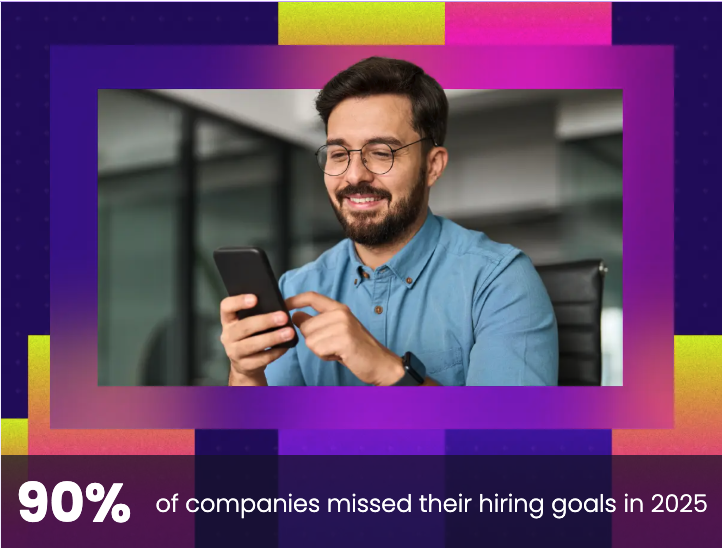
Hiring in 2026 is defined by both progress and pressure. While some teams are improving, the broader picture remains sobering: 90% of companies missed their hiring goals, and talent acquisition continues to operate under sustained structural strain. Nearly every organization now relies on AI, but this shift has introduced a new reality—fake or AI-generated candidates have emerged as the number one anticipated hiring threat for the year ahead.
At the same time, long-standing operational bottlenecks, especially scheduling, continue to slow hiring when speed matters most. The result is a market where authenticity, efficiency, and execution discipline are no longer differentiators; they are prerequisites.
Yet the teams that are outperforming the market tell a different story. They didn’t respond to pressure by simply adding headcount, or even by cutting it. Instead, they reorganized. Top-performing teams redesigned roles, workflows, and responsibilities around an AI-enabled reality, using automation to absorb operational load while elevating human judgment, coordination, and candidate connection.
These teams automate intentionally, standardize what should be repeatable, and leverage AI for insight—not just efficiency. In doing so, they protect the human touchpoints that define great hiring experiences, even as their processes become faster and more resilient.
I hope this year’s report inspires you to build toward that future—one where technology amplifies human connection rather than replaces it, and where hiring teams are structured to operate with confidence in an increasingly complex market.
Warm regards,
Ahryun Moon, CEO and Co-Founder, GoodTime
Unlock 2026’s top hiring strategies: Insights from 500+ TA leaders
Be the first to uncover deep hiring insights specific to your sector — straight from the highest-performing TA teams.
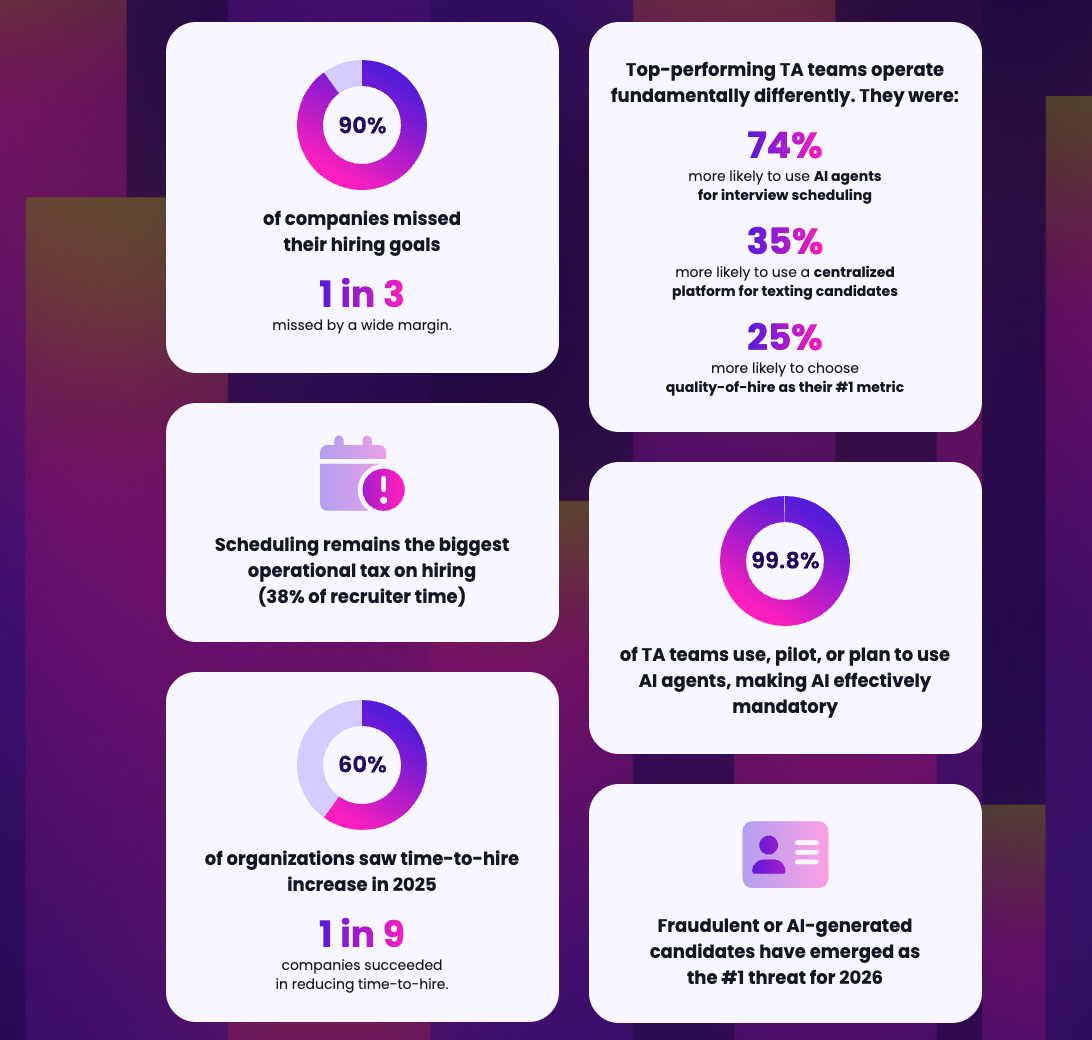
Fraudulent or AI-generated candidates have emerged as the #1 threat for 2026.
90% of companies missed their hiring goals, and 1 in 3 missed by a wide margin.
99.8% of TA teams use, pilot, or plan to use AI agents, making AI effectively mandatory.
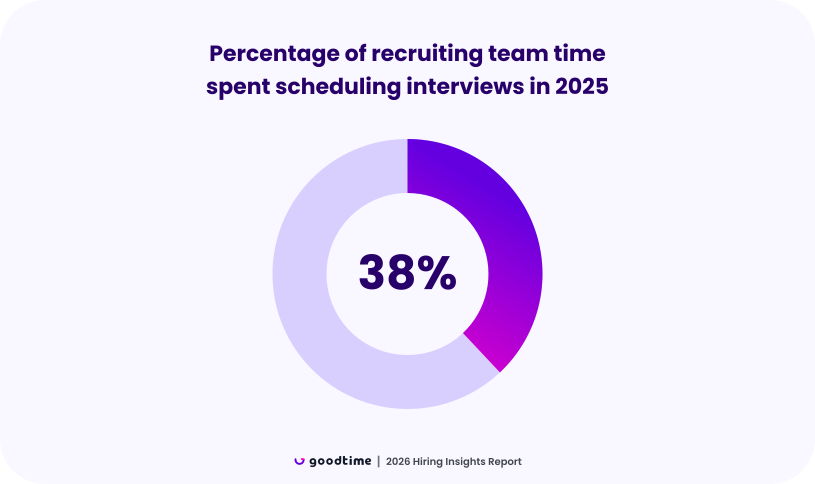
Scheduling remains the biggest operational tax on hiring (38% of recruiter time).
60% of organizations saw time-to-hire increase in 2025.
Only 1 in 9 companies succeeded in reducing time-to-hire.
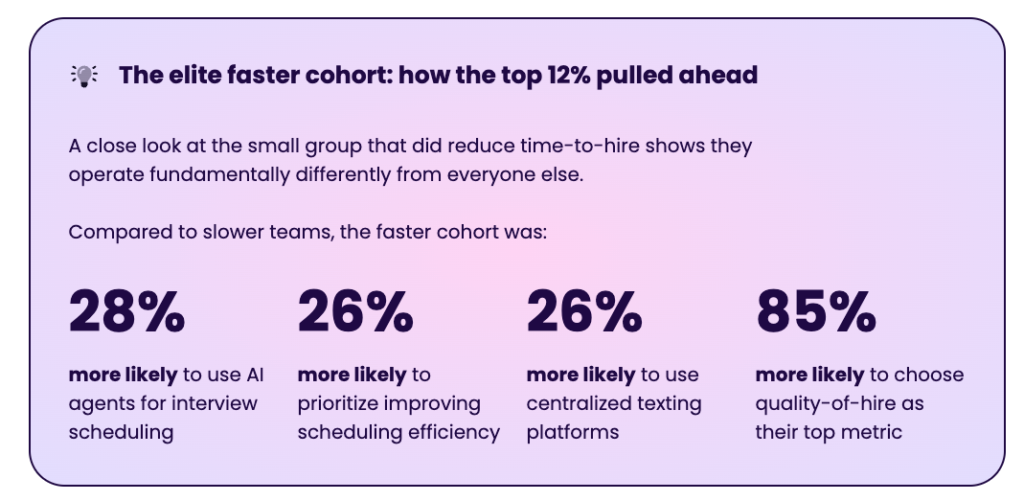
Top-performing TA teams operate fundamentally differently. They were:
74% more likely to keep headcount flat while reorganizing roles
58% more likely to use a centralized platform for texting candidates
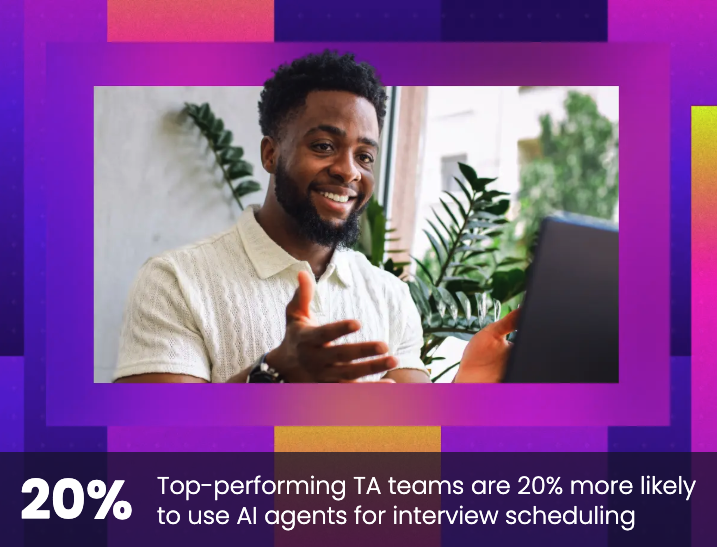
20% more likely to use AI agents for interview scheduling
Source: 2026 Hiring Insights Report
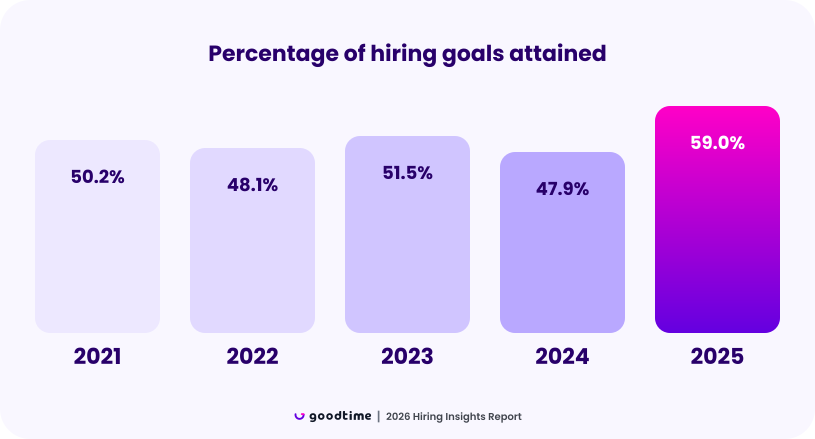
Hiring goal attainment hits a five-year high but still signals a systemic struggle
At first glance, 2025 delivered a surprising headline: hiring goal attainment reached its highest point in five years. But a closer look reveals a more sobering truth. Performance remains dramatically below expectations, with most organizations continuing to fall short of their hiring targets.
More than a third of companies (34%) hit less than half of their hiring goals, and only a small fraction (10%) came close to achieving 90–100% of their targets. Most landed somewhere in the middle, filling between 50–74% of roles but still failing to meet organizational needs.
This paradox—the best year in five years, yet still deeply underperforming—reflects mounting competitive pressures, rising process complexity, and an increasing mismatch between talent acquisition teams’ capacity and the demands placed on them. For many organizations, hitting goals is no longer a matter of marginal improvement; it requires a structural transformation of how hiring operates.
“The headcount plan can often be a moving target. Criteria shift mid-search and teams are adjusting hiring priorities in response to changing business needs. When targets move often, it becomes almost impossible for TA teams to hit their goals. The quickest way to improve is early alignment between Executives, Finance, TA, and Hiring Managers, with clear priorities and expectations.” -Shelby Wolpa, Founder, Shelby Wolpa Consulting
Top overall hiring challenges
This year’s data reveals a hiring environment defined not by a single dominant barrier, but by overlapping obstacles across skills, volume, technology, and candidate behavior.
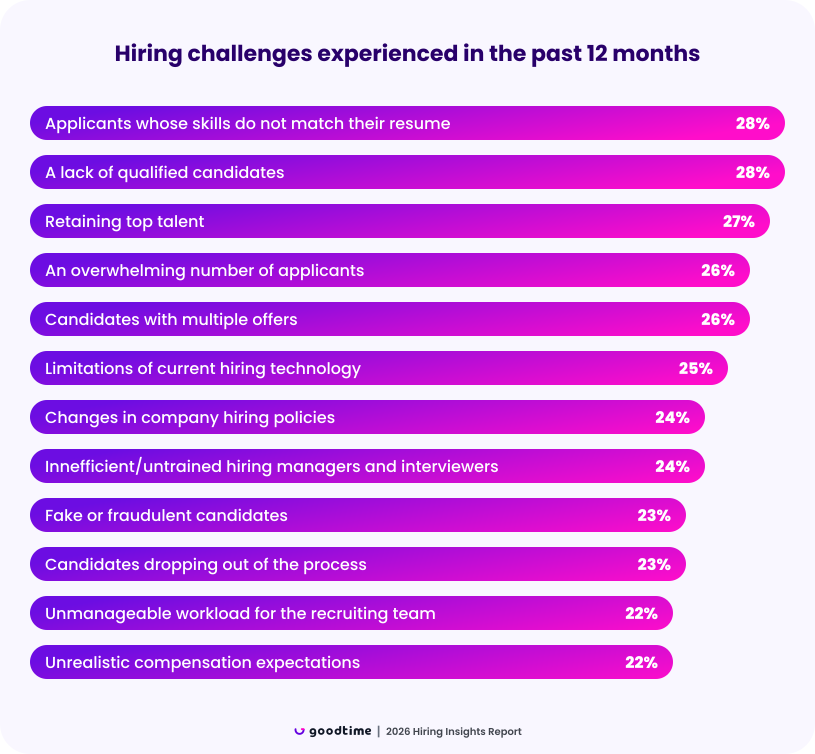
The most widespread challenge was skills misalignment, cited by 28% of TA leaders. Even when candidate pipelines were strong, recruiters struggled to find applicants whose capabilities matched the expectations set on their résumés. This reflects a growing disconnect between what candidates present and what organizations need, a theme that resurfaces repeatedly throughout this year’s findings.
28% of organizations also reported a lack of qualified candidates, continuing a long-standing pain point for TA teams. Yet the data suggests this shortage is now being compounded by other dynamics, including shifting work models and compensation expectations.
Retention pressures persisted as well, with 27% of TA leaders citing retaining top talent as a major challenge. As skilled workers continue to command multiple offers and leverage competitive markets, companies face mounting pressure to deliver compelling experiences both before and after hire.
The emergence of fake or AI-assisted candidates, cited by 23% of leaders, marks one of the most notable new pressures. Although not the most common challenge this year, their rising prevalence signals an accelerating shift in candidate behavior and sets the stage for why fraudulent candidates become the top anticipated threat for the coming year.
“AI and generalized economic precarity across the globe has created the perfect storm which has deluged traditional hiring funnels with job applications. Recruiters and hiring managers alike are both now aware of the challenge of separating signal from noise. ID verification, background checks, fraud detection and cybersecurity are now becoming much more important elements of a recruiter’s job.” -Hung Lee, Founder, Recruiting Brainfood
How the hiring landscape changed this year
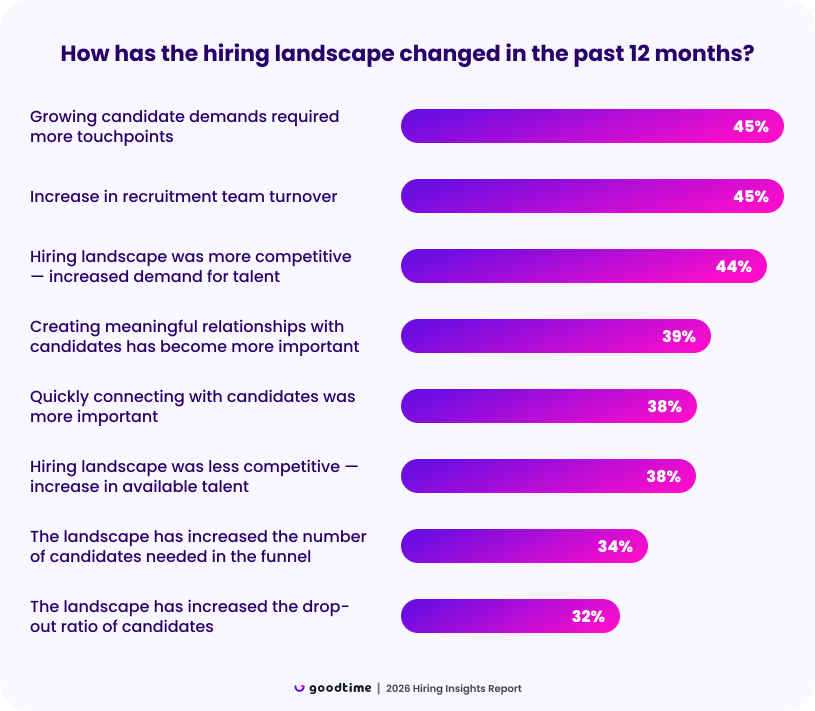
The most widely felt change in the hiring landscape this year was the surge in candidate demands, with 45% of TA leaders reporting an increase in required touchpoints. An equal share said recruitment team turnover disrupted their ability to maintain steady candidate flow, adding operational strain at a time when processes were already stretched.
Competition for talent also intensified: 44% said the landscape has become more competitive due to increased demand, while 39% reported that building meaningful relationships with candidates has become more important. Speed of engagement rose in priority as well, with 38% noting the growing importance of connecting with candidates quickly.
At the same time, shifts in available talent created mixed conditions across industries. 38% said the landscape feels less competitive due to greater talent availability, while 34% now need more candidates in the funnel to meet hiring goals.
Overall, hiring in the past year became higher touch, higher urgency, and more operationally demanding—challenging TA teams to do more with less in an increasingly dynamic talent market.
Time-to-hire continues to worsen for most teams
The time-to-hire crisis shows no signs of easing.
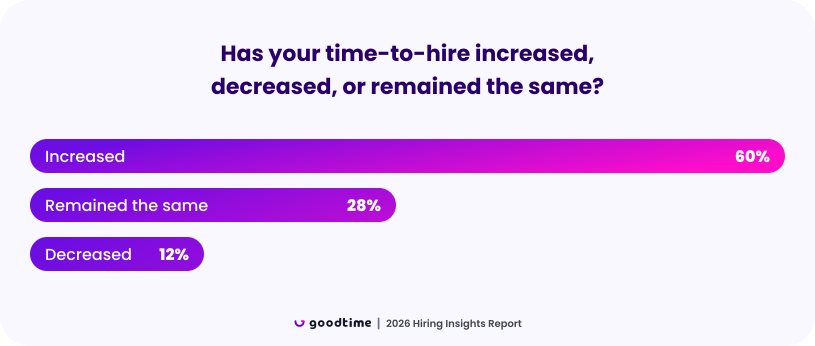
60% of companies reported that time-to-hire increased in 2025.
Only 12% managed to reduce it, an elite minority.
This means nearly nine out of ten organizations are either slowing down or treading water.
The year-over-year persistence of this trend reveals a deeper issue: technology adoption alone is not enough to create speed. Without disciplined workflows, streamlined communications, and clearer ownership across the hiring process, new tools often reinforce existing complexity instead of reducing it.
Just as important is what they didn’t do. Faster teams were:
40% less likely to rely on sourcing bots
56% less likely to use chatbots for early candidate engagement
These leaders focused on structural process improvement rather than volume-driven shortcuts. They modernized the internal mechanics of hiring instead of adding more candidates to an already strained system.
Scheduling remains the top operational burden in hiring
Despite advancements in hiring technology, scheduling remains the single most time-consuming and disruptive part of the process.
Talent teams report spending 38% of their time scheduling interviews, making scheduling the highest operational burden measured. And the ripple effect of scheduling-related bottlenecks shapes nearly every stage of the hiring process.
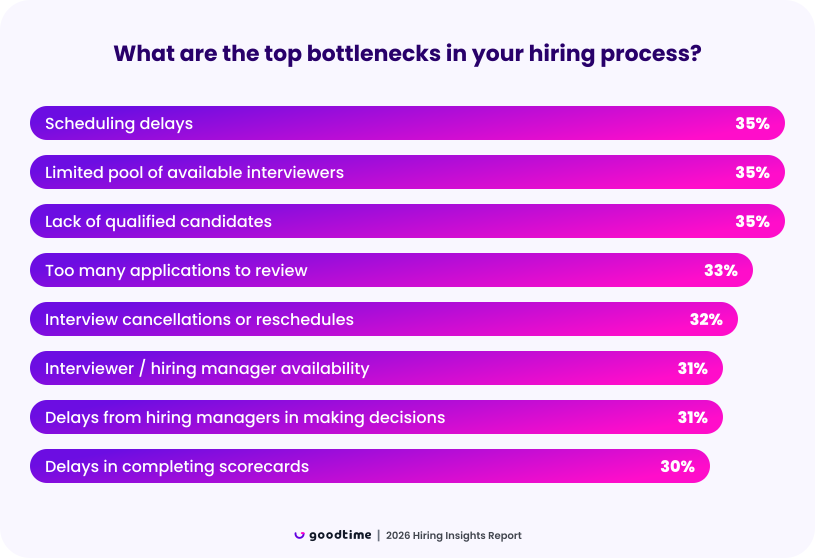
The most-cited scheduling bottlenecks include:
Scheduling delays (35%)
Limited interviewer pool (35%)
Cancellations/reschedules (32%)
Hiring manager availability (31%)
These are not isolated inconveniences. They are systemic blockers that lengthen hiring timelines, frustrate candidates, and increase the likelihood of losing talent to faster-moving competitors. Each cancellation can trigger multi-day delays, and each delayed response can push a qualified candidate toward another offer.
“If recruiters are still spending over a third of their time on scheduling, we’re not just missing hiring goals — we’re misusing talent. AI should handle at least 75% of the operational work so TA can focus on what humans do best: building trust, challenging bias, and hiring diverse teams that move the business.” -Kobi Ampoma, Head of Talent Acquisition (NL), The HEINEKEN Company
Automated scheduling strongly correlates with higher goal attainment
The data has already made one thing clear: interview scheduling is not a side task, but the ultimate bottleneck. But understanding the problem is only half the equation. The more important question is whether fixing it actually changes outcomes.
This year’s data shows that it does.
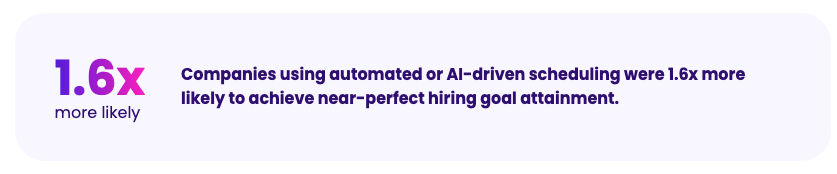
Companies using automated or AI-driven scheduling were 1.6x more likely to achieve near-perfect hiring goal attainment (13% hitting 90–100%, compared with 8% of non-users). This marks scheduling automation not just as a time-saver, but as a meaningful operational advantage tied directly to hiring outcomes.
The correlation makes intuitive sense: when coordination delays, back-and-forth rescheduling, and interviewer bottlenecks are reduced, TA teams regain bandwidth to nurture candidates and make timely decisions. In contrast, organizations still relying on manual scheduling are struggling under operational weight that compounds with every requisition.
Current scheduling benchmarks
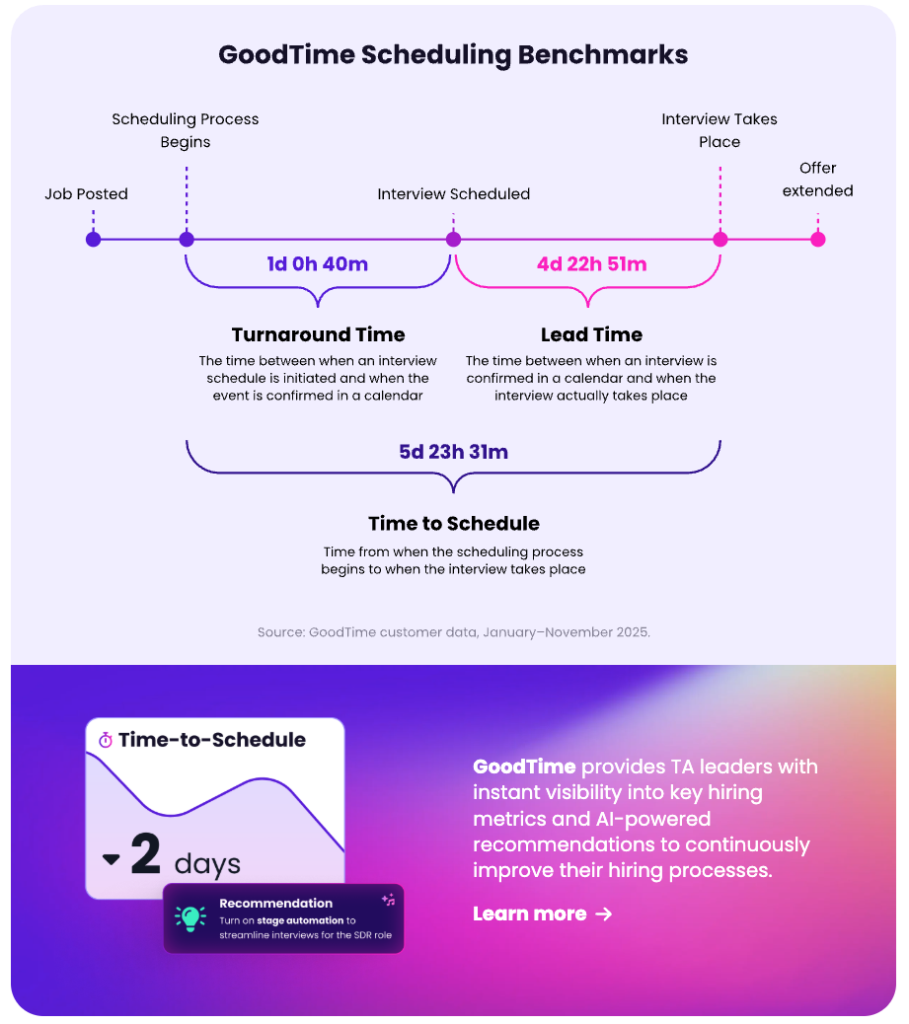
Scheduling speed is one of the clearest operational signals behind time to hire. While time-to-hire captures the outcome, scheduling metrics reveal where momentum is gained or lost—often days before delays show up in aggregate hiring data.
The benchmarks below reflect the three most important scheduling metrics TA teams should monitor to keep hiring moving efficiently.
AI’s role evolves: from basic automation to decision intelligence
AI adoption in talent acquisition reached near-universal levels in 2025, but how teams use AI has changed dramatically.
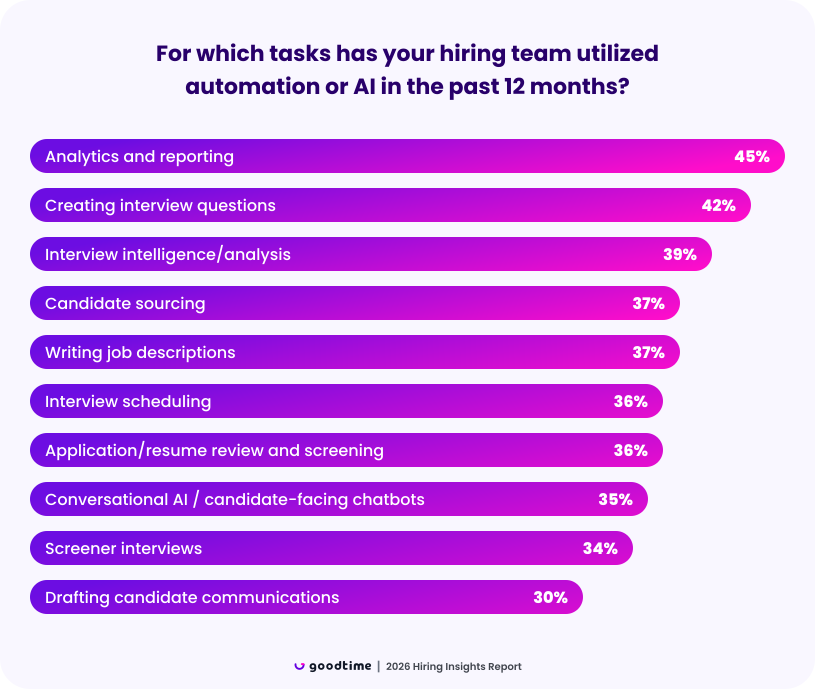
The top AI use case this year was analytics and reporting, with 45% of teams leveraging AI to surface insights, track funnel health, and identify inefficiencies. Scheduling (36%) and resume screening (36%) remain widely used but no longer dominate the narrative.
This signals a critical shift: AI is becoming the decision-making infrastructure behind hiring, not merely a way to automate repetitive tasks.
TA teams are increasingly relying on AI for:
Diagnostic visibility into bottlenecks
High-resolution quality-of-hire signals
Resource allocation insights
Predictive performance indicators
In other words, AI is expanding from “doing work” to “informing how work is done.”
“The goal isn’t just speed. It’s to free people to focus on what matters most. Our coordinators can now focus on the interactions that matter — guiding candidates, coaching hiring managers, and refining the experience instead of chasing calendars.” -Tiffany Clark, Head of HR Strategy & Shared Services, S&P Global
How talent teams changedthis year
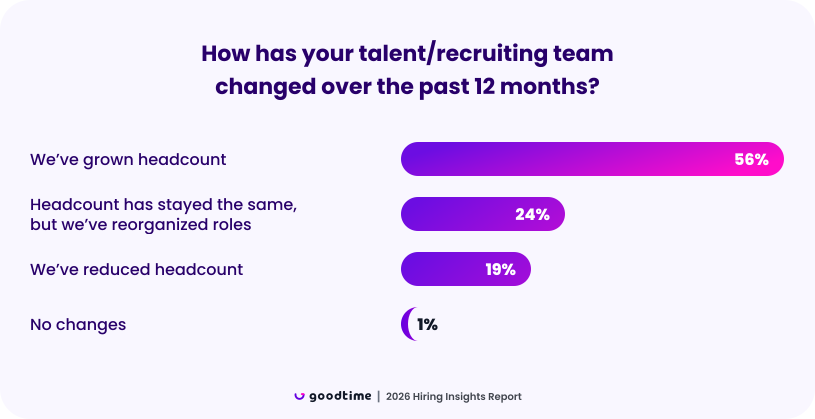
Talent teams underwent significant restructuring last year, driven by shifting hiring demands and evolving organizational priorities. More than half of companies (56%) grew their TA headcount, reflecting increased pressure to meet hiring goals and support more complex workflows. Another 24% kept headcount steady but reorganized roles, often redistributing responsibilities to adapt to new tools, expectations, or process requirements. Meanwhile, 19% reported reducing TA headcount, forcing smaller teams to manage the same or greater workload with fewer resources.
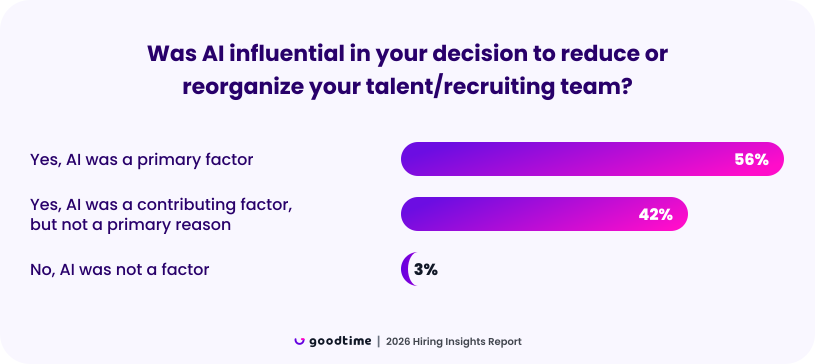
AI played an increasingly influential role in these changes. As AI automated scheduling, screening, and reporting tasks, many organizations reevaluated coordinator responsibilities, expanded recruiter support roles, or shifted bandwidth toward candidate experience and strategic partnership activities.
Collectively, these adjustments reflect a larger transition: TA teams are not simply shrinking or growing—they are transforming.
Roles are being redesigned to align with an AI-enabled hiring ecosystem where operational work is streamlined and human expertise is focused on higher-value decision-making and engagement.
Candidate communication trends: texting becomes central—and centralized
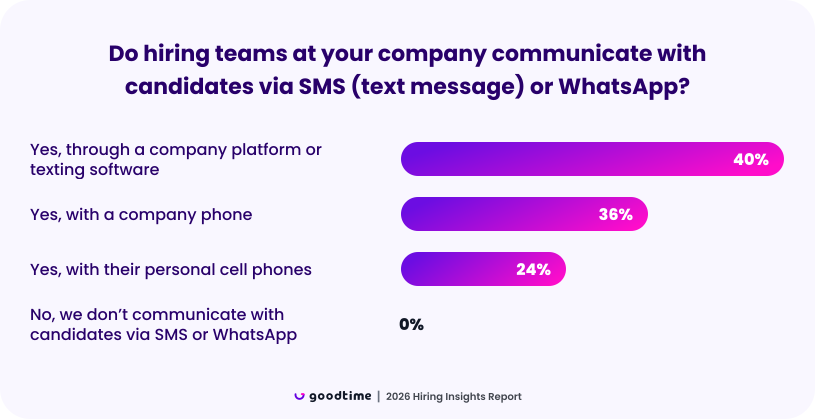
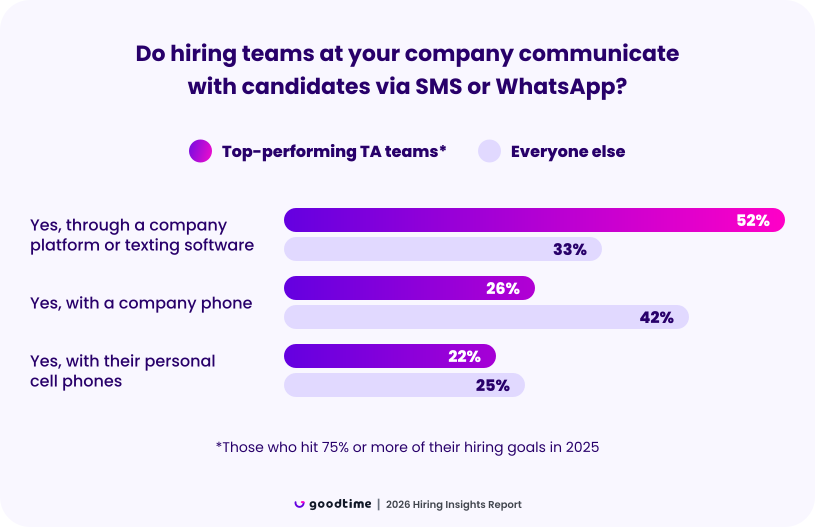
Texting has become a core part of candidate communication, but how teams manage it varies widely. 40% of organizations now use a centralized company platform or texting software, the most common approach and the one most associated with consistency and compliance.
Another 36% text candidates using company-issued phones, while 24% still rely on recruiters’ personal cell phones, introducing risks around tracking, data security, and uneven candidate experience. Notably, 0% of respondents say they avoid SMS or WhatsApp altogether, underscoring how essential mobile communication has become in the hiring process.
More layoffs than we’ve seen in four years
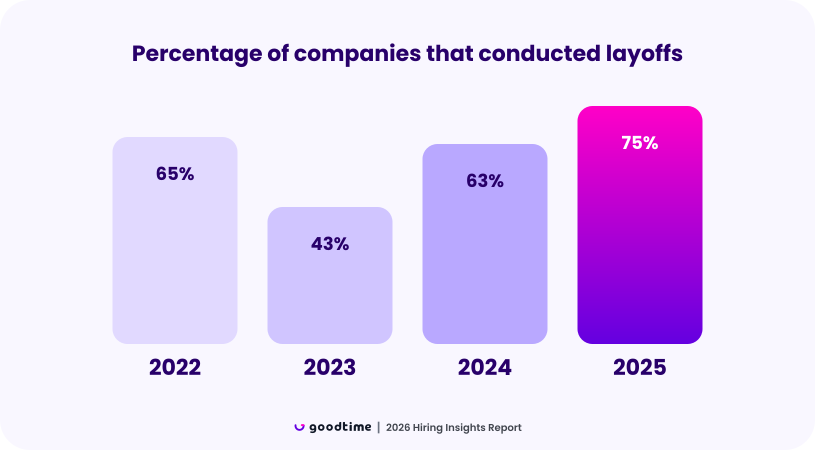
Layoffs surged sharply over the past 12 months, marking one of the most turbulent periods for talent teams in recent years. 75% of companies conducted layoffs in 2025, the highest level in the past four years, and a steep rise from 2024 and 2023. The scale of these reductions signals widespread organizational restructuring and heightened economic uncertainty.
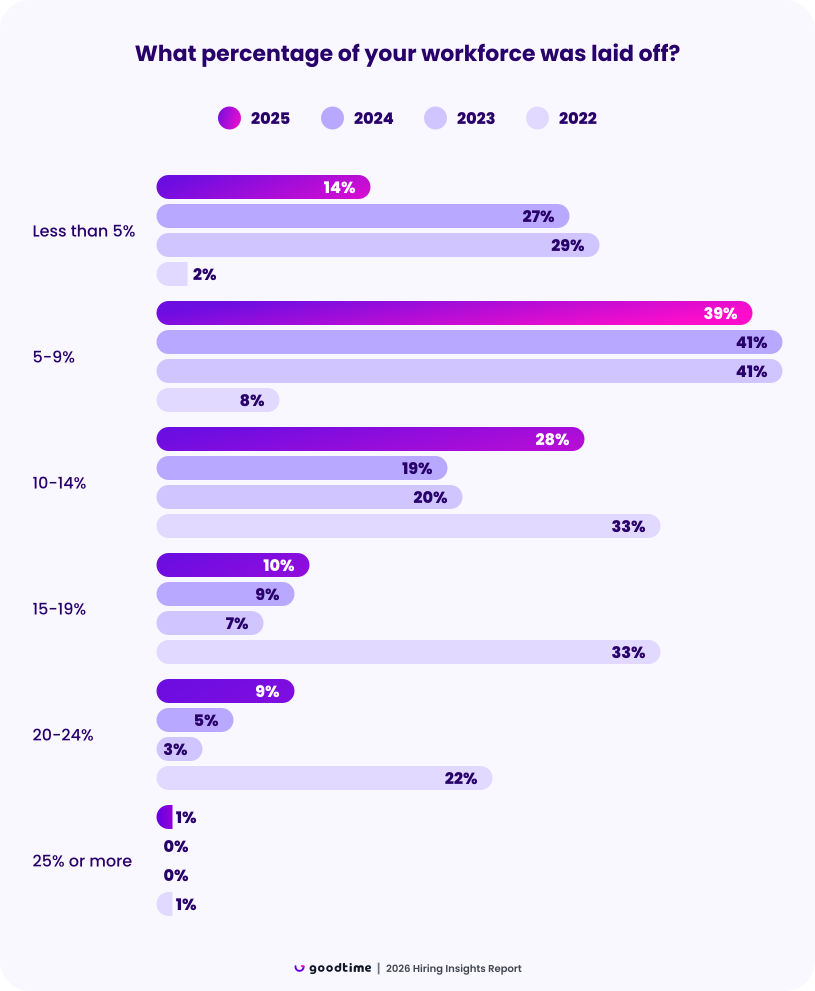
The severity of layoffs also increased. While the majority of organizations kept reductions relatively limited, the distribution reveals escalating pressure across the workforce:
The end of the RTO debate: Office-first becomes the dominant reality
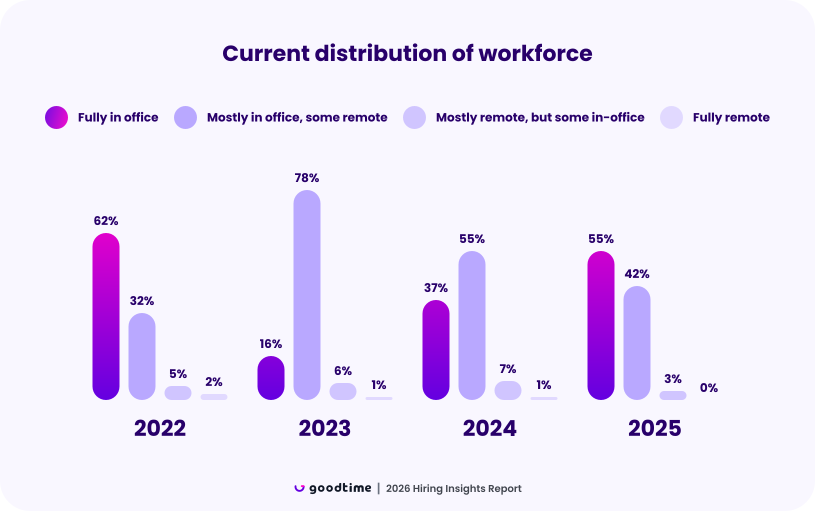
The pendulum has swung decisively. Here’s the current status of workforce distribution:
55% fully in office
42% mostly in office
Only 3% mostly remote
None were fully remote
Despite media narratives about remote stability, the data shows a nearly universal return to office-first operating models.
This shift adds complexity for TA teams who must now navigate redefined candidate expectations, changing geographic recruiting strategies, and evolving internal policies.
A year defined by pressure, and by clarity
2025 exposed deep operational friction across the hiring lifecycle, from scheduling bottlenecks to rising time-to-hire, increasing candidate misrepresentation, and mounting organizational expectations. Yet it also delivered clarity: the organizations making meaningful progress are those that have embraced AI-driven decision-making, standardized workflows, and disciplined process improvement.
The path forward is no longer ambiguous.
To succeed in 2026, talent acquisition must become more efficient, more insight-driven, and more resilient, all while safeguarding authenticity in a rapidly evolving talent landscape.
Editor’s note: The article below is an excerpt from GoodTime’s 2026 Hiring Insights Report. The entire report is available to view online for free here.
In a year when 90% of companies missed their hiring goals, a small cohort broke through the noise. These top-performing TA teams—the organizations that achieved 75% or more of their hiring goals—didn’t simply work harder. They operated differently. Their strategies, tools, and organizational environments show a level of operational maturity that stands in stark contrast to the broader hiring market.
Where many teams struggled with worsening time-to-hire, growing candidate demands, and rising workflow complexity, top performers built uncompromising systems around efficiency, automation, and quality. Their advantage was not incremental; it was structural.
Unlock 2026’s top hiring strategies: Insights from 500+ TA leaders
Be the first to uncover deep hiring insights specific to your sector — straight from the highest-performing TA teams.
“The best Talent teams aren’t ‘adding AI’ — they’re re-architecting how hiring works. Simply layering AI tools onto broken or inefficient processes won’t drive impact. The real opportunity lies in auditing the end-to-end hiring journey, starting with the problem to solve, and intentionally redesigning it.” -Manjuri Sinha, VP HR & Global Head of GTM Org Success & People Partners, Miro
The signature behaviors that set top performers apart
Top-performing TA teams—the small group that met at least 75% of their hiring goals—share a set of behaviors that consistently separate them from the rest of the market.
They are 20% more likely to use AI agents for interview scheduling, and the payoff is measurable: teams that use automated scheduling are 1.6x more likely to achieve near-perfect hiring goal attainment (13% hitting 90–100%, compared with 8% of non-users).
On the surface, these choices can appear operational. In practice, they signal something far more consequential. While many organizations still rely on manual coordination to move candidates through the process, top performers have automated the most failure-prone part of hiring: scheduling.
By reducing back-and-forth, delays, and rescheduling cascades, these teams protect candidate momentum and recruiter bandwidth. The result isn’t just faster movement through the funnel, but a hiring process that is more predictable, more resilient, and easier to scale under pressure.
Their advantage isn’t simply tool adoption; it’s that they invest in automation where it directly improves outcomes.
Who top performers are, and the conditions that enable them
What distinguishes these teams isn’t budget or headcount. It’s the environment they operate in and the discipline with which they design their processes.
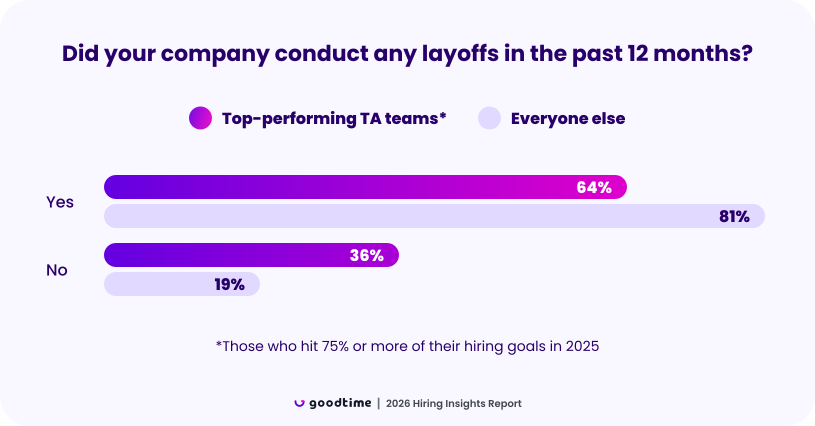
Top-performing teams are more likely to work within stable organizational structures. They were almost twice as likely to report no layoffs in the past year and 74% more likely to have reorganized roles without reducing headcount, a sign that their organizations protected continuity rather than resetting workflows amid turbulence. Stability doesn’t guarantee performance, but it creates the conditions for it: clearer ownership, less churn, and systems that don’t need to be rebuilt every quarter.
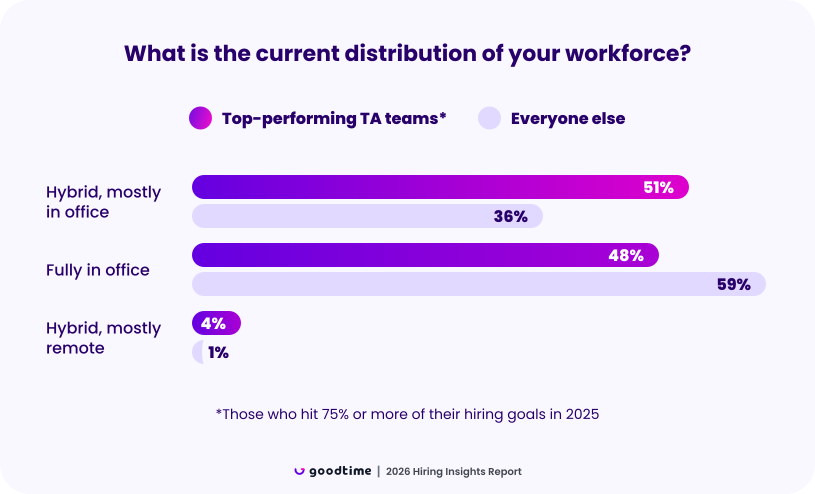
They also operate with flexibility where it matters. Compared to the broader market’s sharp return to office-first models, top performers were significantly more likely to operate in hybrid environments. That flexibility has practical implications: distributed teams tend to rely more heavily on standardized tools, centralized communication, and automated coordination, all of which reduce bottlenecks and improve execution.
Together, these conditions allow top performers to focus less on firefighting and more on system design.
How top performers operate differently than everyone else
Automation is replacing headcount growth as the path to hiring success
One of the most striking findings in the 2026 data isn’t about tools or tactics—it’s about how top-performing teams scale.
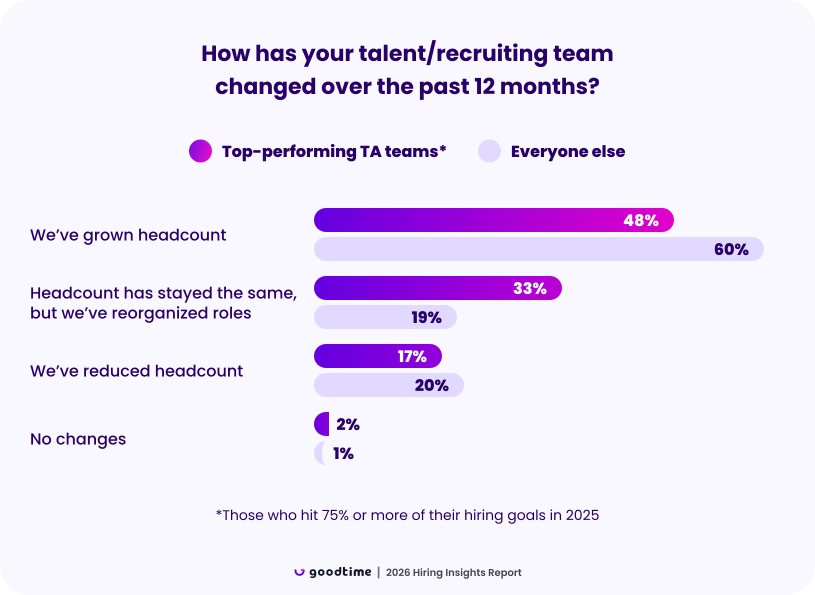
Despite operating in the same market conditions as everyone else, top-performing TA teams are less likely to grow headcount, even as they achieve significantly higher hiring goal attainment. Instead of expanding teams to absorb rising complexity, they modernize their infrastructure to remove it. While 60% of underperforming teams grew headcount over the past year, fewer than half of top performers did the same. Instead, top performers were far more likely to keep headcount stable while reorganizing roles, signaling a deliberate shift away from logistics-heavy work and toward higher-leverage responsibilities.
This pattern reflects a fundamentally different operating model. Top-performing teams lean into automation, AI-powered scheduling, and workflow orchestration to eliminate the manual coordination that slows hiring down. By reducing scheduling drag, communication friction, and process noise, they increase throughput without increasing staffing.
The result is not just efficiency—it’s resilience. These teams hit hiring goals at a higher rate and avoid the cycle of constant headcount expansion that many organizations rely on to keep pace.
In 2026, the strongest TA organizations aren’t scaling by hiring more recruiters. They’re scaling by building systems that make recruiters more effective.
Top performers thoughtfully embraceAI agents
While AI agent adoption is widespread across talent acquisition, how teams deploy AI clearly separates top performers from everyone else.
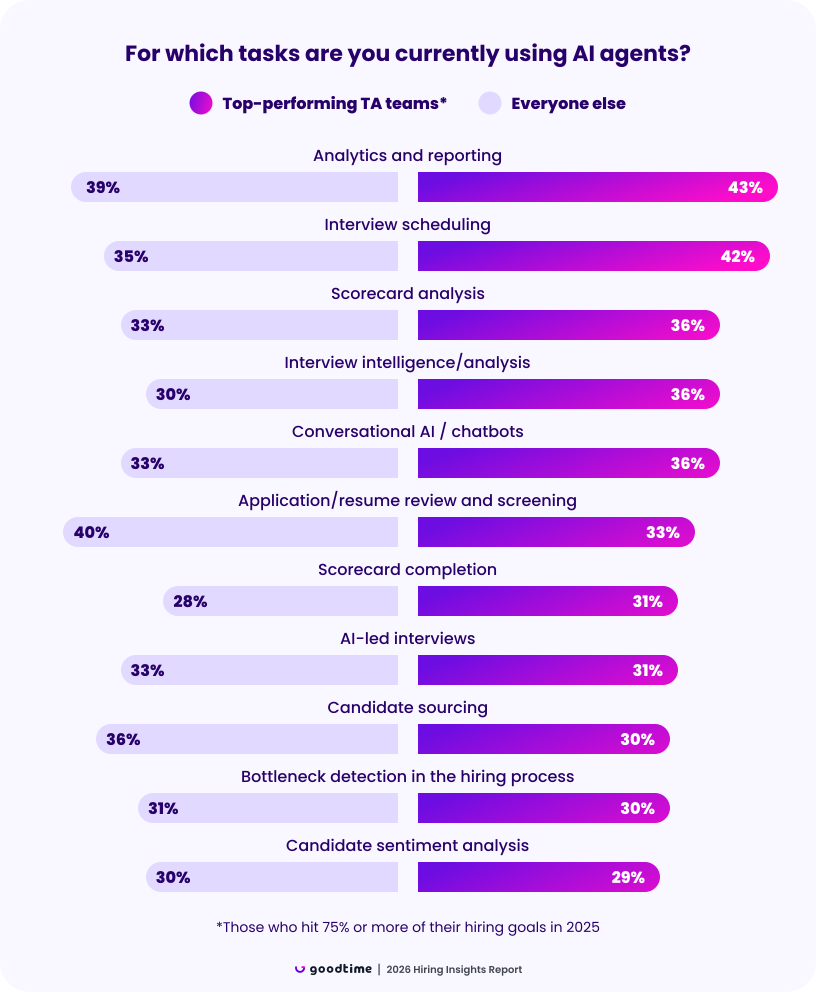
Top-performing TA teams are significantly more likely to use AI agents for core workflow mechanics and decision support, not just surface-level automation. Their highest adoption areas, analytics and reporting (43%) and interview scheduling (42%), map directly to the two biggest operational levers in hiring: visibility and speed. By contrast, teams that underperform are less likely to apply AI in these system-level functions, limiting its impact on overall hiring outcomes.
Notably, top performers also lean more heavily into structured evaluation tools, including scorecard analysis and interview intelligence. This suggests a more mature use of AI, one focused on improving signal quality and consistency, not just reducing manual work.
Where top-performing teams don’t over-invest is equally telling. They are less differentiated in areas like candidate sourcing and conversational AI, reinforcing a broader theme from this year’s data: automation at the top of the funnel is not what drives results. Instead, gains come from tightening execution in the middle of the hiring process, where delays, cancellations, and poor coordination most often derail outcomes.
In short, top-performing teams treat AI as infrastructure, not experimentation. They deploy it where it compounds—speeding scheduling, improving insight, and reinforcing hiring discipline—while others remain stuck using AI tactically rather than transformationally.
Upgrade your hiring journey with AI
GoodTime’s AI agents orchestrate the entire hiring journey — screening, scheduling, messaging, and more — so talent teams hire faster with a better candidate experience.
AI-powered scheduling as a coreoperating mechanism
For top performers, AI scheduling isn’t a convenience feature — it’s foundational.
Top-performing teams were:
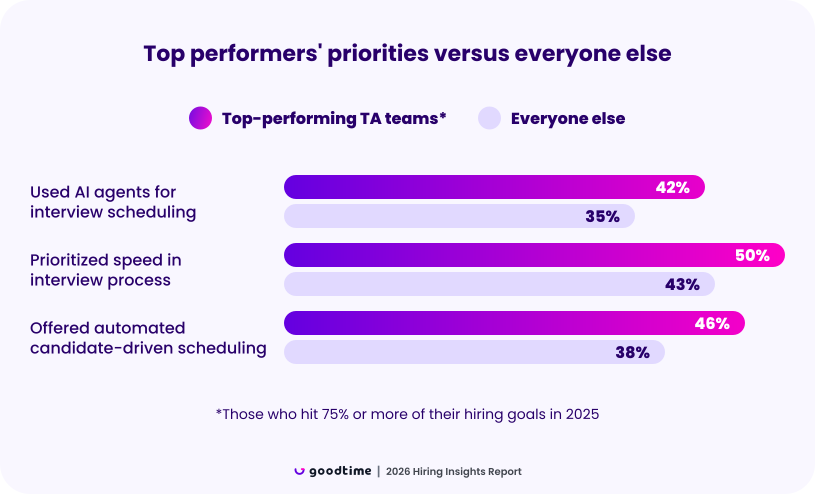
20% more likely to use AI agents for interview scheduling
16% more likely to run a fast, streamlined interview process
18% more likely to offer automated scheduling options directly to candidates
These investments matter because scheduling remains the single largest operational tax in hiring, consuming 38% of recruiter time across the industry. By automating the handoffs, coordination, and rebooking workflows that drain bandwidth, top performers free their teams to focus on higher-value work, while delivering a faster, more consistent candidate experience.
Where others still rely on people to move calendars, top performers use systems.
“The fastest teams don’t work ‘harder’; they design hiring like a product and think with the candidate in mind. They front load clarity: tight intake meetings, clear success profiles, scorecards, and aligned decision makers before the role goes live. They treat time-to-hire as a system metric, not a TA-only KPI.” -Kobi Ampoma, Head of Talent Acquisition (NL), The HEINEKEN Company
Centralized, structured communication,not ad hoc messaging
The second major investment area—and one of the strongest differentiators for 2026—is communication discipline.
Top performers were 58% more likely to use a centralized texting platform This shift away from personal phones and fragmented messaging channels does more than tidy up communications. It fundamentally reshapes hiring operations by enabling:
Faster response times
Consistent candidate messaging
Better compliance and documentation
Reduced candidate drop-off
Clearer accountability across the team
In a year when candidate expectations accelerated and fraud concerns grew, standardized communication became both a performance driver and a risk mitigator.
Top performers treated communication not as a task, but as a system that needed governance.
How top performersmeasure success
Top-performing TA teams distinguish themselves not only by how they work, but by what they choose to measure. In a year where candidate fraud increased, time-to-hire worsened for most organizations, and AI reshaped the mechanics of hiring, the most successful teams gravitated toward the metrics that actually predict meaningful outcomes, not just activity.
Their measurement philosophy is sharper, more sophisticated, and far more focused on downstream impact than their peers.
Quality of hire is the anchor metric
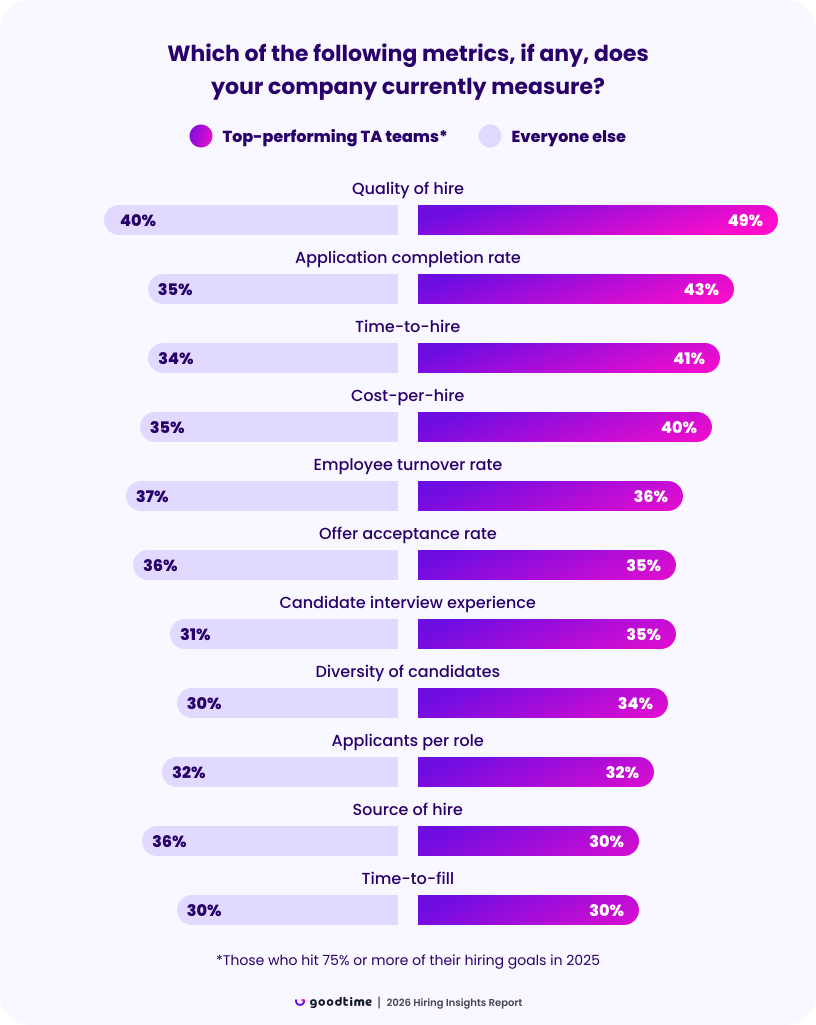
Among all metrics measured in 2026, quality of hire stands out as the signature of top-performing teams.
Top performers were:
22%more likely to track quality of hire
42% more likely to select it astheir top hiring metric
This focus is especially meaningful in a year where fake or fraudulent candidates rose to the top of anticipated challenges. Rather than respond by adding more assessments or slowing the process, top performers rebuilt measurement systems around outcomes—ensuring every hire meets performance expectations and aligns with long-term needs.
Where many teams still lean on volume-based or speed-based measures, top performers look at what happens after the hire.
“AI has raised the bar on what ‘verification’ actually means. A single background check at the end of the process isn’t enough anymore. TA teams now have to confirm identity and authenticity at multiple points – starting at application, continuing through assessments and interviews, and carrying all the way through onboarding.” -Becky McCullough, VP, Talent Acquisition & Mobility, HubSpot
Funnel health takes priority over funnel volume
Another clear differentiator: top performers track funnel health, not just funnel size. They were significantly more likely to measure application completion rates (23% more likely). This matters because application completion, unlike raw applicant volume, reveals:
Where friction exists in the early funnel
Whether job postings and processes are aligned with candidate expectations
How effectively the system converts interest into engagement
By watching the health of the funnel rather than the size of it, top performers avoid the trap of chasing more candidates when the real issue lies in process breakdowns.
It’s a more mature, more diagnostic approach, one that strengthens every downstream stage of hiring.
Less emphasis on cost-per-hire
In contrast to many organizations still under budget pressure, top performers were 21% less likely to treat cost-per-hire as a central metric.
The reason is simple: Cost metrics don’t predict hiring outcomes. Quality, velocity, and funnel integrity do.
This doesn’t mean cost doesn’t matter. It means top performers refuse to optimize for short-term savings at the expense of long-term hiring effectiveness.
A measurement system designed for clarity, not complexity
Together, these choices reflect a coherent philosophy:
Measure performance, not activity
Track what influences outcomes, not what’s easiest to quantify
Use data to surface friction, not justify the status quo
Prioritize metrics that support speed and quality in an environment of rising candidate misrepresentation
“We’re not just looking at metrics like quality of hire now. We’re also reassessing where our bar is for things like time-to-fill and time-to-hire. What GoodTime is really good at is enabling us to quantify how much we can improve metrics and whether those improvements are within our control.” -Robbie Simpson, Head of Talent Acquisition, Glovo
In short, top performers don’t just use better tools—they use better metrics. And those metrics allow them to see the hiring system clearly enough to fix what others can’t.
Top performers’ prioritiesfor 2026
Looking ahead to 2026, top-performing TA teams are doubling down on the same structural advantages that fueled their success in 2025. Their priorities reflect a clear understanding of where hiring is headed: toward greater automation, tighter workflow discipline, and a candidate experience defined by speed and clarity rather than personalization alone.
In contrast to organizations that are still reacting to rising fraud, worsening time-to-hire, and increased operational strain, top performers are proactively strengthening the systems that drove their gains. Their 2026 priorities read less like a wishlist and more like a continuation of a proven strategy.
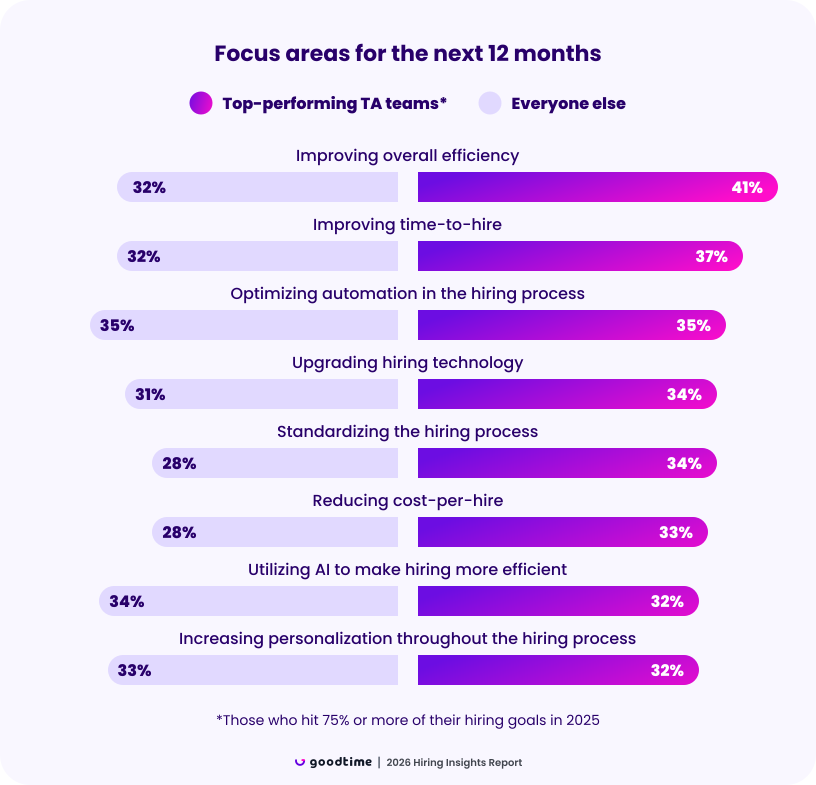
Improving overall efficiency
Efficiency is the top priority for high-performing teams entering 2026. And this time, it’s not shorthand for cost-cutting or incremental process fixes. Top performers are focused on:
Removing friction from every stage of the funnel
Reducing coordination load
Increasing workflow reliability
Streamlining decision paths
Improving time-to-hire
While the majority of companies saw time-to-hire worsen, top performers were far more likely to prioritize and protect speed as a strategic capability.
Their focus reflects an understanding that speed is no longer a nice-to-have, it is:
A defense against candidate dropout
A competitive differentiator in a market with heightened candidate expectations
A requirement for maintaining internal trust in TA
Top performers treat time-to-hire as a system-level output, not an isolated metric.
Upgrading hiring technology
For top performers, tech modernization is not about adding more tools; it’s about replacing brittle, manual steps with systems that can scale.
In 2026, they are more likely to invest in:
AI-driven scheduling
Automated communication workflows
Centralized texting platforms
Analytics and bottleneck diagnostics
These upgrades reflect a broader shift: top performers invest in technology that governs the workflow, not just supplements it.
Enhancing the candidate experience through speed, clarity, and flexibility
Where many organizations still equate candidate experience with personalization, top performers have moved toward a more modern definition rooted in:
Fast interview-to-offer timelines
Clear, automated communication
Self-scheduling and self-rescheduling
Reduced ambiguity and fewer touchpoints
This shift is especially important in a landscape where candidate expectations have risen and patience has dropped. Top performers have recognized that the most valuable form of personalization is removing the friction that slows candidates down.
The blueprint: what others can learn from top performers
Across every data point, from AI usage to workflow design, communication discipline, and measurement, top-performing TA teams reveal the same underlying truth: they win by building systems that remove friction and amplify signal. Their results aren’t the product of luck or lighter workloads. They are the consequence of intentional design decisions that compound across the entire hiring lifecycle.
The blueprint they offer is not abstract. It’s practical and immediately actionable:
1. Treat scheduling as a strategic system, not an administrative task. Top performers automate coordination end-to-end, enabling faster movement and freeing teams from the single largest operational burden.
2. Centralize communication to eliminate inconsistency and reduce dropout. By consolidating texting and candidate outreach, they create a predictable, timely communication rhythm that keeps candidates engaged and reduces risk.
3. Deploy AI where it improves judgment and workflow reliability. Instead of concentrating automation at the top of the funnel, they weave AI into screening, question generation, analytics, and reporting, the areas that shape quality, velocity, and decision-making.
4. Anchor measurement in quality and funnel health. Top performers track the metrics that actually forecast hiring success: quality of hire, completion rates, conversion patterns, and downstream outcomes. And they deprioritize metrics, like cost-per-hire, that create false efficiency.
5. Cultivate organizational stability and role clarity. Reorganizations, not reductions, give teams the stability to adopt new tools and refine workflows. Flexibility in work models enables faster coordination and stronger adoption of modern technology.
6. Build candidate experiences around speed, clarity, and flexibility. Top performers understand that today’s candidates value momentum more than polish. Self-service, automation, and transparent updates create the experience candidates now expect and competitors struggle to match.
Together, these practices form a coherent operating system for modern hiring, one that is resilient to fraud, capable of sustaining speed, and grounded in metrics that matter. The path forward for TA teams is not about working harder or adding more volume. It’s about adopting the structural advantages that top performers have already proven to work.
Editor’s note: The article below is an excerpt from GoodTime’s 2026 Hiring Insights Report. The entire report is available to view online for free here.
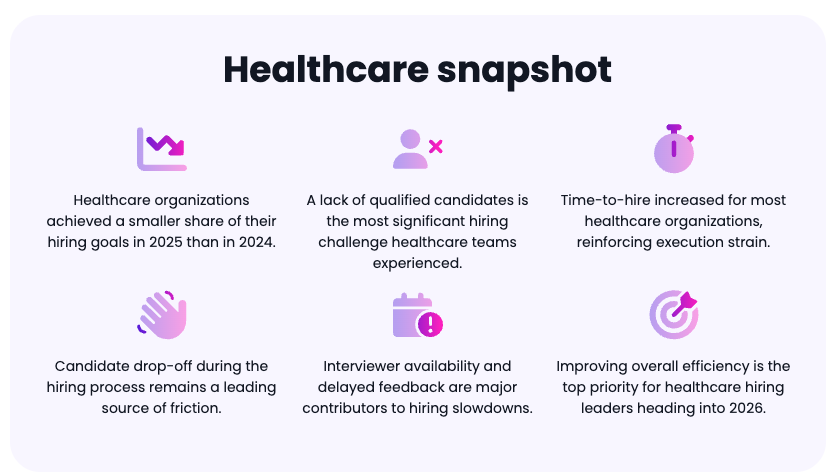
Healthcare hiring teams enter 2026 facing intensified pressure across both talent supply and execution. The data shows that finding qualified candidates is the most significant challenge healthcare organizations experienced, outweighing all other issues by a clear margin. At the same time, process-related strain continues to slow hiring cycles, particularly in interviewing and decision-making.
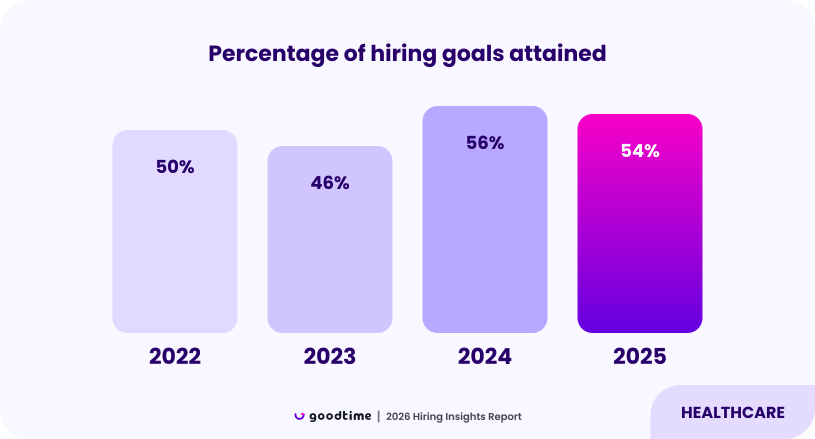
Hiring outcomes deteriorated year over year, with healthcare organizations achieving a smaller share of their hiring goals in 2025 than in 2024. This decline sits alongside rising time-to-hire and persistent candidate drop-off, indicating that healthcare teams are not simply dealing with demand shocks, but with systems that struggle to convert interest into hires.
Looking ahead, healthcare leaders are prioritizing efficiency, speed, and process reliability. Technology investment and selective use of AI are increasingly viewed as necessary infrastructure to stabilize hiring operations rather than optional enhancements.
Unlock 2026’s top hiring strategies: Insights from 500+ TA leaders
Be the first to uncover deep hiring insights specific to your sector — straight from the highest-performing TA teams.
Healthcare hiring performance weakened in 2025. The data shows that organizations achieved a lower portion of their hiring goals than the year prior, reversing earlier progress and reinforcing how fragile gains in this sector can be.
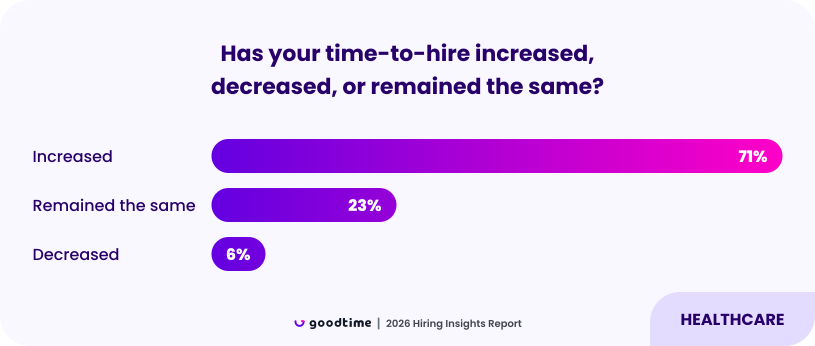
This decline occurred alongside broader signs of strain. Time-to-hire increased for many healthcare teams, and competitive pressure remained high. Together, these signals suggest that hiring shortfalls were driven less by lack of effort and more by constraints in converting available candidates into completed hires.
Rather than pointing to a cyclical dip, the performance results indicate a structural challenge. When qualified talent is scarce and internal processes are slow or inconsistent, even modest disruptions can materially reduce hiring output.
Key challenges
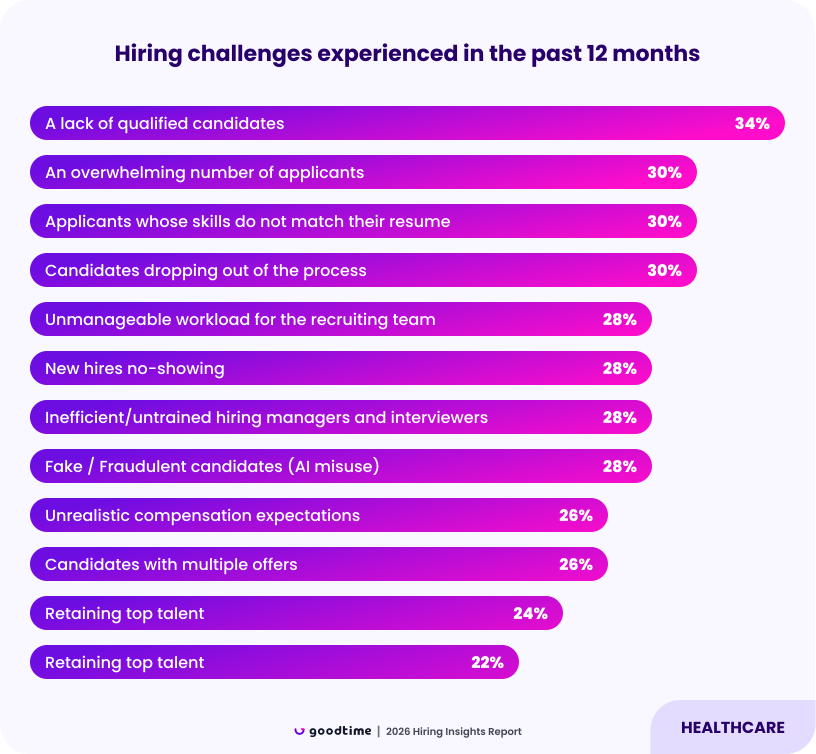
Healthcare leaders are unequivocal about their primary challenge. A lack of qualified candidates stands clearly at the top of the list, reported more frequently than any other issue.
Just below that top concern is a dense cluster of related problems: skills that do not align with resumes, too many applicants to effectively screen, and candidates dropping out during the process. This combination signals that healthcare hiring teams are dealing with both scarcity and noise at the same time.
Execution and workload pressures form the next layer. Unmanageable recruiter workload, candidates holding multiple offers, and rising compensation expectations all contribute to instability, but they do not rival talent availability in prominence.
Scheduling and communication bottlenecks
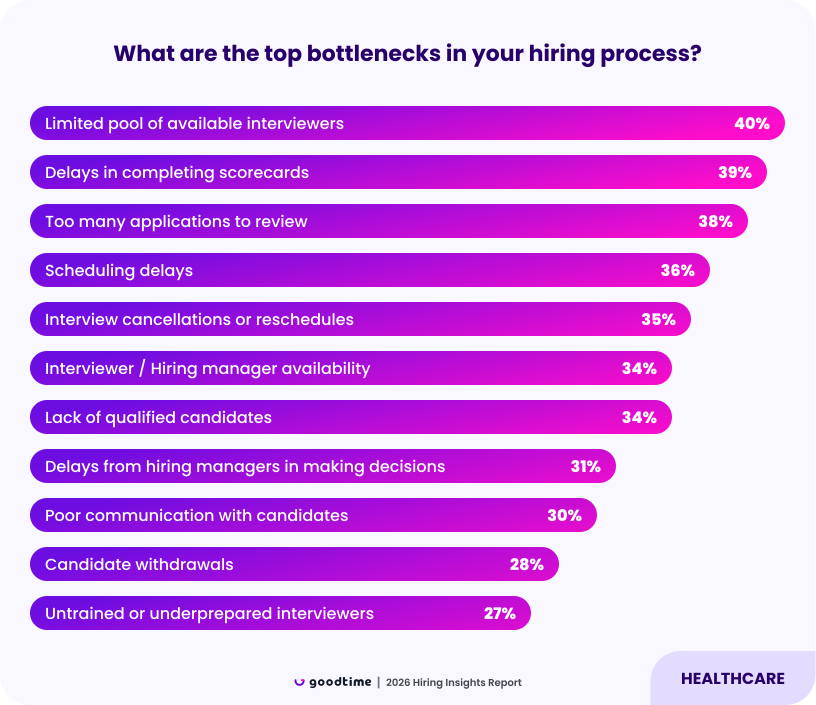
Hiring slowdowns in healthcare are driven primarily by interviewer capacity and follow-through, not by sourcing alone. The most frequently cited bottleneck is a limited pool of available interviewers, which constrains throughput even when candidates are ready to move forward.
Closely following are delays in completing scorecards and the volume of applications requiring review. These responses point to pressure in the middle of the funnel, where decisions depend on busy clinicians and managers who are balancing hiring responsibilities with core operational work.
Scheduling delays and interview cancellations also feature prominently. However, the data suggests these are symptoms of a broader coordination problem rather than isolated failures. When interviewer availability is inconsistent and feedback cycles stall, scheduling becomes fragile and candidates wait longer than they are willing to tolerate.
Go beyond bandaid solutions to hit your healthcare hiring goals consistently
Automate your healthcare hiring process, increase candidate engagement rates, and fill open roles 50% faster.
Candidate disengagement is a recurring theme in healthcare hiring. Dropout during the hiring process ranks among the most commonly experienced challenges, and it remains one of the most anticipated issues for the year ahead.
This pattern aligns with the bottleneck data. Candidates are most likely to disengage when interviews are delayed, rescheduled, or followed by long periods of silence. Engagement, in this context, is not primarily about personalization or employer branding. It is about momentum and clarity.
Healthcare candidates appear willing to enter the process, but far less willing to remain in it when progress slows or expectations are unclear.
Technology adoption and the role of AI in healthcare hiring
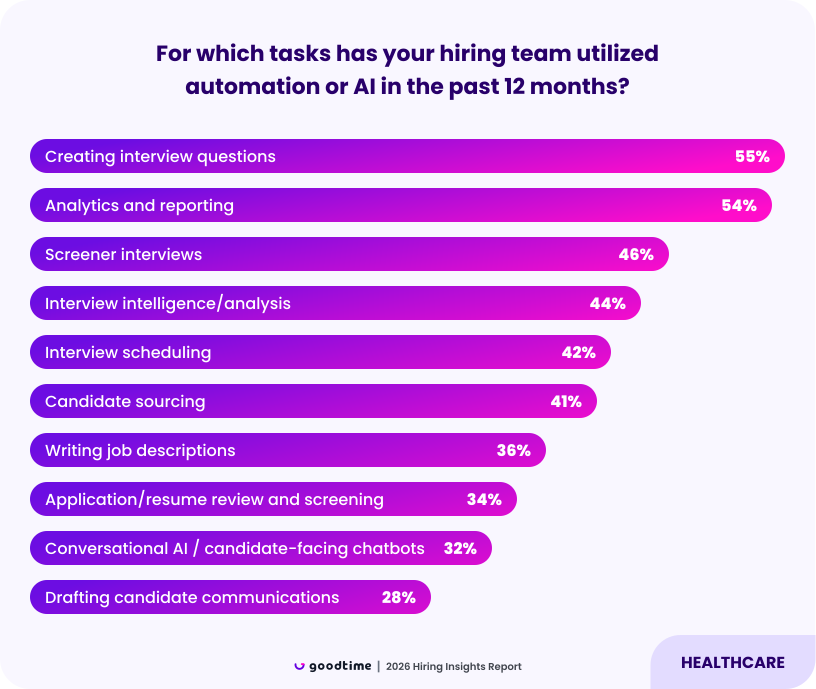
Healthcare organizations are applying automation and AI where it reduces ambiguity and manual effort in the hiring process. The strongest adoption appears in analytics and reporting and interview-related preparation, including generating interview questions.
A second tier of adoption supports interview execution, such as scheduling and interview analysis. These use cases reflect where healthcare teams feel the most operational pain: coordinating interviews, standardizing evaluation, and maintaining visibility into progress.
More candidate-facing automation, including chatbots and automated communications, appears lower in use. This suggests a cautious approach to automating interactions in a high-stakes hiring environment where trust and clarity matter.
Overall, AI is being positioned as supporting infrastructure, not as a substitute for clinical or managerial judgment.
Metrics healthcare teams prioritize
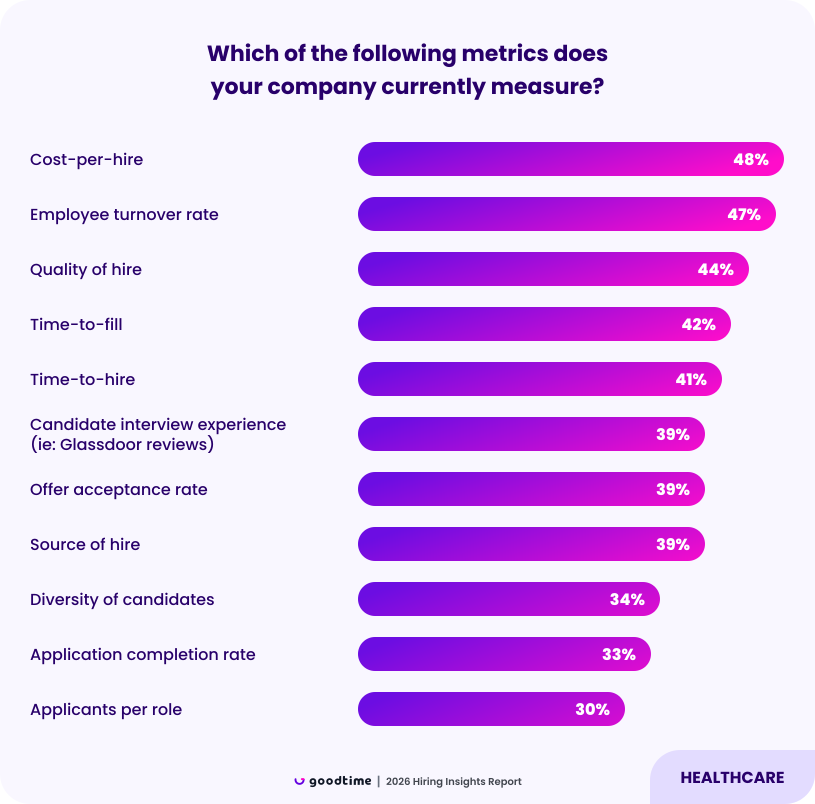
Healthcare hiring teams focus measurement on cost, stability, and outcomes. The most emphasized metrics include cost-per-hire and employee turnover, reflecting concern about the downstream impact of hiring decisions.
Quality of hire and time-based measures such as time-to-hire and time-to-fill also feature strongly. These metrics help teams assess whether hiring processes are producing durable results at a sustainable pace.
Candidate experience and conversion indicators are tracked, but they carry less weight than cost and retention-oriented measures. This suggests that healthcare organizations are primarily trying to control the operational and financial consequences of hiring instability.
2026 healthcare hiring outlook
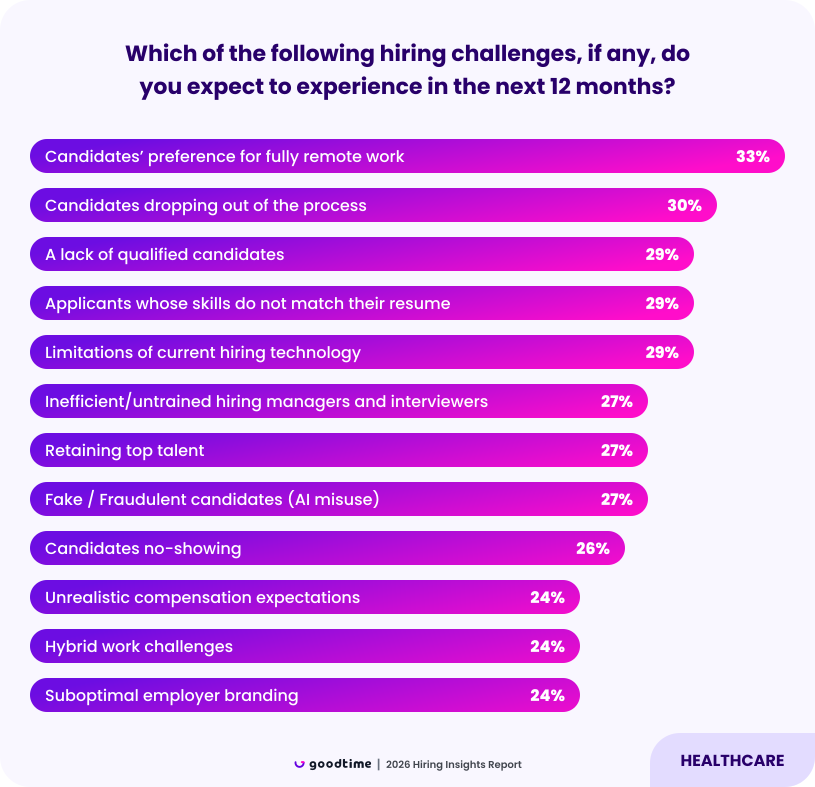
Healthcare leaders expect the same core pressures to persist into 2026. Candidate preferences for fully remote work and continued dropout during the hiring process rise to the top of anticipated challenges.
Lack of qualified candidates and misalignment between skills and resumes remain close behind, indicating little expectation of relief on the supply side. Limitations of existing hiring technology also feature prominently, reinforcing concerns about whether current systems can support faster, more reliable execution.
The outlook reflects caution rather than optimism. Healthcare organizations are preparing for continued friction rather than a return to equilibrium.
2026 priorities
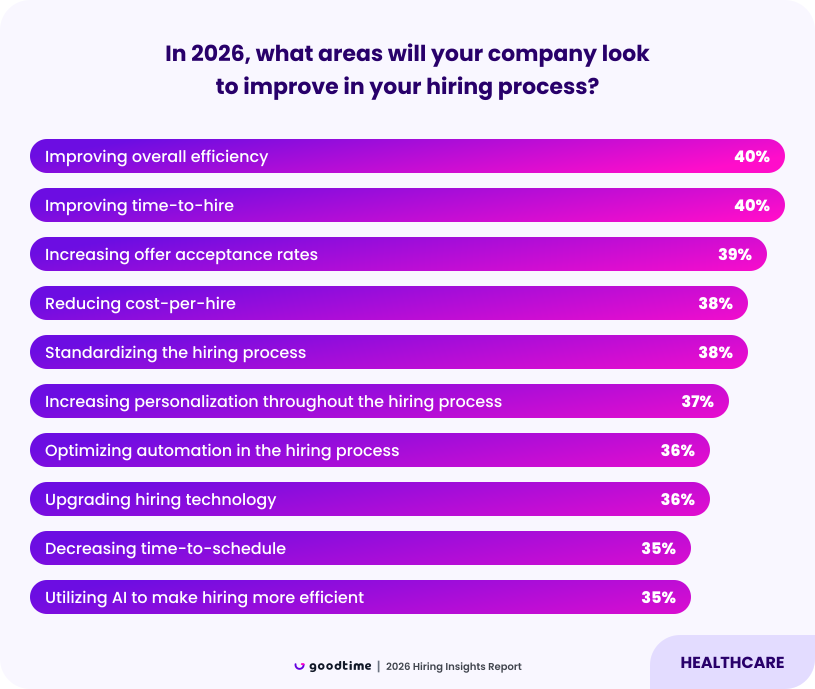
Healthcare hiring priorities for 2026 center on making hiring work more efficiently. Improving overall efficiency leads clearly, followed by reducing time-to-hire and improving offer acceptance.
Cost control and process standardization form the next tier of priorities, reinforcing the focus on repeatability and predictability. Optimizing automation and using AI to improve efficiency appear as enabling strategies rather than headline goals.
Candidate experience and relationship-building are present but secondary. The data suggests that healthcare leaders view experience improvements as the result of faster, more reliable processes, not as standalone initiatives.
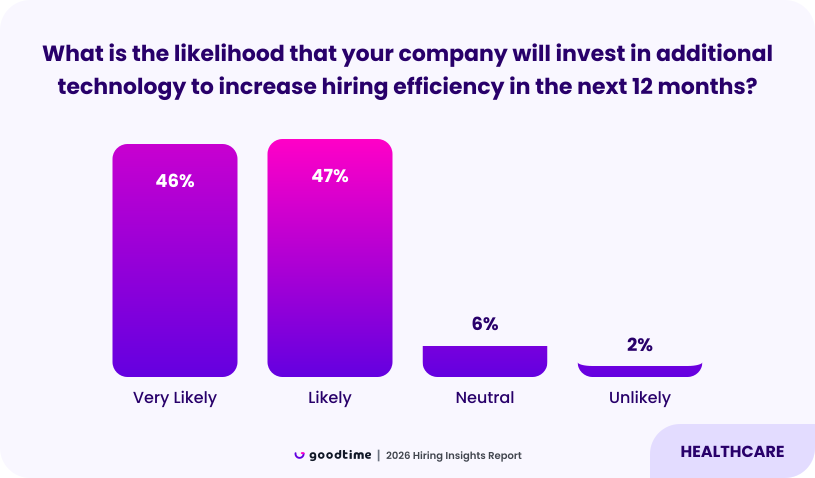
Broad intent to invest further in hiring technology underscores this approach. For healthcare teams, modernization is increasingly seen as a prerequisite for maintaining hiring capacity under sustained pressure.
Final thoughts and key takeaways for healthcare hiring leaders
Address talent scarcity and signal quality at the same time A lack of qualified candidates is the defining challenge in healthcare hiring, but it is compounded by skills mismatch, high applicant volume, and mid-process dropout. Screening rigor and process speed must improve together. Solving only one side of the equation will not materially improve outcomes.
Protect interviewer capacity and decision follow-through. Limited interviewer availability and delayed scorecard completion are the most consistent brakes on hiring speed. Healthcare teams gain more by clarifying interviewer expectations, standardizing feedback workflows, and reducing cognitive load than by adding more candidates to the funnel.
Treat scheduling and coordination as operational infrastructure. Scheduling delays and reschedules are not isolated issues. They reflect fragile coordination across busy clinical stakeholders. Reliable, structured scheduling workflows reduce downstream delays and directly lower candidate dropout.
Use AI to stabilize interviewing and visibility, not to automate judgment. Healthcare teams see the most value from AI when it supports analytics, interview preparation, and coordination. These uses improve consistency and transparency without undermining trust in high-stakes hiring decisions.
Measure outcomes that reflect durability, not just speed. Cost-per-hire, turnover, quality of hire, and time-based metrics dominate healthcare measurement for a reason. They reveal whether hiring decisions hold up under operational pressure. Experience metrics matter, but they follow from reliable execution.
Efficiency is the strategy for 2026. Healthcare leaders are prioritizing efficiency, time-to-hire, and offer acceptance because the system cannot absorb additional friction. Technology modernization and process standardization are increasingly prerequisites for maintaining hiring capacity.
The path forward Healthcare hiring success in 2026 will depend less on market relief and more on operational discipline. Teams that strengthen interviewer readiness, stabilize scheduling, deploy AI for insight, and align metrics with real outcomes will be best positioned to hire consistently in an environment where every delay carries real cost.
Editor’s note: The article below is an excerpt from GoodTime’s 2026 Hiring Insights Report. The entire report is available to view online for free here.
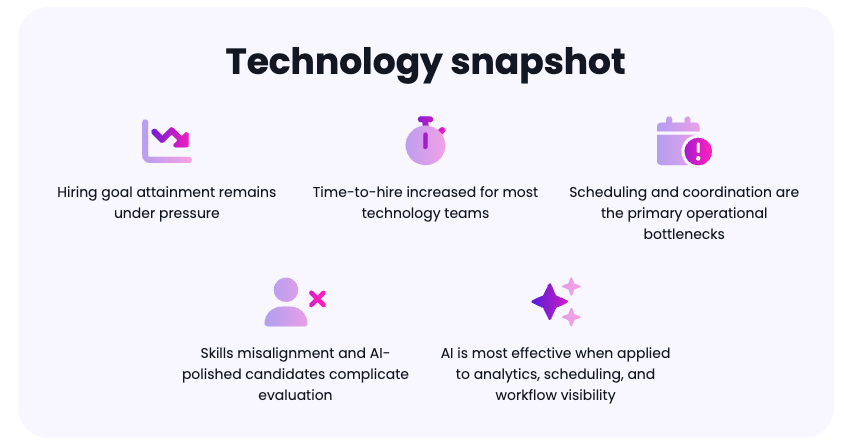
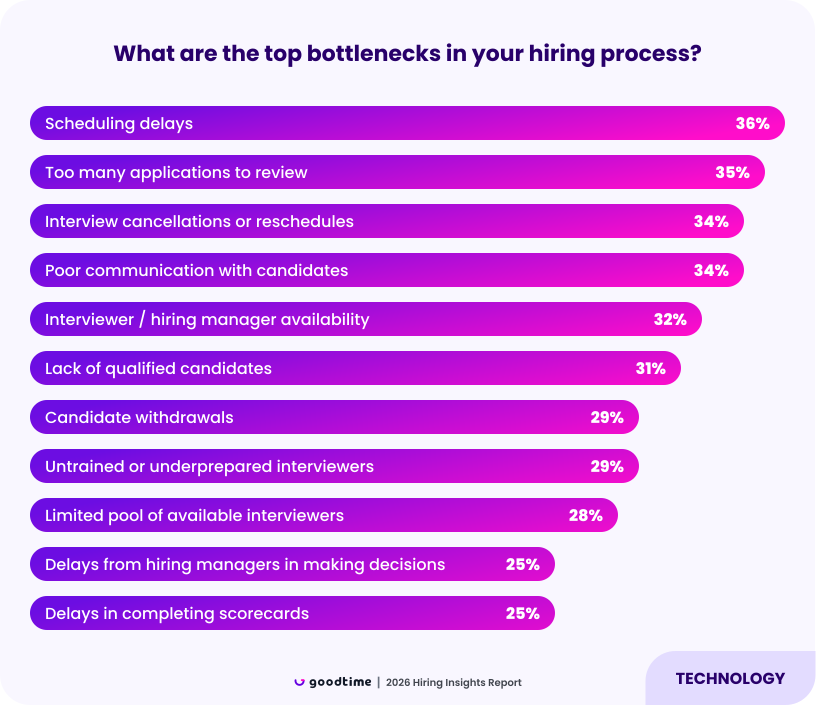
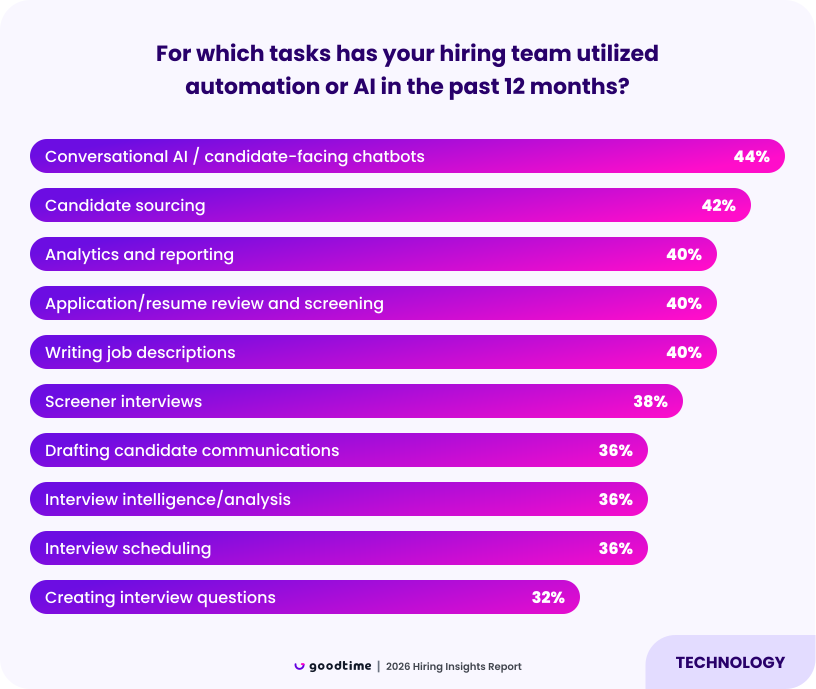
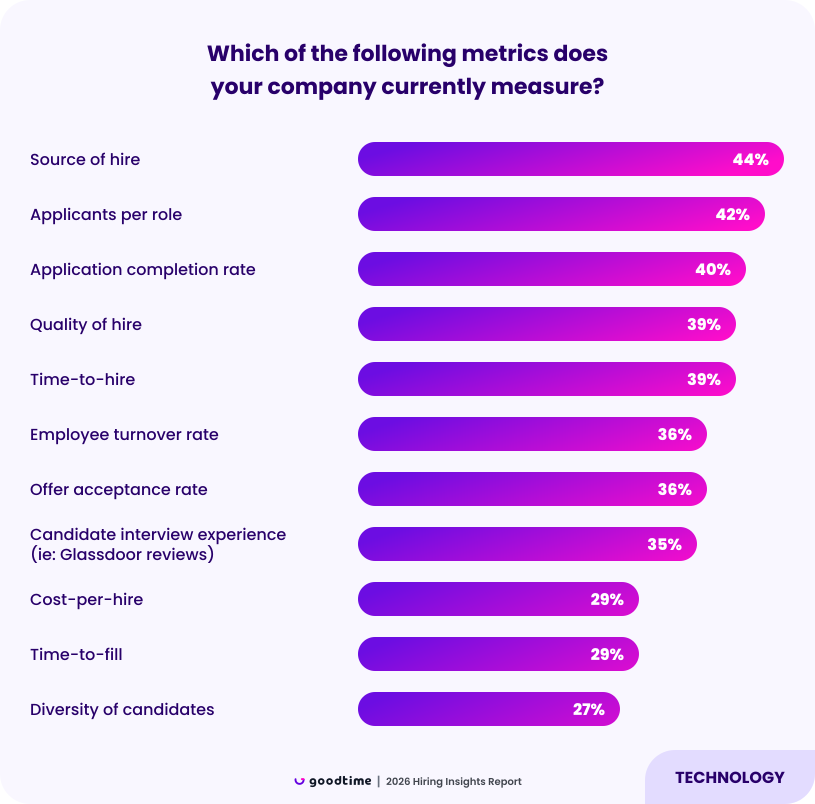
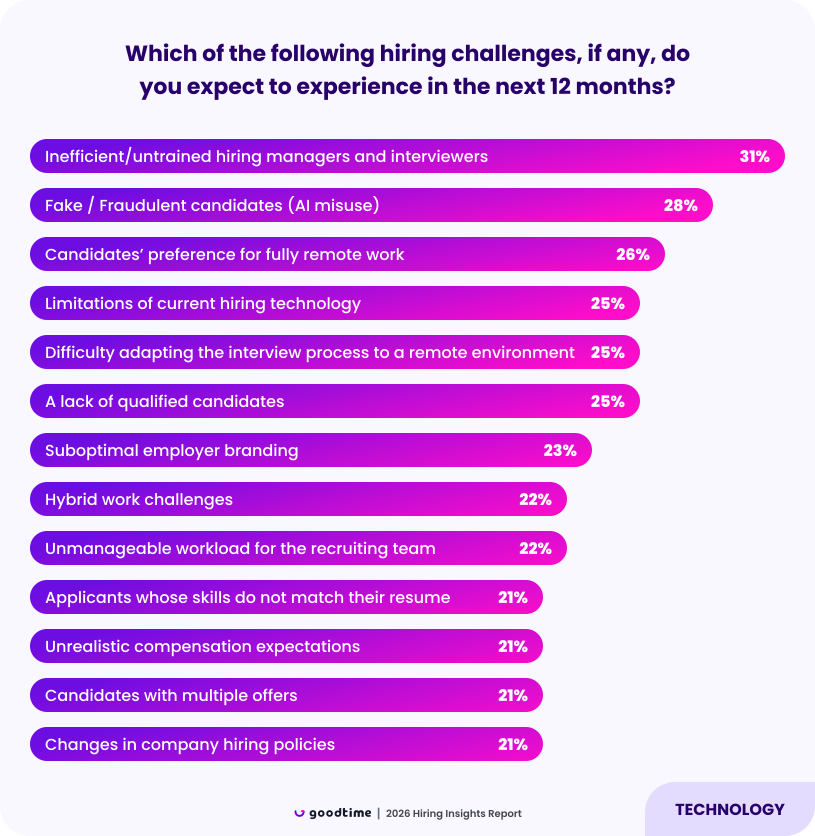
Technology hiring teams enter 2026 operating in a high-expectation, high-friction environment. While demand for technical talent remains strong and AI adoption is widespread, execution challenges continue to limit results. Extended time-to-hire, coordination breakdowns, and declining signal reliability have made it harder for teams to move quickly with confidence.
Despite deep familiarity with hiring technology, most tech organizations have not translated tooling into speed. Scheduling delays, interviewer availability, and inconsistent hiring manager readiness continue to slow progress, particularly in competitive roles where candidates often hold multiple offers. At the same time, skills misalignment and AI-assisted candidate misrepresentation have increased the cost of poor or rushed decisions.
The data shows that success in technology hiring now depends less on adding tools and more on operational discipline. AI delivers the greatest value when applied to analytics, reporting, and scheduling—areas that improve visibility, reduce coordination friction, and support faster decision-making. Teams that focus automation on workflow reliability outperform those that concentrate solely on top-of-funnel activity.
Candidate experience expectations in technology have also narrowed. Speed, transparency, and predictable momentum now matter more than additional touchpoints. Delays in scheduling, feedback, or decisions quickly erode trust and increase drop-off, regardless of employer brand strength.
Looking ahead, technology hiring performance in 2026 will be defined by execution quality. Teams that standardize workflows, strengthen interviewer readiness, modernize scheduling, and use AI as infrastructure, not experimentation, will be best positioned to compete for scarce technical talent.
Unlock 2026’s top hiring strategies: Insights from 500+ TA leaders
Be the first to uncover deep hiring insights specific to your sector — straight from the highest-performing TA teams.
Technology hiring momentum stalled after a brief rebound. In 2023, technology organizations achieved 58% of their hiring goals, the strongest result in the four-year trend. That progress reversed in 2024, with attainment falling to 50% and holding steady in 2025.
The plateau highlights a persistent execution problem. Despite deep familiarity with hiring technology and widespread AI usage, many teams continue to struggle with extended time-to-hire, scheduling delays, and interviewer readiness. These factors compound in competitive technical roles, where candidates often move quickly and disengage when processes slow.
At the same time, skills misalignment and fraudulent candidate profiles have made evaluation more complex, increasing the risk of both false positives and prolonged decision-making. The result is a hiring system that is well tooled, but insufficiently coordinated to translate capability into consistent outcomes.
Core hiring challenges for technology teams
The tech sector’s hiring challenges in 2025 reflect execution friction more than talent scarcity. The most commonly cited challenge was limitations of current hiring technology, signaling that even tech-forward organizations feel constrained by tools that don’t fully support speed, coordination, or decision-making at scale.
Close behind were candidates holding multiple offers and skills misalignment between resumes and actual capability, reinforcing a central tension for technology teams: candidates are moving faster, while signal is becoming harder to trust. Together, these dynamics force teams to slow evaluation and add steps at the very point where speed is most critical.
Brand and funnel quality issues continue to surface as secondary pressures. Suboptimal employer branding and difficulty attracting truly qualified candidates persist, while high applicant volume adds noise rather than relief. More candidates have not translated into better candidates, increasing screening effort and recruiter load.
Operational strain further compounds these challenges. Recruiter workload, interviewer readiness, and internal policy changes all contribute to delays across scheduling, feedback, and decision-making. The result is a hiring process that is well resourced on paper, but increasingly fragile in execution.
“The teams that are pulling ahead treat AI as both a tooling shift and a behavioral one. They set clear principles for how they’ll use AI, build tight operating norms around quality and consistency, and invest in upskilling so people feel confident adopting new workflows.” -Becky McCullough, VP, Talent Acquisition & Mobility, HubSpot
Time-to-hire pressures continue to intensify
Time-to-hire remains a major constraint for technology hiring teams. A clear majority of leaders report longer hiring timelines over the past year, while only a very small share have managed to speed up.
In a sector where candidates often hold multiple offers, these delays are especially costly. Even minor friction in scheduling, feedback, or decision-making can derail otherwise strong candidates.
The takeaway is straightforward: technology teams are not losing talent because of low demand, but because processes are moving too slowly. Reducing time-to-hire will require eliminating coordination friction and improving scheduling and decision velocity across the hiring workflow.
Scheduling and coordination bottlenecks slow tech hiring
The primary bottlenecks in technology hiring are operational, not strategic. Scheduling delays emerged as the most common constraint, closely followed by interview cancellations and reschedules, interviewer availability, and poor communication with candidates. Together, these issues point to coordination breakdowns rather than gaps in intent or effort.
Volume adds friction rather than velocity. Many technology teams report reviewing too many applications, which increases screening time without improving candidate quality. This overload slows progress through the funnel and contributes to delayed feedback and decision-making.
Candidate-side fallout is a direct result. Withdrawals remain common as hiring timelines stretch, while limited interviewer capacity and underprepared interviewers further disrupt momentum. Even when qualified candidates are identified, delays in scorecard completion and hiring manager decisions extend cycles unnecessarily.
Taken together, the data shows that technology hiring is being slowed by workflow mechanics. Without more reliable scheduling, clearer ownership, and faster handoffs between recruiters and interviewers, improvements elsewhere in the process struggle to translate into faster or better outcomes.
Upgrade your hiring journey with AI
GoodTime’s AI agents orchestrate the entire hiring journey — screening, scheduling, messaging, and more — so talent teams hire faster with a better candidate experience.
AI and automation are deeply embedded in tech hiring, but usage patterns reveal a shift from experimentation to practicality. The most common applications center on candidate-facing automation, sourcing, and insight generation, reflecting the sector’s need to move faster while managing increasing complexity.
Technology teams are applying AI across nearly every stage of the hiring lifecycle, from screening and interview preparation to communications and scheduling. Notably, analytics and reporting rank among the top use cases, signaling a growing emphasis on visibility and decision support rather than automation alone.
At the same time, adoption is not limited to back-office tasks. Candidate-facing tools, including conversational AI and automated communications, are widely used to maintain engagement as timelines stretch. Interview intelligence, question generation, and scheduling automation further support consistency in evaluation and reduce manual coordination.
What stands out is not how much AI technology teams are using, but where they are using it. The focus is shifting toward workflow reliability, signal clarity, and faster handoffs between stages. For technology leaders, the takeaway is clear: AI delivers the most value when it strengthens execution and insight, not when it simply adds more activity to the top of the funnel.
The hiring metrics technology teams prioritize
Technology hiring teams continue to track a broad mix of volume, efficiency, and outcome metrics, reflecting the sector’s need to balance speed with signal quality. At the top of the list are funnel visibility measures, including source of hire and applicants per role, underscoring the ongoing effort to understand where candidates are coming from and how demand is shaping pipelines.
At the same time, quality and speed metrics are nearly as prevalent. Quality of hire and time-to-hire are both widely measured, reinforcing how closely technology teams link hiring success to both execution pace and downstream performance. In technical roles, where mis-hires are costly and skills are difficult to validate, these metrics serve as critical checks on decision-making.
Offer acceptance rate and employee turnover rate further reflect the sector’s focus on outcomes beyond the offer stage. Together, these measures help teams assess whether candidates are both choosing the organization and staying once hired, especially in a market where competing offers are common.
Candidate interview experience is tracked by a meaningful share of technology organizations, though it trails operational metrics. Rather than treating experience as a standalone goal, many teams appear to assess it indirectly through funnel conversion and completion rates, using those signals to diagnose friction in the process.
Overall, the metrics landscape in technology hiring suggests a shift toward system-level insight. The most effective teams are using metrics not just to report activity, but to understand where hiring slows, where signal breaks down, and where process improvements will have the greatest impact.
What technology hiring teams expect in 2026
Technology hiring leaders expect internal execution challenges to be the biggest constraint in 2026. Inefficient or underprepared hiring managers and interviewers rank as the most anticipated issue, underscoring how internal readiness continues to slow hiring outcomes.
Concerns around candidate signal and trust are rising. Fake or fraudulent candidates, including those using AI to misrepresent qualifications, are now a top expected challenge, adding pressure to evaluation processes that are already strained by speed requirements.
Work model friction remains unresolved. Candidate preference for fully remote work and ongoing difficulty adapting interviews to remote or hybrid environments continue to complicate coordination and expectation-setting in an increasingly office-first landscape.
Despite years of investment, many leaders still expect limitations in current hiring technology to persist, alongside recruiter workload strain and skills misalignment. Together, these pressures point to a 2026 hiring environment where success will depend less on new tools and more on improving execution, rigor, and workflow reliability.
Where technology teams are focusing in 2026
Technology hiring priorities for 2026 center squarely on execution and efficiency. Improving overall efficiency is the top focus area, signaling broad recognition that existing processes are not scaling effectively in a fast-moving, high-signal-noise environment.
Speed remains a close second. Improving time-to-hire and optimizing automation rank near the top, reinforcing how deeply technology teams feel the cost of slow coordination and delayed decisions. Rather than chasing speed in isolation, leaders are prioritizing changes that reduce friction across the hiring workflow.
Candidate experience continues to matter, but it is increasingly defined by clarity, responsiveness, and momentum. Improving experience and increasing personalization remain important, though they trail efficiency-focused initiatives. This suggests that tech teams see experience as an outcome of better execution, not a standalone effort.
Technology modernization remains a meaningful, but not dominant, priority. Upgrading hiring technology and using AI to make hiring more efficient both rank mid-pack, reflecting a shift from acquiring tools to extracting more value from what teams already have. Standardization and time-to-schedule improvements appear lower on the list, but still reinforce the broader emphasis on workflow discipline.
Taken together, the priorities signal a pragmatic reset. Technology hiring teams are not chasing transformation for its own sake. In 2026, they are focused on tightening systems, moving faster with confidence, and making existing technology work harder to deliver consistent results.
Final thoughts and key takeaways for technology hiring leaders
Execution, not access to tools, is the defining challenge for technology hiring. Despite widespread AI adoption and strong familiarity with hiring technology, most tech teams continue to struggle with speed, coordination, and decision confidence. The gap is no longer about capability; it is about how reliably hiring systems operate under pressure.
Treat scheduling as core infrastructure. Scheduling delays, cancellations, and interviewer availability issues are the most consistent drivers of extended time-to-hire and candidate drop-off in tech. Automating coordination and reducing manual handoffs unlocks more speed than adding candidates or sourcing tools.
Strengthen signal validation without slowing the process. Skills misalignment and AI-assisted candidate misrepresentation are now central risks. Technology teams must reinforce structured interviews, clearer scorecards, and consistent evaluation standards while maintaining momentum for candidates with multiple options.
Use AI where it improves visibility and workflow reliability. The strongest impact comes from AI applied to analytics, reporting, and scheduling. These uses surface bottlenecks, improve decision-making, and reduce coordination load. Automation that only increases top-of-funnel activity does not address core constraints.
Redefine candidate experience around speed and clarity. For tech candidates, experience is shaped less by personalization and more by responsiveness, transparency, and predictable movement through the process. Fast scheduling, timely communication, and clear next steps matter more than added touchpoints.
Measure the system, not just the activity. Technology leaders are increasingly anchoring on quality of hire, time-to-hire, offer acceptance, and funnel health metrics. These measures reveal where execution breaks down and whether hiring outcomes hold up after the offer stage.
The path forward
Technology hiring teams that standardize workflows, modernize scheduling, deploy AI as operational infrastructure, and align metrics with execution reality will be best positioned to compete in 2026. In tech, hiring advantage now comes from discipline, reliability, and speed with confidence—not from adding more tools to an already complex system.
Editor’s note: The article below is an excerpt from GoodTime’s 2026 Hiring Insights Report. The entire report is available to view online for free here.
Manufacturing hiring teams enter 2026 with improved outcomes but rising operational strain. Hiring goal achievement increased in 2025, reaching the strongest level shown in the multi-year trend. However, this improvement occurred alongside mounting execution challenges that threaten sustainability.
The most prominent pressure point is recruitment team turnover, which leads all reported changes affecting candidate flow. At the same time, manufacturing leaders describe a fragmented talent market, with some roles becoming more competitive while others see increased availability. This split environment makes consistency harder to maintain and places greater demand on hiring systems and recruiter capacity.
Across the process, leaders report higher candidate demands, more required touchpoints, and increased dropout, signaling that speed and coordination now play a larger role in conversion. In response, manufacturing organizations are prioritizing efficiency, personalization, and technology upgrades as foundational capabilities for 2026.
Unlock 2026’s top hiring strategies: Insights from 500+ TA leaders
Be the first to uncover deep hiring insights specific to your sector — straight from the highest-performing TA teams.
Manufacturing hiring performance strengthened in 2025. The data shows a clear year-over-year increase in hiring goal achievement, reversing the prior year’s decline and marking the strongest result in the period shown.
This improvement is notable, but it does not signal reduced complexity. Instead, the performance gains appear to have been achieved under more demanding conditions, with teams absorbing higher workload, more variability in candidate quality, and greater internal disruption.
The takeaway is not that manufacturing hiring became easier, but that teams pushed harder and adapted, even as the operating environment grew more fragile.
Manufacturing hiring became harder to run, even as conditions diverged
Over the past year, manufacturing hiring has been shaped less by a single market shift and more by internal instability and rising execution demands. The most widely reported change is increased recruitment team turnover, which has directly affected teams’ ability to manage candidate flow. This stands above all other shifts and signals a loss of continuity at the exact moment hiring processes require more coordination and speed.
At the same time, the talent market itself has fractured. Nearly as many leaders say hiring became more competitive due to increased demand as those who say it became less competitive because more talent is available. Rather than moving in one direction, manufacturing hiring conditions now vary by role, location, and skill set, forcing teams to operate in multiple modes at once.
Candidate-side expectations have risen in parallel. Building meaningful relationships and connecting with candidates quickly both increased in importance, alongside growing candidate demands and the need for more touchpoints throughout the process. These pressures point to higher engagement requirements rather than easier access to committed talent.
The cumulative effect is visible in hiring speed. Time-to-hire lengthened for most manufacturing organizations, while only a small minority saw improvement. This slowdown aligns with the broader picture the data paints: manufacturing teams are managing more complexity with less stability, and even incremental delays now have outsized impact on outcomes.
Together, these signals describe a hiring environment where process resilience matters more than market timing. Manufacturing hiring has not simply become more competitive or less competitive. It has become harder to execute consistently under mixed conditions, higher expectations, and ongoing internal disruption.
Coordination breakdowns, not sourcing alone, slow manufacturing hiring
Manufacturing hiring bottlenecks concentrate in the interview and decision stages, where coordination breaks down most often. Interview cancellations and reschedules lead the list, followed closely by delays in hiring-manager decisions and a limited pool of available interviewers. These signals point to fragile handoffs and heavy reliance on busy stakeholders.
Lack of qualified candidates remains a meaningful constraint, but it sits alongside conversion issues such as candidate withdrawals and delayed scorecard completion. This indicates that hiring slows not only at the top of the funnel, but as candidates move through the process.
Scheduling delays, high application volume, and poor communication with candidates further compound these issues, increasing the risk of disengagement. Taken together, the data shows a hiring system strained by multiple dependencies, where improving reliability and follow-through is as important as expanding access to talent.
Upgrade your hiring journey with AI
GoodTime’s AI agents orchestrate the entire hiring journey — screening, scheduling, messaging, and more — so talent teams hire faster with a better candidate experience.
Manufacturing teams apply AI where it reduces coordination and manual work
Automation and AI use in manufacturing centers on improving visibility, coordination, and consistency, rather than fully automating hiring decisions. Analytics and reporting lead all use cases, signaling a focus on understanding where hiring slows and how work is distributed.
Interview scheduling sits near the top, reflecting the operational pressure to reduce back-and-forth coordination. Content-related tasks follow closely, including writing job descriptions and creating interview questions, suggesting teams are using automation to standardize inputs and reduce preparation time.
Screening and sourcing applications form a broad middle tier. These uses help manage volume, but they do not dominate adoption in the same way operational tasks do. Interview intelligence and analysis also appear at similar levels, indicating growing interest in extracting insight from interviews, even if adoption is still uneven.
Candidate-facing automation and drafting candidate communications trail the rest, while screener interviews appear lowest. Overall, the pattern shows manufacturing teams using AI as workflow infrastructure, prioritizing time savings and process stability over high-risk automation of candidate interactions.
Manufacturing teams measure outcomes that reflect durability and conversion
Manufacturing hiring teams focus measurement on whether hires stick and offers convert, rather than on early-stage activity alone. Quality of hire leads all tracked metrics, indicating a strong emphasis on long-term fit and performance. Cost-per-hire, offer acceptance rate, and time-to-hire form the next tier, reflecting the dual pressure to control cost while moving quickly in a competitive environment. These measures sit at the intersection of efficiency and effectiveness, reinforcing that speed without conversion is not sufficient.
Diversity of candidates and employee turnover also appear prominently, signaling attention to workforce stability and composition beyond immediate hiring volume. Time-to-fill and application completion follow, suggesting growing but secondary interest in funnel mechanics.
Candidate interview experience and applicants per role trail the core outcome metrics, while source of hire appears lowest. Overall, the pattern shows manufacturing teams prioritizing results and sustainability over activity tracking, using metrics to evaluate whether hiring efforts produce durable outcomes rather than just throughput.
Manufacturing leaders expect volume, verification, and retention pressure in 2026
Looking ahead to 2026, manufacturing leaders anticipate a hiring environment defined by volume and complexity rather than pure scarcity. The most frequently expected challenge is an overwhelming number of applicants, signaling continued pressure on screening capacity and funnel management.
Just behind that top concern is a cluster of risk and retention issues. Retaining top talent and managing fake or fraudulent candidates rank at the same level, alongside skills that do not match resumes. Together, these responses point to growing concern about signal quality and trust in the hiring process.
Execution challenges remain prominent. New hires failing to show up, candidates dropping out mid-process, and limitations of current hiring technology all feature strongly, reinforcing that conversion and follow-through are expected to remain fragile.
A lack of qualified candidates appears, but it no longer stands alone as the dominant expected issue. Instead, it sits among a broader set of operational and verification challenges. Hybrid work complexity, recruiter workload, and internal policy changes round out the list, suggesting that 2026 risk is distributed across many points in the system, rather than concentrated in a single bottleneck.
Overall, manufacturing leaders appear to be preparing for a year where managing volume, validating candidates, and retaining talent will require as much attention as sourcing itself.
Priorities for 2026 center on conversion, automation, and technology investment
Manufacturing leaders are entering 2026 with a clear improvement agenda focused on converting candidates more reliably and reducing friction across the hiring process. The top area of focus is increasing offer acceptance, signaling that getting candidates across the finish line is a bigger concern than generating initial interest.
Automation and technology upgrades sit immediately behind that top priority. Optimizing automation, upgrading hiring technology, and using AI to improve efficiency all rank near the top, indicating that manufacturing teams view tooling as a necessary lever to handle volume, speed, and coordination challenges.
Candidate experience and time-to-hire also feature prominently, reinforcing that engagement and speed are tightly linked. Standardizing the hiring process and increasing personalization follow, suggesting a push toward consistency without fully sacrificing flexibility.
Cost reduction and scheduling-specific improvements appear lower, indicating that manufacturing teams are prioritizing effectiveness before efficiency gains at the margins.
That prioritization is reinforced by investment intent. Most manufacturing organizations indicate they are likely or very likely to invest in additional hiring technology to increase efficiency in 2026. Neutral or negative sentiment is minimal, underscoring a broad consensus that existing systems are insufficient for the demands ahead.
Together, these signals point to a sector that is not experimenting cautiously, but actively preparing to modernize hiring operations to support higher expectations, heavier volume, and more complex decision-making.
Final thoughts and key takeaways for manufacturing hiring leaders
Stability matters as much as talent access. Recruitment team turnover is the most disruptive force shaping manufacturing hiring today. Even as hiring outcomes improved in 2025, instability inside TA teams makes it harder to sustain progress. Process reliability and knowledge continuity are now strategic assets.
Fragmented markets demand flexible execution. Manufacturing hiring is no longer uniformly competitive or relaxed. Leaders report both increased competition and increased talent availability, depending on role and location. Teams that rely on a single hiring motion struggle; those that can adapt speed, screening rigor, and engagement by role are better positioned to convert candidates.
Coordination failures are the biggest drag on speed. Interview cancellations, limited interviewer availability, and delayed decisions outweigh sourcing alone as bottlenecks. Improving follow-through in the interview stage unlocks more value than expanding the top of the funnel.
Engagement is about momentum, not messaging. Candidates require faster connection, more touchpoints, and clearer progress signals. Dropout rises when coordination falters. Manufacturing teams see better engagement when they remove delays rather than add personalization.
Use AI to harden workflows, not replace judgment. Manufacturing teams are applying AI most effectively where it improves visibility, scheduling, preparation, and consistency. These uses reduce recruiter load and stabilize execution without introducing risk into candidate-facing decisions.
Measure what holds up over time. Quality of hire, offer acceptance, time-to-hire, and turnover dominate manufacturing measurement for a reason. These metrics reveal whether hiring decisions convert and endure, not just whether activity occurred.
Modernization is no longer optional. Manufacturing leaders are prioritizing automation, technology upgrades, and efficiency improvements because existing systems cannot absorb higher volume, verification risk, and execution complexity. Investment intent is strong because operational strain is real.
The path forward
Manufacturing hiring success in 2026 will depend less on market relief and more on system design. Teams that protect recruiter continuity, stabilize interview coordination, deploy AI as workflow infrastructure, and align metrics with durable outcomes will be best positioned to hire consistently in a fragmented, high-pressure environment.

 Efficiency
 Experience
 Intelligence