This month, we’ve worked tirelessly to roll out features and enhancements that we’re thrilled to share with you. Get ready for a deep dive into what’s new and improved in GoodTime, including:
Calendar View and an updated timezone display are now available on the Confirmed Interview screen.
More error guidance is now available to ensure more interviews get scheduled faster than ever.
Email domain authentication is now available within GoodTime to ensure all your email deliverability needs are met.
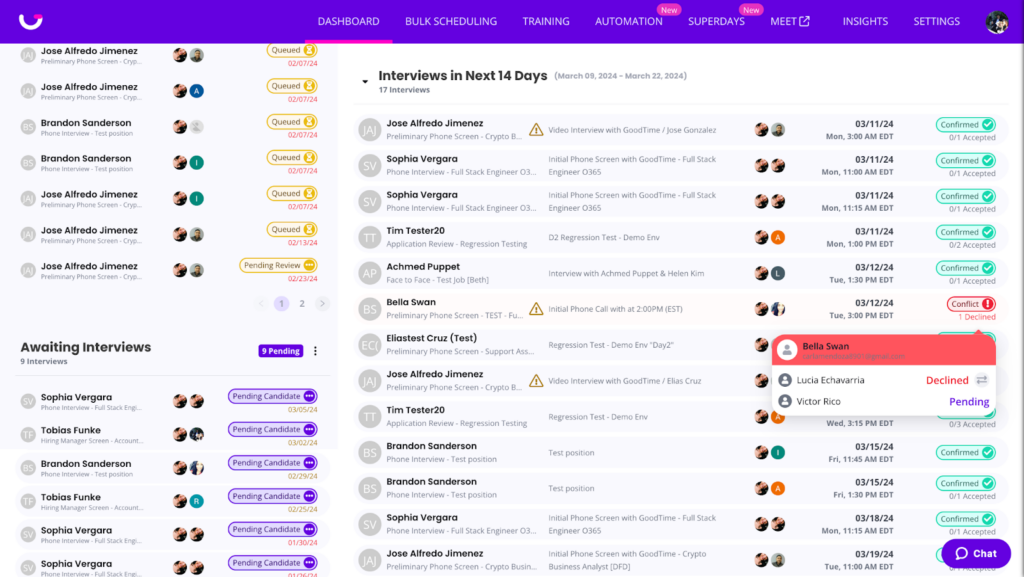
Dashboard updates include new features such as 1-click swapping of interviewers and more.
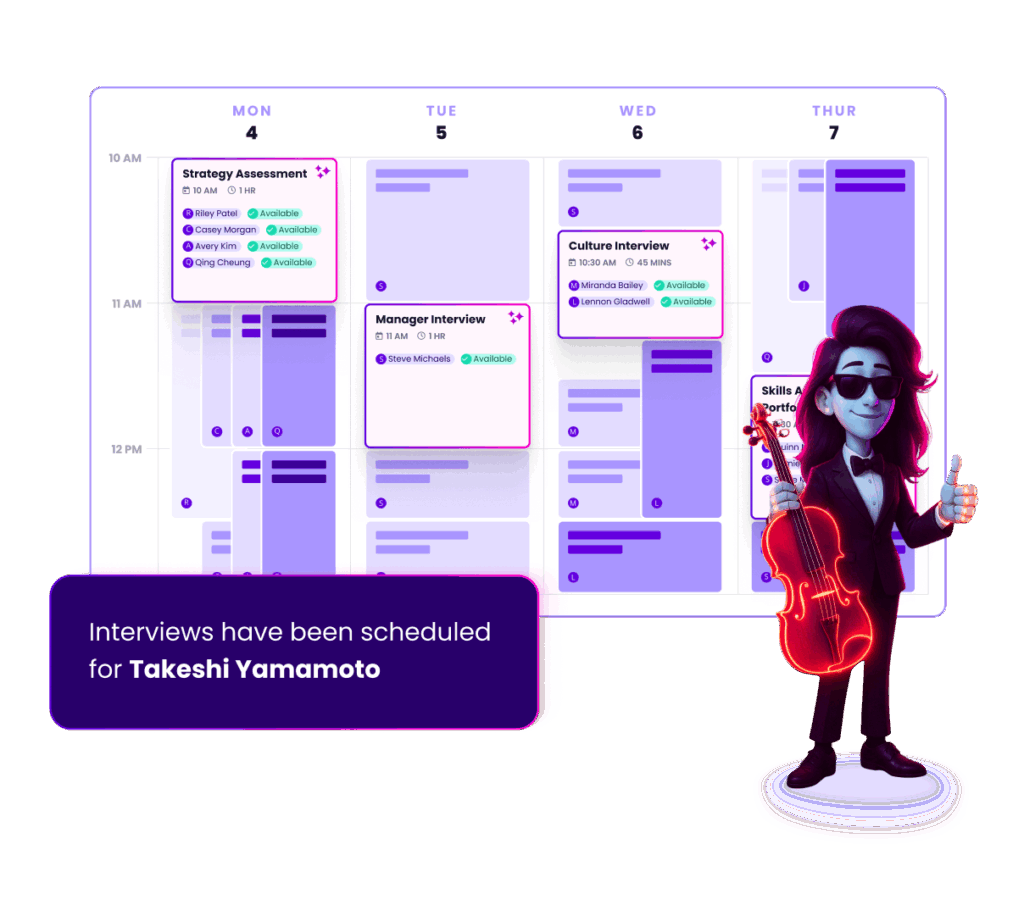
Our Superday redesign allows you to schedule thousands of candidates in a single workflow.
Watch the March 2024 GoodTime product updates webinar or keep scrolling for highlights
Calendar View and updated timezone display
Confirmed interviews now have an all-new display view that not only clearly shows all the relevant time zones for each participant, but also lets RCs update the interview with within the new Calendar View.
Why this is awesome: This revamp eliminates misunderstandings and saves tremendous time on interview adjustments!
More error guidance
Last month we were excited to share error guidance on double bookings. This month we are continuing this thread with error guidance on incompatible settings.
Why this is awesome: Understanding why an interview configuration doesn’t work can be time-consuming. GoodTime saves that hassle for you so you can schedule more interviews in less time, and with a higher success rate!
Email authentication
Email services like Google and Yahoo are imposing stricter requirements for incoming email to not be flagged as SPAM. GoodTime is on it, with a whole new email authentication service so that you can be sure emails sent from all your domains are cleared for receipt by your candidates.
Why this is awesome: All the searching, coordinating, and interview prep in the world won’t help if you aren’t able to reach your candidates. Email isn’t just awesome, it’s critical. Read more about how to ensure your email settings are optimized in GoodTime.
Dashboard updates
We’ve continued to listen to feedback from Early Access users and have added more features to the dashboard, such as messaging and quickly swapping out interviewers.
Why this is awesome: The new features are designed to help you take action when you need to. Easily swap out a declined interviewer, or send a text to the candidate to provide an update, all with a single click.
Superdays overhaul
We’ve updated the design on the Superdays dashboard while re-architecting the product to support even the largest events!
Why this is awesome: Creating events used to be manual, but now with templates, it’s a breeze to get events up and running. With our new approach to interview scheduling, the product supports scheduling thousands of candidates in a single workflow.
Even more updates!
Email addresses in CSV downloads In addition to user names, the Interviewer Leaderboard & Recruiting Leaderboard now also contains emails of each interviewer / recruiter.
Timezone Added To Candidate Portal The candidate can now see and switch the timezone of their interview times for upcoming interview in Candidate portal.
Timezone Picker for Data & Insights Reports historically showed all events in UTC timezone but now have a timezone picker that can be set to any value needed.
Reschedule Now Possible With Require Review On Candidates can once again re-submit availability for confirmed interviews that have Require Review turned on. The reschedule button is also available on Candidate Portal.
Job Filters in Insights Now Track Historical Job Names Now you can filter on all historical names that a job had, or just individual names it had throughout time.
Start using the latest GoodTime features!
We want to help you evolve and take full advantage of the latest upgrades and improvements to our platform. Check out the GoodTime support center for tutorials and tips to help you stress less and get more done!
The world’s largest companies must hire across borders, time zones, and cultures to create resilient, strong, specialized teams. Sound complicated? It is.
Enterprise recruitment isn’t a matter of building and repeating a single hiring process. Large companies can (and should!) embrace some repeatable, standardized hiring processes for high-volume roles, but to attract and vet the world’s top talent for executive positions, they also need to remain extremely adaptable and flexible — which is a major feat in a highly-matrixed organization with a lot of red tape.
For our 2024 Hiring Insights Report, we took a special look at just enterprise hiring — at companies of 5,000 or more employees — to reveal their unique challenges, what sets them apart from other companies, and how the high-achievers hit hiring goals in a challenging market.
In this article, we’ll use those insights to give you a speedrun overview of enterprise talent acquisition. Let’s dive in!
Unlock 2026’s top hiring strategies: Insights from 500+ TA leaders
Be the first to uncover deep hiring insights specific to your sector — straight from the highest-performing TA teams.
Let’s start with a bird’s-eye view of where enterprise hiring stands today.
Enterprise hiring goal attainment in 2024.
Despite achieving a slightly higher hiring fulfillment of 53.8% than other types of organizations, enterprise organizations continue to face challenges in finding and retaining the best-fit talent. Topping the list of headaches for 31% of our surveyed captains of industry? Talent retention. A lack of qualified candidates (27%) and unrealistic compensation expectations (27%) were other challenges cited by survey participants. However, these challenges also present opportunities for strategic innovation and intervention in recruitment.
The report also sheds light on areas where enterprise talent acquisition (TA) teams focused their strategies in 2023. Notably, 37% of survey respondents aimed to improve their time-to-hire, highlighting how important speed is in acquiring top-tier talent.
The report reveals a commitment to building on last year’s successes, with 39% of respondents aiming to grow offer acceptance rates and 38% aiming to standardize the hiring process. This strategic approach suggests that enterprise organizations desire to refine and optimize recruitment strategies based on past learning.
Enterprise hiring challenges in 2024.
Understanding enterprise hiring process
While enterprise hiring is highly complex, it is understandable. It’s helpful to think of it fundamentally as a step-by-step journey, tailored to align with an organization’s specific needs and budget constraints, all aimed at securing the ideal candidates for open roles.
That said, it’s a delicate balancing act, one that evolves constantly. Let’s delve into each of the processes involved in enterprise hiring, and focus on the shifts that occurred over the last year or so.
1. Planning and strategy development
The first step covers careful planning and strategy intervention. Hiring managers and TA professionals prioritize identifying workforce needs, focusing on critical roles without compromising low-critical positions. Once roles have been identified, the TA team delves into defining the job requirements and creating detailed job descriptions.
This planning ensures that the organization will attract well-suited talent while also establishing expectations for successful onboarding. This plan also covers the budgeting and timeline requirements, identifying which region(s) to hire from, job postings, recruitment events, and background checks.
2. Connecting with top applicants
This phase is all about deploying a dynamic mix of strategies to reach the cream of the crop in the talent pool. Recruiters are increasingly turning to an eclectic blend of channels, from the traditional job boards to more unconventional platforms like podcasts and billboards, not to mention the ever-expanding realm of social media.
However, the key to attracting and securing the right candidates goes beyond just casting a wide net. It’s about the finesse in how an organization presents itself – the compelling allure of well-crafted job postings, the magnetic appeal of a thoughtfully designed career site, and the influential power of a strong employer brand. These elements don’t just catch the eye of potential candidates; they play a pivotal role in transforming an interested applicant into a fully engaged employee.
3. Screening applicants
With the rise of remote work opportunities, talent acquisition professionals faced increased applicant volume. Our reports cited that 21% of hiring professionals experienced remote work compensation expectations as one of their hiring challenges over the past year. This is crucial to ensure that screening the candidates’ resumes is also aligned with the organization’s needs. Although reviewing resumes is common, inviting applicants to pre-employment tests and assessments ensures a broader evaluation of knowledge, skills, and behavior.
Our report found that 20% of enterprise recruiting professionals cited applicants whose skills do not match their resume as one of their hiring challenges.
This is where reference calls come into play to confirm applicants’ details and discover any discrepancies. Screening strategies must align with anti-discrimination laws, focusing on behaviors and skills aligned to the open roles, enhancing diversity and inclusion, and decreasing bias in hiring candidates for a more equitable workforce.
4. Interview
In this next step, talent acquisition professionals must carefully define the process, including the format and the questions asked during the interview. Traditional questions may serve as an introduction, but behavioral questions, including candidates’ previous work experiences and hypothetical scenarios, will provide deeper insights into candidates’ proficiency and qualifications for the open position.
5. Selection and job offer
Once the enterprise TA teams have carefully selected shortlisted candidates and offered the job, they must ensure a positive candidate experience during onboarding. Drafting a comprehensive job offer letter, including congratulations and clear job details, sets the tone for the employee. Responsiveness during negotiations indicates how much the organization values its people.
What should successful onboarding look like? It includes meet-and-greets, goal setting for the first thirty days, and ongoing support from various departments. This should also include a 90-day check-in to nurture employee engagement and success from the start.
Strategies for smarter enterprise talent acquisition
As enterprise organizations move forward into 2024 with their recruitment endeavors, we see that more companies are adopting a forward-looking approach and expanding on the achievements of the previous year. While notable progress has been made, there remains a collective effort among these large organizations to improve enterprise talent acquisition.
Our report asked companies what they want to improve next year. They said that they want to make hiring better in many ways. Here are the areas that enterprise organizations are looking to improve in the next 12 months.
Speed, efficiency, and candidate experience were top focus areas for enterprise TA in 2024, supported by efforts to upgrade or better leverage technology.
Challenges in modern enterprise recruitment
Large organizations encounter diverse challenges that require strategic inspection and adept resolution in navigating the modern landscape of enterprise recruitment.
Brenda Purvis, Principal Consultant for Enterprise Talent Strategy at Kaiser Permanente, noticed that most recruitment teams still get stuck with tedious, time-consuming administrative tasks. “How do we make sure that we’re looking at our recruiting teams and equipping them to really reduce the time spent in all of those phases?” she asked.
Below, let’s explore below the prevailing challenges large organizations encounter in enterprise recruitment and delve into our proposed solutions to navigate these dynamic hurdles adeptly.
“Time is the element that we can have some control over. How do we make sure that we’re looking at our recruiting teams and equipping them to really reduce the time spent in all of those phases?”
Brenda Purvis, Principal Consultant for Enterprise Talent Strategy | Kaiser Permanente
Balancing budgets and role alignment
In an era of economic uncertainty and intense competition for best-fit candidates, McKinsey’s report highlighted the paramount challenge companies face in strategically aligning budgets while securing talent-role alignment. The report showed that 20-30% of crucial positions are occupied by individuals who may not be fit for the role.
Our report highlighted the same challenge, where 20% of the survey respondents cited applicants whose skills do not match their resume as one of their hiring challenges in the past 12 months.
Skill shortages
Unprecedented skill shortages pose a formidable challenge, with nearly 75% of TA professionals acknowledging that their organizations grapple with this issue. A staggering 78.2% foresee skills shortages as one of the top three imminent challenges.
Our report has cited this as another challenge of hiring professionals, where 27% of the respondents cited a lack of qualified candidates as one of their hiring hurdles over the past year.
Bridging the diversity, equity, and inclusion (DEI) divide
Despite claims of prioritizing diversity, equity, and inclusion (DEI), there’s a notable gap between organizational values and practical implementation. A concerning 39% of jobseekers decline opportunities due to perceived DEI shortcomings. In this talent-centric market, enterprises must commit to fostering truly inclusive workforces.
Strategic focus on hiring excellence
Enterprise organizations understand that there needs to be an improvement in their talent acquisition efforts. Based on our insights report, 36% of hiring professionals believed that they must improve their time-to-hire, 38% cited that they will still improve in standardizing their hiring process, and 36% emphasized improving their candidate experience.
Looking ahead, in the next 12 months we’ll see a heightened focus from enterprise organizations on increasing offer acceptance rates (39%) and building relationships with candidates (37%). Strategic investments in technology for efficiency and candidate experience are paramount to overcoming these challenges.
Hence, survey participants highlighted a strategic emphasis on communication within enterprise organizations, with a significant 58% expressing a preference for utilizing company sites or dedicated texting software. This statistic signals a proactive approach towards optimizing internal and external interactions, showcasing a commitment to staying abreast of evolving communication trends within the professional landscape.
Lastly, a dedicated commitment to diversity, equity, and inclusion (DEI) initiatives will bridge the gap between organizational values and practical implementation, fostering a more inclusive workforce in this talent-centric market.
Technology’s role in enhancing recruitment
Technological advancements play a pivotal role in reshaping enterprise recruitment. The 2024 report showcases how organizations have prioritized technology-driven improvements. From employing the latest software for interview scheduling to utilizing AI for increased efficiency, enterprise TA teams are leveraging innovation to stay competitive.
Technological advancements play a huge role in reshaping the enterprise talent acquisition teams’ endeavors. Our 2024 report reveals how organizations have emphasized their priorities in technology-driven improvements. 23% of enterprise organizations were more likely to use centralized text recruiting software to communicate with their candidates via SMS compared to other organizations.
In our report, when asked, “What areas in your hiring process did your company look to improve in the past 12 months?” 32% of the respondents cited utilizing AI to make hiring more efficient.
Founder of Cassilion.AI Jonathan Wall advised, “We should be leveraging automation and AI to do those things that aren’t fun. They kind of keep us from doing the things that really are our superpowers. We’re people people. The message I would give is to leverage all of those tools so that you can have higher-quality human interactions.”
Predictions for the future of enterprise recruitment
Large organizations are keen to double down on successful strategies from the previous year, specifically focusing on improving offer acceptance rates and standardizing the hiring process. We believe that this will change the way candidates view large organizations’ approach to acquiring the best talent in today’s talent-centric market.
With employers increasingly embracing a mobile-first strategy in candidate selection, applicants can now expect swift and efficient communication at every stage of the hiring journey. This shift will enhance the overall candidate experience and significantly mitigate the occurrence of no-shows and dropouts.
By streamlining communication through mobile platforms, employers can keep applicants engaged and informed, reducing frustration associated with delays in the recruitment process. This mobile-centric approach aligns with the modern workforce’s expectations, fostering a more dynamic and responsive hiring environment that benefits employers and candidates alike.
Final thoughts: The enterprise is poised for a massive hiring efficiency boost
The 2024 Hiring Insights Report serves as a peek into the intricate maze of enterprise recruitment, offering a deep dive into the challenges and triumphs of talent acquisition. In its pages, we’ve spotlighted a range of strategic solutions tailored for the unique demands of hiring for large, global organizations.
But that’s not all. The report also underscores the transformative impact of technology advancements in recruitment. These innovations are reshaping the way hiring managers and recruiters engage with candidates, marking a significant shift in communication and interaction dynamics.
We strongly recommend industry professionals to view this report as more than just a collection of insights. It’s a navigation tool, designed to steer the talent acquisition strategies of enterprise organizations towards more effective and efficient horizons, aligning seamlessly with their demands and aspirations.
GoodTime’s 2024 Hiring Insights Report: Healthcare Edition unveils how AI and automation have become vital tools for healthcare organizations struggling to fill crucial roles in a tight labor market.
San Francisco – March 12, 2024
In the face of an acute healthcare labor shortage, the 2024 Hiring Insights Report: Healthcare Edition, published today by GoodTime, reveals how healthcare talent acquisition (TA) teams harnessed AI and automation to address critical hiring challenges.
With the US Department of Labor projecting a shortage of 195,400 nurses by 2031 and a 37% increase in demand for home health aides, the report, based on a survey of 105 TA leaders in the healthcare sector, underscores the urgency for innovative hiring strategies to combat the labor crunch.
Key findings from the report:
100% of healthcare TA teams surveyed utilize some form of automation or AI for hiring.
Hiring goal attainment dipped to 45.6% in 2023.
The sector’s top challenges include sourcing qualified candidates, work-life balance, and adapting to remote or hybrid interview processes.
50% of healthcare organizations experienced layoffs in 2023.
97% of healthcare TA leaders plan to invest in more hiring technology in 2024.
Healthcare’s strategic response:
In the face of seemingly insurmountable challenges, the healthcare sector’s TA leaders have embraced:
AI-driven improvements in application and resume screening, and interview preparation.
A shift towards enhancing candidate experience and more efficient interview scheduling.
A move to standardize hiring processes for greater efficiency and fairness
“The healthcare sector is at a pivotal moment in grappling with a skilled labor shortage. Our report highlights how healthcare organizations are turning to AI and automation with optimism to navigate these challenges,” said Ahryun Moon, CEO & Co-Founder of GoodTime. “By optimizing their hiring processes with technology, they can focus on making meaningful connections with candidates that help them secure crucial talent in a lean market.”
GoodTime helps talent acquisition teams hire up to 50% faster by automating interview scheduling, candidate communications, and more. Hundreds of the world’s leading companies including Slack, Sony Interactive Entertainment, Lyft, Shopify, and HubSpot trust GoodTime to accelerate their hiring process while maintaining a best-in-class candidate experience.
With advanced features like multi-day and panel interview scheduling, SMS and WhatsApp communication, workflow automation, intelligent interviewer selection, and powerful data and benchmarking reports, we’re helping enterprise companies cut their time-to-hire in half.
Learn more at goodtime.io.
Media Contact
For more information or to arrange an interview with Ahryun Moon, please contact:
Jake Link
press@goodtime.io
Unlock healthcare’s top hiring strategies in 2025
Our study of 105 healthcare TA leaders reveals how to hit your hiring goals in a challenging market.
Do you sometimes feel overwhelmed by all the processes involved in scheduling an interview? We’ve got your back. This step-by-step guide explains the process clearly and gives you practical tips on mastering the art of scheduling an interview. We provide simple, easy-to-follow steps and tell you how to use technology to streamline your hiring process.
Efficient interview scheduling is the backbone of a successful hiring journey. It lays a smooth path for employers and candidates to meet without any unnecessary issues along the way.
Picture this: a top-tier candidate eagerly awaiting their interview, only to face delays and confusion due to scheduling mishaps. Not exactly the first impression you want to make, right?
Efficient scheduling not only saves time but also sets the stage for a positive candidate experience. When interviews are scheduled with precision, it shows respect for everyone’s time and sets the stage for a successful relationship. It’s not just about finding the right time slot; it’s about creating the right impression and starting off on the right foot.
Unlock 2026’s top hiring strategies: Insights from 500+ TA leaders
Be the first to uncover deep hiring insights specific to your sector — straight from the highest-performing TA teams.
Scheduling an interview may seem like a simple task, but it can be tricky. You need to juggle multiple schedules, coordinate time zones, and find a perfect slot where everyone is available.
Surprisingly, even in today’s tech-savvy world, some talent acquisition teams are still spending a whopping 35% of their time trying to line up interviews. That’s a lot of valuable time spent focusing on logistics instead of finding the best candidates. So, while scheduling interviews might seem straightforward, the reality is that it’s a major challenge that can eat up a sizable chunk of resources.
Source: 2024 Hiring Insights Report (GoodTime)
Steps for scheduling interviews effectively
This section will give you the key elements you need to check off your list for an effective and successful interview schedule:
Identifying suitable time slots
Begin by finding suitable time slots. After this, scour the calendars to pinpoint availability windows for both candidates and interviewers, then find a time when both schedules align. Pro tip: aim for flexibility to accommodate diverse schedules. Flexibility means keeping your options open and being willing to adapt.
Coordinating with candidates and interviewers
After identifying available time slots, the next step is to start coordinating with everyone involved. This is where the real magic occurs – bringing everyone together like a conductor leading an orchestra.
This step involves reaching out to both candidates and interviewers and informing them about the scheduled time, noting their preferences, confirming the details, and making sure both parties are on the same page. Clear communication is crucial here.
Considering time zones for remote interviews
The third step is consideration of the location of everyone involved. In today’s interconnected world, remote interviews are becoming common. They allow us to bridge geographical divides but can be complex when multiple time zones are involved. Suddenly, you’re coordinating schedules and considering different time zones.
Sending confirmation and reminders
Once the interview has been scheduled, send a confirmation email or message to both the candidate and the interviewers. Include all relevant details, such as the date, time, interview location, and any instructions or additional information. Additionally, send reminder messages to all parties a day or two before the scheduled interview to ensure everyone is prepared and on time.
Handling rescheduling and cancellations smoothly
Despite careful planning, there may be instances where rescheduling or cancellations are necessary. Manage these situations graciously by communicating promptly with all parties involved and offering alternative options whenever possible. Maintaining open lines of communication and being flexible can help minimize disruptions and ensure that the interview process continues smoothly.
Following up after the interview
After the interview has taken place, follow up with the candidate to thank them for their time and provide any necessary feedback or next steps in the hiring process. This demonstrates professionalism and keeps the candidate informed about the status of their application.
Seeking feedback and continuous improvement
Finally, seek feedback from the candidates and interviewers about their experience with the scheduling process. Use this feedback to identify any areas for improvement and make adjustments as needed to streamline the process further. Continuous improvement is key to ensuring a positive candidate experience and optimizing the efficiency of the interview scheduling process.
So, whether you’re scheduling interviews for a single candidate or finding a whole team, these steps help ensure everything runs smoothly. By carefully identifying suitable time slots, coordinating with involved parties, noting the different time zones, sending interview confirmations, handling reschedules and cancellations smoothly, ensuring follow-up, and seeking feedback, scheduling interviews becomes a walk in the park.
Scheduling tools and software
Technology can be a beneficial tool when it comes to scheduling interviews. Technology can assist by taking care of all the nitty-gritty details, leaving you free to focus on the crucial aspect: finding your perfect candidate. Interview scheduling software, like GoodTime, acts as your personal assistant, making the whole process easier from start to finish. Say goodbye to the hassle of organizing interviews manually and hello to automated efficiency.
GoodTime has specific features that simplify interview scheduling and eliminate the hassle of coordinating interviews. These features include syncing calendars, automatic selection of the right interviewers, effortless management of interviewer training, automation of interview coordination through SMS, WhatsApp, and emails, and many more.
If you are tired of shuffling interview schedules and all the work in between, allow technology to give you a helping hand. Check out GoodTime and see how your scheduling game will upgrade.
Upgrade your hiring journey with AI
GoodTime’s AI agents orchestrate the entire hiring journey — screening, scheduling, messaging, and more — so talent teams hire faster with a better candidate experience.
If you want to take advantage of technology to take your interview scheduling game up a notch through scheduling tools and software, you will need to know how to use these tools. Here are seven tips to help you master scheduling tools and software.
Familiarize yourself with the features: Firstly, take some time to explore the features of your chosen scheduling tool. Check for essential features that you will need to improve your scheduling game, from calendar syncing to automated communication and a lot more. Understanding what the tool can do will help you leverage its full potential.
Sync your calendars: One of the most valuable features of scheduling tools is calendar syncing. Ensure that all relevant calendars, including those of interviewers and candidates, are integrated into the tool. This will prevent double bookings and save you from the headache of manually checking availability.
Take advantage of automation features offered by scheduling tools: Make use of the automatic interviewer selection and the option of sending out reminder emails and automating repetitive tasks. Doing this will save you time and reduce the risk of human error.
Customize your settings: Tailor the settings of your scheduling tool and software to suit your needs. Whether you prefer to schedule interviews in specific time slots or set certain criteria for interviewer selection, customizing your settings will help you work more efficiently.
Communicate clearly and consistently: Clear communication is vital to successful interview scheduling. Use your scheduling tool’s messaging features to keep all stakeholders informed throughout the process. Be sure to communicate any changes or updates promptly to avoid confusion.
Stay organized: Keep track of all your scheduled interviews and associated tasks within the scheduling tool. Use features such as tagging or categorizing to organize interviews by status or priority. Staying organized will help you stay on top of your workload and ensure nothing falls through the cracks.
Seek feedback and adapt: Finally, don’t be afraid to seek input from your team or candidates on the scheduling process. Use this feedback to identify improvement areas and adjust your approach. Continuously refining your scheduling process will help you work more efficiently in the long run.
Best practices for communication with candidates during scheduling
When communicating with candidates during the scheduling process, there are a few important rules to follow. GoodTime has text recruiting, allowing your recruiters to send WhatsApp messages from your own application tracking system or website. In this way, you can maintain good organization and security over your candidates’ information. Here are 10 best practices to implement for good communication with candidates during scheduling:
Be prompt: Respond to candidate inquiries and scheduling requests quickly. Timely communication respects the candidate’s time and maintains their interest in the opportunity. Also, if there is any need to cancel, message the candidate beforehand.
Set clear expectations: Clearly communicate the next steps in the interview process, including what the candidate can expect and any additional information they may need to provide.
Provide options: Offer candidates multiple options for interview times whenever possible. This shows flexibility and accommodates their schedules, making the process more convenient for everyone involved.
Confirm details: Once an interview time has been agreed upon, send a confirmation email or message outlining the details, including the date, time, and location (if applicable) and any instructions or additional information the candidate may need to know.
Send reminders: Send a reminder message to candidates a day or two before the scheduled interview to ensure they don’t forget. This helps reduce the likelihood of no-shows and provides a smooth interview process.
Be flexible: Understand that candidates may have unforeseen circumstances and require rescheduling. Be flexible and accommodating when possible, and work with the candidate to find a new suitable time.
Maintain professionalism: Maintain a professional tone in all communication with candidates, whether through email, phone, or text messages. Avoid using overly informal language or emojis, which can detract from your professionalism.
Be responsive: Be available to answer any questions or address the candidate’s concerns throughout the scheduling process. Promptly respond to messages and assist when necessary to ensure a positive candidate experience.
Follow up: After the interview has taken place, follow up with candidates to thank them for their time and provide any necessary feedback or next steps in the hiring process.
Seek feedback: Lastly, seek feedback from candidates about their experience with the scheduling process. This can help identify areas for improvement and ensure that future candidates have a positive experience.
In summary, keep the lines of communication open, be prompt in notifying the candidate, and offer alternative options whenever possible. By following these best practices, you’ll streamline the scheduling process and leave a positive impression on candidates, setting the stage for a wonderful experience.
Final thoughts
Efficient interview scheduling is crucial for a successful hiring journey. It sets the stage for a positive candidate experience and saves valuable time. Despite its importance, scheduling interviews can be challenging, with talent acquisition teams spending considerable time on logistics.
Our step-by-step guide simplifies this process, offering practical tips and leveraging technology like GoodTime to streamline scheduling. Clear communication with candidates, using tools like texting platforms within your ATS, ensures a smooth experience. Graciously managing rescheduling and cancellations is also vital.
Following these best practices will save time and leave a positive impression on candidates, paving the way for successful hires and working relationships.
Talent operations pros are quickly becoming the stars of the HR function, especially in enterprise recruitment — and for good reason.
According to SHRM’s HR Benchmarking Report, companies spent an average of $4,683 per new employee hire, and a generous $28,329 per executive hire. With such a large investment in talent, it’s vital to make sure those efforts bear fruit and secure the best possible employees. That means recruiting teams need to operate at maximum efficiency — and that’s what talent operations, sometimes called recruiting operations is all about.
But what exactly do these terms entail? And why are they increasingly crucial given today’s economic climate? In this guide, we’ll examine what makes these functions so important — and how they have changed with the times, and with technology.
Unlock 2026’s top hiring strategies: Insights from 500+ TA leaders
Be the first to uncover deep hiring insights specific to your sector — straight from the highest-performing TA teams.
Historically viewed as administrative roles, talent operations and recruiting operations were traditionally limited to basic HR tasks and were rarely involved in strategic business decisions.
However, the digital revolution and the shift to knowledge-based economies have transformed these roles into key strategic partners, shaping a workforce that aligns with evolving business needs. Several technological and sociological trends are driving this transformation.
The shift from paper-based to digital systems in HR, marked by the adoption of HR Information Systems (HRIS) and Human Capital Management (HCM) systems, has significantly enhanced efficiency and accuracy in HR processes.
Technology has informed change. One of the earliest HR innovations, Applicant Tracking Systems (ATS), revolutionized recruitment by automating applicant tracking and management. Platforms like Monster, Indeed, and LinkedIn have expanded talent acquisition reach, allowing for broader and more efficient candidate sourcing.
Talent management platforms offer a comprehensive approach to managing the employee lifecycle, including performance management and career development. The use of data analytics and metrics have enabled HR to make more strategic, data-driven decisions, enhancing various aspects of HR management. Platforms to track employee satisfaction and productivity help to reduce turnover.
Other technological advances have included the use of artificial intelligence and machine learning for tasks such as resume screening, predicting turnover, and conducting preliminary interviews.
Remote Working tools such as Zoom, Slack, and Microsoft Teams support the growing trend of remote and hybrid work models. Automated interview scheduling systems have made everyone’s life easier.
Diversity and inclusion initiatives aim to shape a more diverse and inclusive workplace, including targeted recruiting strategies and internal policies. Focusing on mental health, work-life balance, and physical health, Employee Wellness Programs are becoming integral to employee well-being.
Meanwhile, outsourcing to professional employer organizations (PEOs) allows smaller organizations to access advanced HR expertise and technology.
These innovations have not only streamlined HR operations but have also repositioned HR as a strategic function that enhances the employee experience and contributes to organizational success.
Key components of talent and recruiting operations
Talent acquisition, development, and retention
The core of talent operations lies in not just acquiring the right candidates but also in nurturing and retaining them. This involves three overlapping, and related HR functions: talent acquisition, development, and retention.
Acquisition refers to the process of identifying, attracting, and hiring skilled individuals to meet organizational needs. Talent Operations is proactive and strategic, focusing not just on filling current vacancies but also on building a talent pipeline for future needs.
Development involves activities and processes aimed at enhancing the skills, knowledge, and competencies of employees. Talent development includes training programs, mentoring, coaching, and providing opportunities for professional growth and career advancement.
Significant focus is placed on keeping employees satisfied, rather than suspecting that the “grass is greener” elsewhere. Retention is the practice of keeping and engaging employees in an organization for as long as possible. Common talent strategies include offering competitive compensation and benefits, providing career development opportunities, and recognizing employee success.
Recruitment analytics and strategies
Recruitment analytics refers to the methodical analysis of data related to the hiring process. This approach utilizes various metrics and algorithms to optimize recruitment strategies and processes.
Key aspects of recruitment analytics include tracking recruitment metrics like time-to-fill, cost-per-hire, source of hire, candidate experience, and quality of hire.
By analyzing this data, organizations can gain insights into the effectiveness of their recruiting efforts, build stronger recruiter capacity models, identify areas for improvement, and make better data-driven decisions.
The role of data and analytics
Data-driven decisions are revolutionizing talent operations and recruitment management. By utilizing metrics like time-to-hire, employee turnover rates, and candidate satisfaction scores, organizations can make informed decisions that significantly improve their talent operations.
A common thread running through modern organizations’ use of technology for recruitment is that it handles the “grunt work,” freeing up consultants to add the personal touch. As Jonathan Wall, founder of Cassillon.AI puts it, “We should be leveraging automation and AI to do those things that aren’t fun. Recruiting is a very defined process and a lot of what I call ‘administrivia,’ it’s the stuff that recruiters don’t like… They kind of keep us from doing the things that really are our superpowers.”
Here are some of the areas of talent recruitment and retention that data science is revolutionizing:
Data-driven recruitment
Analytics can identify the best channels for sourcing candidates, whether it’s job boards, social media, or employee referrals, by analyzing past success rates. Screening is a useful function for a date-driven approach too. Using data from resumes and application forms, machine learning algorithms can help shortlist candidates by matching skills and experience with job requirements.
AI can even predict a candidate’s job performance and likelihood of staying with the company based on historical data, thereby improving the quality of hires.
Enhancing candidate experience
Data enables personalization of the recruitment process, tailoring communication and interactions based on candidate preferences and behavior. Analytics can even help improve the experience for new hires. Analyzing candidate feedback can help in refining the recruitment process, making it more candidate-friendly and efficient.
Improving recruitment efficiency
The use of data analytics can highlight glitches and inefficiencies in the recruitment process, such as prolonged time-to-hire, allowing for targeted process improvements.
As Monika Warchol, Senior Manager of Global Talent Operations at OneStudy explains, “It’s important to start by getting crystal clear on the core problem. Lean on your data to identify where the bottlenecks really are in your process and go from there.”
As well as productivity gains, there are budget savings to enjoy as well. By examining the cost-per-hire and the effectiveness of different recruitment strategies, organizations can allocate resources more efficiently.
Join a community just for talent pros
GoodTime Talent Innovators is an online community for TA professionals to engage in discussions, network with one another, and discover exclusive events.
Our Hiring Insights Report found that talent retention was the top struggle for TA teams.
Analyzing data related to employee turnover can help identify patterns and root causes of why employees leave, enabling targeted interventions. Surveys and feedback mechanisms, analyzed through data analytics tools, can provide insights into employee satisfaction and engagement levels.
Craig Pyke, Director of Talent Acquisition at Rivian, finds data invaluable in this respect. He told us, “When you combine exit survey data of why they’re leaving […] you can really start to pinpoint if that’s a TA challenge or if that’s a challenge somewhere within the business.”
When it comes to performance management, there’s a role for analytics here too. Data on employee performance can inform tailored development programs, career progression paths, and reward systems appropriate to each employee.
Predictive modeling for retention
AI models can predict which employees are at risk of leaving, allowing HR to proactively address their concerns or reasons for potential turnover. Personalization in terms of learning and development can help boost retention, and this is guided in informed with better employee performance and behavior data.
Workforce planning
It’s not just about what’s happening right now, either. Data analytics can forecast future workforce requirements, helping in planning recruitment and development initiatives in advance.
The identification of current skill gaps and prediction of future skill needs can help direct recruiting operations as well as shape internal training programs.
Best practices in talent and recruiting operations
Adopting best practices such as building a strong employer brand, implementing continuous feedback mechanisms, and utilizing predictive analytics can substantially enhance talent and recruiting operations.
Here are three successful case studies to consider:
IBM: identifying potential using AI
IBM has been at the forefront of using artificial intelligence in HR, particularly with their Watson Talent suite. They’ve implemented AI to assist in talent acquisition, using predictive analytics to assess candidates’ future performance and cultural fit.
This approach has streamlined their recruitment process, making it more efficient and effective. IBM emphasizes personalized learning experiences for its employees, using AI to offer tailored training programs and career development suggestions.
Siemens: tracking and developing talent
Siemens has innovated in talent acquisition and development by integrating digital tools and platforms into their HR processes. They use sophisticated applicant tracking systems and AI-based tools for candidate screening and selection.
The telecom company places a strong emphasis on continuous learning and skill development, offering a variety of digital learning platforms and programs for their workforce.
Walmart: focusing on staff development
Walmart has leveraged digital platforms and data analytics to enhance their recruitment processes. This includes using sophisticated applicant tracking systems to identify the best candidates for various roles, from in-store associates to corporate positions.
Walmart stands out for its investment in employee training and development programs. They have established Walmart Academies, which are dedicated facilities where employees receive training in skills ranging from leadership and soft skills to retail fundamentals and technology.
Challenges in managing talent and recruitment operations
Our Hiring Insights Report offers a comprehensive view of the challenges and innovations in talent acquisition for the year.
One of the standout findings is the widespread adoption of AI and automation by talent acquisition teams, with 99% of teams using these technologies to enhance their processes. This shift towards technology is a response to the challenging landscape faced by TA teams, characterized by stretched resources and the need for more efficient hiring processes.
Other significant trends identified include a focus on talent retention and internal mobility, the rise of multi-disciplined recruitment professionals, and the evolving role of employer branding and authentic engagement.
Our report also highlights the continued growth of global, remote, and hybrid work models, and shifts in market dynamics regarding pay and contract transparency.
Brenda Purvis, a consultant at Kaiser Permanente, notes “For the first time, professionals in healthcare are finding themselves in a position similar to those in other industries. They are now seeking flexibility, much like what has been common in the tech and corporate sectors for a long time, such as remote work and flexible work hours.”
Increased Use of Artificial Intelligence and Machine Learning: AI and ML will further permeate talent acquisition and management.
Emphasis on Diversity, Equity, and Inclusion (DEI): Companies will use advanced analytics to ensure their hiring practices are unbiased and inclusive.
Remote and Flexible Work Arrangements: The trend towards remote or hybrid work, accelerated by the COVID-19 pandemic, is likely to continue.
Data-Driven Decision Making: The use of big data in HR will become more prevalent, with analytics playing a key role in strategic decision-making.
Employee Experience and Wellbeing: There will be a growing focus on the overall employee experience, encompassing aspects like workplace environment, work-life balance, mental health, and professional development.
Recruitment and retention: a strategic focus
Talent and Recruiting Operations are more than just HR functions. They are strategic drivers of organizational success.
By understanding their evolution, embracing technology, and implementing best practices, organizations can not only overcome challenges but also thrive in the dynamic landscape of the future workplace.
As we step into an era where talent is the primary competitive differentiator, mastering these domains is not just beneficial; it’s essential.
The Financial Services Edition of GoodTime’s 2024 Hiring Insights Report highlights the sector’s strategic adoption of AI and automation to address critical hiring challenges, including talent retention, unrealistic compensation expectations, and integrating hybrid work models.
San Francisco – February 27, 2024
The 2024 Hiring Insights Report: Financial Services Edition, released today by GoodTime, uncovers critical shifts in the financial services sector’s approach to hiring. Amidst a competitive landscape, 99% of surveyed talent acquisition (TA) leaders in financial services are utilizing automation or AI to secure top talent and enhance personalization in the hiring process.
Key findings from the report:
Hiring goal attainment in the sector increased by 4 percentage points.
Top challenges include talent retention, compensation expectations, and candidates no-showing.
46% of financial services companies conducted layoffs in 2023.
88% of financial services TA leaders plan to invest in additional hiring technology in 2024.
The financial services sector’s response to hiring challenges:
Amid volatile market conditions, there’s a wave of enthusiasm as the sector’s leaders capitalize on cutting-edge technologies to sharpen their competitive edge in securing top talent.
Embracing AI and automation: Key focus areas include application and resume screening, creating interview questions, and writing job descriptions.
Improving the candidate experience: Focusing on personalization and efficient scheduling to win top talent.
Standardizing hiring processes: To enhance efficiency and ensure fairness.
“Financial services companies face unique hiring challenges in a market that continues to shift. Our report shows a clear trend towards the adoption of AI and automation, not as a replacement for human interaction, but as a tool to enhance it,” said Ahryun Moon, CEO & Co-Founder of GoodTime. “By automating mundane tasks, financial services firms can focus more on building meaningful relationships with candidates, which is crucial in a competitive talent market.”
GoodTime helps talent acquisition teams hire up to 50% faster by automating interview scheduling, candidate communications, and more. Hundreds of the world’s leading companies including Slack, Sony Interactive Entertainment, Lyft, Shopify, and HubSpot trust GoodTime to accelerate their hiring process while maintaining a best-in-class candidate experience.
With advanced features like multi-day and panel interview scheduling, SMS and WhatsApp communication, workflow automation, intelligent interviewer selection, and powerful data and benchmarking reports, we’re helping enterprise companies cut their time-to-hire in half.
Learn more at goodtime.io.
Media Contact
For more information or to arrange an interview with Ahryun Moon, please contact:
Jake Link
press@goodtime.io
Unlock finance’s top hiring strategies in 2025
Our study of 105 financial services TA leaders reveals how to hit your hiring goals in a challenging market.
February may be the shortest month of the year, but we’re not short on some highly-anticipated updates to our platform! We can’t wait to show these off to you, so let’s dive in!
Multi-Day Calendar View: Calendar View now supports multi-day interviews and many more updates to make complete customization possible!
Dashboard Redesign: Our new dashboard overhaul comes with multiple updates including custom SLA warnings, better data around queuing and when candidates submit availability,
Interviewer Sign-up: Interviewers can now sign up to opt into Super Days and provide their own availability. No more back and forth between hiring teams and TA organizations for events.
Plus, we’ve got special GoodTime guests Jenn Oswald, Head of People Strategy, and Ariel Matthews, Recruiter, sharing how they used Superdays to supercharge hiring at GoodTime (and some practical tips to help you decide if you should try Superdays too).
Watch the February 2024 GoodTime product updates webinar or keep scrolling for highlights
Dashboard redesign
The largest update to GoodTime’s dashboard since launch is here! We’ve overhauled the dashboard to be more intuitive, navigable, and context-rich.
Why this is awesome: The new design is focused on helping notify you to take action when you need to. See upcoming interviews by their start time, see when queued interviews are past their SLA time, and quickly get access to interviewer acceptance information all without needing to click into the interview.
Multi-Day Calendar View
Calendar View now supports multi-day options, the ability to switch dates and move events from one day to another. Not only that, but it’s all neatly packaged with the candidate’s availability overlayed.
Why this is awesome: Now you can not only get the most complete transparency & overview before booking – but also complete control for any adjustments.
Interview Conflict Guidance
No matter how diligent TA teams and their tools are, there eventually comes a time when an interviewer gets double-booked. GoodTime now helps you understand the sequence of events better as the first portion of our Error Guidance program.
Why this is awesome: Interview Conflict Guidance helps you easily understand what happened, save time, and decide how to act faster than ever. Say goodbye to long, drawn-out investigations about where things went south.
Variable validation
Not all variables are suitable for every scenario. GoodTime now flags whether or not a variable will work for each flow.
Why this is awesome: Spend your energy on more important things than predicting whether variables will resolve, and most importantly; give your candidates the best experience!
Interviewer Sign-up for Superdays
We now allow your interviewers to sign-up and submit availability for your Superdays and Interview Day events! Share a link with your interviewers and sit back as your event availability populates without needing to do anything else.
Why this is awesome: No more Excel spreadsheets, messaging interviewers to provide their availability, or manually calculating interview schedules with interviewer availability automatically updating.
Start using the latest GoodTime features!
We want to help you evolve and take full advantage of the latest upgrades and improvements to our platform. Check out the GoodTime support center for tutorials and tips to help you stress less and get more done!
The Technology Edition of GoodTime’s 2024 Hiring Insights Report reveals a major acceleration in hiring tech adoption. Despite challenges with talent retention and longer time-to-hire, tech companies improved hiring goal attainment through thoughtful use of AI and automation.
San Francisco – February 13, 2024
The 2024 Hiring Insights Report: Technology Edition, published today by GoodTime, reveals a major acceleration in tech adoption, with 91% of the tech sector’s talent acquisition (TA) leaders planning to increase their investment in hiring technology in 2024.
After surveying 525 talent acquisition leaders across sectors, this new edition of the 2024 Hiring Insights Report focuses on the 100 respondents in technology and highlights a significant increase in hiring goal attainment. However, the report shows the sector also faced persistent challenges with talent retention, lack of qualified candidates, and an escalating time-to-hire.
Key tech sector hiring trends from the report:
On average, TA teams hit 58.2% of their hiring goals in 2023, up from 51.7% the previous year.
41% of TA leaders cite talent retention as a top challenge.
45% of companies said their time-to-hire increased in 2023.
Nearly half (49%) of tech companies conducted layoffs in 2023.
The tech sector leads in hiring goal attainment
Of all sectors analyzed, tech ranked highest in hiring goal attainment. We compared the sector’s focus areas to all other industries and found that tech companies were:
78% more likely to utilize AI for hiring efficiency.
45% more likely to have upgraded their hiring technology.
18% more likely to have improved their candidate experience.
Planning for more human-AI collaboration in 2024
When asked about key focus areas for 2024, tech TA leaders pointed to:
Increasing personalization in the hiring process (49%).
Utilizing AI for hiring efficiency (42%).
Optimizing automation in the hiring process (42%).
“Too often AI and automation are perceived as being at odds with human-centric experiences,” said Ahryun Moon, CEO & Co-Founder of GoodTime. “Our report shows that tech’s TA leaders have adopted a different perspective. I’m glad to see they recognize that automating time-consuming, mundane tasks empowers them to prioritize and enhance the human element in their hiring process.”
GoodTime helps talent acquisition teams hire up to 50% faster by automating interview scheduling, candidate communications, and more. Hundreds of the world’s leading companies including Slack, Sony Interactive Entertainment, Lyft, Shopify, and HubSpot trust GoodTime to accelerate their hiring process while maintaining a best-in-class candidate experience.
With advanced features like multi-day and panel interview scheduling, SMS and WhatsApp communication, workflow automation, intelligent interviewer selection, and powerful data and benchmarking reports, we’re helping enterprise companies cut their time-to-hire in half.
Learn more at goodtime.io.
Media Contact
For more information or to arrange an interview with Ahryun Moon, please contact:
Jake Link press@goodtime.io
Unlock tech’s top hiring strategies in 2025
Our study of 100 tech TA leaders reveals how to hit your hiring goals in a challenging market.
Despite layoffs in the tech sector making headlines nearly daily in the first month of the year, one of the biggest takeaways from GoodTime’s 2024 Hiring Insights Report is that we are still in a candidate-driven job market.
With fierce competition for talent predicted for 2024 and layoff anxieties still looming, I consistently advise companies that it is now more crucial than ever to dedicate resources to protecting and improving their employer brand.
Below, we’ll explore how strategic use of automation can not only enhance your employer branding but also position your company to attract and retain top talent in 2024’s competitive landscape.
Unlock 2026’s top hiring strategies: Insights from 500+ TA leaders
Be the first to uncover deep hiring insights specific to your sector — straight from the highest-performing TA teams.
A company’s online reputation has a tremendous amount of swaying power for candidates as they consider prospective employers.
Each week I speak with dozens of candidates, and I always ask what’s most important to them in their next career move. Over the last three years, their answers have increasingly strayed away from compensation-based responses to more culture-based responses, such as prioritizing companies that offer good work-life balance and ample opportunities for career growth, development, and mentorship. Candidates care increasingly about the kinds of people they’ll be working with, whether or not they’ll be backed by supportive teams, and how upper management communicates goals and expectations with the rest of the company.
The risks to your employer brand: The impact of online platforms
So where do candidates look to see if their prospective employer checks these boxes? Sites like Glassdoor and Reddit.
It takes a company years to build and implement the policies, practices, and philosophies that shape its employer brand. Unfortunately, it only takes a few minutes for an unhappy employee or a handful of people affected by a reduction in force (RIF) to take to one of these many online opinion platforms and effectively undo years of reputation building.
It’s a delicate task to maintain a positive employer brand in an era where information spreads at lightning speed. Each phase in an employee’s journey contributes to the overall narrative that forms your company’s brand in the public eye. As much as positive experiences can bolster your reputation, negative ones, especially those shared publicly, can cause significant damage.
This is where strategic employer brand management comes into play. It’s not just about crafting a positive image; it’s about genuinely creating a positive experience that resonates with both current and prospective employees. This experience, when handled correctly, turns employees into brand ambassadors, spreading positive narratives that counteract any negative feedback.
The role of hiring automation in enhancing employer brand: Addressing interview process complaints
People take to Glassdoor and similar platforms not only to share about their time working at a particular company, but also to talk about their experience during an interview process.
Some of the most common interview process complaints that I hear from candidates are:
The process was too lengthy
Too much time passed in between stages
Companies failed to give timely feedback
There was generally poor communication throughout the process
The good news is that all these common complaints can be addressed with the right interview automation tool. These tools don’t just accelerate the hiring process. They also create positive, memorable experiences that directly impact your reputation among candidates. Plus, they free up time for you to focus on those essentially human elements of hiring.
By automating elements of interview scheduling and candidate communications, TA teams are getting back more than 30% of their time all while protecting the company’s employer brand and providing a white-glove candidate experience.
Source: 2024 Hiring Insights Report (GoodTime)
The future of HR and talent acquisition: Prioritizing employer brand
To attract top talent in 2024’s competitive landscape, employer brand should be top of mind for all HR and TA leaders. However, recent trends suggest a worrying shift. The de-prioritization of Diversity, Equity, and Inclusion (DE&I) efforts, a cornerstone of a strong employer brand, has been noticeable in many organizations. This, combined with an uptick in employee layoffs and terminations often conducted without adequate outplacement services, paints a concerning picture. Such actions can inadvertently erode trust and goodwill, which are essential components of a strong employer brand.
To meet hiring goals and retain talent, companies must adopt a holistic approach to reputation management. This involves actively managing every touchpoint in the employee lifecycle, from initial contact to exit. Best-in-class automated solutions can play a pivotal role in this strategy. By leveraging automation, companies can streamline recruitment processes, enhance communication, and provide a more engaging and candidate-friendly experience. Automation tools can also aid in gathering and analyzing feedback, allowing for real-time adjustments to recruitment strategies and employer branding efforts.
In essence, employer branding in 2024 requires a nuanced understanding of the evolving job market and employee expectations. By aligning their values with their practices and leveraging the right technology, companies can not only attract top talent but also foster a culture of loyalty and advocacy, essential for long-term success in a competitive landscape.
The 2024 Hiring Insights Report, a study of 525 talent acquisition leaders, reveals a persistent struggle with talent retention, a need to automate repetitive tasks, and the strategies top-performing teams used to hit hiring goals in a challenging market.
San Francisco – January 31, 2024
After a trying year that tested talent acquisition (TA) teams in every sector, GoodTime today published the 2024 Hiring Insights Report to reveal top challenges, how TA is evolving, and how top-performing teams hit their hiring goals.
The independently conducted survey of 525 talent, HR, and recruiting leaders across the U.S. shows that hiring teams have faced colossal challenges and pressures that have forced them to evolve quickly to meet the demands of today’s market.
Key findings from the 2024 Hiring Insights Report:
On average, TA teams hit just 51.3% of their hiring goals in 2023.
Contrary to perceptions of an employer’s market, 44% of TA leaders said hiring became more competitive in the last 12 months, and 27% reported a lack of qualified candidates as a primary hiring challenge.
A significant 34% of TA leaders cite talent retention as a top challenge.
99% of TA teams are now employing AI and automation.
Talent teams still spend 35% of their time scheduling interviews alone, among other easily automated tasks.
Layoffs have significantly affected employee morale. Companies that experienced layoffs in 2023 were about 83% more likely to report fair or poor engagement from employees.
Learning from top-performing TA teams
GoodTime’s report dives into what top-performing teams (defined as those who hit 75% or more of their hiring goals) did differently than the rest of their peers. The report reveals that the top performers were:
40% more likely to focus on upgrading hiring technology.
24% more likely to prioritize candidate experience improvements.
23% more likely to invest in improving overall efficiency.
A major adjustment in return-to-office (RTO) efforts
After persistent tensions around stringent RTO mandates, it seems companies are letting up a bit and compromising with mixed or hybrid working models. TA leaders reported a massive shift from a fully in-office workforce to a mostly in-office approach, with a mix of fully in-office, fully remote, and hybrid workers.
Of the 525 companies surveyed, only 16% were fully in office in 2023 (compared to 62% the previous year).
78% of companies surveyed were mostly in-office, with some hybrid or remote workers.
Just 1% of respondents said their company was fully remote.
A struggle to prioritize diversity, equity, and inclusion (DE&I)
The previous year’s Hiring Insights Report found that 28% of companies planned to make DE&I a measurable priority in 2023, but this year’s report shows that only 24% followed through on that goal. Overall, the number of companies prioritizing DE&I has fallen two years in a row now.
What’s even more concerning is that DE&I is likely to be deprioritized further, with only 24% saying it’s a focus area for 2024.
TA teams are becoming more resilient
While 2023 presented immense hiring challenges, the report also surfaces major opportunities and optimistic trends among TA professionals.
45% said time-to-hire remained flat, with 10% saying it decreased.
On average, TA teams saw a 7% lift in hiring goal attainment over the previous year.
90% said they would rate their overall recruiting process as ‘Good’ or ‘Excellent.’
“This is our third year publishing this report, and positive trends are starting to emerge: Hiring tech adoption is accelerating and while teams are getting leaner, they’re also evolving and becoming more resilient for the next set of challenges that come our way,” said Ahryun Moon, CEO & Co-Founder of GoodTime. “TA professionals honed their ability to spot top talent faster. They made processes leaner and smarter. And for many of the leaders surveyed for this report, those actions are paying off. We hope that by sharing these insights, we can help struggling TA teams tap into their resilience in the year ahead.”
GoodTime helps talent acquisition teams hire up to 50% faster by automating interview scheduling, candidate communications, and more. Hundreds of the world’s leading companies including Slack, Sony Interactive Entertainment, Lyft, Shopify, and HubSpot trust GoodTime to accelerate their hiring process while maintaining a best-in-class candidate experience.
With advanced features like multi-day and panel interview scheduling, SMS and WhatsApp communication, workflow automation, intelligent interviewer selection, and powerful data and benchmarking reports, we’re helping enterprise companies cut their time-to-hire in half.
Learn more at goodtime.io.
Unlock 2026’s top hiring strategies: Insights from 500+ TA leaders
Be the first to uncover deep hiring insights specific to your sector — straight from the highest-performing TA teams.

 Efficiency
 Experience
 Intelligence