4 Companies Pioneering the Future of the Distance Economy

In the Distance Economy, work transcends beyond physical offices and across time zones. “It doesn’t matter where you live” is now the new hiring mantra. More and more employers recognize that candidates want freedom, autonomy, and trust—all found in flexible and remote work arrangements. 

While our new world of work widens the talent pool, it also widens the employer pool. Companies must offer applicants the work models that they seek, or get lost in the competition. After all, if your organization doesn’t give candidates what they want, another organization will.

Here are four trail-blazing companies that have reimagined what the workplace can be.

Spotify’s Work From Anywhere Program

In Spotify’s opinion, work is something you do—not somewhere you go. The streaming powerhouse uses their Work From Anywhere Program to allow employees to work wherever suits them best.

How They Navigate the Distance Economy

  1. Allow employees to choose their “work modes” (mix of home and/or office).
  2. Set up multiple registered entities in different locations across the globe for employees who want to work in the office. 
  3. Focus on creating virtual experiences, rather than in-person events, to emphasize belonging across the company.

Why This Work Model?

On their HR blog, Spotify described how the flexibility within their work model benefits everyone. Flexible companies not only retain existing employees thanks to a better work-life balance, but they also attract large sums of candidates.

Spotify’s thinking in the right direction. Our latest data shows that 32% of HR teams expect to struggle with retaining talent in the next 12 months, and 28% believe that they’ll face difficulties in attracting qualified candidates. The way forward is clear, and it’s offering flexible work.

Zapier’s Long Remote Work History

Remote work is nothing new to Zapier. They’ve been remote-first ever since their inception in 2011. The software company’s employees are spread across over 18 different time zones and 38 countries.

How They Navigate the Distance Economy

  1. Establish a 100% distributed workforce.
  2. Create a global community founded on DEIB principles. Hold candid conversations on the experiences of employees and take active steps to boost diversity and inclusion.

Why This Work Model?

Zapier cited that on multiple grounds, remote work just makes sense. From a financial perspective, they don’t have to handle the significant expenses that come with maintaining a physical office. After all, flashy office perks are old news. 

Their model also increases the amount of time that each employee has at their disposal. Without the distractions that arise in a traditional office space, Zapier allows for more valuable focus time. (And not having to sit in traffic during a long commute is a pretty sweet deal.)

HubSpot’s Flexible Work Options

“Work isn’t a place” defines HubSpot’s flexible work philosophy. In 2021, they shifted to a hybrid remote-office model.

How They Navigate the Distance Economy

The company offers three work arrangements to choose from, called @office, @flex, and @home.

  1. @office: Work from one of their offices for three or more days per week. Employees receive a dedicated desk space in the office.
  2. @flex: Work from one of their offices for two or fewer days per week. Employees get a “hotel desk” rather than a dedicated space, but will receive support in setting up a WFH office space.
  3. @home: Employees do the majority of their work from home and within a HubSpot-approved area. The company assists in assembling their home office.

Why This Work Model?

Before the switch to their current work model, HubSpot considered themselves a “remote-ish” company. However, the feedback from an internal survey signaled that they needed to evolve. Back when HubSpot closed their offices due to the pandemic, two-thirds of their employees reportedly planned on working remotely more often once their offices re-opened.

Determined to elevate their commitment to DEIB, HubSpot also cited how remote work serves as a crucial component in diversifying their community of talent and future employees.

Pinterest’s Pinflex Initiative

Two principles guide Pinterest’s work model: flexibility and collaboration. Their Pinflex initiative champions an autonomous workplace with a healthy dose of in-person interaction.

How They Navigate the Distance Economy

  1. Encourage employees to work wherever feels best, whether this means working at home, in an office, or another virtual location.
  2. Allow U.S. employees to live anywhere in the U.S., and international employees to live anywhere within the country or region where Pinterest employs them.
  3. Create in-person experiences for all employees to attend throughout the year.

Why This Work Model?

While Pinterest recognizes that most work can be completed anywhere, they also see the need for in-person collaboration to drive innovation and connection. Pinflex kills two birds with one stone.

Occasionally bringing employees together in person is a smart move. Studies show that remote workers feel isolated at higher rates than those that work on-site. Like Pinterest, companies should include strategies to foster human-to-human experiences within their flexible work plans.

The New World of Work Means New Hiring Tools

Spotify, Zapier, HubSpot, and Pinterest embraced flexible work in varying ways. But the common thread that unites them? They all use GoodTime.

The Distance Economy flipped recruiting on its head, but GoodTime Hire helps talent teams win candidates throughout each challenge. Hire harnesses Candidate Relationship Intelligence to build connections with every single applicant.

But don’t just take our word for it. Hear from HubSpot, Pinterest, and more in our customer testimonials.

Does interview scheduling automation make sense for my team?

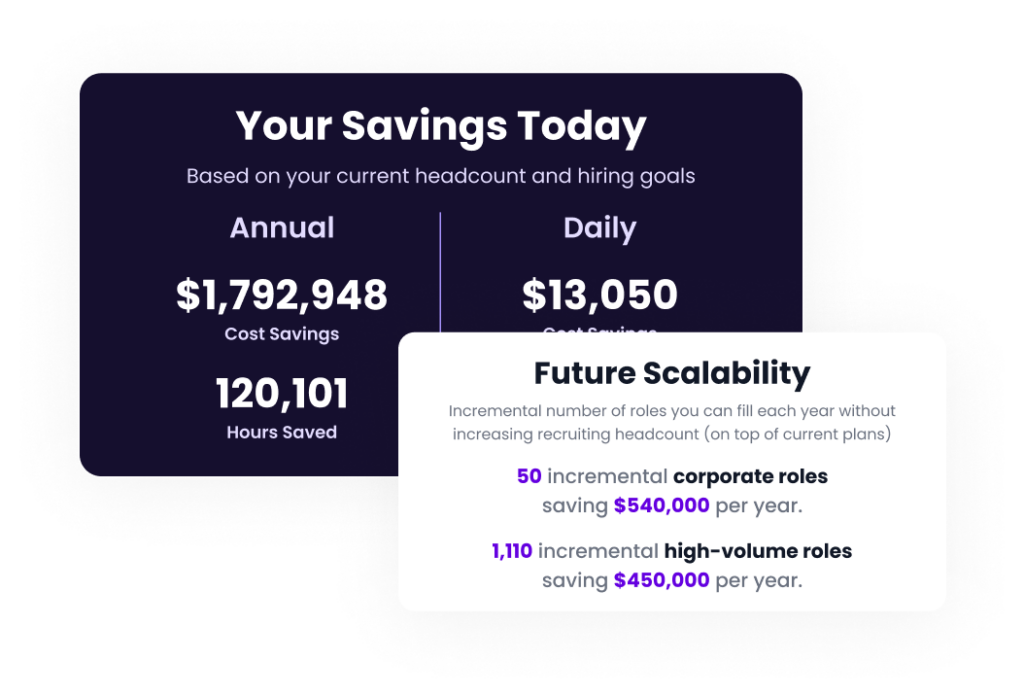
ROI is key. This is not a time to invest in software that won’t bring you immediate value. So let’s eliminate the guesswork with our free ROI calculator.
5 Takeaways: Smash Your Recruiting Goals with Candidate Relationships

At GoodTime, we’re always on high alert for the latest shifts in recruiting. We hypothesized that the companies that build genuine candidate relationships are the ones that come out on top—but we didn’t want to lean on a hunch. We needed data. This prompted us to conduct our 2022 Hiring Insights Report to survey 560 TA leaders and understand their biggest challenges, what they’re doing (or not doing) to improve their candidate relationships, and how those efforts impacted their goals.

Ahryun Moon, Co-founder and Head of Company Strategy at GoodTime, presented our survey’s findings and the latest HR trends in a jam-packed, data-driven SHRM webinar. Read on for the key takeaways from the webinar, and get ready to crush your recruiting goals with ease.

1. We’re in a Candidate’s Market

It’s a candidate’s market in a candidate’s world, and it’s about time that talent teams got used to it. Based on GoodTime internal data, we now know that the competition for the most talented candidates has skyrocketed since the pre-pandemic era. The average candidate interviews at four times the number of companies as they did before. To ramp up the competition even more, candidates typically receive multiple offers before making their next job move.

It’s clear that today’s candidates have a lot of options to choose from. So, what are the most crucial factors in their decision-making process?

Candidates now put a heavy emphasis on key intangibles. These include transparency, company mission, and DEIB. Candidates want to learn more about these elements through cultivating a connection with your interviewers and talent team.

All signs point to a need for talent teams to reimagine their hiring process and cater to what candidates really want. Yet still, we needed more data to back this up. That’s where our 2022 Hiring Insights Report comes in.

2. The (Hiring) Struggle Is Real 

The 2022 Hiring Insights Report unearthed several alarming realities for talent teams. Out of the companies that were surveyed, they attained an average of just 50% of their hiring goals in 2021. “Yikes” is an understatement.

Companies chose “retaining top talent” as the number one hiring challenge that they’ve experienced over the past 12 months. With the ever-increasing popularity of remote work, some might assume that in-office companies struggled with this challenge the most. However, that wasn’t the case. Remote companies were more than twice as likely to struggle than the overall average. 

The key takeaway? Yes, the Distance Economy widens the talent pool, but it also widens the employer pool. This gives more options for top candidates to choose from, making it hyper-critical to take the correct steps to retain, attract, and win talent.

Does interview scheduling automation make sense for my team?

ROI is key. This is not a time to invest in software that won’t bring you immediate value. So let’s eliminate the guesswork with our free ROI calculator.

3. Candidate Relationships Are the Solution

Hiring is tough all over. So, what needs to happen? When asked how they expect the hiring landscape to evolve in the next 12 months, “the ability to create meaningful relationships with candidates” claimed the number one spot. 

This is a good sign; talent leaders recognize the shifts in the market and in what candidates now search for. They understand that forming candidate relationships is the key to smashing their hiring goals, retaining top talent, and surpassing the competition.

This datapoint also signals that traditional hiring strategies just don’t work anymore. Talent teams can’t expect to win by pouring more and more candidates into the top of the funnel. Instead, they must craft an interview process that facilitates strong relationships with talent so that they don’t lose qualified candidates in the middle of the funnel.

4. Employ Candidate-focused Hiring Practices

The data is clear: it’s time to make candidate relationships the priority. It’s what every applicant wants. Success in hiring is now found in the implementation of candidate-focused practices. These practices can be split into four buckets: genuine connection, transparency, adaptability, and candidate well-being.

  • Genuine Connection: Candidates want to know if they align with a company’s mission, values, culture, and DEIB involvement. In order to understand an employer’s stance on those factors, candidates want to build a genuine connection with them.
  • Transparency: Today’s candidates also expect a transparent hiring process. They won’t stand for ghosting or beating around the bush. Candidates want open, honest, and frequent communication from companies and interviewers.
  • Adaptability: If your hiring process doesn’t adapt to the needs of your candidates, it’s time to change things. Candidates want to schedule interviews at times that best fit their schedule, as opposed to sitting through an all day in-person interview. 
  • Candidate Well-being: On the topic of well-being, candidates want to gain an understanding for where companies stand on mental health support and related benefits.

5. Use Tools and Techniques To Boost Candidate Relationships

Talent teams have an abundance of powerful methods to use when connecting with candidates. Three of the most crucial tools and techniques include collecting candidate feedback, showcasing a commitment to DEIB, and training interviewers.

  • Candidate Feedback: Gathering candidate feedback helps hiring teams understand how to adapt their interview process to fit the needs of candidates. In order to generate the most actionable feedback possible, teams should collect a simple “candidate pulse” after each interview. 
  • Commitment to DEIB: More than 70% of candidates reportedly want employers to showcase their dedication to DEIB. One of the most powerful ways to reinforce your commitment to DEIB is through your interview process. Take time to cultivate diverse interview panels.
  • Interviewer Training: The number of companies that overlook the importance of interviewer training is shocking. Training interviewers is not only important in generating better relationships with candidates, but it’s also crucial in hiring fast.

Want the Latest Insights? Read the 2023 Hiring Insights Report

Investing in candidate relationships is the future of hiring. The companies that build a foundation of strong connections with applicants can expect higher levels of productivity, loyalty, and engagement. 

But this is only half the story. Want to catch up on the latest hiring trends? Get excited: our 2023 Hiring Insights Report is now available. 500+ HR leaders, 1,000s of real findings, 1 industry-leading report. Read the report today.

DEIB in Hiring: Data Shows Talent Teams Fall Short

DEIB is a hot topic among HR professionals, and rightfully so. Conveying a commitment to DEIB in hiring not only attracts candidates, but also benefits your bottom line.

Companies that emphasize DEIB come out on top. However, our 2022 Hiring Insights Report shows that these companies are few and far in between. The report features responses from 560 HR, talent, and recruiting leaders across the U.S. on their most critical challenges. We found that despite the buzz surrounding DEIB in hiring, active commitments are scarce.

Few Companies Prioritize DEIB in Hiring

Take a scroll through LinkedIn and you’re bound to come across at least one post on the importance of DEIB. No matter the industry, people keep talking about how crucial it is for organizations to prioritize diversity, equity, inclusion, and belonging. 

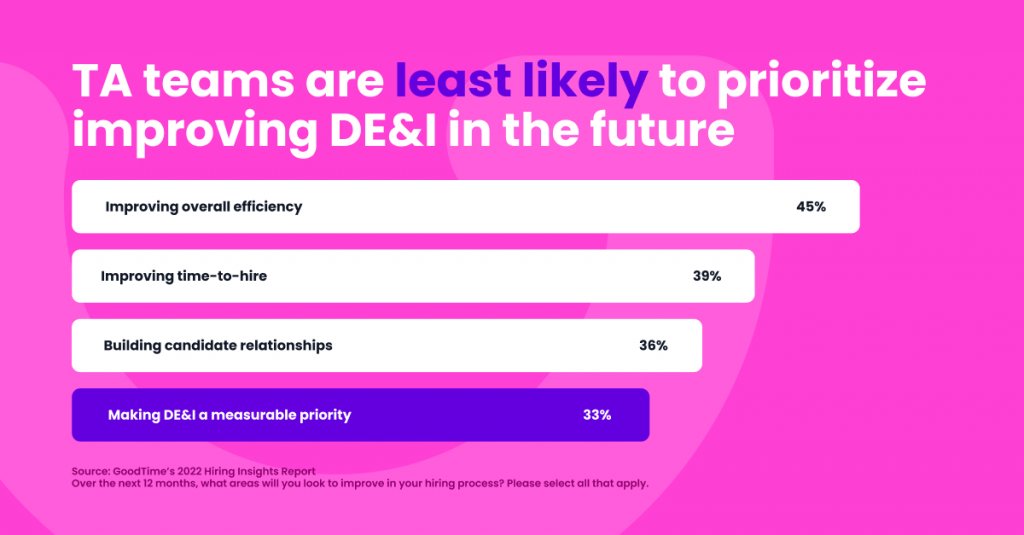
…But is this all just talk? Or is there action behind these conversations? Unfortunately, the responses from our report aren’t too hopeful. When asked to identify what they improved in their hiring process over the past 12 months, making DEIB a measurable priority was the least selected option (31%). The next 12 months look just as bleak. Only 33% of companies plan on prioritizing DEIB in the year ahead—still the least selected option. Oof.

Failing to prioritize DEIB is simply bad for business. In fact, diverse teams produce 19% higher revenue. But finances aside, focusing on DEIB just makes sense. Today’s Distance Economy opens the talent pool to a wide range of diverse candidates. Those candidates don’t just want to see an emphasis on DEIB in the hiring process—they expect it.

Disconnect Between DEIB and Employee Well-being

Sorry to be the bearer of more bad news, but the data doesn’t lie. Our report shows a disconnect between employee well-being and DEIB—a crucial component that goes into creating that well-being. 

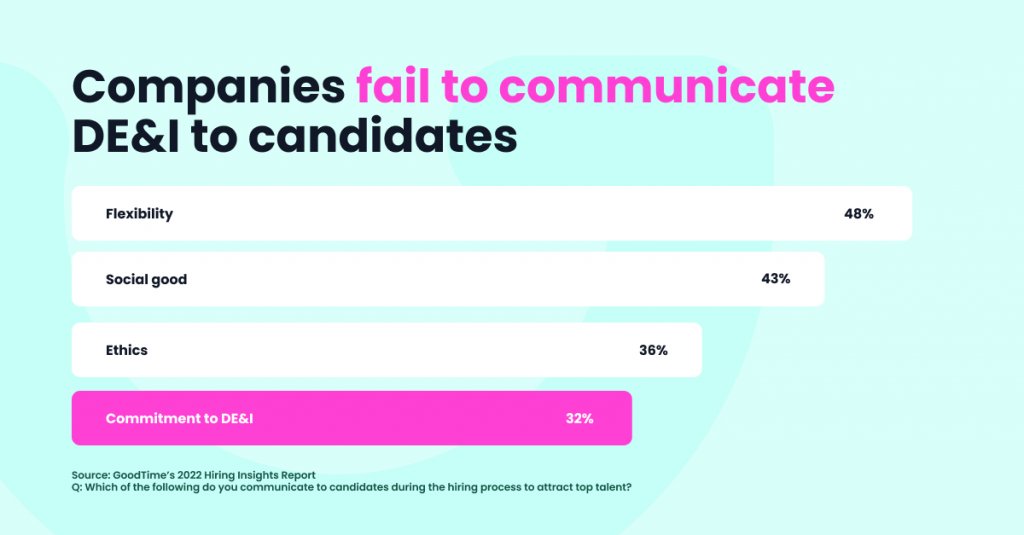
When asked what they communicate to candidates during the hiring process, the lowest percentage of companies (32%) selected a commitment to DEIB. But here’s the catch: the highest percentage of companies (59%) chose employee well-being. 

DEIB and employee well-being should go hand in hand, especially when it comes to recruiting diverse candidates. If a candidate is part of an underrepresented community, is a company really considering their well-being when their commitment to DEIB is last in line?

The smartest companies communicate DEIB to candidates. Need proof? The average time-to-hire among the 179 companies that communicate DEIB to candidates is two and a half weeks, shorter than average (three weeks). A lack of communication on DEIB leads to fewer applicants, rejected offers, and less diverse teams.

Remote Companies Pick up the Slack—Slightly

While our report pinpoints multiple areas where remote talent teams falter, committing to DEIB isn’t one of them.Thirty-eight percent of remote teams plan on making DEIB a priority in the next 12 months, making them more likely to emphasize DEIB than their in-person counterparts.

When considering the previous bleak data points on DEIB in hiring, this statistic seems like a sign for hope. In a way, it is. But let’s be real: companies could do better. Much more than 38% of remote workplaces should focus on DEIB. This percentage is a fine start, but if remote teams want to draw in diverse applicants, more teams need to kick DEIB initiatives into high gear.

All in all, with 63% of remote companies agreeing that the hiring landscape will become more competitive in the coming months, keeping DEIB top of mind is the best decision. A commitment to DEIB is high on the average candidate’s wish list. The companies who openly convey this commitment possess a major advantage in snagging the best talent.

The C-suite Must Step Up

Let’s make one thing clear: despite the needs for improvement, making a high-quality DEIB program is a lot easier said than done. Uplifting DEIB across an organization can be a big undertaking, especially for companies with limited resources and people to get the job done.

Yes, the data shows that most talent teams stumble in conveying DEIB to applicants, but this isn’t all their fault. DEIB must start at the top. Having a CEO who includes DEIB in their company roadmap is a major asset. In order for talent teams to fully breathe life into DEIB, the C-Suite needs to partner with them.

Want the Latest Insights? Read the 2023 Hiring Insights Report

Keeping up with the latest happenings in the hiring landscape is the key to staying ahead of the game. Lucky for you, we have plenty of information on the most crucial hiring trends. 

Want the latest hiring insights? Get excited: our 2023 Hiring Insights Report is now available. 500+ HR leaders, 1,000s of real findings, 1 industry-leading report. Read the report today.

Does interview scheduling automation make sense for my team?

ROI is key. This is not a time to invest in software that won’t bring you immediate value. So let’s eliminate the guesswork with our free ROI calculator.
The Anatomy of Smart Meetings

Think about the last time that you had a pointless meeting. How long ago was it? More likely than not, it might’ve been as recent as this week—or even today. Perhaps sitting in meaningless meetings is a weekly occurrence for you. If that’s the case, you’re not alone. Disorganized, aimless meetings define our modern-day meeting culture. But it doesn’t have to be this way. There’s a better, much more productive way to meet. Ever heard of “smart meetings”?

If not, you’ve come to the right place. Smart meetings unearth how powerful meetings can be. They’re masterfully structured to help attendees make more meaningful accomplishments, progress, and connections than ever before. All in all, they’re a saving grace in a flood of dumb meetings.

If you want to master the building blocks of smart meetings, get ready to take notes. Class is in session.

The Right Attendees

The importance of thoughtfully crafting your meeting invite list cannot be overstated. Bad meetings cost companies up to $37 billion a year due to employees losing time that they could spend on productive tasks. In other words, it’s imperative that your smart meetings include the right attendees so that no one’s time is wasted.

Including the best attendees allows for teams to reach their goals in record time and for meaningful connections to evolve. When planning an invite list, take time to consider the true stakeholders whose presence is absolutely essential, versus the team members who are on the fringe of the conversation and could spend their time on other high-value tasks. The last thing that you want is a meeting filled with people whose time could be better used elsewhere.

There’s also legit research behind the perfect number of meeting attendees. A professor at Stanford University found that the most productive meetings have between five and nine people. Including too many attendees increases the risk of “cognitive overload,” while including too few attendees decreases the diversity of perspectives.

The Right Time and Place

Smart meetings work for everyone’s calendar. They occur at the perfect time and place for all attendees. A meeting’s time and place plays an integral role in its success, yet meeting coordination isn’t always easy. When scheduling across multiple time zones, teams, and available work hours, setting up a meeting can feel like a massive headache. 

To spend less time coordinating meetings and more time focused on high-value tasks, enlist the help of tech. Leveraging meeting scheduling software to set the meeting at the right time with the right people makes a world of a difference.

Coordinating meetings at the “right time” also means reaching the perfect balance between scheduling too many and not enough meetings. This involves identifying which discussions require scheduling time on your team’s calendar, and which can be handled asynchronously. Get into the habit of using tools such as Slack for quick back-and-forth communication, and Asana for short project status updates. Your meeting attendees will never again think, “Did this really need to be a meeting?”

Engineered With a Clear Goal

If your meetings aren’t backed by defined goals, you’re setting yourself up for failure. Smart meeting attendings convene for the purpose of working towards a common objective. Meetings that don’t accelerate teams towards their goals must be reengineered. 

Use a meeting agenda as your roadmap for attaining your goals. Instead of structuring your agenda as just bullets and bullets of discussion topics, create an agenda that includes specific questions instead. A meeting structured on topics opens the door to irrelevant conversations that only partly pertain to the most pressing issues. However, if you start your meetings with questions, attendees acutely understand what they need to resolve and accomplish.

Every attendee should leave your meetings with a crystal clear understanding of their next steps. For an added layer of clarity and accountability, record the discussed action items in your meeting notes or log them into a project management software.

Deliver Smart Meetings Every Time

Meetings aren’t the enemy, and the solution certainly isn’t to get rid of your meetings. You just need to make them smarter—and luckily, you don’t need to do it alone. GoodTime is here to help.

The GoodTime Meeting Optimization Engine automates scheduling, ensures the right people are in the room, and provides actionable insights to meet smarter. From interviews, to sales calls, to customer meetings, you’ll hit your goals faster than ever before.

Ready to say good-bye to dumb meetings? Learn more about GoodTime today.

Candidate Relationship Intelligence? What’s That?

“Candidate Relationship Intelligence.” Maybe you’ve heard the buzz around this phrase on our social media or in previous blog posts, or perhaps this is your first introduction to it. Regardless, we’re glad you’re here. If there was ever a prime time to get acquainted with Candidate Relationship Intelligence, the time is now.

In case you haven’t noticed, the hiring landscape has faced some drastic changes in the past few years. Hiring is now tough all over. The only way to succeed is to evolve your hiring methods and tools. That’s where Candidate Relationship Intelligence comes in.

But we’re getting ahead of ourselves. Let’s first dive into why we need Candidate Relationship Intelligence now more than ever. 

The State of Hiring

Talent teams currently stand at the intersection of multiple macro trends. For one, we face an unprecedented talent shortage that coincides with the Great Resignation. As a way to mitigate this shortage, many companies now hire remotely. Yet in turn, hiring in the absence of physical contact makes creating a positive candidate experience even more challenging. 

On top of all this, the expectations of candidates have skyrocketed. For instance, candidates now highly covet a speedy hiring process. But even more than that, candidates expect companies to transparently showcase their stance on intangible elements, such as DEIB, flexibility, employee well-being, and social good. Candidates want to learn more about an employer’s stance on those elements through forming a genuine connection with them. 

If talent teams want to win in this all-time competitive hiring market, superficial hiring tactics must be laid to rest. In our 2022 Hiring Insights Report, 46% of HR and talent leaders agreed that creating meaningful relationships with candidates is now non-negotiable. In fact, out of all the companies surveyed, the ones that implemented four or more candidate-focused hiring practices outperformed others in hiring goal attainment.

It’s clear that the future of attracting, winning, and retaining top talent is meaningful interactions. In order to hit their hiring goals, teams must utilize new tools to boost efficiency and build authentic relationships with candidates.

The Way Forward: Candidate Relationship Intelligence

The solution to connecting with candidates and beating the talent competition is none other than Candidate Relationship Intelligence. Three core pillars compose this solution. These three pillars all feed into each other to keep the Candidate Relationship Intelligence machine moving.

Pillar 1: Automation

A long time-to-hire can sour your candidate relationships and cause disengaged applicants to consider alternate opportunities. More than half of applicants will move on if they haven’t heard from an employer within two weeks of applying. 

That’s why Candidate Relationship Intelligence brings automation to the recruitment process to remove any time lag on the recruiting team and candidate side. It automates everything that goes into coordinating an interview, from simple phone interviews, all the way to complex multi-stakeholder interviews.

Pillar 2: Relationship

Creating a genuine, long lasting bond with candidates starts with having the right interviewers in each interview. A negative interviewing experience can completely shatter a candidate’s impression of your company. In fact, 44% of job seekers say that their experience in the interview stage is the most influential part of the hiring process. This makes interviewer selection and training mission critical. 

A Candidate Relationship Intelligence solution helps to ensure that each interview includes interviewers with the right skill sets, well-trained interviewers, and diversity across the interview panelists. All of these factors combine to deliver a positive interviewing experience for candidates that further nurtures their relationship with an employer and the recruiting team.

Pillar 3: Insights

Your time-to-hire and relationships with candidates won’t improve if you don’t actively measure them. That’s what makes this third and final pillar so crucial.

Candidate Relationship Intelligence empowers recruiting teams with actionable insights—such as interviewer performance and recruiting team performance—to continuously optimize their relationships and the effectiveness of each interview. With an increased visibility on your hiring process, you’ll have an even deeper understanding of the actions you need to take to hit your hiring goals.

Ignite the Power of GoodTime Hire

GoodTime Hire is the only platform that delivers Candidate Relationship Intelligence with the full power of all three pillars. There’s a reason why over 300 companies, like Slack and Spotify, look to Hire to stay ahead of the talent competition—and get to “yes” up to 70% faster.

Ready to learn more about Hire? We can make that happen.

Does interview scheduling automation make sense for my team?

ROI is key. This is not a time to invest in software that won’t bring you immediate value. So let’s eliminate the guesswork with our free ROI calculator.
GoodTime’s Ahryun Moon Talks the Evolution of the Hiring Landscape

A word of advice for the modern-day hiring team: get comfortable with change. Because if there’s one thing that we’ve learned in recent years, it’s that the hiring landscape can evolve in an instant. GoodTime’s Co-founder and Head of Company Strategy Ahryun Moon met with RecTech Podcast’s Chris Russell to discuss recent and upcoming shifts in the hiring industry, and how GoodTime helps teams adapt to the changing times.

If you’d like to hear the conversation in full, the podcast episode can be found here. Read on for a quick rundown.

“Everything has shifted so quickly and so fast over the last couple of years. Even the most tenured HR leaders with multiple decades of experience are still trying to figure things out.”

— Ahryun Moon, Co-founder and Head of Company Strategy at GoodTime

Tumultuous Recent Years in Hiring

A lot has changed in the hiring industry and job market—where do we even start? For one, companies felt the sting of the Great Resignation back in 2021, and the phenomenon is still going strong. A record-breaking 4.5 million people in the U.S. quit their jobs in March 2022.

Ahryun noted that based on GoodTime’s conversations with customers, the “big quit” isn’t limited to just the U.S. It’s happening across the globe. And that’s not the only worldwide hiring trend; the entire world is also facing a severe shortage of knowledge workers. In February 2022, there were 5 million more job openings than unemployed workers in the U.S. alone. This all culminates into a hyper-competitive job market.

On top of these changes, job seekers have drafted up new demands, heralding the next era of recruitment tactics.

“Now that we’re working remotely and in hybrid mode, all the past lure of office spaces, the physical spaces, those perks are not very relevant anymore,” Ahryun said. 

Instead of placing value on in-office benefits, candidates now vet employers on elements such as DEIB, work-life flexibility, vision, and mission. Above all, candidates want to connect with employers.

Upcoming Changes in the Hiring Landscape

An outpour of hiring freezes, slowdowns, and layoffs characterize the latest changes in the job market. Major tech companies like Uber and Twitter slowed their hiring, while startups like Klarna and Carvana laid off employees.

Ahryun’s take? The market is correcting itself. She noted that it doesn’t look like these recent events in the market will remain as permanent trends. From her view, it seems that the market will stabilize over time.

All things considered, the market’s recent volatility shouldn’t come as a surprise. In many ways, 2021 created an unsustainable environment.

“Last year was crazy, a whole slew of unicorns had been born,” Ahryun said. “Some companies are extremely solid companies that are worthy of becoming unicorns, and some probably not in terms of the metrics.”

In opposition to the downturn in Silicon Valley, there’s several forces at play that will keep other companies hiring. A severe lack of knowledge workers remains within an extremely competitive hiring market, Ahryun added. Companies will continue hiring—just not as recklessly. The smartest companies will implement the best TA tech to hit the ground running and prepare for future growth.

How GoodTime Has Adapted to the Shifts

Talent teams aren’t the only ones that must adapt to the ever-changing hiring landscape. In order to solve the most pressing issues facing companies, TA tech must also evolve with the times.

GoodTime Hire has changed quite a lot to respond to the latest customer needs, Ahryun said. Hire uses Candidate Relationship Intelligence, which includes two main focus areas: speed and relationships. The focus on speed comes from the increasingly fast-paced talent competition. 

“Nowadays, candidates get about four offers on the table within about 18 days of their job search, which is crazy,” Ahryun said. 

The fastest talent team is often the team that snags the best candidates. On the flip side, a slow hiring process heightens the risk of losing qualified candidates in the middle of the funnel. To satisfy the need for speed, Hire’s automation removes any time lag that occurs on both the recruiting team and candidate side.

Hire’s focus on relationships stems from the need to form meaningful connections with candidates to win top talent. As a way to cultivate these connections, Hire makes data-driven decisions to place the right interviewers into each and every interview. Better yet, one of the latest features, Candidate Pulse, gathers candidate sentiment throughout the interview process to help teams better understand the quality of their relationships.

Does interview scheduling automation make sense for my team?

ROI is key. This is not a time to invest in software that won’t bring you immediate value. So let’s eliminate the guesswork with our free ROI calculator.

Want the Latest Insights? Read the 2023 Hiring Insights Report

Keeping up with the constant flow of changes in the hiring landscape can feel overwhelming. Luckily, our 2023 Hiring Insights Report is now available. 500+ HR leaders, 1,000s of real findings, 1 industry-leading report. Read the report today.

Remote Companies Stumble in the New Hiring Landscape

The rise of remote hiring stands as one of the most influential trends impacting today’s hiring landscape. What started as a way to adapt to the pandemic has evolved into a method to combat the talent shortage and deliver on the work flexibility that many candidates now desire. The problem? Most remote companies have stumbled rather than soared.

For our 2022 Hiring Insights Report, we surveyed 560 HR, talent, and recruiting leaders across both remote and in-person workplaces. We learned that compared to their in-office counterparts, remote TA teams fall flat on multiple grounds, from hiring efficiency to connecting with candidates.

And to top it all off, most remote TA leaders don’t even have full confidence in their own operations. When rating their overall recruiting process, 25% of remote leaders rated it as excellent—compared to 42% from in-office leaders.

Let’s dig into the data.

Candidate Relationships Take a Back Seat

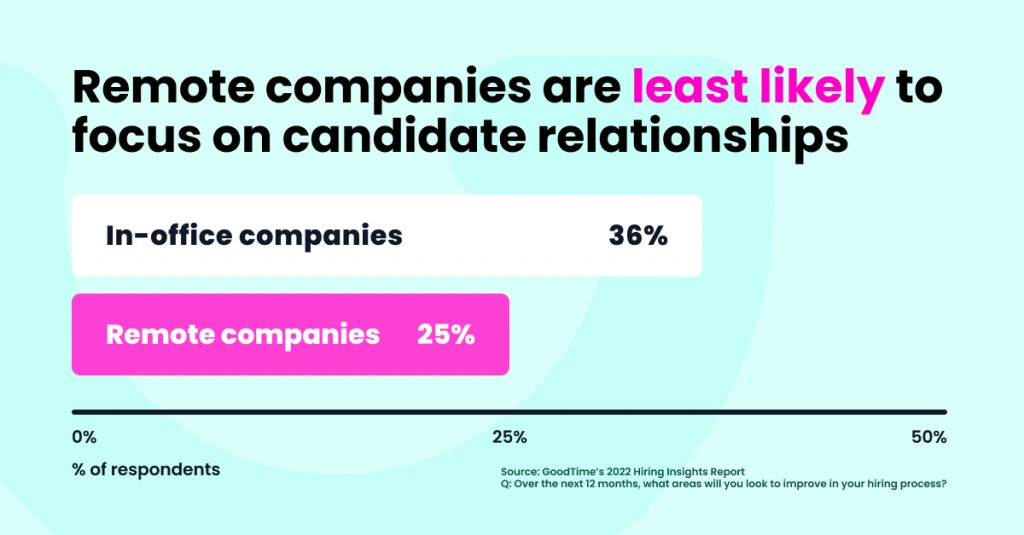
Applicants expect to form a relationship with your company and your TA team that’s founded on trust and mutual respect. Our report’s data shows that fully-remote companies are least likely to create bonds with candidates—though if anyone should, it’s them.

Among fully-remote workplaces, just 25% will look to build relationships with candidates in the next 12 months. This is 11 percentage points lower than in-person workplaces.

Remote employees report higher rates of isolation, yet connection is at the top of most candidates’ wish lists. When hiring at a distance, it’s even more important to invest in these connections—and the data shows that these companies have a lot of work to do.

With the lack of emphasis on candidate relationships, it’s no wonder that 63% of remote workplaces reportedly struggled with retaining talent in the past 12 months. Talent retention begins once a future employee has their first conversation with a recruiter. The secret to turning candidates into long-term hires lies in creating authentic connections with new hires from the start.

Remote TA Teams Struggle With Efficiency

The efficiency of remote companies’ TA processes leaves much to be desired. But at least the majority of them aren’t blind to this; just 38% of remote workplaces rated their TA process as very efficient, compared to 56% of in-person companies.

In today’s intensely competitive job market, hiring fast is essential. The best candidates disappear from the market in just 10 days. Yet here’s the kicker: a shocking 100% of fully-remote companies said that their rate of time-to-hire increased in the past 12 months. In comparison, 65% of in-person companies said the same.

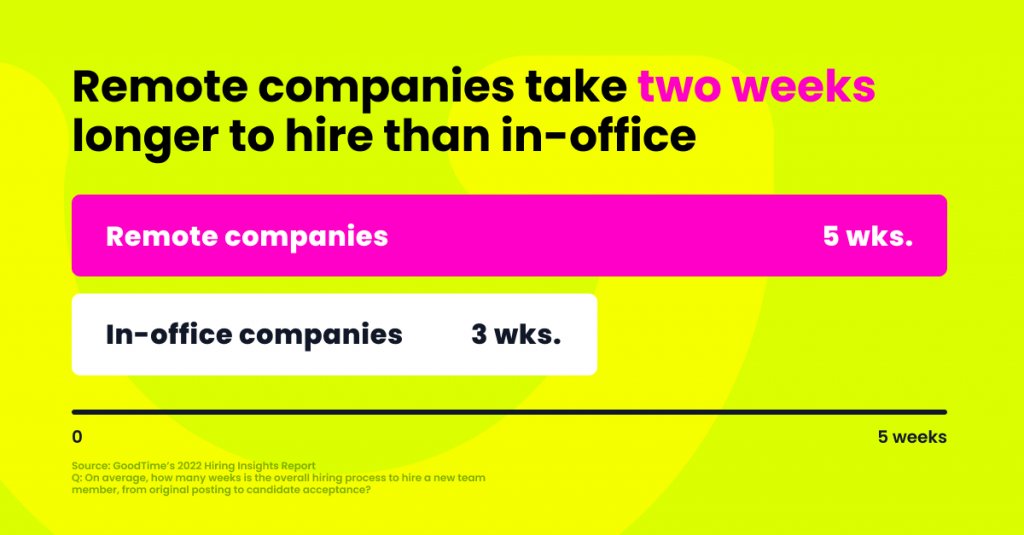
Even worse, remote talent teams said it takes them an average of five weeks to hire a new employee—contrasted against three weeks for in-person teams. With a hiring process that lengthy, remote employers shouldn’t be surprised when their star candidates lose interest and look elsewhere.

Remote companies reportedly spend 41.6% of their time scheduling interviews, three percentage points higher than in-person companies. Yet while remote companies spend a bit more of their time on interview scheduling, they’re way behind in-person companies when it comes to the number of interviews that they schedule. On average, remote workplaces schedule 50 interviews per month, versus 125 for in-person.

So what’s the hold up? It’s possible that remote teams haven’t equipped themselves with the proper TA tech to get to where they need to be in scheduling volume. But if anything’s certain, it’s that if remote TA teams don’t get to the root of their efficiency issues, they’ll only continue to struggle.

Does interview scheduling automation make sense for my team?

ROI is key. This is not a time to invest in software that won’t bring you immediate value. So let’s eliminate the guesswork with our free ROI calculator.

DEIB Efforts Show Grounds for Hope

Want some positive news for a change? On the bright side of things, fully-remote companies are most likely to emphasize DEIB in the near future. Thirty-eight percent of remote workplaces surveyed will make DEIB a priority in the next 12 months, two percentage points higher than in-person workplaces.

This is a good move, especially considering how 25% of remote teams reportedly expect to struggle with a lack of qualified candidates. A broader talent pool comes with more diverse candidates, and an increased need to improve—and communicate a commitment to—diversity.

While the stats on DEIB and remote companies are promising, all companies surveyed could—and should—make greater strides in championing DEIB. Diverse teams that feel welcome and supported boost revenue and innovation. Smart companies make DEIB a top priority.

Want the Latest Insights? Read the 2023 Hiring Insights Report

Remote companies, you have your work cut out for you. While some assume that remote workplaces have it easy thanks to a wider talent pool, they forget that the Distance Economy also widens the employer pool. This makes it even more critical for remote TA teams to take meaningful, calculated steps to attract, win, and retain candidates.

From connecting with candidates without physical interaction, to conveying intangible company values through a Zoom window, it’s not too unexpected for newly remote workplaces to trip up. Hiring remotely comes with a learning curve. Yet despite the challenges ahead of them, remote TA teams must act fast to avoid getting swallowed up by the talent competition.

Want to catch up on the latest hiring trends? Get excited: our 2023 Hiring Insights Report is now available. 500+ HR leaders, 1,000s of real findings, 1 industry-leading report. Read the report today.

Meetings Suck. Here’s How to Fix Them.

You know the feeling. You’re sitting in a meeting, watching the clock, and before you know it, the conversation goes sideways. You ask yourself, “Why am I even here? Why are any of us here?” 

Your mind wanders to the multitude of tasks that you’d rather be dealing with. Finally, the meeting ends and your real work begins. You start crossing off items on your to-do list, and then—

Bam. The calendar notification of doom: time for the next meeting.

How did we get to this point? Why are we up to our eyeballs in meetings?

Some argue that the pandemic created our current avalanche of meetings—and they’re not completely wrong. Since 2020, companies have gone from holding 40 to 66 million daily meetings in the U.S. alone. And given the meteoric rise of remote and hybrid work, the amount is sure to increase.

But that’s not the full story. The phrase “this should’ve been an email” made its way into our lexicon long before the pandemic. The truth is that we never mastered meetings. The pandemic accelerated the issue, and now we’re finally facing the consequences of our haphazard meeting culture.

We need smart meetings, and we need them now. It’s time to stop the meeting mayhem.

Meeting Mayhem by the Numbers

The data doesn’t lie: our meetings are broken. Like, really broken.

We waste a whopping 24 billion hours each year due to unproductive meetings. The majority of professionals now spend up to a third of their workweek stuck in meetings.

And the financial costs? They’re devastating. U.S. businesses reportedly lose a grand total of $37 billion a year due to unnecessary meetings. Bad meetings mean bad news for businesses.

Unsurprisingly, the general consensus is that meetings suck. Working professionals ranked having too many meetings as the biggest workplace distraction. Research shows that 90% of people daydream in meetings, and 73% use meeting time to get other work done. To make matters worse, 75% of people haven’t even received training on how to conduct a meeting.

If all of that wasn’t bad enough, there’s now a term for the negative effects of meetings: “meeting recovery syndrome.” This phenomenon refers to the feelings of fatigue and frustration that arise from a bad meeting.

“No Meeting Monday” Won’t Save You

To mitigate the onslaught of meetings, companies resorted to establishing “No Meetings” days. Blocking off days for uninterrupted heads-down work sounds great in theory. But in practice, workers end up with back-to-back meetings the following day to make up for their singular day of meeting-free bliss.

Eliminating meetings isn’t the best way forward. After all, there’s a reason why people hold meetings. Meetings can be extraordinary; they’re where collaboration moves mountains, and where big ideas find their legs. With less than one-third of knowledge workers coming to the office each day, meetings offer one of the only opportunities for coworkers to connect face to face. 

Meetings aren’t the problem. The problem is how we conduct them. Instead of getting rid of meetings, the solution lies in making meetings smarter. So—how do we do that?

Fundamentals of Smart Meetings

The hallmark of a smart meeting is if a meeting is attended by the right people, at the right time, in the right place for a clear goal. Attendees of these meetings make bigger accomplishments and more meaningful progress than ever before. And, most importantly, smart meetings cultivate the type of genuine relationships among attendees that no other form of communication can replicate. 

Luckily, you don’t have to create smarter meetings on your own. A Meeting Optimization Engine handles the entire coordination, relationship building, and insights gathering process to make smart meetings come to life. 

Let’s dig into the three foundational elements of smart meetings:

The Right Attendees

Meetings are breeding grounds for collaboration and connection. And in the distance economy, where 98% of today’s meetings reportedly include at least one remote attendee, meetings stand as optimal spaces to form bonds in the absence of physical interaction.

However, problems arise when meetings don’t include the right key players. When the wrong people are placed in meetings, frustration builds, which erodes any sense of community within a team.

That’s why smart meetings include the most suitable attendees. When the right people join forces, teams accelerate towards their goals and meaningful relationships blossom.

The Right Time and Place

Smart meetings are “smart” from the get-go, and that means before any meeting even takes place. Smart meeting scheduling involves identifying the optimal time and place for all attendees to connect. Smart meetings should work for everyone’s calendar.

Overall, the time and place of your meetings should be conducive to productivity and success. If a meeting takes place too frequently, or not frequently enough, it isn’t smart. Likewise, if a meeting’s presence just takes up space on a calendar, it’s not a smart meeting—it’s a time sink.

Achieves a Clear Goal

If you aren’t meeting to achieve a clear goal, ask yourself why you’re even meeting. Your meetings need to be purposeful. The goals of your meetings should be clearly defined, and all attendees should be firmly aligned on what they must achieve.

Each and every meeting should move your team closer to your pre-defined goals. If your meetings don’t generate progress, they must be reengineered.

More on Smart Meetings

Okay, so we’ve laid down the fundamentals of smart meetings. Ready to dive even deeper?

From meticulously crafting meeting agendas, to thoughtfully selecting the best meeting structure, making your meetings smart is a fine art. Here are several elements to consider when crafting your meetings.

The Perfect Meeting Agenda

Far too often, meeting organizers come with an agenda that’s just a list of topics. Even though there’s likely several crucial topics that you want to cover in your meetings, agendas that are just bullets after bullets of topics set your meetings up for failure.

The most purposeful agendas include specific, pre-defined questions for attendees to discuss and answer. Starting meetings with the knowledge of exactly what you must resolve gives them a strategic edge.

Even better, narrowing your agenda topics into questions promotes meeting efficiency. Starting meetings with topics to discuss opens the door for irrelevant conversations that don’t get to the heart of the issue. But when you start meetings with questions, attendees know exactly what they’re there to hash out.

Aside from fine-tuning the content of your agenda, make sure that you’re practicing proper agenda etiquette. Share the agenda with attendees well in advance, always include the agenda in the meeting invitations, and hold yourself to following the agenda’s main points.

All in all, now isn’t the time to just “wing it.” Use your meeting agenda as your road map to delivering smarter meetings.

Selecting the Meeting Structure

There’s plenty of useful meeting structures out there to leverage—when they’re appropriate. When choosing the right structure, consider several factors: the purpose, the attendees, and the group size.

For quick status reports, consider holding daily team huddles. These meetings are normally 10 or 15 minutes. They keep your team aligned throughout the week on their priorities. Attendees provide updates and talk through any obstacles. The brevity of these meetings provides teams with ample time to execute on high-value tasks.

Have a crucial project or campaign that’s in the works? A weekly campaign planning meeting can be a productive time for all of the campaign’s stakeholders to talk through the goals for the weeks ahead, what’s in progress and what still needs to be kicked off, and any roadblocks. However, stay vigilant on the importance of this meeting each week. Some weeks of a campaign may be smooth sailing, with nothing significant to discuss.

If you feel like your projects tend to remain stagnant, it may be time to establish Level 10 (L10) meetings. An L10 is a weekly meeting that takes place at the same time and same day each week. It’s recommended for these meetings to last around 90 minutes, yet the length will depend on your team’s needs. Dedicate the bulk of each L10 to discussing any outstanding priorities.

Know When To Say No

Say it with us: not everything needs to be a meeting. Some meetings are just emails in disguise. In order to truly live by the smart meeting code, learn how to sniff out unnecessary meetings.

Useless meetings come with common red flags. If a meeting doesn’t include even a loose agenda, it’s time to start asking questions. And just because a certain weekly meeting has always taken place on your team, doesn’t mean that it’s needed. Have these conversations moved your team closer to a goal? How has your team progressed thanks to these meetings?

Don’t be afraid to question a meeting’s purpose, or if the meeting needs to occur at all. Your entire team will be better off without these questionable meetings. Ask what’s the desired outcome, or question if the frequency of a meeting is necessary, if applicable.

Maybe a meeting feels necessary for certain members to attend, but not you. Be direct—ask the organizer what value you would add, or why your attendance is important.

Making Every Minute Count

For years, we’ve made attending useless meetings a punchline for office jokes. We bond over these jokes because we all know the feeling of counting down the minutes for a meeting to end. Yet the consequences of wasting precious time in inefficient meetings are no laughing matter.

Every once in a while, we attend a meeting that reminds us of how powerful meetings can be. We connect with our teammates, smash through roadblocks, and can practically taste how close we are to attaining our goals. But then this meeting passes by, and we’re back to facing the aimless meetings that we’re accustomed to.

Imagine if every single minute spent in meetings actually mattered. To create this reality, meetings just need a fresh, new approach.

Together, we can stop the meeting mayhem—but only if we make meetings smarter.

TA Teams and Candidate Relationships: Big Talk, Little Action

Let’s start with the good news. More and more TA leaders finally recognize that to snag the best talent, forming candidate relationships is the way forward. They know that candidate-focused hiring practices must take center stage, and one-sided practices must be laid to rest.

Now…the bad news: the execution just isn’t adding up. Our 2022 Hiring Insights Report surveyed 560 TA decision makers across the U.S. to understand their perceptions of the most pressing challenges facing their teams, and what should be done to reel in top talent. The report’s data shows that yes, talent teams recognize the importance of connecting with candidates, but not enough teams actually put candidate relationships in motion—and that’s a problem. Too much talk, not enough action. 

If there was ever a time to kick relationship building into high gear, the time is now. In 2021, companies surveyed fell 50% short of their hiring goals. Failing to prioritize meaningfully connecting with candidates means bad news for your hiring goal attainment. It’s time for less saying and more doing.

Candidate Relationships in Short Supply

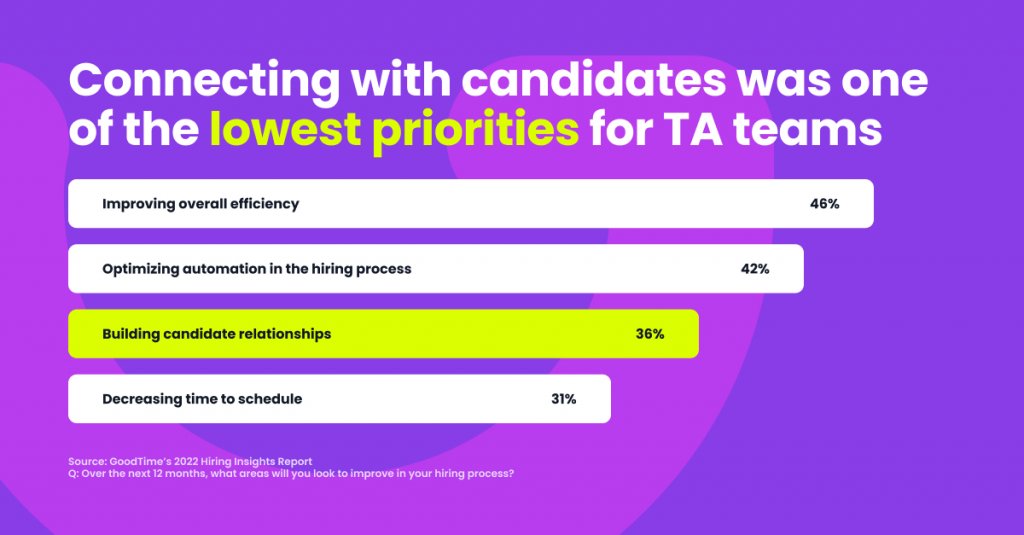
On the bright side, 46% of our report’s respondents agree that creating genuine relationships with candidates is more important than ever. But the positives end there.

Despite this consensus, only 36% of respondents looked to build better candidate relationships in the past 12 months, and the same percentage plan on improving these relationships in the coming months. Companies have good intentions, but struggle with taking action.

Remote workspaces do not fare any better. Among the fully-remote companies surveyed, just 25% plan to build relationships with candidates in the future. Yet if anyone should focus on relationship building, it’s them. Remote employees are more perceptible to feelings of isolation. This makes it even more important to cultivate trust and connection in a remote hiring process.

Hiring Efficiency Falters

TA leaders surveyed indicated that their main focus lies in improving the overall efficiency of their hiring process. This is a good sign; respondents agree that prompt and clear communication throughout the hiring process is most valuable to candidates, which goes hand-in-hand with an efficient process. Improved efficiency also means more time and space to focus on high-value tasks—such as authentically connecting with candidates. 

But before companies can even start to use this space for building relationships with applicants, they have a ways to go in ramping up their overall hiring efficiency. The majority of respondents—60%—say that over the past 12 months, their time-to-hire has increased. Companies that hire fast have a major advantage in keeping talent engaged enough to win them over. However, the average time-to-hire among all respondents was three weeks.

As for the time spent on administrative tasks, HR teams reportedly spend more than one-third of their time scheduling interviews. Manual, clunky interview scheduling majorly lowers the quality of a hiring process—and a candidate-recruiter relationship. 

By establishing the right processes and technology to eliminate the time spent on administrative tasks and boost hiring efficiency, TA teams can maximize their bandwidth to focus on what matters most: connecting with candidates.

Does interview scheduling automation make sense for my team?

ROI is key. This is not a time to invest in software that won’t bring you immediate value. So let’s eliminate the guesswork with our free ROI calculator.

Disconnect in Company Culture

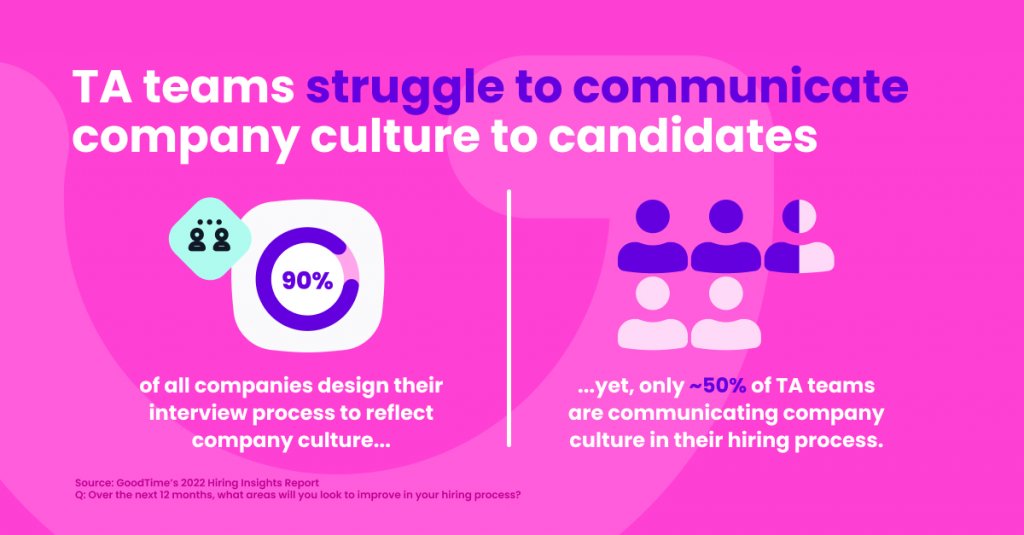
It’s not lost on TA teams that job seekers deeply consider company culture before accepting an offer. Nearly all (90%) companies reportedly designed their interview process to reflect their culture.

The problem? Just 53% communicate their company culture to candidates during the hiring process. In other words, 47% of companies neglect to communicate an element that is incredibly top-of-mind for candidates—and risk losing out on star applicants due to this disregard.

Candidates want to know whether a company’s mission, values, and culture align with their own beliefs. They’re quick to turn down an offer if they don’t see themselves feeling happy and welcome at your company. One of the clearest paths to forming candidate relationships is by having them feel deeply connected to your culture—yet this can’t happen if the culture isn’t communicated to them to begin with. 

Want the Latest Insights? Read the 2023 Hiring Insights Report

It’s abundantly clear that in the HR world, there’s lots of talk but little execution—and companies aren’t achieving their hiring goals as a result. Candidates are interviewing you as much as you’re interviewing them, and they expect you to put in the work to form a connection. 

For TA teams to make long-lasting bonds with applicants, they must pull themselves up by the bootstraps and take action. That means leveling up their efficiency to free up time to focus on candidates, and thoughtfully communicating elements of their culture to win applicants over. 

Want to catch up on the latest hiring trends? Get excited: our 2023 Hiring Insights Report is now available. 500+ HR leaders, 1,000s of real findings, 1 industry-leading report. Read the report today.

Four-Day Workweek: A Magic Bullet for Talent Acquisition?

When considering the major shifts in work arrangements that we’ve seen in the past few years (oh hello, remote work), the recent buzz around the four-day workweek comes as no surprise. If we’ve learned anything from post-pandemic life, it’s that the typical 9 to 5, in-office work paradigm is old news. Normalizing three-day weekends—once just a pipe dream—sounds a lot less far-fetched.

Proponents praise four-day workweeks for prioritizing the wellness of employees with promises of decreased stress and increased happiness. With numerous companies testing out a shortened workweek, we now have evidence to use when judging if this new arrangement really delivers on its promises. Spoiler alert: it does.

Overall, the rise of the four-day workweek comes at an incredibly opportune time for TA teams. With the Great Resignation showing no signs of slowing down, teams must pull out all the stops to attract candidates and keep employees from jumping ship. And with 92% of U.S. employees in favor of a four-day workweek, implementing this policy may be just the thing that puts your company ahead of the rest.

Employee Well-being Wins Talent

The companies that champion employee well-being are the ones that snag and retain the best talent. It’s just that simple. The positive byproducts of shorter workweeks mark a whole new frontier in supporting the wellness of employees.

In a Paychex survey, six out of ten employees identified well-being benefits as a major priority when job hunting—despite the fact that less than half of employees feel their current company makes it a priority. Among five areas of employee well-being, 24% of respondents rated mental and emotional wellness as their biggest struggle at work. This was due to a lack of benefits such as flexible schedules. 

As for the number one way to support well-being, the majority of employees rated additional time off as the best employee benefit. In a similar vein, 68% of workers said they’d rather change careers for a better work-life balance than higher pay.

Noticing a theme? Today’s burned-out employees want companies to honor their personal wellness, and they want to see this through more free time. All signs point to four-day workweeks as a solution to giving workers what they clearly desire. 

Four-day Workweek in Practice

In theory, a four-day workweek and the allure of additional personal time seems like a logical way to elevate talent acquisition. But in practice, does this work arrangement stack up to expectations? Let’s look at the companies that recently tested the waters.

Bolt Improves Work-life Balance

To combat employee burnout, Bolt, a fintech startup, conducted a three-month 32-hour workweek pilot. Employees worked from Monday to Thursday each week and experienced no reduction in salary. 

At the end of the trial, a company survey revealed that 94% of workers and 91% of managers wanted to continue the program. The vast majority of Bolt employees reported experiencing a better work-life balance and more productivity throughout the three months. As a result, Bolt made four-day workweeks permanent.

When first rolling out the pilot, Bolt employees wiped their entire calendars clean. This way, they’d be highly intentional when scheduling meetings and would avoid squishing five days worth of work into four. Workers cut some meetings in half, made some less frequent, and eliminated others altogether.

The Wanderlust Group Boosts Profits

The Wanderlust Group, an outdoor tech company, took a slightly different approach to the four-day workweek. In order to give employees more time to invest into themselves, TWG piloted a 32-hour workweek program that eliminated Mondays rather than Fridays. Like Bolt, employees received no reduction in pay.

The results? Employee morale increased and TWG saw a 121% year-over-year increase in profits. The only loss? A reduction in bad meetings that employees didn’t want to attend anyways. Unsurprisingly, their Tuesday to Thursday schedule is now a permanent policy.

On the logistics side of things, TWG realized that they’d need to cut down on their meetings to maximize productivity during their four days of work. They slashed around a third of their standing meetings and weeded out any meetings without a robust agenda.

TWG also recognized that they’d still need their customer support staff to help customers on Mondays. To alleviate this problem, they adopted a rotating schedule where some staff take off on Mondays while others take off on Fridays. 

thredUP Attracts Candidates

thredUP, a fashion resale platform, tested out a Monday to Thursday 32-hour workweek in 2021 and never looked back. The company wanted to actively prove to employees that a true work-life balance matters.

As a result, thredUp reported that more than half of their new hires who completed an onboarding interview mentioned that the abbreviated workweeks influenced their decision to join the company. 88% of employees cited the new work policy as a positive change. Better yet, voluntary turnover within the corporate team decreased by over 50% since the four-day workweek’s implementation.

Similar to Bolt and TWG, thredUP mentioned that for the new workweek to succeed, employees needed to reconsider the importance of certain meetings. As a whole, employees had to prioritize the most high-value tasks.

No One-size-fits-all

A four-day workweek can do wonders for talent acquisition and retention, yet implementing a successful program isn’t cut and dry. Evident from Bolt, TWG, and thredUP’s varying programs, there’s no “right” way to implement a 32-hour workweek. For a four-day workweek program to succeed, companies need to establish their own unique operational and workflow changes based on their business model.

However, if there’s anything to gain from the recent four-day workweek pilots, it’s that we could all benefit from reprioritizing how we spend our time at work—and that means rethinking our meetings.