Culture Fit Is Dead. It’s Time to Hire for Culture Add.

Keeping your company’s culture in mind is a must-do when recruiting for open positions, but should you really hire for culture fit? Or is hiring for culture add the new way to go?

When done right, hiring for culture fit means looking for candidates that align with the core company values and the way that things are done at an organization, making it even more likely that they would thrive in the workplace and successfully perform as new employees.

Sounds logical, right? Most recruitment teams would agree: 83% of recruiters reportedly consider culture fit to be the most important hiring factor after previous job experience. Meshing with company culture is equally significant to candidates, as more than half of job seekers say that company culture is more important than salary when it comes to being satisfied at work.

But as is the unfortunate fate for many recruiting buzzwords, culture fit has been misinterpreted and misused to the point where the concept now does more harm than good. It’s time to say good-bye to hiring for culture fit and hello to hiring for culture add.

Dangers of Hiring for Culture Fit

Culture Fit Is Difficult to Define

How well a candidate fits into a company’s culture is incredibly subjective and hard to measure. One recruiter may see a candidate as a perfect culture match, and another may have a completely different perspective.

Leaving culture fit open to interpretation makes it susceptible to misuse. What recruiters and hiring managers often end up measuring instead is how well they get along with a candidate. This is where hiring for culture fit becomes problematic.

Prioritizes Similarities When Hiring

The rumors are true: birds of a feather really do flock together. Science shows that we naturally take comfort in identifying with people who are similar to us. In a recruitment context, this means that if a candidate shares a specific characteristic or lived experience with a hiring manager, this commonality creates a bond. 

In turn, some hiring managers neglect to prioritize alignment between the company and the candidate — aka, what culture fit should really be about — and instead focus on alignment between themselves and the candidate. Hiring for culture fit turns into hiring for homogeneity, and I’m sure you can guess how this impacts DEI recruitment efforts.

Negates DEI Recruitment Principles

Selecting candidates based on how well you mesh with them goes against everything that equitable hiring stands for. What started as an attempt to hire for culture fit snowballs into a company that lacks diversity and struggles with DEI hiring practices.

Prioritizing sameness maintains the status quo and creates unconscious biases. Diverse candidates — whether this means diversity of thought or of demographic characteristics — find themselves at a disadvantage.

All in all, hiring for culture fit in this manner creates a workforce with employees that think and look the same. A truly successful company is a diverse company, where issues are tackled and innovations are created thanks to employees with a wide range of thought processes and lived experiences. 

Start Hiring for Culture Add

Stop looking for someone who simply fits your company culture and start searching for something more meaningful: culture add. 

Hiring for culture add means considering your company’s culture while looking for candidates who would enrich the culture with diverse experiences and ideas. In this way, your hiring team fosters a forward-thinking mindset by considering how adding certain perspectives and backgrounds would create a successful future for your organization. 

How to Hire for Culture Add

Assess What’s Missing from Your Organization

It’s impossible to identify candidates who would add to your company culture without first examining what your company lacks. Perhaps you don’t have enough employees who take risks and propose pie in the sky ideas, or who thrive when hyper-focused on the details of a project.

Once you’ve identified what you’re missing, your hiring team can venture forward in their search for candidates who would be successful additions.

Ask Candidates How Your Culture Can Improve

A good candidate keenly understands and appreciates your company culture. A great candidate goes against the grain and recognizes where your culture needs improvements.

If a candidate acknowledges gaps within your company culture, they’d likely be an employee who contributes to your culture with positive change and a different perspective on how to do things, instead of an employee who assimilates to how things have always been done and fits your current company image.

By hiring candidates who can recognize these gaps, your company benefits from a diversity of thought that pushes your organization forward and challenges the status quo.

Diversify Your Sourcing Channels

If you’re struggling with hiring for culture add, it might be because your talent pool is too homogeneous. Take this as a sign that you need to add diversity to your sourcing strategies.

Start by getting acquainted with online job posting platforms that cater to diverse populations, such as the Professional Diversity Network and Diversity Job Board. Posting your job openings on these websites encourages historically underrepresented groups to consider employment at your company.

You can also seek out and hold events with local chapters and associations where diverse candidates meet. This way, you’ll form meaningful candidate relationships with job seekers who could add immense value to your organization’s culture.

4 Ways to Compete with Big Tech Recruiting for Top Talent

The tech recruiting world is changing — and fast. 

Between the tumultuous years of 2019-2021, the tech recruiting landscape faced notable shifts. Tech hiring growth strongly recovered in 2021, with the overall advertisements for tech jobs in 2021 being nearly double the number for 2019 and 2020. Even though the world’s tech giants continue to expand their influence, non-Fortune 500 tech companies made up the bulk of recent hiring growth.

While tech hiring surges, applicant pools dwindle. Compared to the average candidate pool sizes from 2020, the sizes were 35% lower in 2021. Not only that, but amid the Great Resignation, candidates have had a change of heart. Candidates no longer want to waste time at organizations that don’t live up to their expectations of the ideal employer. In fact, three-quarters of candidates say they’re considering leaving their jobs.

It’s prime time for growing tech companies to stand out from Big Tech recruiting and snag the best candidates, but only if they can handle the shifting state of applicant pools and meet tech hiring challenges head-on.

To keep pace with the ever-changing world of tech recruitment and to differentiate your company from the competition, take a good look at your recruitment strategies — they’re probably long overdue for a makeover. 

Here are four key ways you can compete with Big Tech recruitment teams and land top candidates.

Does interview scheduling automation make sense for my team?

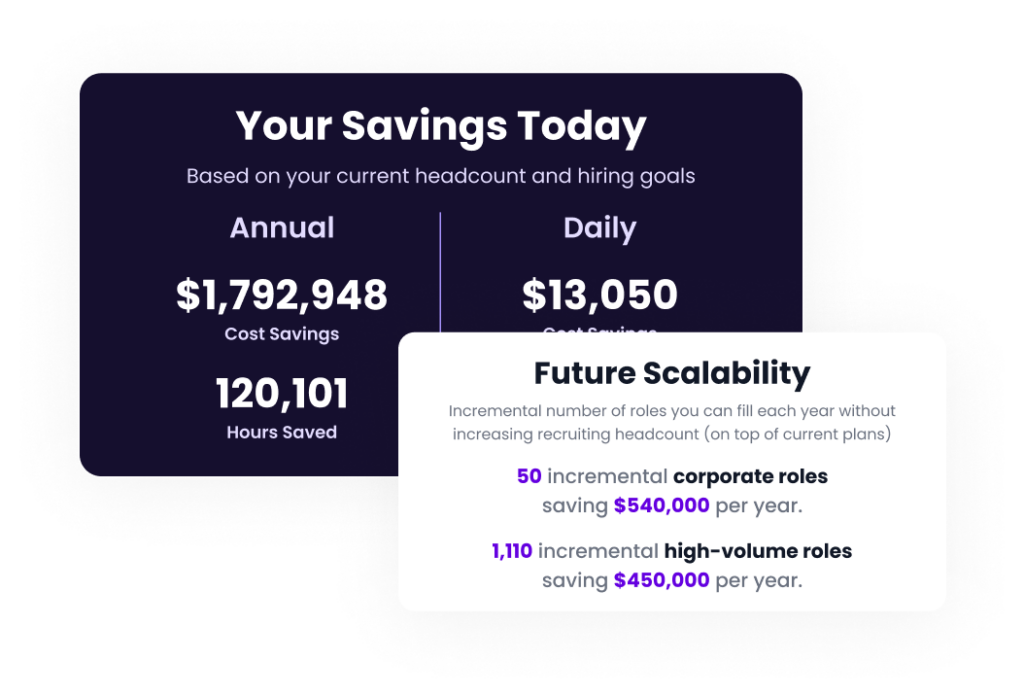
ROI is key. This is not a time to invest in software that won’t bring you immediate value. So let’s eliminate the guesswork with our free ROI calculator.

1. Offer Remote Work Opportunities

The gravitational pull between candidates and remote work opportunities is undeniable. To stay competitive with the big tech recruiting teams, you need to consider making remote work a reality for your organization.

If you’re not offering remote opportunities, you’re missing out on candidates. 75% of tech industry workers say it’s important for their company to allow them to work remotely indefinitely. Despite the desire to work remotely, it seems that each day a top tech company discloses their plans for an eventual return to office.

The fact is that a growing majority of people don’t want to work unless it’s from home. Offering remote options is the way to go, but there’s one caveat: it’s common for tech industry candidates who seek remote work outside of Big Tech companies to expect Big Tech salaries. If your organization can’t meet these expectations, be prepared to upgrade other elements of your compensation and benefits.

2. Show Leniency in Degree Requirements

With a number of Big Tech companies no longer requiring degrees and 90% of employers reportedly open to accepting candidates without four-year college degrees, it’s time to change your expectations on a candidate’s education.

The idea that a college degree is the surest path to a career is now antiquated. Boot camps, digital badges, vocational programs, and self-taught skills demonstrate just as much, or more, competencies necessary to excel in a professional environment.

Removing your degree requirements isn’t just a way to keep pace with the tech talent competition — from a DEI standpoint, it’s also the right thing to do. A college degree is a pricey investment that a wide range of applicants cannot afford. By removing degree requirements, you’ll create an equitable playing field for candidates of all socioeconomic backgrounds, benefit from a diversity of educational experiences, and widen your talent pool all in one fell swoop.

3. Emphasize Your Company’s Continuous Growth

Working at a tech giant with a household name may sound alluring, but don’t discount how enticing it is to work for a company with much untapped potential. 

When carving out your employee value proposition, emphasize the immense learning opportunities that come with working at a company with a focus on growing and scaling. This may be just the thing that attracts the attention of Gen Z, the future leaders of the tech workforce.

Among Gen Z-ers  who plan on leaving their current roles, 76% of this cohort indicate that they’re looking for more opportunities to learn and gain new skills, which is more than any other age group before them.  To win the hearts of Gen Z, capitalize on the growth potential of your organization. Turn your growth potential into a selling point that speaks to the opportunities that you offer in thinking outside of the box and contributing to innovation.

4. Provide What Candidates Expect: Strong Candidate Relationships

If your tech recruitment team doesn’t instill energy into generating memorable candidate relationships, you’ve already lost in the competition for tech talent.

A great candidate experience might have won candidates over in the past, but not anymore. Today’s candidates expect something deeper. Candidates want to feel valued before, during, and after the hiring process, yet more and more companies find themselves losing out on desirable candidates due to their own impersonal processes.

Don’t make that the reality for your organization. GoodTime Hire leverages Candidate Relationship Intelligence to help you transcend temporary experiences and create the type of high-quality connections that win the best talent.

Request a demo to see how Hire provides the edge that talent teams need to need stand out from the competition.

The Candidate Relationship: Erick Green from Beamery

Do you feel that? That’s the talent competition heating up. In today’s all-time competitive recruiting environment, your candidate relationships are more important than ever before. Creating a unilateral, fleeting candidate experience just doesn’t cut it; candidates expect something deeper. It’s time to create genuine connections with candidates.

For Erick Green, meaningfully connecting with the recruiters at Beamery made the interview process an overwhelmingly positive experience — one that transformed him from a passive candidate who wasn’t looking for a new job — to one of Beamery’s newest account executives.

After introducing GoodTime Hire’s Candidate Relationship Intelligence to their tech stack, Beamery’s recruitment team elevated their interview process to transcend temporary experiences and build genuine relationships with candidates like Erick.

Read on to learn how Hire helped Erick accept Beamery’s job offer by cultivating a top-notch interview process.

Sparking the Candidate Relationship 

Transparent Communication from Recruiters

Transparency in the hiring process is high in demand, yet low in supply. 63% of job seekers are reportedly dissatisfied with the communication — or lack thereof — that they receive from most employers. 

Before interviewing with Beamery, Erick had become all too familiar with this lack of communication. In most hiring processes, he found himself left with more questions than answers: What’s the next step? When will I get a call back? Didn’t the recruiter say they would follow up?

With Hire, Beamery removed ambiguity from the equation with automated, personalized interview invites and reminders.

“The hiring experience at Beamery really stood out to me because they really took the guesswork out of it. I knew when my next call was going to be, I knew who it was going to be with.”

— Erick Green, Account Executive at Beamery

No one likes to be left in the dark, especially when interviewing for a job. Leveraging your tech stack to transparently and consistently communicate with each candidate is a crucial step in crafting a candidate relationship that lasts.

Quick and Easy Interview Process

Interviewing for jobs shouldn’t be a guessing game — and it shouldn’t be a waiting game either. Stringing job seekers along through a lengthy hiring process is a surefire way to tarnish your relationship with candidates and miss out on quality talent. 

In fact, 57% of candidates say that the most frustrating part of job hunting is a long wait time after the interview to hear back from a recruiter, and another 57% say that they lose interest in the open position if the hiring process is too long.

Determined to capture and sustain Erick’s interest, Beamery used Hire’s intelligent scheduling automation to eliminate back-and-forth communication and extensive time spent playing calendar tetris.

“With GoodTime, recruiters don’t have to worry and spend time on entering dates into their calendar and scheduling.”

—  Erick Green, Account Executive at Beamery

When recruiters use tech to reduce the time spent on tedious scheduling tasks, they have more time to focus on the task that really matters: meaningfully connecting with candidates.

Learn More About Erick’s Experience

The companies with the most efficient hiring strategy are the ones that snag the best candidates, and Beamery is living proof.

For Erick, the quality of Beamery’s hiring process made accepting their job offer an easy decision. Thanks to the bandwidth that Hire gave back to Beamery’s recruiting team, the team had time to cultivate a meaningful bond with Erick that he wouldn’t soon forget.

“When you’re not worrying about the scheduling, you can worry about the one-on-one interaction which is going to provide a better candidate experience and ultimately, I think, more hires and quicker hires.”

— Erick Green, Account Executive at Beamery

Watch the video below to hear more about Erick’s experience with Beamery and Hire.

Want Better Candidate Engagement? Treat Talent Like Customers

Hot take: if recruiting teams only focus on forming relationships with candidates within the hiring funnel, then they’re missing out on a lot of talent. That’s where continuous candidate engagement comes in. Let’s explain…

The traditional idea of the candidate experience is short and sweet. It starts when talent becomes a candidate, and ends when they’re rejected. But what about before and after?

Charles Mah, Chief Customer Officer at iCIMS, sat down with GoodTime’s CEO and Head of Company Strategy, Ahryun Moon, to share his strategy for continuously engaging candidates. This “customer-driven” hiring model converts candidates into engaged ambassadors of your brand, helping your hiring team make the most coveted hires.

Here’s the TLDR with five takeaways from the session.

1. The Talent Acquisition Model is Antiquated

The talent acquisition model is in dire need of a makeover. TA has always been about simply filling positions, and this used to be sufficient. But as the talent landscape continues to undergo major changes — with the rise of the distance economy, remote work, and a candidate-driven market, to name a few — we also need to change our candidate engagement.

Traditionally, the TA model is short and linear. Recruiting teams send mass amounts of emails and in-mails in a sourcing frenzy, interviewing candidates, and then relaying offers and rejections. The point when candidates enter the recruitment funnel and start interviewing is thought of as the prime time to focus on the candidate experience. However, the experience is largely neglected during all other touchpoints.

This process is no longer up to the standards of what candidates want out of their hiring experience. Candidates want to feel engaged at every stage of recruitment. This means before, during, and after the process. 

2. Create Candidate Relationships — Not Just Candidate Experiences

Move over, candidate experience, and make way for the candidate relationship.

The candidate experience is all about how candidates gauge their interactions with potential employers during the hiring process. Having recruiting teams focus on creating a positive experience for candidates is undoubtedly important, but the candidate experience as it’s traditionally executed comes with pitfalls. That’s why we need to shift towards crafting rich, engaging candidate relationships.

When companies focus on the candidate experience, they don’t usually nurture the connection with the talent they’ve passed on. This is mistake number one: failing to connect with rejected candidates prevents you from tapping into them for new roles. 

Mistake number two occurs when hiring teams neglect to cultivate the candidate relationship before the interviewing stage. Candidates often have multiple job offers on the table, and the companies that go the extra mile to engage potential hires pre-interview are the ones that stand out.

3. Hiring Pools Still Lack Representation

Creating diverse talent pools is a major talking point in the recruiting world, yet data shows that there’s still a lot of work to be done in turning these conversations into actions. Even as recruiting teams expand their talent pools, they struggle to move the diversity needle.

“We’ve seen an average of 11% to 15% of diverse candidates get the opportunity to interview.

That’s still far below where it needs to be.”

– Charles Mah, Chief Customer Officer at iCI

The current methods of recruiting candidates aren’t conducive to championing diversity. If recruiters want to bring a wider range of representation to their talent pools and tap into more diverse candidates, they need to change the ways that they engage and evaluate quality candidates. 

4. Recruiting Teams Need CCE

It’s time to treat candidates like customers and focus on continuous candidate engagement (CCE). Just as brands engage and re-engage with their customers, CCE refers to the ongoing, value-driven connection between candidates and an organization. It’s established through continuously nurturing candidates.

CCE starts with reaching out to candidates about ideas that you’re mutually interested in, such as by sending relevant blogs or podcasts. You can then add these candidates to your CRM to nurture this engagement.

The next step is to connect candidates in your CRM to larger-scale events, whether this means hackathons or ERG events. When it comes to diversifying your talent pool, encouraging participation in ERG events can greatly accomplish this goal.

Participation in these events leads to networking. By connecting your talent pool to hiring managers and ERG members, you can facilitate genuine connections.

After using your CRM to collect data on these dynamic experiences, you now have a high-quality pool of engaged candidates to interview, already pre-vetted on key soft skills. Rejected candidates are not forgotten – the CCE model moves them back to the talent network and continuously nurtures those connections.

5. Why Ongoing Candidate Engagement Matters

CCE is the key to building meaningful candidate relationships for life. Through facilitating ongoing candidate engagement, these incredible experiences with talent not only build diverse and highly skilled workforces, but a community of loyal customers as well.

“Ongoing engagement creates a network of extremely engaged talent that will jump at the opportunity to work at your company.”

– Charles Mah, Chief Customer Officer at iCIMS

If you want to build a CCE engine that breathes life into your candidate relationships, look at your tech stack. iCIMS’ CRM allows you to cultivate robust relationships with candidates by creating moments that matter.

At GoodTime, our automated interview scheduling solution elevates your hiring team’s ability to connect with and win top talent at scale (and save your team major time and money along the way).

Use our free ROI calculator to see how much time and money you could save on hiring by using GoodTime.

Hiring Gen Z? Here’s What They Want in the Candidate Relationship

Gen Z is the newest demographic entering the workforce, and they’re here to make waves. As the youngest, largest, and most diverse generation in United States history, Gen Z stands out from any generation that’s come before them. They’re already redefining the workplace with their unique preferences, and with Gen Z employees set to comprise 27% of the workforce by 2025, their influence will only continue to expand.

From a hiring perspective, teams need to consider how to cultivate a strong candidate relationship with the Gen Z job seeker. Talent leaders who want to win over this next generation of workers will need to get acquainted with their expectations— and fast. Forming an authentic connection with your Gen Z candidates throughout the hiring process is crucial to maintaining their interest amid a sea of other attractive job offers. 

Read on to learn how you can attract and engage Gen Z at every touchpoint in the interview process by living up to their expectations of the candidate relationship

Demonstrated Emphasis on Company Values

Despite being new to the workplace, Gen Z already knows what they value, and they don’t want to compromise. If an employer doesn’t demonstrate their principles, Gen Z will find a workplace that does. In fact, nearly 70% of young professionals in this cohort are likely to switch industries to locate opportunities that align with their values.

Work-life balance is among this group’s top principles; 42% of Gen Z candidates make a healthy work-life integration a top priority when job hunting. Gen Z seeks out employers that recognize the need to unplug and recharge once in a while to avoid burnout. It’s unlikely you’ll find this age group sacrificing their well-being for the sake of a paycheck.

Companies that don’t emphasize their values are setting themselves up for disappointment when it comes to attracting Gen Z talent. Taking time to clearly communicate what matters most to your organization in the interview stage goes a long way in cultivating a relationship with Gen Z candidates.

Commitment to DEI

DEI (diversity, equity, and inclusion) holds a special place in the hearts of Gen Z. 48% of United States Gen Z-ers are racial or ethnic minorities, and they want to see the diversity of their demographic reflected in the workplace.

Gen Z is leading the charge in shifting a heavier emphasis on DEI, and much of their interest comes from first-hand experiences with discriminatory workplaces. A recent study shows that 67% of Gen Z employees reported witnessing racial, ethnic, sexual, or gender-driven discrimination in the workplace, and 44% have been on the receiving end of this discrimination themselves.

In turn, this means that this generation is even warier regarding if an organization really cares about facilitating an inclusive and equitable work environment. Gen Z wants companies to champion DEI at all stages of an employee’s journey— even the pre-employment stage. 

Evaluate your pool of interviewers; do your interviewers come from a variety of backgrounds and characteristics? If not, you’re presenting an image of a workplace devoid of a diversity of perspectives. The interview is Gen Z’s first impression of your company, and failing to promote DEI starts the candidate relationship on the wrong foot.

Transparency on the Compensation Package

Gen Z candidates want their future employers to have a strong social conscience, but they want to be paid well, too; 70% say that salary is their top motivator when considering a job offer.

Salary transparency is becoming a widely discussed topic, and Gen Z is oftentimes at the forefront of these conversations. A healthy workplace culture now includes better salary transparency, and 70% of Gen Z would consider switching jobs for more of this transparency.

As a generation defined by money-conscious mindsets and honest discussions on compensation, Gen Z is not likely to tolerate companies that withhold details regarding salaries and benefits. Companies seeking to form trusted candidate relationships with Gen Z must be transparent with their compensation packages, and this means facilitating candid discussions in interviews.

Open Communication on Growth Opportunities 

To cultivate a genuine candidate relationship between Gen Z and your hiring team, it is essential to include discussions on growth opportunities within the interview process. The data doesn’t lie: in a survey, 64% of Gen Z workers identified growth opportunities as one of their top career priorities. 

Gen Z candidates want to know that they can have an exciting future at your company, but this doesn’t mean that they want to hear all about how they can someday fulfill their dreams of becoming a top executive. In the same survey, only 3% of Gen Z cited having a “fancy job title” as a priority. 

Instead, Gen Z wants their hiring process to include open dialogue surrounding how they’d be able to pick up new skills and grow their learnings in their potential future job. Overall, these candidates are looking for additional responsibilities at companies that are dedicated to maintaining their values and prioritizing the well-being of their employees.

Tech-Driven Candidate Experience

Gen Z learned how to scroll before they could speak. They were born with technology in their hands, and they expect the hiring process to keep up with their fast-paced, tech-driven lifestyles. In fact, a staggering 54% of Gen Z job seekers won’t even submit their applications if your hiring process seems outdated or unnecessarily time-consuming.

Arming your tech stack with intelligent recruitment software allows you to keep pace with Gen Z’s expectations. Prioritizing a tech-driven candidate relationship will save you both time and energy, all while ensuring that outdated hiring procedures don’t hold you back from securing top talent.

The Bottom Line: Prioritize the Candidate Relationship

Every generation has preferences in what they want in the candidate relationship, and Gen Z is no exception. This new demographic is redefining not only what an ideal work environment looks like, but also what a desirable hiring process looks like. Staying up-to-date on their expectations is crucial to winning them over.

Cultivating candidate relationships doesn’t have to be complicated. Download our eBook to learn more about the key pillars to a strong candidate relationship.

6 Steps Proven To Boost Your Employer Brand

Great compensation alone no longer tops the list of must-haves for job seekers. So what is driving competitive talent your way? Today, it’s all about how candidates perceive your company’s culture, aka your employer brand – and whether or not they can visualize themselves being part of it. 

In fact, with 25% of candidates willing to accept a pay cut to work for a company with an engaging employee experience, it’s becoming increasingly evident that the employer brand is just as important as the consumer brand. All things considered, focusing on your brand is undoubtedly good for business: organizations that invest in their employer brand are three times more likely to hire quality candidates.

In a world where your reputation as an employer can be discovered in just a few clicks, leveling up is mission-critical. Here are six proven strategies to help you do just that.

1. Audit, Both Inside and Out

It’s one thing to create a flashy careers page – it’s another to live out those promises. To foster a healthy company culture full of happy employees, start by listening. 

Commit to asking your team for honest feedback through regular employee pulse surveys so you can measure and track how they feel about their work experience. Then – and most importantly – let the feedback inform your business strategy.

Don’t stop there. Take an external look at your employer brand by “listening” to what people are saying about your company across social media platforms and job review sites. Gathering this data will help you not only identify your strengths and play to them in the future, but also identify your weaknesses and prioritize next steps for mitigating them.

2. Employer Brand Starts With Employee Value Proposition

Next, get clear on why competitive talent would want to work for you. What do you offer in exchange for their valuable time and skills?

Today’s candidates want to work for a place that not only shares their values, but also provides a sense of belonging. Use the data gathered during your audit to write compelling job descriptions that make it clear why a talented individual should join your team.

To further reel in star candidates, ensure that these same value propositions are intelligently conveyed in the hiring process, leaving no doubt in the minds of candidates that your company is the place for them.

3. Demonstrate a Commitment To DEI  

It’s not enough to show off your diversity, equity, and inclusion (DEI) efforts after a candidate is hired; 85% of job seekers want to know where employers stand on DEI before making a final decision about a job.

A great place to start? Your careers page. If DEI is truly a clear focus for your organization, demonstrate it by including images of people from diverse backgrounds, inclusive language, and employee testimonials that speak to your efforts.

Committing to DEI is one of the most consequential factors in creating a workplace where employees feel comfortable to be their authentic selves. But practicing DEI is a continuous journey. Make a habit out of regularly evaluating your DEI efforts and identifying areas needing improvement. 

4. Broadcast Growth Opportunities

Employees want and need a challenge — especially high performers. In fact, 33% of employees cite boredom as the main reason for leaving a job (Korn Ferry’s Breaking Boredom survey).

So if growth isn’t part of your employer brand, it needs to be. Employees who are offered growth and development opportunities learn new skills, making them more valuable and more engaged.

Don’t forget to emphasize these opportunities everywhere you talk about open roles: on your careers page, in job descriptions, and on social media. Showing that you invest in the well-being of your employees will quickly capture a job candidate’s attention.

5. Give Current Team Members a Voice

One of the most significant assets that will reinforce your employer brand is sitting right in front of you: your employees. In fact, candidates trust what current employees say about working for a company three times more than they trust the employer.

To leverage your team, ask them to leave reviews on job sites, request testimonials to share on your website or social media, or record videos of employee stories you can use in recruiting activities.

Your employees’ stories will breathe personality into your employer brand, showcasing real-life examples of people who love being part of your team. Take it from Microsoft, a company that took this idea to another level by creating a Twitter profile, @MicrosoftLife, which is exclusively centered around their company culture and the lives of their employees.

6. Remember: The Candidate Relationship Is Your Employer Brand

Amidst auditing and improving your employer brand, never lose sight of the connection built between candidates and your organization during the interview process – because at the end of the day, the candidate relationship is your employer brand. How you treat and interact with candidates in their hiring journey directly reflects the type of employer you are. To position yourself as a great place to work, ensure that candidates feel respected.

Here’s where your tech stack comes in: implementing features that allow candidates to self-schedule their interviews for a time that works best for them, and leveraging automation for a quick and easy recruitment process, sends a message to candidates that their time is valued.

Don’t let a negative candidate relationship weigh down your employer brand. Give candidates a seamless experience by leveling up your tech stack today.

Interviewing 101: Building a Superstar Interview Panel

When executed correctly, an interview panel can be your secret weapon in optimizing your hiring process and securing top talent for your organization.

Interview panels offer a wide range of benefits, from reducing your time to hire, to minimizing interviewer bias, to gauging how candidates navigate group dynamics. A well-rounded panel — stacked with a diversity of perspectives, aligned to the same objective, and well-trained in interviewing — has the potential to wield spectacular results in meeting your hiring goals. 

On the flip side, a weak, haphazardly assembled panel can be disastrous. And with today’s candidates, the stakes have never been higher: 44% of job seekers agree that the interview experience is the most influential part of the hiring process. 

A negative interview can shatter a candidate’s impression of a company, and candidates aren’t afraid to share their bad experiences with the world. 72% of candidates say they’ve shared bad hiring experiences online, and we all know that negative word-of-mouth can do wonders in damaging an organization’s reputation.

All in all, a thoughtfully crafted interview panel can add significant value to your hiring strategy. Choosing adept, trained interviewers for your panel is key to standing out to candidates and delivering a memorable candidate experience. Here are five best practices to assemble the interview panel of your dreams.

Identify Potential Interviewers

At the crux of a successful interview panel building strategy is robust knowledge on the interviewers who are available to you. As a recruiter, this means you should know who’s completed interviewer training and who’s in the shadowing stage, as well as their available hours, their interview loads, etc.

When you have this information immediately at hand, it’s easier to identify and schedule the right people for your interviews. However, when tasked with scheduling multiple interviewers for a panel, navigating the different schedules, time zones, workloads, and training stages of your interviewers can quickly become overwhelming.

The good news: here in the digital age, your tech stack is vital to handling the logistics of panel interviews. Investing in interview scheduling software that assists in intelligent interviewer selection allows you to automate the process of identifying and load balancing your interview teams, reduce the complexities of communications, and schedule along with the risk of interviewer burnout. This way, scheduling an interview panel is just as easy as scheduling one-on-one chats.

Emphasize Representation and Inclusivity 

A commitment to DEI is a must-have for job seekers – 86% of candidates say that DEI in the workplace is crucial for them when considering a role. With interviews being candidates’ first impressions of a workplace, presenting a diverse, representative interview panel ensures your organization is conveying a corporate culture that is both inclusive and equitable, all while mitigating factors such as unconscious bias.

Take time to thoughtfully consider what your interview panel looks like. Does your panel consist of interviewers with an array of backgrounds and perspectives, properly representing the diversity of your organization’s employees, or is your panel a sea of homogeneity?

Sharing pronouns (she/her, they/them, etc.) when meeting candidates is another way to actively practice inclusivity in hiring. Candidates want to feel comfortable where they work, and interviews are the prime time to show that your organization doesn’t just talk about the importance of DEI, but actually takes time to implement equitable practices.

Align on the Ideal Candidate

The interviewers in your panel should be in complete alignment with the attributes they’re looking for in a candidate based on the job posting’s requirements. When interviewers are in agreement with what they want a candidate to bring to the table in consideration of what the role needs to accomplish, the interview process becomes even more efficient and effective in identifying the right talent in the fastest time possible.

After the interview panel, holding a post-interview debrief is a great way to come together to understand how the interviews went, if the candidate matches the attributes the interviewers were looking for, and if an offer should realistically be made.

Widen Your Interviewer Pool 

The more aggressive your hiring goals, the more employees you’ll need to be interviewers for your various interview panels and individual interviews. Less than 10% of HR executives require interviewer training in their companies, meaning that the vast majority of organizations risk losing out on candidates due to interviewers unequipped to fulfill their roles.

Broadening your interviewer pool with interviewer training is crucial to distributing the interview load evenly across your organization’s employees, all while making sure that your interviewers are qualified to hire quality talent in record time. Interviews are the first interaction that candidates have with your company – make sure you start on the right foot! 

Download our guide to learn how interviewer training can transform your hiring process.

3 Ways To Reduce Employee Turnover With Candidate Relationships

In the world of recruitment, finding top talent is only half the battle—it’s all about candidate relationships. For hiring teams with goals to not only reel stellar candidates in, but to also ensure that candidates stay engaged in an opportunity that lives up to expectations, talent retention requires just as much attention as talent acquisition.

As a recruiter, if this component of hiring is overlooked (as it all-too-often is), an alarmingly high employee turnover rate can directly negate your efforts to grow your teams. And within the age of the Great Resignation as more and more companies lose their top performers to other opportunities, now is the time to amplify your employee retention efforts.

If the importance of driving retention needed further proof, the cost of replacing an employee reportedly amounts to between 90% to 200% of their annual salary, meaning that keeping retention top-of-mind from the start of the interview process can save both time and money down the road.

We’ve talked about the importance of prioritizing candidate relationships in order to turn candidates into new hires, yet this key component of hiring is equally important when ensuring those new hires decide to stick around for a while. 

While 31% of employees reportedly left their new job within the first six months of working, this statistic doesn’t have to be the reality for your organization. In fact, it is incredibly preventable, and the solution lies in cultivating strong, genuine connections with potential new hires from the get-go. Read on to learn how to use candidate relationships as your secret weapon in boosting retention and reducing turnover.

Be Transparent With Advancement Opportunities

Employees don’t just want to have a job at your organization – they want a career, and part of having a career means having a defined path for promotions and advancement. If these opportunities aren’t present, employees aren’t afraid to look to other places, seen in the more than one-quarter of employees that are reportedly hunting for a new career for better advancement opportunities. 

Clearly and transparently communicating the projected career path in the interviewing stage not only bolsters candidate relationships with a trustworthy foundation of communication but also ensures that both your hiring team and the candidate are on the same page with what can be expected in growth opportunities. 

With 51% of hires left feeling misled over opportunities for career progression, being upfront about how your candidates can advance within the role mitigates the chance that they’ll be disappointed with these opportunities down the line and will decide to move on to a different organization. 

Convey Your Organization’s Culture

Clear communication is undoubtedly a core component in forming a strong relationship with candidates that translates to success and retention once they’re hired, yet this goes beyond articulating growth opportunities: this also means communicating the company culture. 

Company culture has always been somewhat difficult to fully convey to candidates, and the distance economy along with the new norm of remote hiring has made this concept even more abstract and difficult to properly illuminate. But with 38% of workers wanting to leave their jobs due to the culture, it’s evident that taking time to communicate a clear image of the workplace’s culture in the interview process is a must-do.

In the end, a candidate relationship embedded with open discussions on culture ensures that whoever is hired for the role fully understands and aligns with the environment and values of the organization, reducing the likeliness of turnover due to a bad cultural fit down the line.

Demonstrate Flexibility When Hiring

If the rise of remote working has taught us anything, it’s that flexibility is good for business. With 42% of employees reporting that they would leave their jobs for a more flexible work environment, companies that don’t offer flexibility risk losing out on acquiring and retaining top talent.

Facilitating candid conversations with candidates on their options for flexible work and flexible schedules is a great way to both strengthen the candidate relationship and make sure that the new hire won’t quit soon after they start the job due to dissatisfaction with the room for flexibility provided within the position.

But, showing is nearly always better than telling, so if you want your recruiting team to really stand out from the crowd, it’d be wise to demonstrate your organization’s commitment to flexibility using the tools in your tech stack. You can make flexibility paramount in the interview process with optimized virtual interviewing experiences, complete with self-scheduling capabilities that allow candidates to interview at a time that is most convenient for them.

The Bottom Line 

When faced with an increasingly picky candidate pool combined with job-hopping employees that drive up turnover rates, acquiring and retaining talent can oftentimes feel like an uphill battle. In times like this, cultivating the candidate relationship grows ever more important. This means enacting hiring practices that present potential hires with a genuine, true-to-life preview of the job.  

Check out our eBook on the candidate relationship to learn how to give candidates personable experiences at every step in your hiring process.

The Candidate Relationship: Seth Waterman from Databricks

In the distance economy, the talent competition continues to grow more cut-throat as remote jobs garner hundreds upon thousands of eager applicants. Fine-tuning your hiring strategy to foster a strong candidate relationship makes the difference between a candidate accepting or rejecting an offer. 

For candidates like Seth Waterman, feeling prioritized during the interview process made accepting the role of Partner Sales Director at Databricks a no-brainer.

With GoodTime in their tech stack, Databricks streamlines their hiring to win over Seth and other stellar candidates. But that’s not all. Thanks to GoodTime’s interviewer training paths, Databricks increased the size of their interviewer pool, allowing them to move candidates forward faster and deliver quick and easy candidate experiences.

Read on to learn how GoodTime helped Seth accept Databricks’ job offer by boosting one of the most defining factors in every interview: the candidate relationship.

Igniting the Candidate Relationship

Fast-Tracked Hiring Process

Job hunting is known to be one of the most stressful events in one’s life life. Painstakingly long hiring procedures can only make matters worse. Throughout his job search, Seth experienced this all-too-common reality: companies with drawn-out interview processes that sour the candidate experience.

That’s where Databricks stood out from the crowd. After using GoodTime to supercharge their hiring, what could’ve been over a month-long interview process took less than three weeks.

“It was the first time in six years that I had really considered making a move in my career, and with the speed and pace that they worked at through GoodTime, it really made me feel the urgency that they had in me as a candidate.”

— Seth Waterman, Partner Sales Director at Databricks

When companies double down on their tech stack to implement a smooth interview process, candidates feel that their time is honored. From here, the candidate relationship only grows stronger.

Candidate-Driven Interviews

With 87% of candidates preferring to lead interviews, it’s no surprise that candidate-driven interview processes yield more success than the company-driven approach. With the help of GoodTime’s advanced interview scheduling, Databricks put Seth in the driver’s seat with a hiring process centered around his schedule. 

As over half of job seekers prefer more flexibility over a higher salary, flexibility is a growing priority for candidates. Making self-scheduling a central part of the hiring process can be key to creating a great first impression — and first impressions are everything when it comes to recruitment.

How a candidate is treated in the interview process heavily dictates whether they accept a job offer. In fact, 68% of applicants believe that how they’re treated as a candidate reflects how the organization treats their employees. Implementing a candidate-driven interview process ensures candidates that they’d be stepping into a flexible and trusting work environment.

Learn More About Seth’s Candidate Experience

In the end, both Seth and the Databricks recruiting team came out on top. Seth felt valued at every step of his interview journey, and the recruiting team snagged a star candidate. Prioritizing the candidate relationship to win top talent: it works every time.

“If you’re not using GoodTime today, I’d definitely look into it. If you’re interested in having a premier candidate experience for your company, it will go a long way in creating that type of atmosphere.”

— Seth Waterman, Partner Sales Director at Databricks

Watch the video below to hear more about Seth’s experience with Databricks and GoodTime.

How the Distance Economy Changed the Way We Work

In 2019, only 6% of Americans worked from home — a number that soared to 45% early in the pandemic. People everywhere went from working side-by-side to collaborating solely online in a matter of weeks.

More than just where we work, there’s no question that this distance economy has impacted how we work. It’s even changed what people want from work.

Feelings of social isolation and burnout drove candidates to re-prioritize what’s important to them. And now they’re demanding the very thing they’ve been missing the most — genuine connections and conversations around the things that matter. The distance economy generated a need to communicate differently.

63% of candidates say most employers don’t effectively communicate

Candidates want regular feedback and communication during the interview process. In remote hiring, where human connection is lacking, this is more important than ever.  

84% of candidates want hiring process transparency before they apply 

Emerging from a period of uncertainty, candidates want to see full transparency from companies, including what to expect with salaries, benefits, job responsibilities, and work arrangements.

37% of people experience lower trust in leadership     

Remote work created feelings of isolation for many. Connection builds trust, and it’s important to start building that connection as early as the interview stage. The distance economy created a desire for a more personally fulfilling work experience.

33% of recruiters say more candidates ask about their DEI initiatives than before the pandemic

Candidates want to be a part of an equitable workplace that demonstrates a commitment to diversity, equity, and inclusion. And they’re prepared to pass up job offers from companies that don’t.

76% of millennials want to know about a company’s social and environmental stance before accepting a job       

Environmental and social commitment matters to many candidates, especially the largest segment of today’s workforce — millennials.

More than one in three candidates would take a pay cut for learning opportunities

The uncertainty of the recent economic crisis accelerated the need for upskilling, especially in technology. Candidates want employers who can maximize their potential and set them up for a better tomorrow. The distance economy amplified the need to feel appreciated and prioritized.

75% of people say their mental health is now a top priority

Remote work took a major toll on personal well-being. Now, candidates are looking for employers that place as much value on mental health as they do.

Flexibility is the fastest-growing priority for job seekers right now. Candidates want continued flexibility to gain better work-life balance and to prioritize their mental and physical health.

Only 17% of remote employees want to return to the office full-time

Two years into the pandemic, people have figured out how to work from home. Now, they’re looking for companies that give them the flexibility to work in a way that suits their life.

Trust, transparency, flexibility. If you’re noticing a pattern in the data being reported, you’re not alone. Now more than ever before people want genuine connection. For hiring leaders, that means developing positive candidate relationships. 

Elevate Your Recruitment Process Today

If you want to stand out among other companies in the distance economy, you need recruitment tech that truly prioritizes candidates. Look no further than GoodTime Hire.

GoodTime Hire harnesses Candidate Relationship Intelligence to automate coordination, build relationships during interviews, and provide actionable insights to continuously improve your hiring process.


Learn more about how Hire can take your recruitment process to the next level.