Meetings Suck. Here’s How to Fix Them.

You know the feeling. You’re sitting in a meeting, watching the clock, and before you know it, the conversation goes sideways. You ask yourself, “Why am I even here? Why are any of us here?” 

Your mind wanders to the multitude of tasks that you’d rather be dealing with. Finally, the meeting ends and your real work begins. You start crossing off items on your to-do list, and then—

Bam. The calendar notification of doom: time for the next meeting.

How did we get to this point? Why are we up to our eyeballs in meetings?

Some argue that the pandemic created our current avalanche of meetings—and they’re not completely wrong. Since 2020, companies have gone from holding 40 to 66 million daily meetings in the U.S. alone. And given the meteoric rise of remote and hybrid work, the amount is sure to increase.

But that’s not the full story. The phrase “this should’ve been an email” made its way into our lexicon long before the pandemic. The truth is that we never mastered meetings. The pandemic accelerated the issue, and now we’re finally facing the consequences of our haphazard meeting culture.

We need smart meetings, and we need them now. It’s time to stop the meeting mayhem.

Meeting Mayhem by the Numbers

The data doesn’t lie: our meetings are broken. Like, really broken.

We waste a whopping 24 billion hours each year due to unproductive meetings. The majority of professionals now spend up to a third of their workweek stuck in meetings.

And the financial costs? They’re devastating. U.S. businesses reportedly lose a grand total of $37 billion a year due to unnecessary meetings. Bad meetings mean bad news for businesses.

Unsurprisingly, the general consensus is that meetings suck. Working professionals ranked having too many meetings as the biggest workplace distraction. Research shows that 90% of people daydream in meetings, and 73% use meeting time to get other work done. To make matters worse, 75% of people haven’t even received training on how to conduct a meeting.

If all of that wasn’t bad enough, there’s now a term for the negative effects of meetings: “meeting recovery syndrome.” This phenomenon refers to the feelings of fatigue and frustration that arise from a bad meeting.

“No Meeting Monday” Won’t Save You

To mitigate the onslaught of meetings, companies resorted to establishing “No Meetings” days. Blocking off days for uninterrupted heads-down work sounds great in theory. But in practice, workers end up with back-to-back meetings the following day to make up for their singular day of meeting-free bliss.

Eliminating meetings isn’t the best way forward. After all, there’s a reason why people hold meetings. Meetings can be extraordinary; they’re where collaboration moves mountains, and where big ideas find their legs. With less than one-third of knowledge workers coming to the office each day, meetings offer one of the only opportunities for coworkers to connect face to face. 

Meetings aren’t the problem. The problem is how we conduct them. Instead of getting rid of meetings, the solution lies in making meetings smarter. So—how do we do that?

Fundamentals of Smart Meetings

The hallmark of a smart meeting is if a meeting is attended by the right people, at the right time, in the right place for a clear goal. Attendees of these meetings make bigger accomplishments and more meaningful progress than ever before. And, most importantly, smart meetings cultivate the type of genuine relationships among attendees that no other form of communication can replicate. 

Luckily, you don’t have to create smarter meetings on your own. A Meeting Optimization Engine handles the entire coordination, relationship building, and insights gathering process to make smart meetings come to life. 

Let’s dig into the three foundational elements of smart meetings:

The Right Attendees

Meetings are breeding grounds for collaboration and connection. And in the distance economy, where 98% of today’s meetings reportedly include at least one remote attendee, meetings stand as optimal spaces to form bonds in the absence of physical interaction.

However, problems arise when meetings don’t include the right key players. When the wrong people are placed in meetings, frustration builds, which erodes any sense of community within a team.

That’s why smart meetings include the most suitable attendees. When the right people join forces, teams accelerate towards their goals and meaningful relationships blossom.

The Right Time and Place

Smart meetings are “smart” from the get-go, and that means before any meeting even takes place. Smart meeting scheduling involves identifying the optimal time and place for all attendees to connect. Smart meetings should work for everyone’s calendar.

Overall, the time and place of your meetings should be conducive to productivity and success. If a meeting takes place too frequently, or not frequently enough, it isn’t smart. Likewise, if a meeting’s presence just takes up space on a calendar, it’s not a smart meeting—it’s a time sink.

Achieves a Clear Goal

If you aren’t meeting to achieve a clear goal, ask yourself why you’re even meeting. Your meetings need to be purposeful. The goals of your meetings should be clearly defined, and all attendees should be firmly aligned on what they must achieve.

Each and every meeting should move your team closer to your pre-defined goals. If your meetings don’t generate progress, they must be reengineered.

More on Smart Meetings

Okay, so we’ve laid down the fundamentals of smart meetings. Ready to dive even deeper?

From meticulously crafting meeting agendas, to thoughtfully selecting the best meeting structure, making your meetings smart is a fine art. Here are several elements to consider when crafting your meetings.

The Perfect Meeting Agenda

Far too often, meeting organizers come with an agenda that’s just a list of topics. Even though there’s likely several crucial topics that you want to cover in your meetings, agendas that are just bullets after bullets of topics set your meetings up for failure.

The most purposeful agendas include specific, pre-defined questions for attendees to discuss and answer. Starting meetings with the knowledge of exactly what you must resolve gives them a strategic edge.

Even better, narrowing your agenda topics into questions promotes meeting efficiency. Starting meetings with topics to discuss opens the door for irrelevant conversations that don’t get to the heart of the issue. But when you start meetings with questions, attendees know exactly what they’re there to hash out.

Aside from fine-tuning the content of your agenda, make sure that you’re practicing proper agenda etiquette. Share the agenda with attendees well in advance, always include the agenda in the meeting invitations, and hold yourself to following the agenda’s main points.

All in all, now isn’t the time to just “wing it.” Use your meeting agenda as your road map to delivering smarter meetings.

Selecting the Meeting Structure

There’s plenty of useful meeting structures out there to leverage—when they’re appropriate. When choosing the right structure, consider several factors: the purpose, the attendees, and the group size.

For quick status reports, consider holding daily team huddles. These meetings are normally 10 or 15 minutes. They keep your team aligned throughout the week on their priorities. Attendees provide updates and talk through any obstacles. The brevity of these meetings provides teams with ample time to execute on high-value tasks.

Have a crucial project or campaign that’s in the works? A weekly campaign planning meeting can be a productive time for all of the campaign’s stakeholders to talk through the goals for the weeks ahead, what’s in progress and what still needs to be kicked off, and any roadblocks. However, stay vigilant on the importance of this meeting each week. Some weeks of a campaign may be smooth sailing, with nothing significant to discuss.

If you feel like your projects tend to remain stagnant, it may be time to establish Level 10 (L10) meetings. An L10 is a weekly meeting that takes place at the same time and same day each week. It’s recommended for these meetings to last around 90 minutes, yet the length will depend on your team’s needs. Dedicate the bulk of each L10 to discussing any outstanding priorities.

Know When To Say No

Say it with us: not everything needs to be a meeting. Some meetings are just emails in disguise. In order to truly live by the smart meeting code, learn how to sniff out unnecessary meetings.

Useless meetings come with common red flags. If a meeting doesn’t include even a loose agenda, it’s time to start asking questions. And just because a certain weekly meeting has always taken place on your team, doesn’t mean that it’s needed. Have these conversations moved your team closer to a goal? How has your team progressed thanks to these meetings?

Don’t be afraid to question a meeting’s purpose, or if the meeting needs to occur at all. Your entire team will be better off without these questionable meetings. Ask what’s the desired outcome, or question if the frequency of a meeting is necessary, if applicable.

Maybe a meeting feels necessary for certain members to attend, but not you. Be direct—ask the organizer what value you would add, or why your attendance is important.

Making Every Minute Count

For years, we’ve made attending useless meetings a punchline for office jokes. We bond over these jokes because we all know the feeling of counting down the minutes for a meeting to end. Yet the consequences of wasting precious time in inefficient meetings are no laughing matter.

Every once in a while, we attend a meeting that reminds us of how powerful meetings can be. We connect with our teammates, smash through roadblocks, and can practically taste how close we are to attaining our goals. But then this meeting passes by, and we’re back to facing the aimless meetings that we’re accustomed to.

Imagine if every single minute spent in meetings actually mattered. To create this reality, meetings just need a fresh, new approach.

Together, we can stop the meeting mayhem—but only if we make meetings smarter.

TA Teams and Candidate Relationships: Big Talk, Little Action

Let’s start with the good news. More and more TA leaders finally recognize that to snag the best talent, forming candidate relationships is the way forward. They know that candidate-focused hiring practices must take center stage, and one-sided practices must be laid to rest.

Now…the bad news: the execution just isn’t adding up. Our 2022 Hiring Insights Report surveyed 560 TA decision makers across the U.S. to understand their perceptions of the most pressing challenges facing their teams, and what should be done to reel in top talent. The report’s data shows that yes, talent teams recognize the importance of connecting with candidates, but not enough teams actually put candidate relationships in motion—and that’s a problem. Too much talk, not enough action. 

If there was ever a time to kick relationship building into high gear, the time is now. In 2021, companies surveyed fell 50% short of their hiring goals. Failing to prioritize meaningfully connecting with candidates means bad news for your hiring goal attainment. It’s time for less saying and more doing.

Candidate Relationships in Short Supply

On the bright side, 46% of our report’s respondents agree that creating genuine relationships with candidates is more important than ever. But the positives end there.

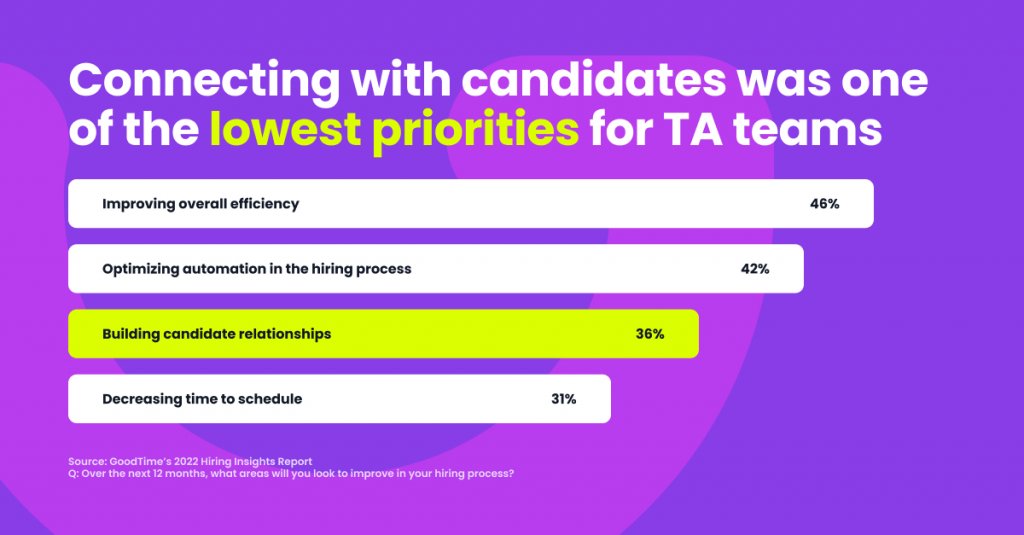
Despite this consensus, only 36% of respondents looked to build better candidate relationships in the past 12 months, and the same percentage plan on improving these relationships in the coming months. Companies have good intentions, but struggle with taking action.

Remote workspaces do not fare any better. Among the fully-remote companies surveyed, just 25% plan to build relationships with candidates in the future. Yet if anyone should focus on relationship building, it’s them. Remote employees are more perceptible to feelings of isolation. This makes it even more important to cultivate trust and connection in a remote hiring process.

Hiring Efficiency Falters

TA leaders surveyed indicated that their main focus lies in improving the overall efficiency of their hiring process. This is a good sign; respondents agree that prompt and clear communication throughout the hiring process is most valuable to candidates, which goes hand-in-hand with an efficient process. Improved efficiency also means more time and space to focus on high-value tasks—such as authentically connecting with candidates. 

But before companies can even start to use this space for building relationships with applicants, they have a ways to go in ramping up their overall hiring efficiency. The majority of respondents—60%—say that over the past 12 months, their time-to-hire has increased. Companies that hire fast have a major advantage in keeping talent engaged enough to win them over. However, the average time-to-hire among all respondents was three weeks.

As for the time spent on administrative tasks, HR teams reportedly spend more than one-third of their time scheduling interviews. Manual, clunky interview scheduling majorly lowers the quality of a hiring process—and a candidate-recruiter relationship. 

By establishing the right processes and technology to eliminate the time spent on administrative tasks and boost hiring efficiency, TA teams can maximize their bandwidth to focus on what matters most: connecting with candidates.

Does interview scheduling automation make sense for my team?

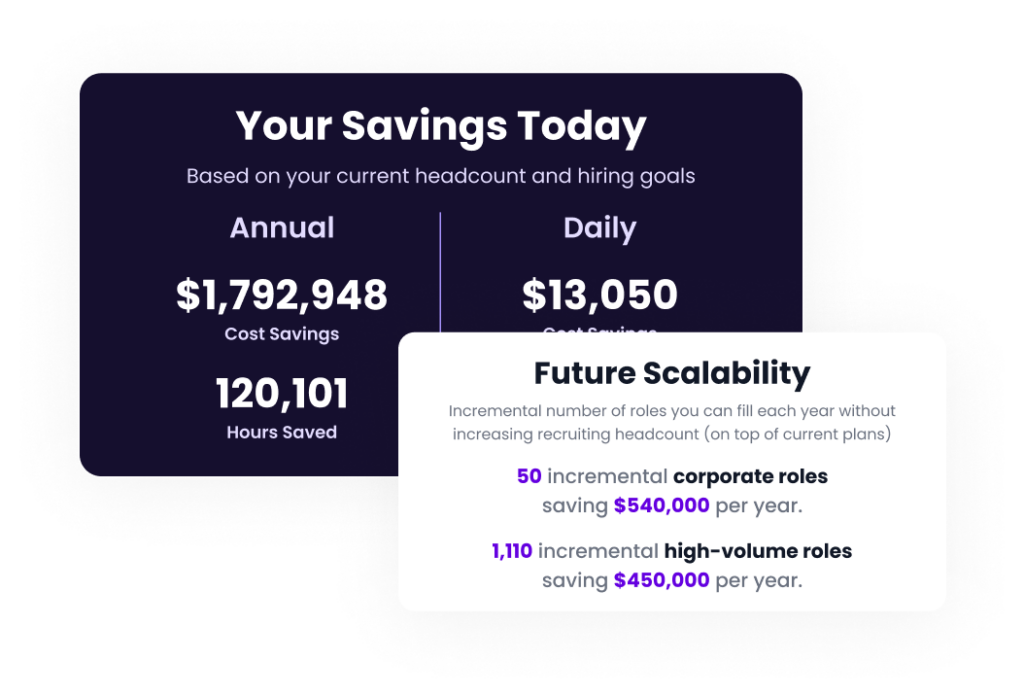
ROI is key. This is not a time to invest in software that won’t bring you immediate value. So let’s eliminate the guesswork with our free ROI calculator.

Disconnect in Company Culture

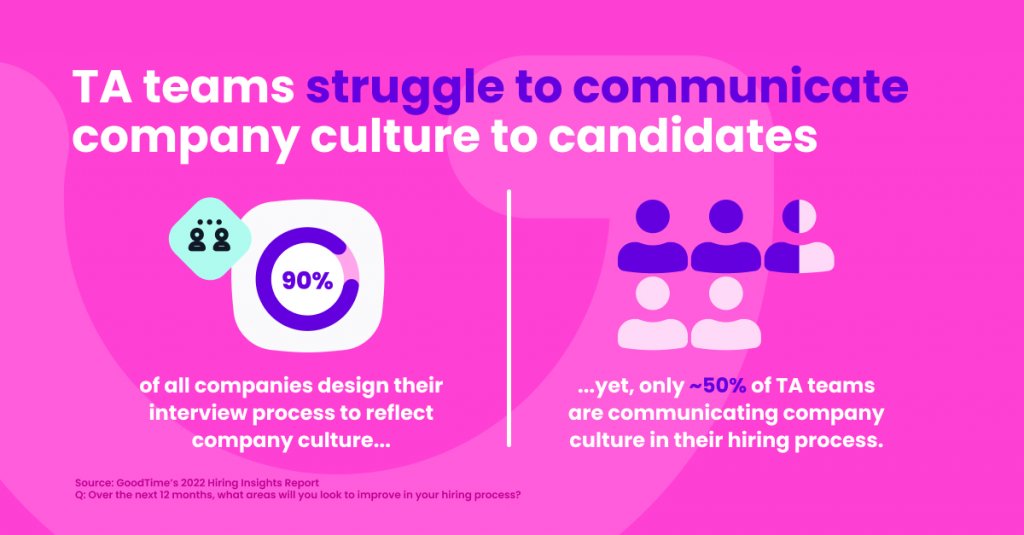
It’s not lost on TA teams that job seekers deeply consider company culture before accepting an offer. Nearly all (90%) companies reportedly designed their interview process to reflect their culture.

The problem? Just 53% communicate their company culture to candidates during the hiring process. In other words, 47% of companies neglect to communicate an element that is incredibly top-of-mind for candidates—and risk losing out on star applicants due to this disregard.

Candidates want to know whether a company’s mission, values, and culture align with their own beliefs. They’re quick to turn down an offer if they don’t see themselves feeling happy and welcome at your company. One of the clearest paths to forming candidate relationships is by having them feel deeply connected to your culture—yet this can’t happen if the culture isn’t communicated to them to begin with. 

Want the Latest Insights? Read the 2023 Hiring Insights Report

It’s abundantly clear that in the HR world, there’s lots of talk but little execution—and companies aren’t achieving their hiring goals as a result. Candidates are interviewing you as much as you’re interviewing them, and they expect you to put in the work to form a connection. 

For TA teams to make long-lasting bonds with applicants, they must pull themselves up by the bootstraps and take action. That means leveling up their efficiency to free up time to focus on candidates, and thoughtfully communicating elements of their culture to win applicants over. 

Want to catch up on the latest hiring trends? Get excited: our 2023 Hiring Insights Report is now available. 500+ HR leaders, 1,000s of real findings, 1 industry-leading report. Read the report today.

Four-Day Workweek: A Magic Bullet for Talent Acquisition?

When considering the major shifts in work arrangements that we’ve seen in the past few years (oh hello, remote work), the recent buzz around the four-day workweek comes as no surprise. If we’ve learned anything from post-pandemic life, it’s that the typical 9 to 5, in-office work paradigm is old news. Normalizing three-day weekends—once just a pipe dream—sounds a lot less far-fetched.

Proponents praise four-day workweeks for prioritizing the wellness of employees with promises of decreased stress and increased happiness. With numerous companies testing out a shortened workweek, we now have evidence to use when judging if this new arrangement really delivers on its promises. Spoiler alert: it does.

Overall, the rise of the four-day workweek comes at an incredibly opportune time for TA teams. With the Great Resignation showing no signs of slowing down, teams must pull out all the stops to attract candidates and keep employees from jumping ship. And with 92% of U.S. employees in favor of a four-day workweek, implementing this policy may be just the thing that puts your company ahead of the rest.

Employee Well-being Wins Talent

The companies that champion employee well-being are the ones that snag and retain the best talent. It’s just that simple. The positive byproducts of shorter workweeks mark a whole new frontier in supporting the wellness of employees.

In a Paychex survey, six out of ten employees identified well-being benefits as a major priority when job hunting—despite the fact that less than half of employees feel their current company makes it a priority. Among five areas of employee well-being, 24% of respondents rated mental and emotional wellness as their biggest struggle at work. This was due to a lack of benefits such as flexible schedules. 

As for the number one way to support well-being, the majority of employees rated additional time off as the best employee benefit. In a similar vein, 68% of workers said they’d rather change careers for a better work-life balance than higher pay.

Noticing a theme? Today’s burned-out employees want companies to honor their personal wellness, and they want to see this through more free time. All signs point to four-day workweeks as a solution to giving workers what they clearly desire. 

Four-day Workweek in Practice

In theory, a four-day workweek and the allure of additional personal time seems like a logical way to elevate talent acquisition. But in practice, does this work arrangement stack up to expectations? Let’s look at the companies that recently tested the waters.

Bolt Improves Work-life Balance

To combat employee burnout, Bolt, a fintech startup, conducted a three-month 32-hour workweek pilot. Employees worked from Monday to Thursday each week and experienced no reduction in salary. 

At the end of the trial, a company survey revealed that 94% of workers and 91% of managers wanted to continue the program. The vast majority of Bolt employees reported experiencing a better work-life balance and more productivity throughout the three months. As a result, Bolt made four-day workweeks permanent.

When first rolling out the pilot, Bolt employees wiped their entire calendars clean. This way, they’d be highly intentional when scheduling meetings and would avoid squishing five days worth of work into four. Workers cut some meetings in half, made some less frequent, and eliminated others altogether.

The Wanderlust Group Boosts Profits

The Wanderlust Group, an outdoor tech company, took a slightly different approach to the four-day workweek. In order to give employees more time to invest into themselves, TWG piloted a 32-hour workweek program that eliminated Mondays rather than Fridays. Like Bolt, employees received no reduction in pay.

The results? Employee morale increased and TWG saw a 121% year-over-year increase in profits. The only loss? A reduction in bad meetings that employees didn’t want to attend anyways. Unsurprisingly, their Tuesday to Thursday schedule is now a permanent policy.

On the logistics side of things, TWG realized that they’d need to cut down on their meetings to maximize productivity during their four days of work. They slashed around a third of their standing meetings and weeded out any meetings without a robust agenda.

TWG also recognized that they’d still need their customer support staff to help customers on Mondays. To alleviate this problem, they adopted a rotating schedule where some staff take off on Mondays while others take off on Fridays. 

thredUP Attracts Candidates

thredUP, a fashion resale platform, tested out a Monday to Thursday 32-hour workweek in 2021 and never looked back. The company wanted to actively prove to employees that a true work-life balance matters.

As a result, thredUp reported that more than half of their new hires who completed an onboarding interview mentioned that the abbreviated workweeks influenced their decision to join the company. 88% of employees cited the new work policy as a positive change. Better yet, voluntary turnover within the corporate team decreased by over 50% since the four-day workweek’s implementation.

Similar to Bolt and TWG, thredUP mentioned that for the new workweek to succeed, employees needed to reconsider the importance of certain meetings. As a whole, employees had to prioritize the most high-value tasks.

No One-size-fits-all

A four-day workweek can do wonders for talent acquisition and retention, yet implementing a successful program isn’t cut and dry. Evident from Bolt, TWG, and thredUP’s varying programs, there’s no “right” way to implement a 32-hour workweek. For a four-day workweek program to succeed, companies need to establish their own unique operational and workflow changes based on their business model.

However, if there’s anything to gain from the recent four-day workweek pilots, it’s that we could all benefit from reprioritizing how we spend our time at work—and that means rethinking our meetings.

4 Tools to Modernize Your TA Tech Stack

Feeling overwhelmed by all of the TA software options on the market? You’re not alone. In today’s tech-driven world, the key to standing out from the talent competition is a strong TA tech stack. But with so many solutions available, it’s difficult to assess which tools are necessities and which ones are just nice-to-haves. 

Don’t worry—we’re here to point you in the right direction. With these four tools, you’ll impress candidates and smash your TA goals in one fell swoop.

1. Applicant Tracking Systems

If you don’t already have an applicant tracking system (ATS), this is your sign to invest in one. There’s a reason why over 98% of Fortune 500 companies use an ATS software (that’s all but nine companies). With an ATS in your TA tech stack, you can facilitate the application process without the risk of losing qualified candidates to the “black hole.” 

An ATS also allows you to easily filter applicants through keywords, skills, or previous roles. No need to spend time organizing applicants; an ATS conveniently collects all your applications in one place. 

While an ATS is a must-have, it’s not without limitations. Even though the typical ATS can now do more than just handle applications, their main expertise lies in that area. You’ll need to add additional products to your tech arsenal if you want to robustly tackle performance metrics, load balance, or enhance DEIB.

The ATS that you choose depends on the needs of your talent team and company. Consider your company size, scalability, and additional features that you’d like to use (text recruiting, referral program management, etc). 

Can’t decide which ATS is right for you? We get it—there’s a LOT. Here’s some recommendations:

  • Greenhouse
  • iCIMS
  • Jobvite
  • SmartRecruiters
  • Workday
  • Lever

2. Virtual Interviewing Platforms 

Remote hiring is far from a pandemic-born phase. Just look at the numbers: 93% of employers reportedly plan to conduct virtual interviews well into the future. If one thing’s for sure, getting acquainted with virtual interviewing platforms is non-negotiable. 

From Zoom to BlueJeans, adding virtual interviewing platforms to their TA tech stack enable recruiting teams to connect with applicants from across the world. No longer limited by a candidate’s geographic location, these platforms both widen and diversify your talent pool.

While remote interviewing is here to stay, you’ll need to master several best practices to maximize the potential of virtual interviewing platforms. These platforms are only as helpful as you make them. To give candidates the best impression of your virtual interview process, standardize the virtual interviewing process and troubleshoot your software before diving into an interview. Remember: candidates are assessing you as much as you’re assessing them.

3. Employee Pulse Surveys

Listen: from a talent retention standpoint, we need to change our employee surveys. 74% of companies still use detailed surveys to analyze employee engagement, but large-scale surveys just don’t cut it anymore. They’re time-consuming to both create and orchestrate—and not to mention an absolute pain to analyze. Instead, opt for employee pulse surveys. 

Pulse surveys allow leaders to solicit feedback and benchmark their employee satisfaction “health” by asking the same questions every survey. They’re designed to be short-and-sweet, so you can expect a high response rate with simplified, actionable feedback. 

Similar to virtual interviewing platforms, employee pulse surveys are what you make them. Pulse surveys can measure anything and everything, and the question types are up to you. Most companies use these surveys on a monthly basis, but there’s no one-size-fits-all survey cadence.

4. Candidate Relationship Intelligence

Throwing more candidates into the top of the funnel simply isn’t an effective way to hit your hiring goals and snag the best talent. The real secret to recruitment success lies in forming connections with candidates in the middle of the funnel, all while moving them through the process as quickly as possible. That’s why companies like Slack and Box now use Candidate Relationship Intelligence as the solution to their hiring.

GoodTime Hire is the only platform that harnesses Candidate Relationship Intelligence to win the best talent. Hire’s success comes from three pillars: automation, relationships, and insights. The magic happens by automating coordination to reduce time to hire, building genuine connections between recruiters and candidates, and gathering actionable insights to continuously optimize the entire process. 

And the results: companies hire up to 70% faster and impress more candidates than ever before.

Ready to learn more about how Hire can transform your recruiting process? Let’s do it.

The Data Is In: Recruiters Must Connect to Compete

Recruitment teams, let’s make one thing clear: candidates now call the shots.

In every sense of the word, we’re living in a candidate’s market. The job market is twice as competitive as it was pre-pandemic, and it’s increasingly common for candidates to end up spoiled for choice with multiple offers. To top it all off, the Great Resignation is still in full swing, as employees leave for greener pastures in droves.

In our ever-evolving hiring landscape, companies must stay in-the-know on the latest HR trends—or risk getting left in the dust. To gain an inside look on these trends and uncover how to succeed in a candidate’s market, GoodTime surveyed 560 HR, talent, and recruiting leaders across the U.S. for our 2022 Hiring Insights Report.

The findings? Companies that build genuine candidate relationships smash their hiring goals. If teams want to compete with the talent landscape, they must invest time and energy into building relationships with applicants. There’s no way around it.

Candidate Relationships Remain Paramount

When asked how they would describe the changes they’ve observed in the hiring landscape over the past 12 months, 46% of HR leaders said that the ability to create meaningful relationships with candidates has become more important than ever before. This is 1% below the top response, “the hiring landscape has become more competitive due to an increased demand for talent.”

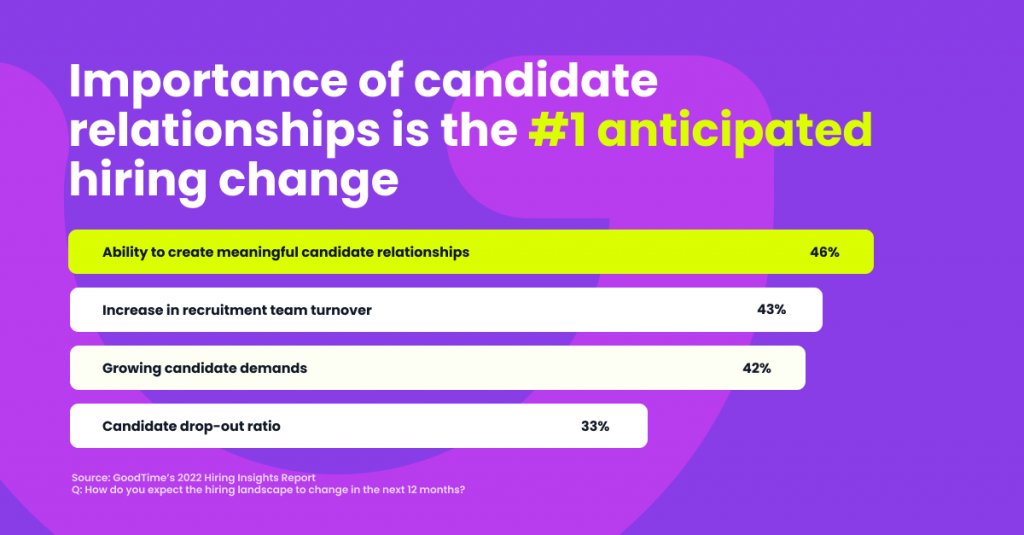
The data shows that focusing on candidate relationships will remain of utmost importance in the future. The ability to create meaningful candidate relationships topped the list of how HR leaders expect the landscape to evolve in the next 12 months. 

Interestingly, when asked which hiring challenges they’ve faced in the past 12 months and which challenges they expect to face in the coming months, HR leaders ranked “retaining top talent” as the biggest challenge each time.

The writing’s on the wall: connecting with candidates is a key component of a successful hiring process. This won’t change anytime soon. But creating candidate relationships is as important for talent retention as it is for acquisition. Retaining talent starts from the very first moment that a candidate has a conversation with a recruiter. In order to turn candidates into long-term hires, talent teams must cultivate genuine connections with new employees from the get-go.

Say Good-bye To One-sided Hiring Practices…

If you didn’t know before, now you know: one-sided, staged hiring practices belong in the past. “Our company has ‘Bring Your Pet to Work Days!’” just doesn’t have the same pizzazz anymore. Candidates expect something deeper.

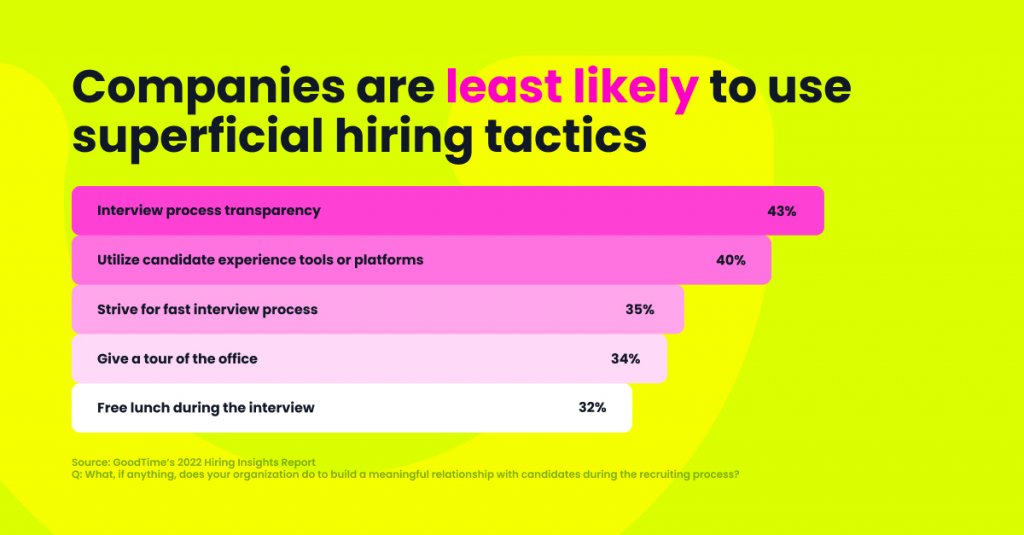
We asked our report’s respondents what, if anything, does their organization currently do to build a meaningful relationship with candidates throughout the recruiting process. Out of the seven items to choose from, the first seven are candidate-focused hiring practices, and the last two—office tours and free lunch—are outdated methods. Unsurprisingly, we found that less than 35% of companies partake in the last two methods.

The vast majority of companies now realize that one-sided practices don’t generate offer acceptances. Flashy perks hold no value in today’s Distance Economy. (Finally, we can put the in-office ping pong table to rest.) Emphasizing genuine connection, transparency, adaptability, and candidate well-being transforms candidates into new hires.

…And Say Hello To Candidate-focused Methods

It’s no secret that hiring in today’s intensely competitive labor market can feel like an uphill battle. If you want to give your hiring goal attainment a major boost, look no further than candidate-focused hiring practices. 

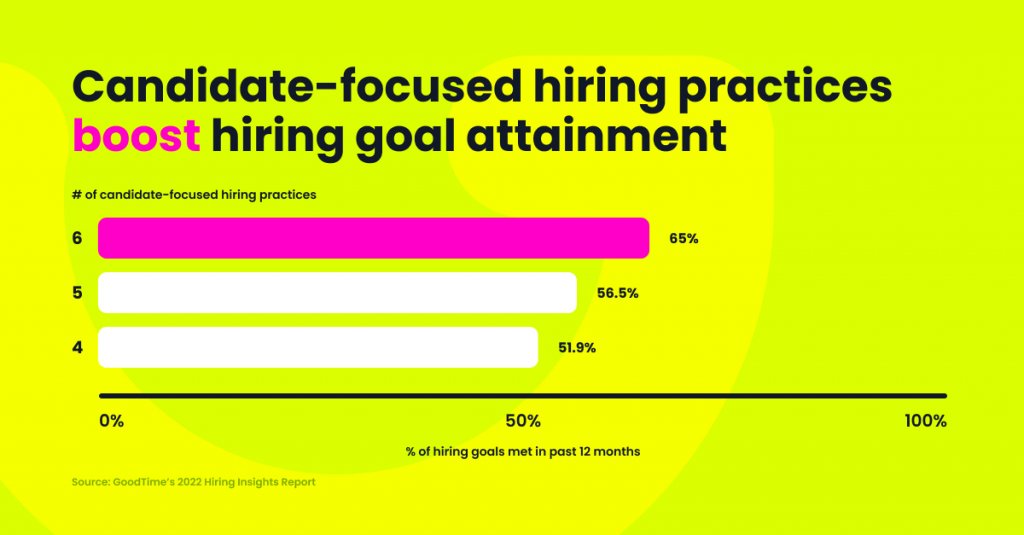
Among the report’s respondents, we found a notably positive correlation between the number of candidate-focused hiring practices implemented and the percentage of hiring goals met. Specifically, companies implementing seven candidate-focused practices from the previous list saw a 17.7% gain in attaining their hiring goals. 

In fact, as long as companies implemented at least four candidate relationship best practices from the list, they outperformed the average. The business gains from creating genuine candidate relationships are very real. If you care about your bottom line, it’s time to connect.

Want the Latest Insights? Read the 2023 Hiring Insights Report

The recent changes in the hiring landscape are enough to make anyone’s head spin, but at its core, succeeding at TA in today’s world isn’t as complicated as it seems. If applicants don’t feel connected to your company, they won’t join. And if employees feel disconnected from your company, they will leave. It all boils down to connection. Candidates are people, and everyone yearns for a genuine connection. It’s only human nature.

The solution to TA is right in front of us: invest in candidate relationships as you would in any meaningful asset. You’ll be impressed with the payoff.

Want to catch up on the latest hiring trends? Get excited: our 2023 Hiring Insights Report is now available. 500+ HR leaders, 1,000s of real findings, 1 industry-leading report. Read the report today.

Imposter Syndrome in the Workplace: You’re Not A Fraud

Do you feel like a phony even though your accomplishments tell a different story? Don’t worry, you’re not crazy. You just have imposter syndrome. And you’re far from alone: 70% of adults experience these feelings at some point in their lifetime.

In Crosschq’s latest installment in their People Lead/HER webinar series, Debra Wade Carney, Director of Marketing, and Elena Arney, Director of People & Culture, sat down with three women leaders to get to the root of imposter syndrome in the workplace. 

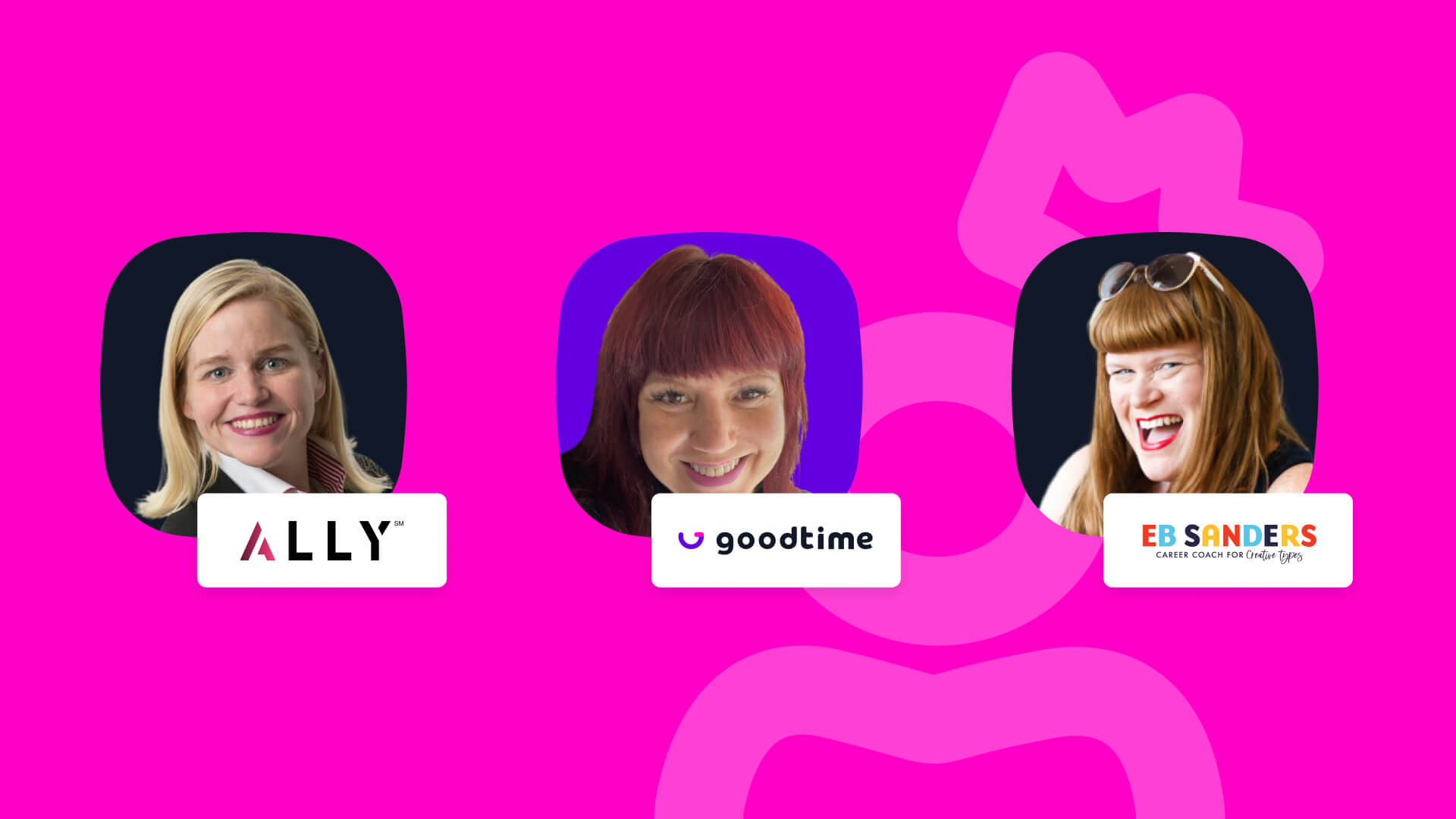
Jenn Oswald, Head of People Strategy at GoodTime; Katie Mehnert, CEO at ALLY Energy; and ErinBlythe “EB” Sanders, Career Coach and Consultant, dove into how they’ve experienced and navigated imposter syndrome to become the strong leaders that they are today.

You can watch the full webinar here, but for the TLDR, here’s the key takeaways from the chat. 

Is Imposter Syndrome the Best Label?

First thing’s first: should we even call it “imposter syndrome”? EB noted that when the concept behind imposter syndrome became popularized in the 1970s, people referred to it as “imposter phenomenon” before later morphing into imposter syndrome.

“Somewhere along the way, that became ‘syndrome,’ which is problematic in that it pathologizes it,” EB said. “What it’s saying is that there’s something off neurologically with everyone that’s experiencing it.”

EB uses the term “inner critic” to emphasize that these feelings aren’t signs of a disorder, but that they’re feelings that the majority of people experience.

“Imposter syndrome is not categorized as mental illness, but at the end of the day it gets back to a reflection of who we think we are, and that is powerful work we have to do ourselves.”

— Katie Mehnert, CEO at ALLY Energy

Coping With Imposter Syndrome 

The things that trigger feelings of inadequacy and self-doubt vary from person to person. Recognizing the triggers—whether they stem from specific actions, people, or situations—is the first step to mitigating them.

To alleviate imposter syndrome in the workplace, Jenn encourages people at GoodTime to hold open discussions when those feelings begin to arise. She finds it helpful to have a peer at work to confide in for coaching tips or a different perspective.

“Find those allies and people who will support you, and coach you, and mentor you so that you can realize your greatness,” Jenn said.

As a CEO, Katie tries to foster a culture of openness. Similar to Jenn, she encourages people at ALLY to share whenever they experience imposter syndrome, if they feel comfortable. She’s found that imposter syndrome is all around us and can affect anyone, regardless of their title.

Not Just a “Female Thing”

While Katie, EB, and Jenn all have their fair share of experiences with imposter syndrome, its effects extend far beyond the female population. Imposter syndrome remains prevalent among both men and women across a variety of age groups. However, EB noted, women tend to discuss imposter syndrome more openly than men. 

Yet within those populations, she added, people who are part of systematically marginalized and underrepresented groups—such as POC and LGBTQ individuals—tend to experience imposter syndrome to a higher degree. This can be attributed to the negative stimuli that they already experience due to their identities.

As for people with a neurodevelopmental disorder, such as ADHD, imposter syndrome can be a massive struggle. 

“There is a saying in the community that you have to work twice as hard to feel as if you are half as good,” EB said. “If you are neurodivergent, there is the daily baseline of functioning that you’re trying to work with, and then trying to feel as if you are competent and as if you are fitting in.”

Social Media’s Impact

Does social media heighten imposter syndrome? For many people, the answer is yes. Social media generates a constant flow of feedback—both good and bad. That never-ending feedback can compound feelings of self-doubt and feed the inner critic.

In order to combat the negative side of social media, Katie encourages her team to have digital breaks once in a while to center themselves outside of the noise. Digital breaks allow people to reconnect with their purpose and the reasons behind the work that they do each week.

“Reconnecting with what those reasons are, and who we are, and what we want, and why we want those things builds a little shield of, ‘It doesn’t matter what all that chatter is, because I got my own path, I’m doing my own thing,’” EB added.

However, EB said, some people find value in the comparisons that social media breeds. For some, feeling envious of others on social media can inform what they’d like to achieve. They then use this information to the advantage of their personal growth. Instead of comparing, they compete.

“We’re moving into a space where employers need to think of the overall well-being of their people.” 

— Jenn Oswald, Head of People Strategy at GoodTime

The Way Forward

As a byproduct of the COVID-19 pandemic, mental wellness is now top of mind in the work environment. In order to overcome imposter syndrome in the workplace and other negative thought patterns, give your mind a little TLC.

Jenn sees value in going to therapy to address your mental health head-on. She added that as GoodTime grows, they continue to evaluate their employee wellness benefits.

“I think we’ll continue to see the landscape of benefits change over the next few years and see much more of a focus on mental health,” Jenn said.

Katie believes that there are two distinct parts to addressing negative thoughts: one involves coaching to develop confidence and leadership skills, and the other involves doing the inner work to see where the thoughts come from. Both hold equal merit, and we must tackle both to understand why we think the way that we do.

“We are the way that we are because of the environment that we grew up in,” Katie said. “It is super important as professionals to make sure we are taking care of our mental health.”

Recruitment Automation vs. Human Touch: How to Balance Both

Balancing recruitment automation and human touch is much like walking a tightrope. Too much automation? Your hiring process starts to feel robotic and impersonal. Too much human touch? Your daily recruitment tasks become far too tedious and inefficient.

Reaching a perfect balance between automation and humanity is the secret to building solid relationships with candidates and maintaining the efficiency that’s needed to engage top-tier talent. So—how do you achieve the perfect balance?

Automate To Boost Human Connection

HR professionals spend a whopping 86% of their time on administrative duties. The right tech tools can slash this time in half. But while your tech automates tasks for you, should you kick your feet up and bask in your newfound free time? Of course not—you have candidates to attend to!

Recruitment process automation is only helpful to the extent that it gives your talent team more time to connect with applicants on a personal level. If you use technology to replace rather than amplify human connection, you’re doing something wrong.

As wonderful as it is to have your tech stack take care of recruitment tasks, certain human elements are incredibly hard to replicate. Take empathy, for example. 96% of employees agree that empathy makes them want to stay at a job. Displaying empathy from the first moment a future employee interacts with a recruiter is crucial, and true empathy simply doesn’t have a technological equivalent.

Far too often, people view HR tech tools as a threat to human connection. But in reality, it isn’t the tools that are threats. The ways that some people use the tools are the true threats to connection. Talent professionals must recognize that technology can free up time for their teams to focus on what matters: building empathy, trust, and transparency to create better candidate relationships.

Leverage Talent Tech for Personalization

Personalization goes a long way in making people feel special, and the same applies to candidates. It’s the reason why people love personalized music recommendations. We want to feel unique, and above all, we want to feel seen. It’s only human nature.

While recruiting tech can’t replicate all the human elements that a successful hiring process requires, technology that enables personalization adds a human touch. For instance, custom email templates that automatically generate personalized communications for each candidate foster meaningful connections with minimal effort. The companies that succeed in making their automation feel less automated are the ones that come out on top.

Use the free time that automation provides to further emphasize personalization and elevate the recruiter-candidate relationship. Spend time jotting down more notes on relatable aspects of a candidate’s background that could translate to conversations in the interview stage (who knows—maybe you attended the same college). 

Candidate Relationships Are Human Relationships

Applicants have increasingly high expectations of your recruitment process. They expect a tech-driven hiring process to match their tech-driven lifestyle. However, candidates still want to connect with your talent team on a human-to-human level. After all, candidates are humans, too. If candidates don’t connect with your company in the process, there’s a good chance that they’ll turn down your job offer. 

Ironically, while candidates crave a personal touch throughout the hiring process, more and more candidates seek virtual work opportunities. Now that remote hiring is the norm, companies are pulling out all the stops to make hiring from across the world feel a bit less distant.

Achieving a balance between leveraging recruitment automation and human touch is the key to competing in today’s fiercely competitive market. To strike the perfect balance, treat candidate relationships the same way you would treat human relationships. Texting a friend can sustain a friendship, but you still need to connect in person once in a while. Likewise, recruitment automation can boost your hiring efficiency to impress applicants, but you still need to personally refine your connection to candidates. 

Say Hello to Candidate Relationship Intelligence

Pre-pandemic, less than half of recruiters said that they have the technology they need to build relationships with candidates. 53% wanted to emerge post-pandemic with the tools needed to improve their relationship building. Want to become one of the recruiters that rave about their tech stack? Time to level up your technology.

GoodTime Hire harnesses Candidate Relationship Intelligence to automate coordination, build relationships during interviews, and provide actionable insights to continuously improve your connections with applicants. It’s the tech of your candidate relationship-building dreams.

Learn more about how Hire can supercharge your talent acquisition team.

How to Win Top Talent With Strong Candidate Relationships

Want to move the needle on your hiring goals? Sorry to break it to you, but cool swag and flashy benefits don’t cut it. Today’s top talent leaders focus on fostering candidate relationships. 

Recruiters had the upper hand in the recruiter-candidate relationship in the past, but not anymore. Candidates now hold all the cards in choosing where they want to go for their next career, and they’ve grown more and more selective. Job seekers won’t just accept any offer that comes their way; they expect deeper relationships and intangibles such as flexibility, transparency, and a visible commitment to DEIB.

To snag the best talent from the bunch, you must establish a genuine connection to your company’s mission, to the team, and to your recruiters. So, where do you start? 

GoodTime Account Executives John Bartsch and Siegfried Huffnagle, joined by Maria Riabukhina and Matthias Schmeißer from Beamery’s talent team, sat down to discuss the secret sauce to cultivating healthy candidate relationships. If you didn’t catch the webinar, here’s the TLDR with the key takeaways on how to better connect with candidates for hiring success.

Four Pillars of Candidate Relationships

Yes, investing time into connecting with candidates is non-negotiable for recruiters, but what do candidates actually expect from the relationship? Here are four main pillars that should comprise your candidate relationships.

Genuine Connection

While remote work has created a distance economy, candidates don’t want to feel so “distant.” Genuine connections are now more valuable than ever. In fact, 72% of candidates would reject a job offer if they didn’t feel connected to the company culture during the hiring process. Even if the salary and the job description are aligned, if candidates don’t recognize a human-to-human connection, it’s a no go. Recruiters must address candidates from a position strongly rooted in authenticity.

Transparency

To instill your recruitment process with authenticity, start by prioritizing transparency. Don’t leave candidates guessing; applicants want to know what it’s like to work for your company from the very beginning of the interview process. 39% of candidates expect to be informed about compensation in the initial job post. Besides expecting open communication surrounding compensation, candidates want potential employers to be loud and clear on their DEIB initiatives.

“People have spent the last couple years thinking about what’s most important to them, how they want to spend their time, and what their values are. People want to make sure that the time that they spend at work is aligned with that.”

— Siegfried Huffnagle, Account Executive at GoodTime

Adaptability

GoodTime found that candidates currently interview at 4x more employers than pre-pandemic — meaning that the talent competition is more intense than ever. This is largely due to the rise of remote work. As the office workspace continues to evolve, so does candidates’ ideal work arrangement. Flexible work arrangements are now at the top of job seekers’ wish lists. Companies must adapt to the work preferences of candidates, and demonstrate that adaptability throughout the company culture.

Candidate Well-being

All in all, candidates don’t want to sacrifice their well-being for their job. Sixty-two percent of employees cite well-being support as their top priority when job hunting. Work must exist in harmony with health — there’s no way around it. Recruitment teams should be prepared to openly address the efforts that their company makes in prioritizing the health and general well-being of their employees.

Boost Connections With Recruiting Tools and Techniques

Once you’ve mastered the building blocks of candidate relationships, it’s time to reel candidates in — hook, line, and sinker. Examine your hiring methods and tools and look for areas of improvement. You’ll not only enhance the relationships created from your hiring process, but also move candidates through the funnel more efficiently to get an offer in their hand.

Gather Candidate Feedback

Now that candidates are in the driver’s seat, they want more ownership and involvement in the recruitment process. For this reason, gathering candidate feedback becomes both necessary and expected. Who can speak to the quality of your hiring process better than those that experience it firsthand? By factoring in candidate feedback on your entire interview process, talent teams can ensure that their process exceeds expectations.

Build DEIB From the Studs Up

If you think you can skate by in the hiring process without highlighting your company’s DEIB efforts, think again. To align with candidate expectations, recruitment teams must present candidates with a holistic image of what their company stands for on DEIB. This translates to having the tools and strategies in place to provide this image from the very first moment that candidates sit down to interview.

“Companies that are enabling diverse and inclusive interview panels experienced a 4X increase in interviews in less than one year. This really speaks to the importance of training up your interviewers and having a broad and diverse pool.”

— John Bartsch, Account Executive at GoodTime

Prioritize Interviewer Training

How do you demonstrate a genuine commitment to DEIB? Start by training a diverse and expansive pool of potential interviewers. Widening your interviewer pool not only ensures that you’ll always have people available to interview applicants, but also cultivates a group of diverse panelists that are representative of both your company and the candidates you want to attract. Having five alternative interviewers for each interview translates to a 95% chance that one of them will be available for the time slot selected by the candidate.

Empower Your Recruiting Tech Stack

A robust tech stack seals the deal when it comes to impressing candidates. Beamery’s talent lifecycle management platform delivers meaningful insights to shape customers’ holistic talent strategy. Here at GoodTime, our Hire product uses Candidate Relationship Intelligence to automate coordination, connect with candidates, and gather actionable data.

Interested in learning all about the positive change Hire can make for your recruiting process? Say no more.

Behavioral Interview Training 101: How to Support Hiring Managers

Not all interviews are created equal. Behavioral interviews just happen to be better than most.

By using a candidate’s past experiences to assess their future potential, behavioral interviews serve as one of the most accurate predictors of how a candidate would perform as an employee. 

The popular logic is that if a candidate exhibited questionable behavior in professional settings in the past, who’s to say that they won’t do the same in the future? And by the looks of it, this logic usually prevails: 89% of hiring managers and recruiters rated behavioral interviewing techniques as effective, which was more than any other traditional interviewing technique.

If you want to harness the full power of behavioral interviews and weed out bad hires, the first step is ensuring that your interviewers are trained in the art of this special type of interviewing. That’s right—candidates aren’t the only ones who need to prepare for interviews.

Read on to discover several best practices to emphasize in your behavioral interviewer training.

WATCH: We asked Socotra’s Head of Talent Acquisition about his process for coaching and training interviewers, including behavioral interviewing techniques and making sure he has a reputation as a trusted advisor and mentor.

Craft Strategic Initial Questions

Your interviewers’ questions for behavioral interviews need to be thoughtful and strategic. Now isn’t the time to say, “Tell me about yourself,” or the classic, “Walk me through your resume.” All of that information can be learned from the materials submitted in a candidate’s application. Now’s the time to dig deep.

The behavioral questions that your interviewers ask should get to the heart of a candidate’s experience and uncover specific competencies most relevant to the role, such as leadership, quick thinking, and teamwork. 

To ensure that the questions are purposeful, write down several of the competencies that an ideal candidate should possess. Then, plan out questions that prompt candidates to discuss past behaviors that allude to each competency. These questions should be open-ended and shouldn’t hint at the desired response.

Ask Explorative Follow-up Questions 

Ready to dig even deeper? Initial behavioral interview questions are effective on their own, but your interviewers must be prepared to probe further with follow-up questions.

Unlike initial questions, follow-up questions shouldn’t be pre-planned. Rather, they should arise from cues that your interviewers pick up on from candidates during the interview. This makes active listening a crucial component in successful behavioral interviewing techniques.

Follow-up is necessary when responses need more detail, don’t fully answer the original question, or outwardly attempt to evade the question. Non-verbal cues, such as a shift in a candidate’s demeanor, should also elicit follow-up.

These additional questions shouldn’t feel interrogative toward candidates. Rather, they should feel explorative, adding nuance and depth to a candidate’s behavior.

Unlock 2026’s top hiring strategies: Insights from 500+ TA leaders

Be the first to uncover deep hiring insights specific to your sector — straight from the highest-performing TA teams.

Look Out for STAR-Studded Answers

As another component of proper behavioral interviewing techniques, your interviewers should keep an eye out for candidates that use the STAR method when structuring their answers.

The STAR method is a structure candidates should use to answer behavioral interview questions in a thoughtful manner. A STAR (situation, task at hand, action taken, and result) response contains a structured beginning, middle, and end. This adds a storytelling framework to a candidate’s response, providing fluidity, depth, and clarity for your interviewers. 

The structure of a candidate’s responses tells just as much about their competencies as the actual content of their responses. A candidate who effortlessly employs STAR likely instills meaningful thought into their everyday speech. If a job requires articulate communication, your interviewers should highly prioritize candidates who demonstrate STAR.

Remember to Practice Empathy

We all know how nerve-wracking a job interview can be, and the high level of thought that behavioral interviews require can feel even more stress-inducing.

When interviewers practice empathy, candidates feel at ease. Comfortable candidates are better equipped to demonstrate their abilities, which makes it easier for interviewers to assess their true nature and make smart hiring decisions.

Interviewers that fail to lean into their empathetic side are bad for business. 58% of job seekers reportedly declined a job offer due to a poor experience in the hiring process, meaning that an uncomfortable interview may prompt candidates to run the opposite way.

To practice empathy, interviewers should allow candidates an appropriate amount of time to think about each question before they respond. While interviews should be kept professional, starting each interview with light small talk can go a long way in alleviating a candidate’s stress. All in all, interviews that feel a bit more human form trust between interviewers and the candidate, cultivating the all-important candidate relationship.

Join a community just for talent pros

GoodTime Talent Innovators is an online community for TA professionals to engage in discussions, network with one another, and discover exclusive events.

Ready to Elevate Your Behavioral Interviewer Training?

Behavioral interviews can be a fantastic tool for hiring teams, yet they are only as good as their interviewers. Enforcing training on proper behavioral interviewing techniques guarantees that your interviewers ask the right questions and use the best strategies to hire top talent and build meaningful connections with every candidate. 

Learn more about how interviewer training creates hiring success by reading our eBook, The True Cost of Untrained Interviewers.

Yes, You Can High-Volume Hire AND Create Candidate Relationships

High-volume hiring isn’t for the faint of heart. Hiring a mass amount of candidates in a short time frame AND investing the time to create bespoke candidate relationships with each potential hire? Recruitment teams must practically become superheroes to get the job done.

Recruiting coordinators should always focus on fostering strong candidate relationships, but when overwhelmed with the unique challenges that come with hiring at scale for rapidly growing companies, how can you possibly make time for candidates?

Here’s the good news: with the right strategies and software, you’ll hire at scale AND develop genuine candidate relationships in one fell swoop. 

Don’t get trapped in a cycle of tedious recruiting tasks at the expense of your candidates. Read on to discover key ways to keep the candidate relationship front and center while acing your high-volume hiring strategy

Grow Your Interviewer Pool

The last thing you want to deal with when hiring a large number of employees is an interviewer pool that’s much too small for your scheduling needs. Expanding this pool is an absolute must-do to guarantee that you always have quality interviewers at your fingertips.

Need further encouragement to grow your interviewer pool? Consider the cost of interviewer burnout. Our studies show that 30% of employees typically handle 70% of the interviewer load. When interviewers find themselves bogged down by heavy workloads, they can’t possibly be on their A-game to connect with candidates.

Interviewer training is the key to evenly distributing the interview load across your company’s employees. Training your interviewers might sound time consuming in the context of high-volume hiring, but have no fear: tech tools make scaling interviewer pools an effortless process.

After you train more employees in the art of interviewing, you’ll have a large group of capable interviewers with ample time to personally connect with candidates — even in the middle of chaotic high-volume recruiting seasons.

Automate Your Interview Scheduling

When you say good-bye to manual scheduling and hello to automation, everything falls into place. Suddenly you can spend more time prioritizing candidates and less time playing calendar tetris.

Automated candidate-driven scheduling streamlines your high-volume hiring and mitigates long wait times to ensure that candidates move on to the next step in the process as soon as possible. After all, recruiting coordinators are busy, but so are candidates. Candidates don’t want to wait around for someone to schedule their interview, so why not let them schedule themselves?

Allowing candidates to self-schedule their interviews based on their own calendar eliminates back-and-forth emails and conveys that you appreciate their time. That’s a win-win.

Rediscover Eligible Candidates

The best strategy when high-volume hiring: work smarter, not harder. Before you scour the job boards for qualified candidates, first identify the candidates you already have at hand that fit the criteria for a new opportunity.

Now is the time to consider previous silver or bronze-medal candidates. Just because you passed on a candidate previously doesn’t mean that you should forget about them — the timing might not have been right, another candidate might’ve narrowly beat them, or the candidate might’ve been better suited for a different position.

In addition to considering previous candidates, you can also look into current employees who are interested in switching jobs internally and talent that your hiring team connected with at professional events.

Tapping into candidates that are already on your radar gives your hiring efforts a boost by eliminating the time it takes to source and screen fresh candidates. Not only that, but reaching out to old connections promotes positive candidate relationships through the power of continuous candidate engagement.

Engage with Candidate Experience Surveys

In a perfect recruiting world, we’d suggest for you to supply each every candidate with feedback on how they performed within your hiring process. But this is the real world, and sending each candidate feedback is nearly impossible to do when hiring in mass quantities.

What is possible is sending automated candidate experience surveys to your candidates. Collecting candidate feedback through anonymous surveys provides an inside look at the current state of the candidate relationship within your hiring process, straight from the perspectives of those who know your hiring process best: your candidates. 

This is a highly effective, highly low-effort way for you to collect crucial data to improve your recruitment strategies and keep candidates engaged, all without expending valuable time and energy during your hiring frenzy. What’s better than that?

Above All: Leverage Tech When High-Volume Hiring

When filling many positions at once, it’s much too easy to get caught up in the noise and neglect to engage with your candidates. One of the worst things that you can do while trying to attract the best talent is to provide candidates with a hiring process that feels cold and impersonal.

Make every interview impactful with Candidate Relationship Intelligence. GoodTime’s high-volume recruiting software supercharges your recruiting and unlocks meaningful data so that your team gives candidates the genuine connections that they expect — every single time.

Request a demo to see how Hire creates more than just a candidate “experience.”