Financial Services Hiring Trends and Stats for 2026: What Leaders Need to Know

Editor’s note: The article below is an excerpt from GoodTime’s 2026 Hiring Insights Report. The entire report is available to view online for free here.

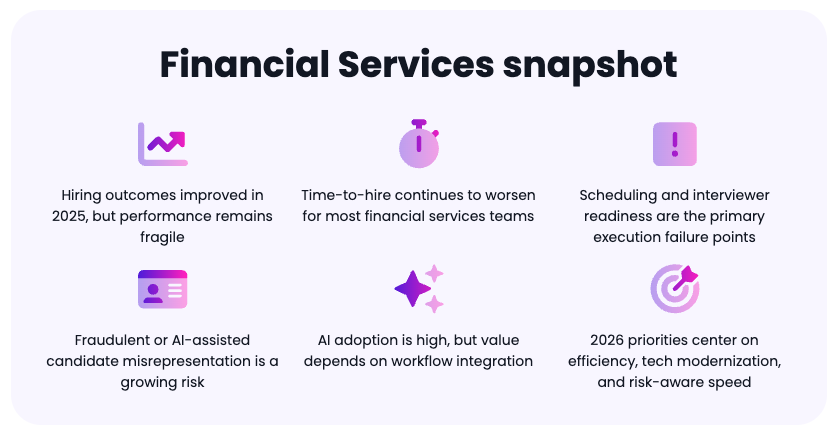
Financial services hiring teams enter 2026 under sustained pressure from execution complexity, rising candidate risk, and tighter timelines. While hiring outcomes improved in 2025, the sector’s core challenge is no longer demand alone—it is moving candidates through a slow, risk-sensitive hiring process without sacrificing quality or credibility.

Time-to-hire continues to worsen for most organizations, driven by fragile coordination in the middle of the funnel. Scheduling delays, inconsistent interviewer readiness, and slow decision cycles compound quickly in a sector where candidates often juggle multiple offers and prolonged timelines increase both drop-off and compliance risk. Even with better goal attainment, execution speed has not stabilized—leaving recent gains exposed.

At the same time, the threat landscape is shifting. Fraudulent or AI-assisted candidate misrepresentation has become a material concern, forcing teams to apply greater scrutiny while still moving faster. This tension between speed and rigor now defines financial services hiring.

In response, leaders are prioritizing efficiency-first modernization. AI adoption is widespread, but impact depends on deployment. The most effective teams use AI as infrastructure—strengthening analytics, interview quality, and workflow reliability—rather than chasing speed through surface-level automation. Scheduling, despite being a primary source of delay, remains under-automated and represents one of the clearest opportunities for 2026.

The data points to a widening divide. Teams that modernize scheduling, standardize communication, and align AI with core workflow mechanics are better positioned to compete, regardless of market conditions. Those that rely on manual coordination and fragmented processes continue to absorb delay, risk, and candidate loss.

Unlock 2026’s top hiring strategies: Insights from 500+ TA leaders

Be the first to uncover deep hiring insights specific to your sector — straight from the highest-performing TA teams.
2025 performance review: Financial services hiring shows improvement, but remains fragile
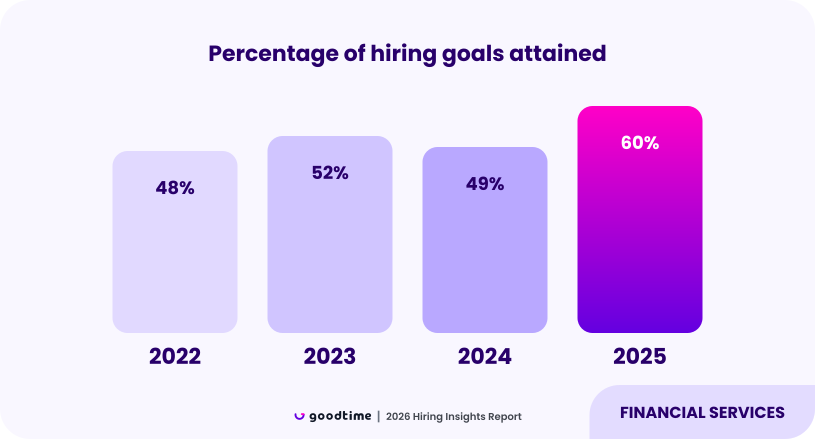
Financial services hiring performance improved in 2025, with organizations achieving 60% of hiring goals, the sector’s strongest result in four years. After declining to 49% in 2024, this rebound signals meaningful progress and places financial services ahead of several other industries still struggling to regain momentum.

Yet even with this improvement, performance remains structurally constrained. At 60% attainment, financial services organizations are still leaving a significant share of planned roles unfilled — a notable risk in a sector that depends on specialized skills, regulatory rigor, and consistent execution.

The volatility of recent years underscores the challenge. Hiring goal attainment rose in 2023, slipped in 2024, and then rebounded sharply in 2025, reflecting how sensitive outcomes are to execution quality. When scheduling breaks down, interviewer readiness falters, or decisions slow, performance regresses quickly.

The 2025 rebound appears driven less by easing market conditions and more by incremental operational gains. As this chapter will show, organizations that improved scheduling discipline, tightened communication, and invested in AI-supported workflows were better positioned to convert candidate interest into completed hires.

The implication for 2026 is clear: financial services hiring is improving, but not yet durable. Sustaining progress will require continued focus on execution systems (not just demand conditions) to prevent recent gains from proving temporary.

Time-to-hire continues to constrain financial services hiring
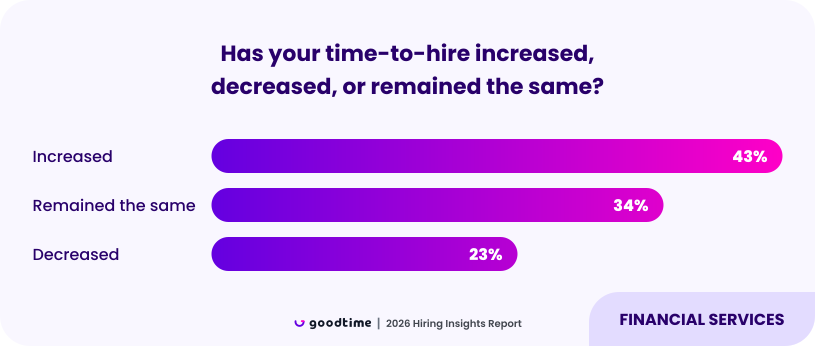
Even as hiring outcomes improved in 2025, time-to-hire remains a structural constraint for financial services teams.

The data shows that hiring speed continues to move in the wrong direction for many organizations, with only a minority managing to meaningfully accelerate their processes. For most teams, hiring either slowed or failed to improve, reinforcing that execution challenges remain unresolved beneath the surface of better goal attainment.

This matters acutely in financial services, where hiring processes are often layered, risk-sensitive, and dependent on senior stakeholder availability. When interview coordination falters or feedback loops stall, delays compound quickly, increasing candidate drop-off and weakening competitive position.

The gap between improving outcomes and lagging execution speed suggests that recent gains are fragile. Some organizations are clearly finding ways to stabilize and accelerate hiring, but they remain the exception rather than the rule.

Where hiring execution breaks down
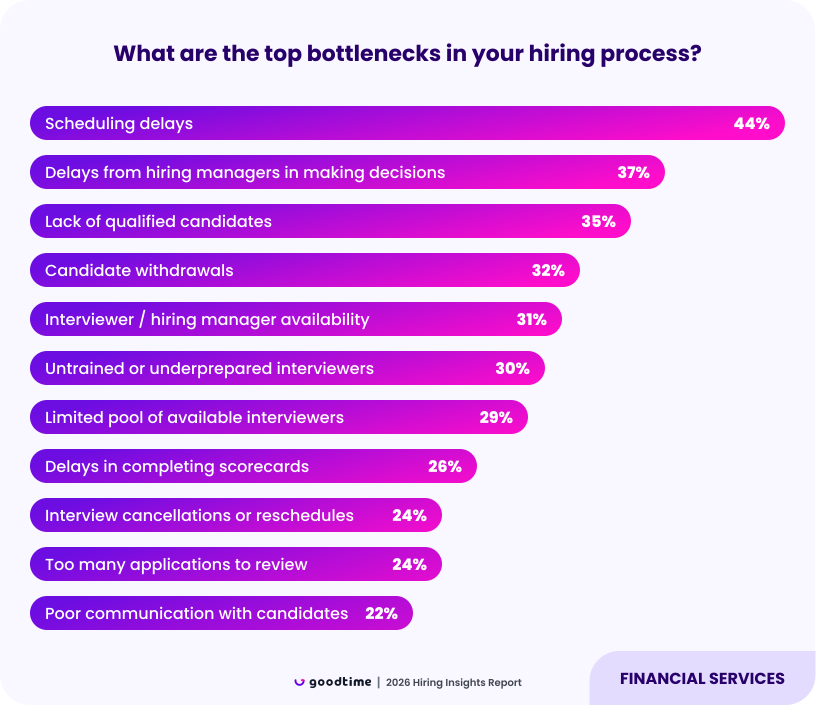
The most common breakdowns occur in the middle of the hiring process, where scheduling delays, slow decision-making from hiring managers, and interviewer availability issues converge. These are not isolated frictions; they compound. When calendars don’t align or feedback stalls, candidates wait, withdraw, or accept competing offers.

Candidate-side challenges remain present, including a lack of qualified applicants and rising withdrawals mid-process. But the data suggests these issues are often downstream effects of internal delays rather than primary causes. As timelines stretch, even strong candidates disengage.

Interviewer readiness is another critical fault line. Limited interviewer pools, untrained or underprepared interviewers, and delays in completing scorecards all contribute to uneven evaluation and slower movement. In a sector that values rigor and risk management, these inconsistencies create both speed and quality concerns.

Upgrade your hiring journey with AI

GoodTime’s AI agents orchestrate the entire hiring journey — screening, scheduling, messaging, and more — so talent teams hire faster with a better candidate experience.
AI adoption emphasizes insight over speed in financial services
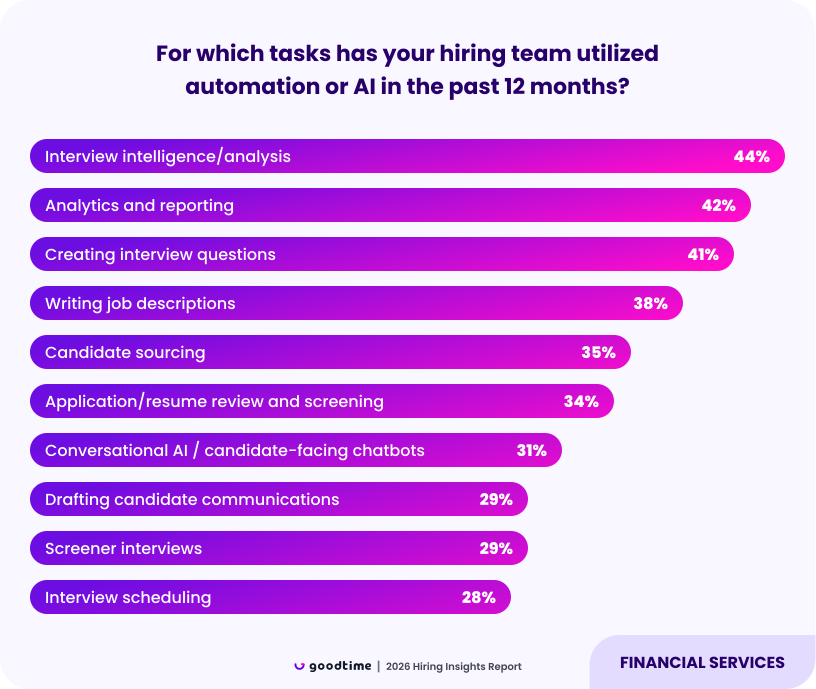
Financial services hiring teams are applying AI primarily to strengthen evaluation and decision-making, not simply to accelerate volume.

Adoption is strongest in interview intelligence, analytics, and interview preparation, areas where consistency, rigor, and defensibility matter most. This reflects the sector’s need to balance faster hiring with careful signal validation in a high-stakes environment.

More transactional use cases, such as sourcing, screening, and candidate-facing automation, are used more selectively. Notably, scheduling shows lower AI adoption than evaluative tasks, despite being a major source of delay elsewhere in the data.

The pattern points to a mature but incomplete AI strategy. Financial services teams are using AI to improve judgment, but many have yet to fully extend it to the workflow mechanics, especially scheduling, where it could deliver meaningful speed without sacrificing quality.

What financial services teams choose to measure
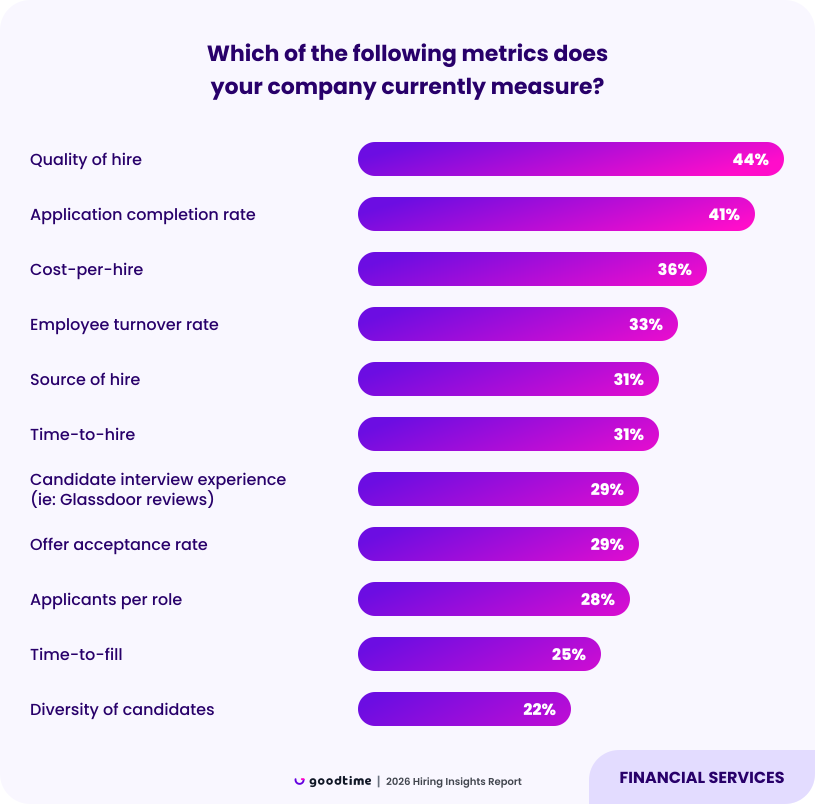
The metrics financial services teams prioritize reveal a balanced but still evolving measurement strategy.

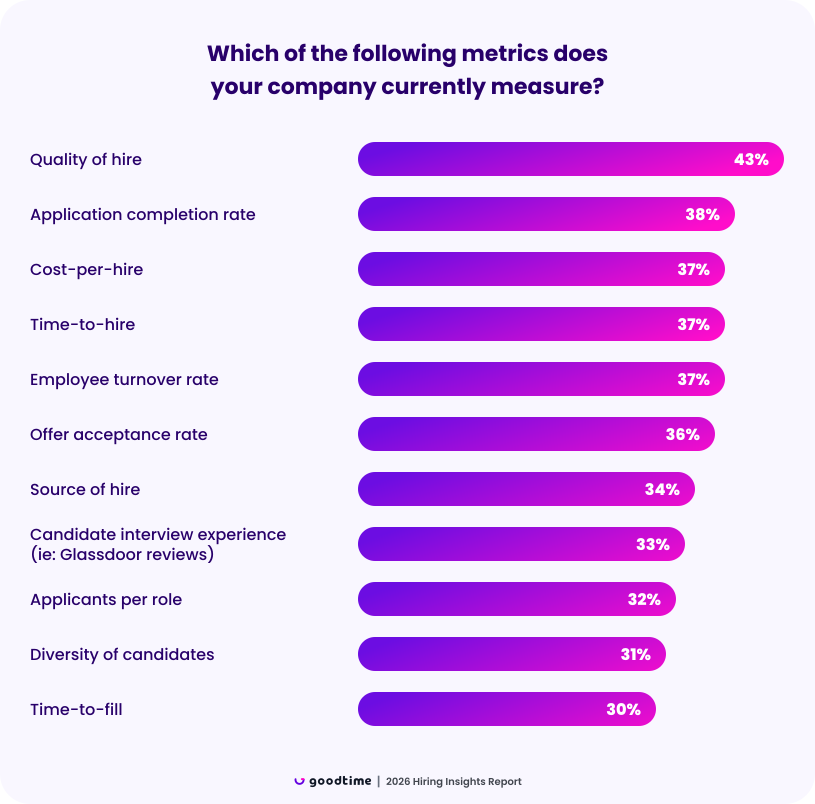
Quality of hire sits clearly at the center of measurement, reflecting the sector’s emphasis on long-term performance, risk mitigation, and defensible hiring decisions. This focus aligns with growing concern about candidate misrepresentation and reinforces why evaluation rigor remains non-negotiable.

Alongside quality, teams track a mix of efficiency and cost signals. Application completion and cost-per-hire point to awareness of funnel friction and budget pressure, while time-based metrics such as time-to-hire and time-to-fill indicate continued concern about execution speed, even if improvement has been uneven.

Operational stability also features prominently. Metrics tied to employee turnover and source of hire suggest that financial services leaders are watching not just how hires are made, but whether they stick and perform over time.

Overall, the data shows a sector that measures what it feels accountable for: quality, cost, and stability. The opportunity for 2026 is to more tightly connect these metrics to execution drivers, using funnel health and experience signals as earlier indicators, not just retrospective checks.

2026 outlook: Faster hiring, higher risk, and tighter margins for error
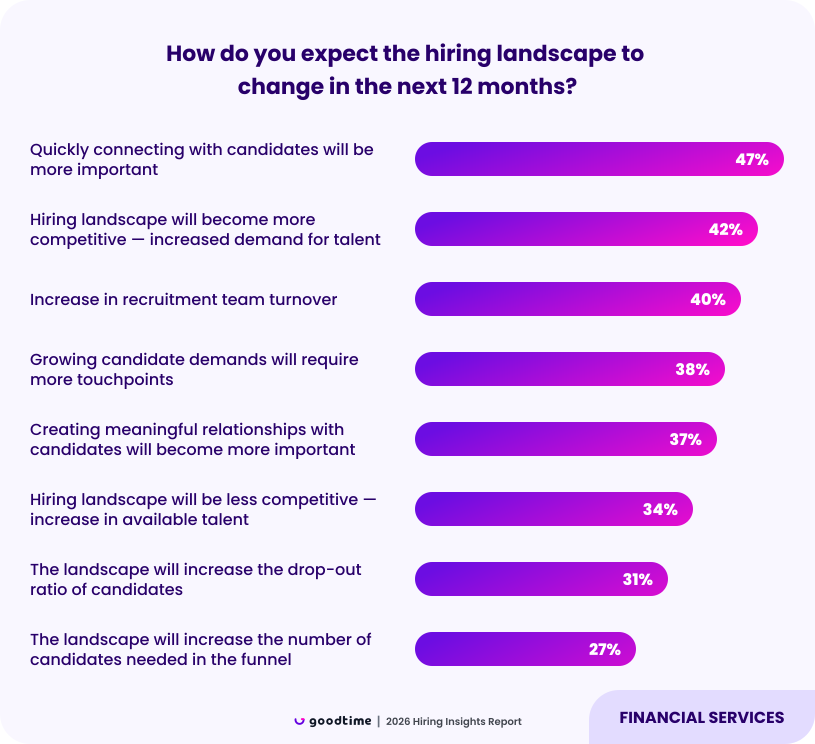
Financial services leaders expect 2026 to be defined by speed under pressure.

The dominant shift is the growing importance of connecting with candidates quickly. As competition for specialized talent remains intense, slow engagement is increasingly viewed as a direct cause of lost hires. Speed is no longer just an efficiency goal; it is a competitive requirement.

At the same time, leaders anticipate rising internal strain. Recruiter turnover, expanding candidate demands, and a growing number of required touchpoints are expected to make candidate flow harder to manage. These pressures compound existing execution challenges, particularly around scheduling, interviewer readiness, and decision follow-through.
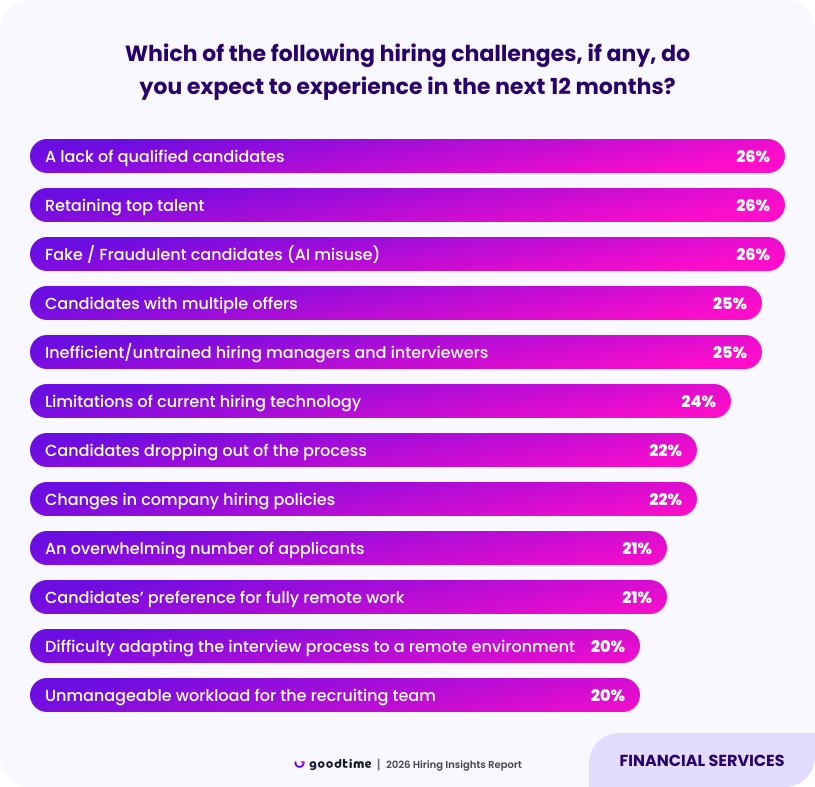
The expected challenges reinforce this tension. Alongside familiar issues like talent availability and candidates holding multiple offers, candidate fraud and AI-assisted misrepresentation stand out as a growing concern. This adds a new layer of risk, forcing teams to balance faster movement with stronger signal validation. Inefficient or untrained interviewers and limitations in current hiring technology further threaten consistency at scale.

Notably, the outlook reflects a fragmented market. Some leaders expect competition to intensify, while others anticipate easing conditions due to increased talent availability. The implication is clear: market conditions will vary, but execution quality will determine outcomes.

For financial services teams, 2026 will reward those that can move faster without sacrificing rigor:  modernizing workflows, stabilizing coordination, and reinforcing trust at every stage of the hiring process.

Where financial services leaders are investing for 2026
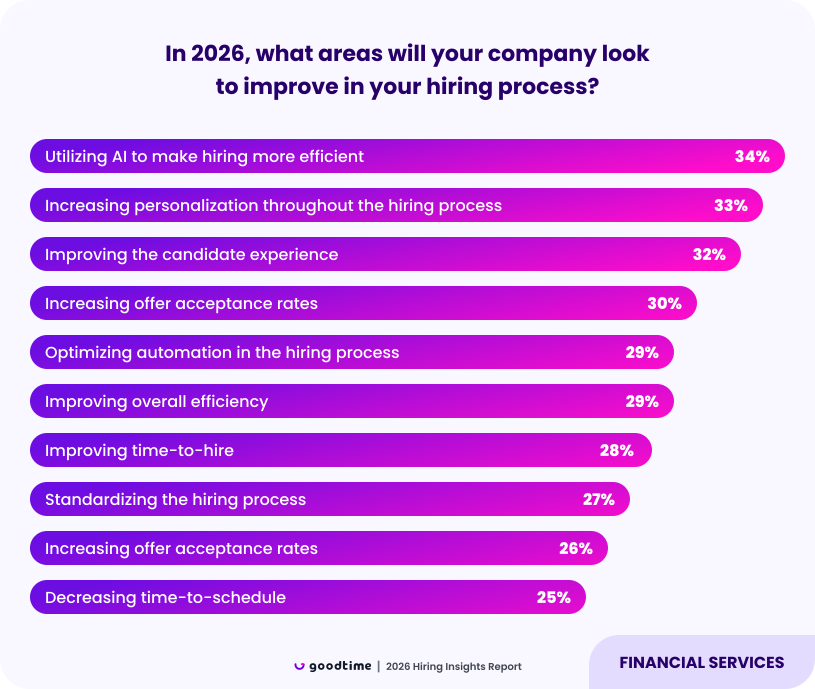
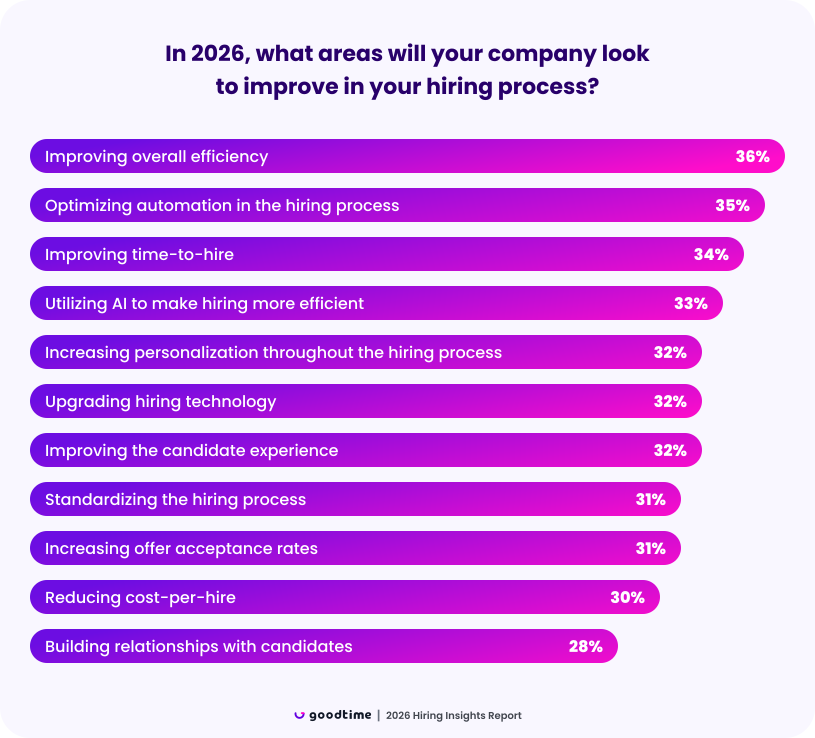
Financial services hiring priorities for 2026 reflect a clear shift toward execution discipline powered by technology.

Leaders are focused first on making hiring more efficient through AI and automation. Rather than experimenting at the margins, teams are looking to apply AI more deliberately to improve how work gets done, reducing manual coordination, stabilizing workflows, and enabling faster, more consistent decision-making. This emphasis reinforces a theme seen throughout the chapter: efficiency gains are no longer optional, but foundational.

Candidate experience remains a close second, with personalization, speed, and reliability at the center. Importantly, these goals are not positioned as soft initiatives. Improving experience is tightly linked to improving time-to-hire, offer acceptance, and candidate follow-through, especially in a market where top talent has leverage.

Standardization also rises as a priority. Financial services leaders are signaling the need to reduce variability across interviewers, processes, and timelines, particularly as concerns around candidate misrepresentation and interviewer readiness grow. Standardized processes are increasingly viewed as a safeguard for both speed and quality.
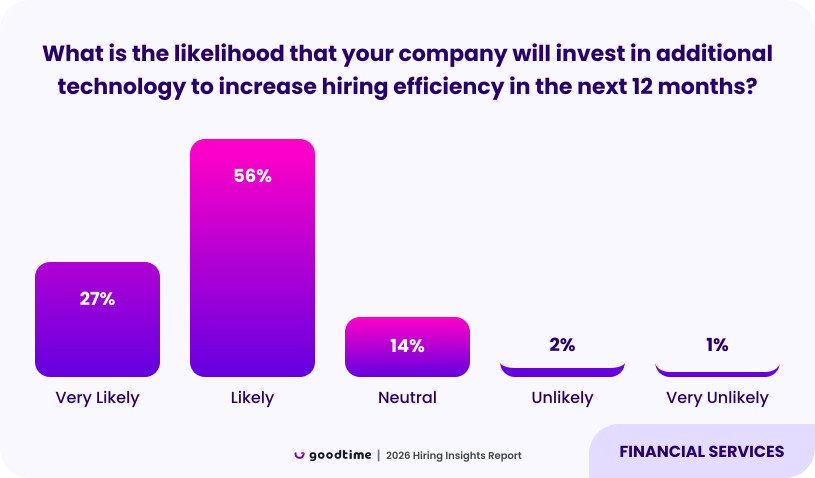
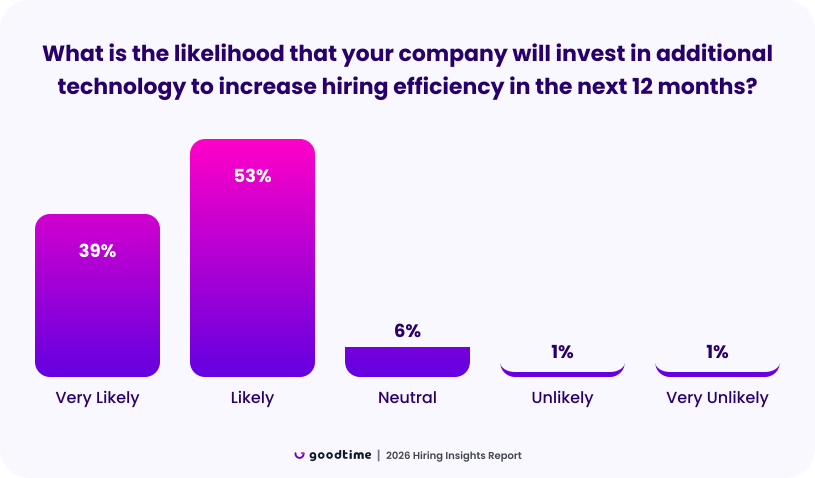
These priorities are backed by strong intent to invest. Financial services organizations overwhelmingly expect to increase technology investment to support hiring efficiency, reinforcing that modernization efforts in 2026 will be resourced—not aspirational.

Taken together, the direction is clear. Financial services teams are moving away from fragmented, people-dependent execution toward system-led hiring operations. Those that successfully align AI, automation, and standardized workflows will be best positioned to hire faster, manage risk, and sustain the gains achieved in 2025.

Key takeaways for financial services leaders

Financial services hiring is improving, but the margin for error is shrinking. The data points to a sector that can no longer rely on incremental gains or favorable market shifts to meet hiring needs. Execution quality now determines outcomes.

Speed is the new baseline, not a differentiator.
Candidates expect rapid movement, clear timelines, and minimal friction. Teams that cannot coordinate interviews, feedback, and decisions quickly will continue to lose qualified talent, regardless of brand or compensation.

Efficiency must be designed into the system.
Manual scheduling, inconsistent interviewer readiness, and fragmented communication are structural liabilities. Leaders should prioritize workflow modernization that reduces coordination work and stabilizes execution across roles and regions.

AI delivers the most value when it strengthens judgment.
Financial services teams are right to focus AI on evaluation, analytics, and consistency. The next opportunity is extending those gains to operational mechanics where AI can accelerate hiring without compromising rigor.

Standardization protects both speed and quality.
As concerns about candidate misrepresentation grow, standardized interviews, clearer scorecards, and disciplined processes become essential. Consistency is no longer just an efficiency play. It’s a risk-management strategy.

Candidate experience follows execution health.
Personalization and relationship-building matter, but they cannot compensate for slow or unreliable processes. Improving experience in financial services starts with predictable timelines, transparent communication, and momentum.

2026 will reward disciplined operators.
Market conditions may fluctuate, but teams that invest in technology, reinforce execution discipline, and align speed with scrutiny will be best positioned to sustain hiring gains and build resilient talent pipelines.

The path forward

For financial services leaders, the next phase of hiring advantage will come from operational precision. Teams that modernize scheduling and communication, apply AI to strengthen—not replace—human judgment, and enforce consistent standards across regions will move faster without increasing risk. In a sector where trust and execution are inseparable, disciplined systems will be the difference between incremental improvement and durable hiring performance.

Retail Recruiting in 2026: Key Trends, Challenges, and Insights

Editor’s note: The article below is an excerpt from GoodTime’s 2026 Hiring Insights Report. The entire report is available to view online for free here.

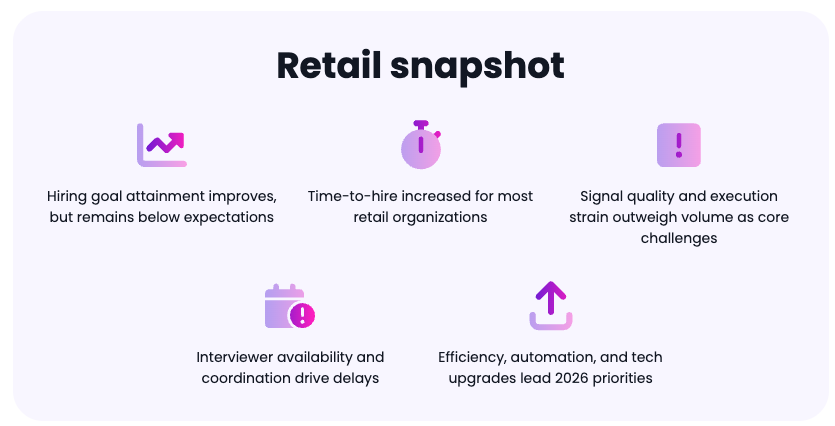
Retail hiring teams enter 2026 under sustained operational pressure. Across the retail hiring lifecycle, delays compound quickly. Limited interviewer availability, heavy recruiter and manager workload, and coordination breakdowns continue to slow hiring cycles and increase candidate drop-off. At the same time, signal-quality issues, such as skills misalignment and candidate misrepresentation, make it harder to confidently assess fit at scale.

Retail leaders are responding with a sharper focus on efficiency. Improving overall efficiency leads 2026 priorities, followed closely by upgrading hiring technology and optimizing automation. AI adoption is pragmatic and execution-driven, concentrated in analytics, reporting, scheduling, and screening—areas that improve visibility and speed without replacing human judgment.

How retail teams measure success reflects this mindset. Leaders prioritize metrics that reveal funnel friction and downstream outcomes, including application completion rate, quality of hire, offer acceptance, turnover, and time-to-hire. Looking ahead, continued capacity strain and rising complexity mean retail hiring success in 2026 will depend on strengthening workflow resilience rather than adding more volume.

Unlock 2026’s top hiring strategies: Insights from 500+ TA leaders

Be the first to uncover deep hiring insights specific to your sector — straight from the highest-performing TA teams.

2025 performance review

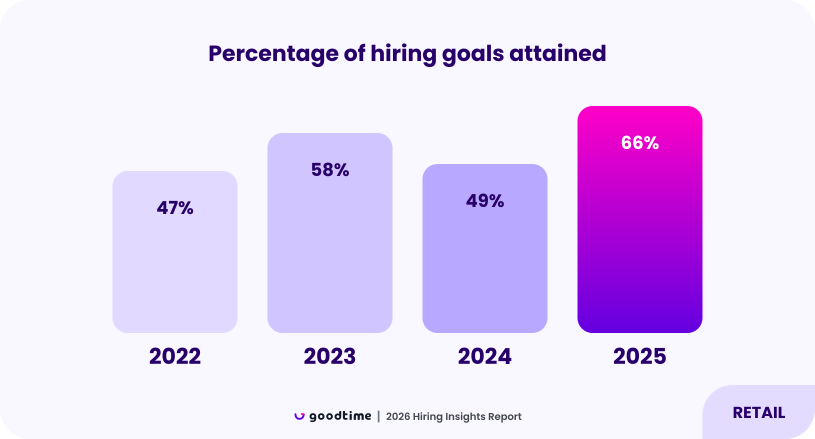
Retail hiring performance continued to lag behind organizational needs. Despite incremental improvements in tooling and automation, most retail teams still missed hiring goals, reflecting how difficult it has become to sustain hiring velocity at scale.

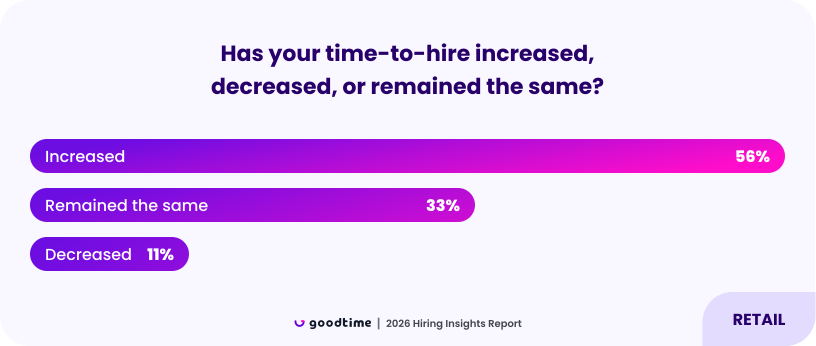
Extended time-to-hire emerged as a defining issue. As hiring cycles lengthened, retail teams faced compounding consequences: higher candidate drop-off, lost seasonal talent, and added pressure on store leaders to operate understaffed locations. In an industry where speed directly impacts revenue and customer experience, slow hiring has become a material business risk.

Key challenges: Candidate scarcity, misrepresentation, and execution strain

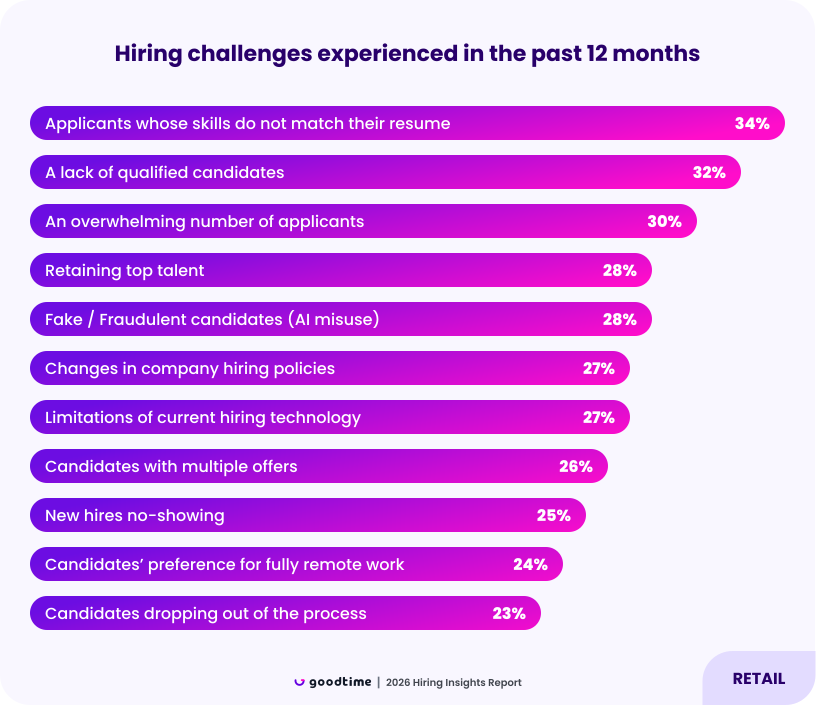
Retail hiring challenges are increasingly driven by signal quality and volume, not just talent availability.

The most common issue retail leaders report is skills misalignment (applicants whose capabilities don’t match their resumes) followed closely by a lack of qualified candidates. High application volume compounds the problem, forcing recruiters to filter more noise while still struggling to identify job-ready talent. Ongoing retention pressure keeps teams in near-constant backfill mode, limiting stability.

Execution strain adds another layer. Fake or misrepresented candidates, limitations in hiring technology, and policy changes slow decision-making and reduce predictability. Candidates juggling multiple offers, no-shows, and drop-off further increase friction when processes stall.

Overall, the chart shows that retail hiring is constrained less by sourcing reach and more by signal clarity, execution discipline, and system reliability.

Scheduling and communication bottlenecks

Retail’s bottlenecks are first and foremost capacity bottlenecks, then coordination bottlenecks.

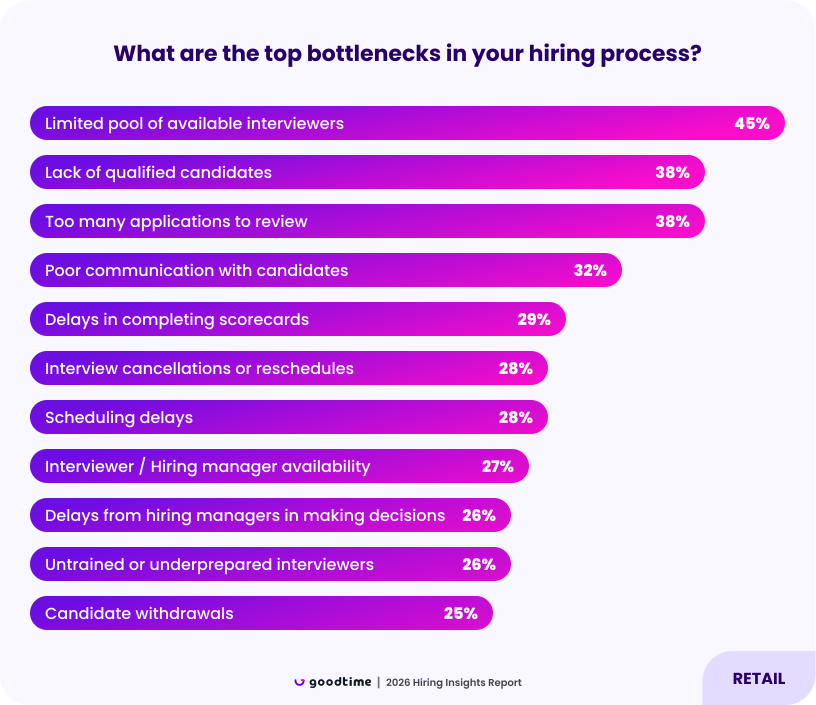
The top constraint retail leaders cite is a limited pool of available interviewers, which makes it difficult to move candidates through the funnel quickly, especially when store operations compete for the same time. Just behind that, retail teams are dealing with candidate-side and volume pressures: a lack of qualified candidates and too many applications to review. That combination forces recruiters to sift through more noise while still struggling to find true fit.

Communication and coordination issues still matter, but they show up as the next layer of friction. Poor communication with candidates ranks among the top bottlenecks, and downstream execution blockers, like delays in completing scorecards, interview cancellations or reschedules, and scheduling delays, compound the impact of limited interviewer capacity. Availability continues to be a theme: interviewer/hiring manager availability and delays from hiring managers in making decisions (26%) both reinforce how easily retail hiring stalls when the process depends on busy, distributed stakeholders.

The takeaway is clear: in retail, speed breaks down less because of a single scheduling tool gap, and more because interviewer capacity and decision follow-through can’t keep up with volume. The most effective fixes pair structured availability and scheduling workflows with clear accountability for feedback and decisions, so candidates aren’t left waiting long enough to withdraw.

Upgrade your hiring journey with AI

GoodTime’s AI agents orchestrate the entire hiring journey — screening, scheduling, messaging, and more — so talent teams hire faster with a better candidate experience.

Technology adoption and the role of AI in retail hiring

Retail hiring teams are using AI most heavily where it helps them see and move the process faster—not necessarily where it replaces human judgment.

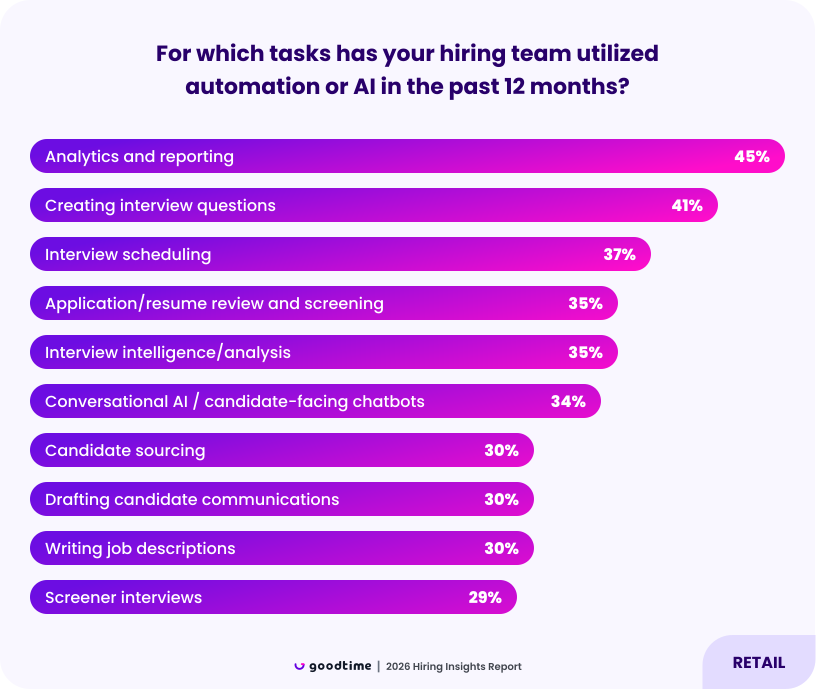
The strongest adoption shows up in analytics and reporting, signaling that retail leaders are increasingly relying on AI to understand funnel health, spot slowdowns, and manage high-volume hiring more effectively. Close behind are interview-related use cases, including generating interview questions and coordinating interview scheduling, reflecting how much of retail hiring pressure sits in the middle of the funnel rather than at sourcing alone.

Retail teams are also applying AI to resume review, screening, and interview intelligence, indicating a growing focus on improving signal quality and consistency when volume is high. Candidate-facing automation, such as conversational AI and drafting communications, appears more selectively adopted, suggesting that many retail organizations are cautious about automating direct candidate interaction too aggressively.

Overall, the data reflects a pragmatic approach to AI in retail. Teams are using technology first as workflow infrastructure and decision support, not as a wholesale replacement for recruiters or hiring managers. The retail organizations seeing the most value are those aligning AI investment with their core realities like speed, volume, and limited recruiter bandwidth, while keeping human oversight where it matters most.

Metrics retail teams prioritize

Retail hiring teams are measuring what helps them manage volume, quality, and funnel health—not just cost control.

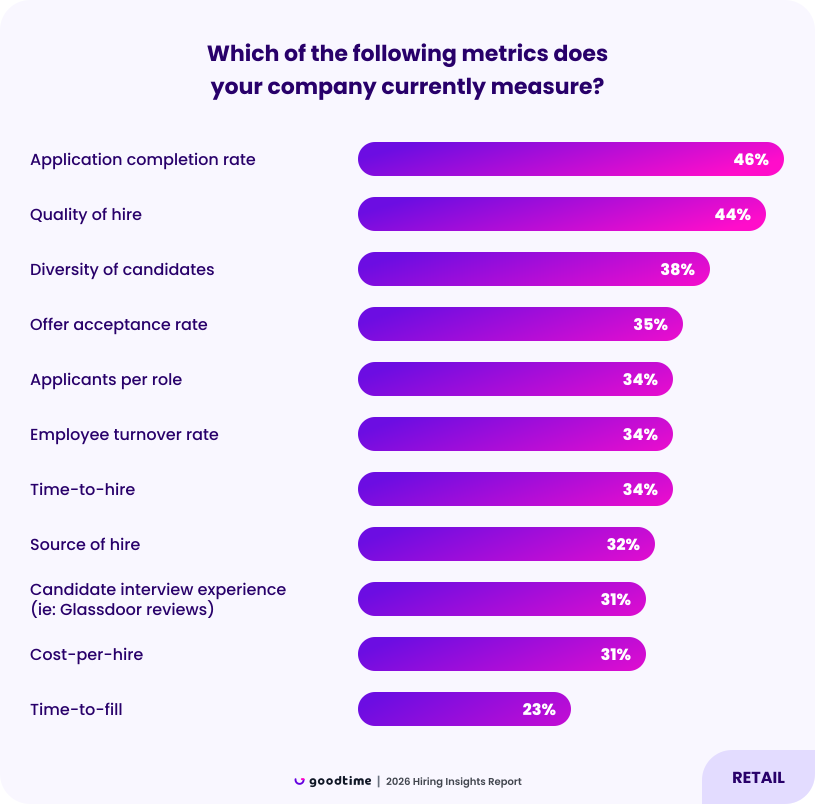
The most commonly tracked metrics focus on early-funnel effectiveness and downstream outcomes. Application completion rate sits at the top, reflecting how critical it is for retail teams to understand where candidates drop out in a high-volume environment. Close behind is quality of hire, signaling that even in fast-paced retail hiring, teams are prioritizing long-term fit and performance rather than speed alone.

A second tier of metrics centers on conversion and stability. Offer acceptance rate, applicants per role, employee turnover, and time-to-hire are all widely measured, underscoring how retail leaders are trying to balance hiring velocity with retention and workforce continuity. These metrics help teams diagnose whether hiring slowdowns stem from candidate hesitation, role attractiveness, or internal execution issues.

Candidate experience metrics and cost-per-hire appear less dominant, suggesting that while experience and cost matter, they are often viewed as supporting indicators rather than primary decision drivers. Time-to-fill trails further behind, reinforcing that retail teams are more focused on keeping the funnel moving than on measuring the full end-to-end vacancy window.

Overall, the chart shows a pragmatic measurement strategy. Retail teams are tracking the metrics that reveal friction, drop-off, and hire quality across a large funnel, prioritizing operational visibility over purely financial optimization.

2026 outlook for retail hiring

Retail leaders expect 2026 to be defined by execution complexity and operating-model strain, rather than a single dominant hiring obstacle.

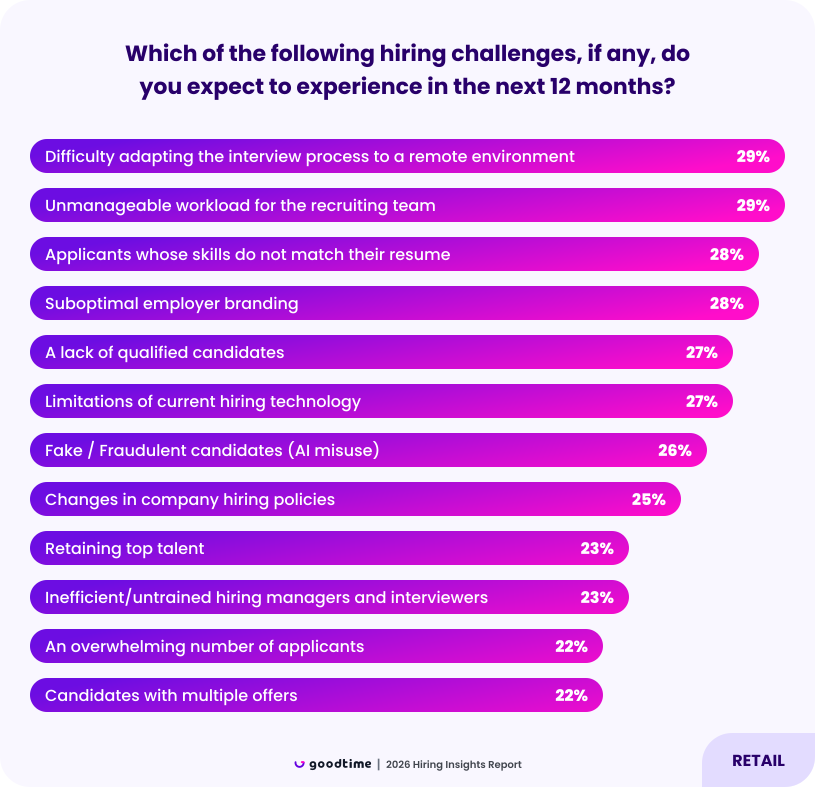
The most frequently anticipated challenges cluster around how retail hiring is run day to day. Difficulty adapting hiring processes to remote or distributed environments and unmanageable recruiter workloads rise to the top, signaling continued pressure on team capacity and process design. These concerns sit alongside persistent signal-quality issues, including applicants whose skills do not match their resumes and an ongoing lack of qualified candidates.

Brand and infrastructure limitations also feature prominently. Many retail leaders anticipate challenges tied to employer branding and limitations in their current hiring technology, suggesting that existing systems may struggle to support hiring at the required speed and scale. At the same time, concern about fake or misrepresented candidates points to a growing need to verify authenticity without adding friction to already stretched processes.

Overall, the outlook reflects a retail hiring environment where success in 2026 will hinge on process resilience, recruiter capacity, and execution discipline across the funnel.

2026 priorities: technology upgrades remain the top focus

Retail hiring priorities for 2026 are tightly centered on making hiring work better at scale.

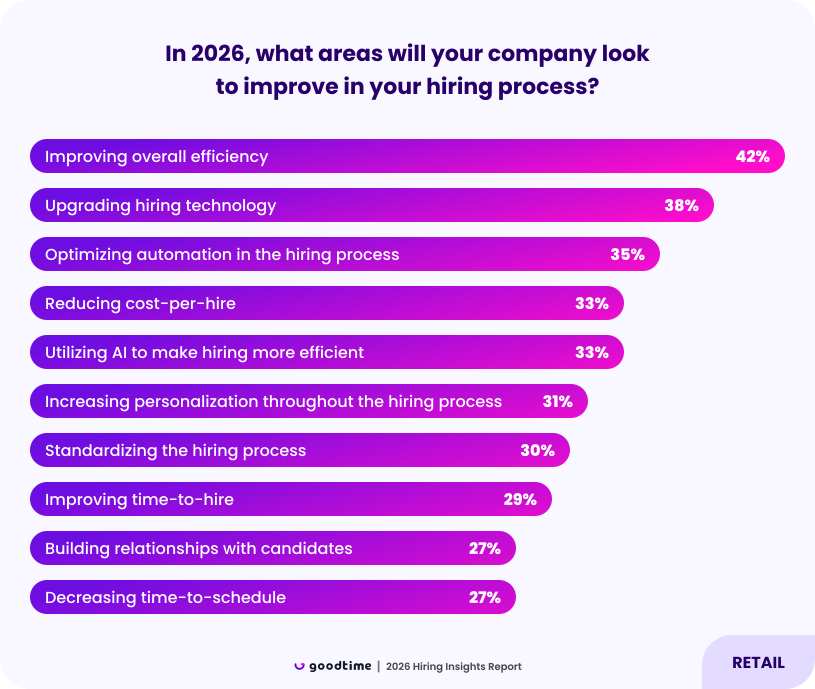
Improving overall efficiency clearly leads the agenda, reinforcing that retail teams see speed, throughput, and reduced friction as the most urgent needs. Upgrading hiring technology and optimizing automation follow closely, signaling that leaders view tech investment as a primary lever for achieving those efficiency gains,not as a secondary support.

Cost control and smarter use of AI also feature prominently, reflecting pressure to do more with constrained recruiter capacity while improving consistency across high-volume roles. At the same time, personalization, standardization, and incremental time-to-hire improvements appear as meaningful but secondary priorities, suggesting that retail teams are balancing flexibility with the need for repeatable, reliable processes.

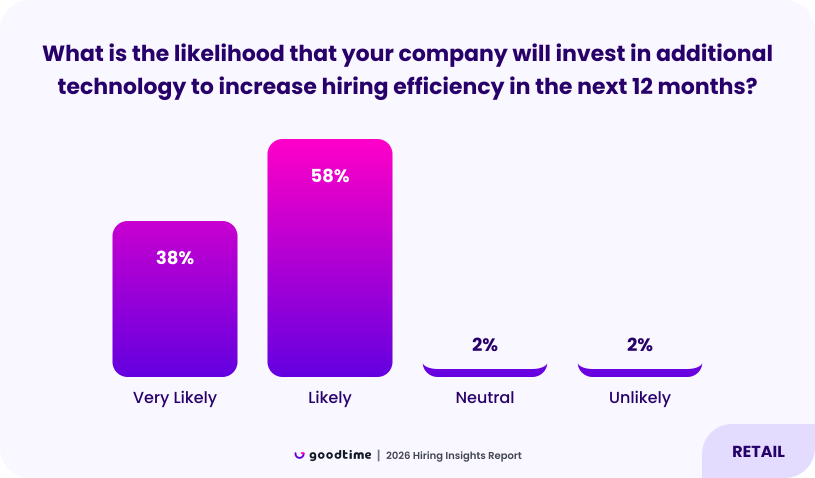
Nearly all retail organizations expect to invest in additional hiring technology in 2026, underscoring broad confidence that modernization, particularly around efficiency, automation, and workflow support, will be central to staying competitive in the year ahead.

Final thoughts and key takeaways for retail hiring leaders

Focus on capacity before volume. Limited interviewer availability and recruiter workload are the primary constraints in retail hiring. Protecting hiring time, clarifying interviewer accountability, and structuring availability unlock more value than adding applicants.

Treat scheduling as a system, not a task. Interview coordination remains one of the biggest drivers of delay and candidate drop-off. Automated scheduling, self-service rescheduling, and standardized availability are now foundational capabilities for retail teams.

Use AI to improve visibility and speed—not to replace judgment. Retail teams see the greatest gains when AI supports analytics, reporting, scheduling, and screening. These use cases strengthen decision-making and execution without eroding human oversight.

Measure funnel health and outcomes, not just activity. Application completion, quality of hire, offer acceptance, turnover, and time-to-hire provide earlier and more actionable signals than cost or raw volume metrics.

Modernize communication to reduce drop-off and risk. Centralized, consistent candidate communication improves response times, reduces confusion, and mitigates compliance risk in a mobile-first hiring environment.

Strengthen defenses against candidate misrepresentation. As AI-assisted or misrepresented candidates become more common, retail teams must reinforce skill validation and structured evaluation without slowing the process.

The path forward

Retail teams that modernize scheduling, centralize communication, deploy AI as workflow infrastructure, and align measurement with quality and funnel health will be best positioned to hire reliably in 2026. In retail, hiring success is no longer about doing more; it is about building systems that hold up under pressure.

Enterprise Talent Acquisition Report: Key Stats and Trends for 2026

Editor’s note: The article below is an excerpt from GoodTime’s 2026 Hiring Insights Report. The entire report is available to view online for free here.

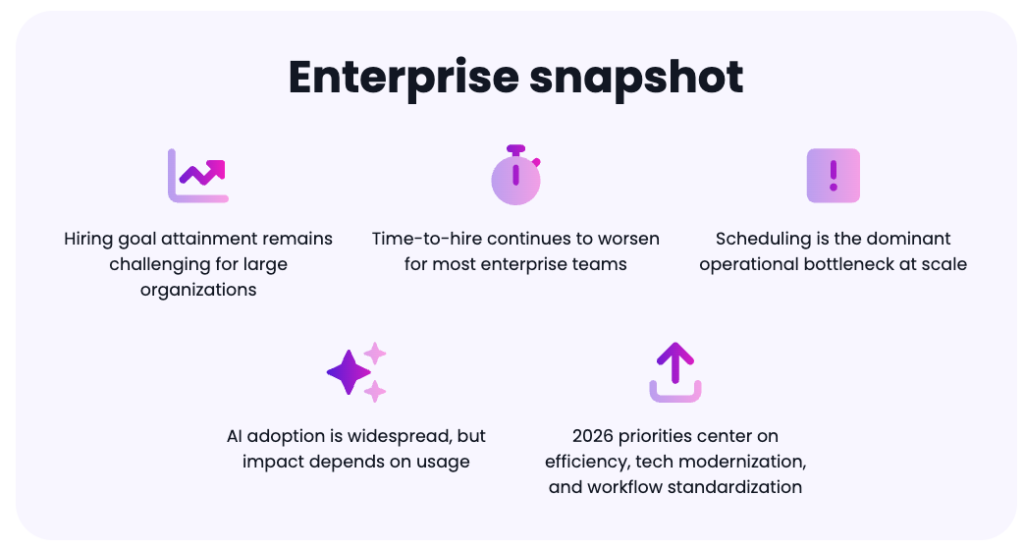
Enterprise hiring teams entered 2026 facing sustained pressure, and little margin for error. Despite having broader access to technology, data, and AI than smaller organizations, large employers continue to struggle with execution at scale.

TA leaders at large-scale organizations operate in an environment where small inefficiencies compound quickly. Scheduling complexity, interviewer availability, layered decision-making, and fragmented communication don’t just slow hiring—they destabilize it. As a result, enterprise teams feel the impact of rising time-to-hire, candidate drop-off, and recruiter workload more acutely than most.

At the same time, the enterprise risk profile is changing. Candidate fraud and misrepresentation are emerging as serious concerns, while candidate expectations for speed, flexibility, and transparency continue to rise. In this environment, process discipline matters as much as talent strategy.

The data shows a growing divide among enterprise organizations. Teams that standardize workflows, modernize scheduling, centralize communication, and deploy AI as hiring infrastructure (not just automation) are better positioned to keep pace. Those that rely on manual coordination and fragmented systems are falling further behind.

Unlock 2026’s top hiring strategies: Insights from 500+ TA leaders

Be the first to uncover deep hiring insights specific to your sector — straight from the highest-performing TA teams.

Challenges and bottlenecks at enterprise scale

Enterprise hiring teams face many of the same challenges as the broader market—but scale magnifies their impact.

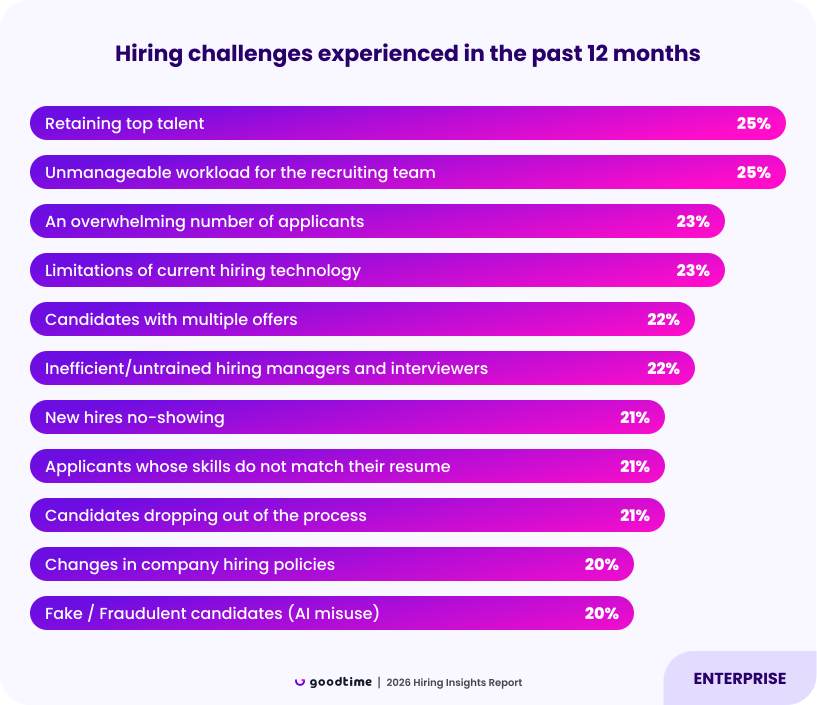
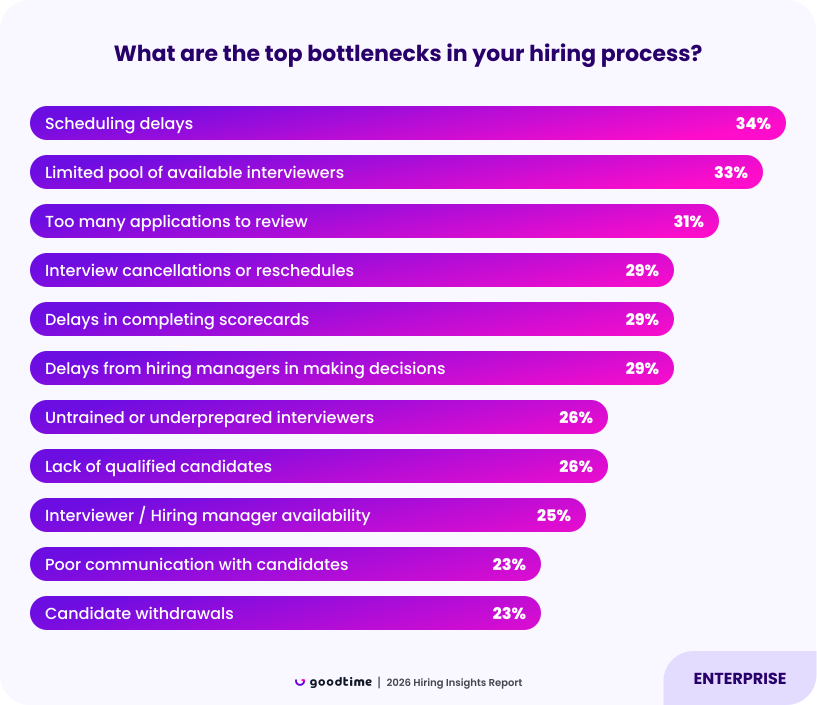
The data shows that enterprise strain is driven first by workload and volume, not a single talent constraint. Retaining top talent and unmanageable recruiter workload are the most cited challenges, highlighting how difficult it has become for large teams to sustain performance under constant hiring pressure. An overwhelming number of applicants and limitations of current hiring technology follow closely, signaling systems that are struggling to keep up with demand.

Execution challenges further compound the issue. Candidates with multiple offers, insufficiently trained hiring managers and interviewers, and new-hire no-shows all rank among the top enterprise obstacles—pointing to breakdowns in consistency and follow-through at scale.

Skills misalignment and candidate drop-off remain persistent concerns, particularly as fraudulent resumes created with AI make it harder to assess true capability across high-volume pipelines. The appearance of fake or fraudulent candidates among the top challenges adds yet another layer of risk for already overextended enterprise teams.

Taken together, the picture is clear: enterprise hiring challenges are systemic and operational, driven by volume, workload, and execution strain rather than talent scarcity alone.

“The reality is that, in the age of AI, the resume and application is going to give significantly less signal on a candidate’s capability. That means putting more weight on work-sample–style assessments, scenario walkthroughs, and live problem-solving that reveals how someone thinks, not how well they can prompt AI.”
-Becky McCullough, VP, Talent Acquisition & Mobility, HubSpot

Time-to-hire trends: scale compounds delay

Time-to-hire remains one of the most pressing issues for enterprise TA teams.

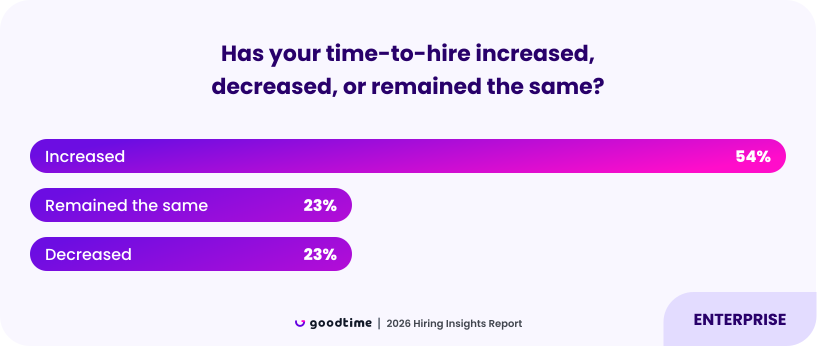
A majority of enterprise leaders report that time-to-hire increased over the past year, while only a small minority managed to reduce it. While this trend mirrors the broader market, its consequences are amplified at enterprise scale—where slow hiring directly impacts productivity, revenue, and workforce planning.

Complex approval structures, interviewer scarcity, and manual scheduling workflows all contribute to longer cycles. As timelines stretch, enterprise teams face higher candidate drop-off rates and increased competition from faster-moving employers.

The takeaway is clear: enterprise hiring speed is constrained by systems, not effort. Without structural fixes, incremental changes will not reverse the trend.

Candidate experience pressures intensify

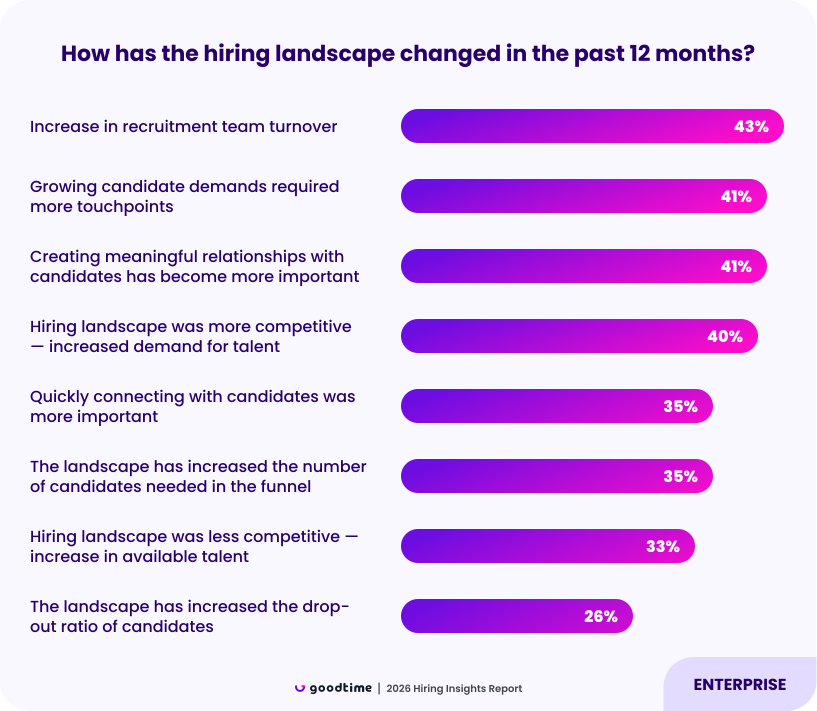
Enterprise leaders report that the hiring landscape has become more demanding, more competitive, and more operationally complex over the past year.

The most widely felt change is recruitment team turnover, with enterprise leaders citing its impact on their ability to manage candidate flow. At the same time, growing candidate demands have increased the number of touchpoints required throughout the hiring process, making consistency harder to maintain at scale.

Relationship-building has also taken on greater importance. Enterprise leaders increasingly emphasize the need to create meaningful connections with candidates and to connect faster, as slow or fragmented engagement raises the risk of losing candidates to competing employers. Competition remains intense, with many leaders reporting increased demand for talent. At the same time, others note growing talent availability, illustrating a fragmented market where volume may increase, but speed and clarity still determine outcomes.
Finally, a rising candidate drop-off rate reinforces the stakes. As processes grow longer or less transparent, candidates disengage more quickly, putting additional pressure on already stretched enterprise teams.

Taken together, the data shows that enterprise candidate experience is now defined by execution under pressure. Managing candidate flow, maintaining engagement across more touchpoints, and moving quickly have become essential to competing at scale.

AI and automation adoption: ubiquitous, but uneven

AI and automation are widely used across enterprise TA teams, but adoption is uneven by task.

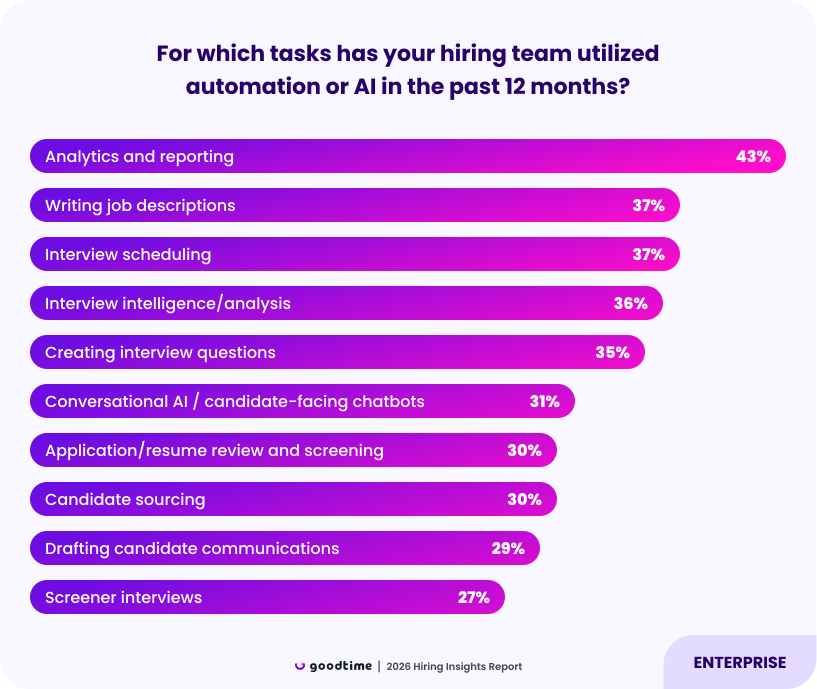
Analytics and reporting lead all enterprise AI use cases, followed by writing job descriptions and interview scheduling. These top applications reflect where enterprise teams are seeing the most immediate value: visibility into hiring performance and relief from high-friction, repeatable work.

Adoption drops off across more candidate-facing and judgment-heavy tasks. Conversational AI, resume screening, candidate sourcing, and drafting candidate communications are used by fewer teams, suggesting a more cautious approach to automating direct candidate interaction.

Overall, the data shows that enterprise teams are applying AI broadly—but prioritizing internal efficiency and insight over front-of-funnel automation

Scheduling presents the biggest opportunity for improvement

Scheduling remains the single largest operational burden in enterprise hiring.

Across the market, recruiters spend a substantial share of their time coordinating interviews. For enterprise teams, this burden is intensified by:

  • Larger interviewer pools
  • Cross-functional scheduling dependencies
  • Higher frequency of cancellations and reschedules

Manual scheduling workflows don’t just slow enterprise hiring—they introduce instability, consume recruiter capacity, and degrade the candidate experience.
Upgrade your hiring journey with AI

GoodTime’s AI agents orchestrate the entire hiring journey — screening, scheduling, messaging, and more — so talent teams hire faster with a better candidate experience.
2026 outlook: expected disruptors for enterprise teams

Enterprise TA leaders expect disruption in 2026 to be driven primarily by execution and evaluation challenges, not sourcing alone.
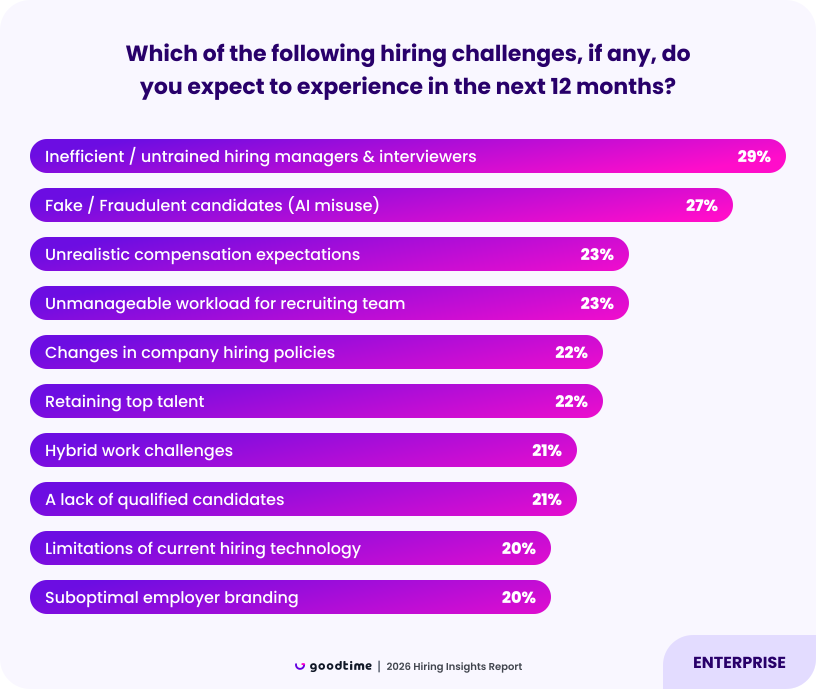
The most anticipated issue is inefficient or untrained hiring managers and interviewers, cited more often than any other disruptor. This points to growing strain on interview quality, interviewer readiness, and decision consistency at enterprise scale.
Close behind is candidate fraud, including AI-generated or misrepresented qualifications. For large organizations with high hiring volume, this introduces new complexity into screening and verification and raises both operational and reputational risk.

Several additional disruptors cluster closely together, including unrealistic compensation expectations, unmanageable recruiter workload, and changes in company hiring policies. These pressures reflect both external market dynamics and internal complexity that enterprise teams must navigate simultaneously.

Notably, traditional concerns like lack of qualified candidates and technology limitations remain present but rank lower than people- and process-related challenges. Candidate drop-off and difficulties adapting interview processes also persist, reinforcing how fragile execution becomes as systems scale.

Overall, the chart shows that enterprise hiring risk in 2026 is less about access to talent and more about managing people, process, and signal quality under pressure.

2026 priorities and tech investment plans

Enterprise hiring priorities for 2026 are tightly centered on execution and efficiency.

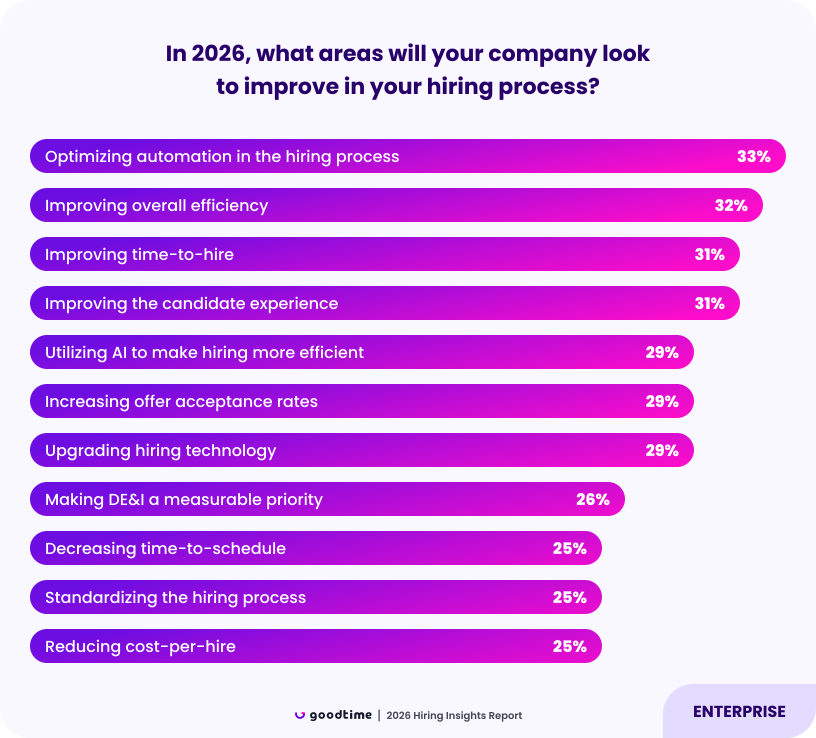
The top focus areas reflect a clear desire to make hiring systems work better at scale. Optimizing automation and improving overall efficiency lead all priorities, followed closely by reducing time-to-hire and improving the candidate experience. Together, these signals point to enterprise teams working to remove friction from core workflows rather than adding new layers of process.

Just behind those top priorities, enterprise leaders cite using AI to make hiring more efficient, upgrading hiring technology, and increasing offer acceptance rates—reinforcing that technology investment is expected to directly support speed, coordination, and follow-through. Standardizing hiring processes and reducing time-to-schedule also rank highly, highlighting the importance of consistency across teams and regions.

Lower on the list are relationship-building and personalization efforts, suggesting that in 2026, enterprise teams are prioritizing reliability and execution over bespoke experiences.

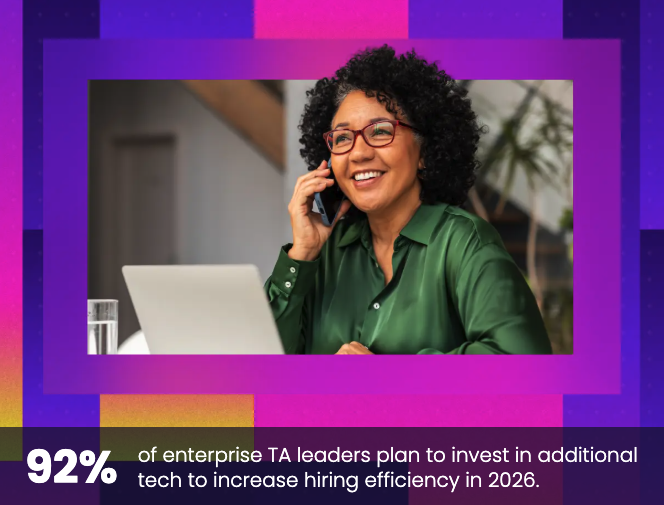
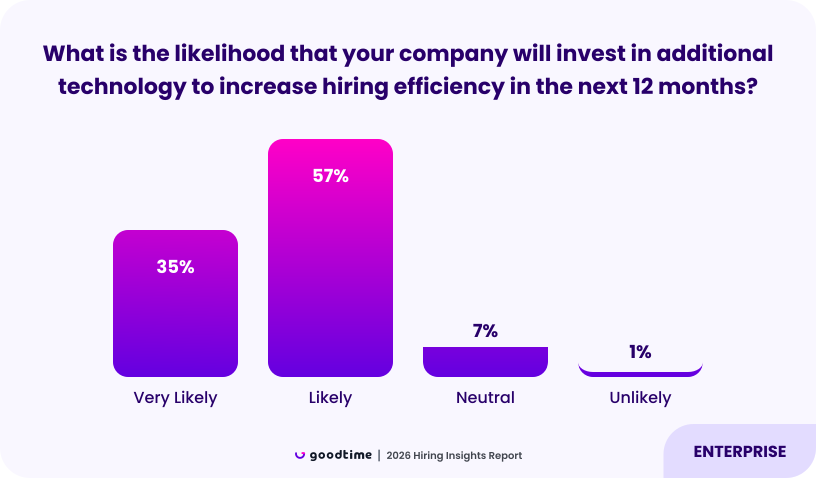
Nearly all enterprise TA leaders say they are likely or very likely to invest in additional hiring technology in 2026, with very few expressing uncertainty or resistance. This confirms that modernization is not optional at enterprise scale.

At the same time, the priorities data makes one thing clear: technology alone is not the goal. Enterprise teams are investing in tech as a means to improve efficiency, speed, and consistency—especially where manual work and coordination strain have become unsustainable.

Enterprise hiring in 2026: Execution is the strategy

Enterprise hiring in 2026 demands operational resilience.

The organizations best positioned to succeed are not those with the most tools, but those with the most disciplined systems. By modernizing scheduling, centralizing communication, and deploying AI as infrastructure rather than experimentation, enterprise TA teams can regain speed, reduce risk, and restore confidence in their hiring engine.

At enterprise scale, execution is strategy. The teams that fix the mechanics of hiring will be the ones that can withstand pressure—and hire with confidence—in the year ahead.

TA Leaders Reveal How to Win Top Talent in 2026

Editor’s note: The article below is an excerpt from GoodTime’s 2026 Hiring Insights Report. The entire report is available to view online for free here.

As talent teams look toward 2026, the path to winning top talent is defined less by sourcing volume and more by operational discipline. Rising candidate expectations, concerns about authenticity, and persistent workflow bottlenecks have pushed organizations to rethink how hiring should function. And after a year marked by strain, leaders enter 2026 with remarkable alignment on what must change.

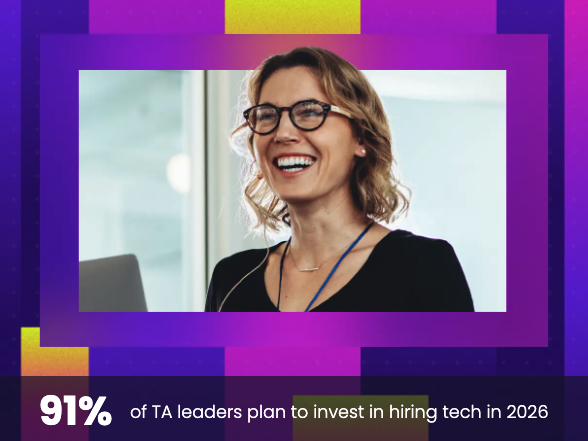
The data shows that modernization is no longer optional. 91% of TA leaders plan to invest in additional hiring technology, and AI adoption has reached a pivotal threshold: 99% of teams now use, pilot, or plan to use AI agents. With this shift, hiring is entering an era where speed, clarity, and system-level intelligence determine competitive advantage.

Unlock 2026’s top hiring strategies: Insights from 500+ TA leaders

Be the first to uncover deep hiring insights specific to your sector — straight from the highest-performing TA teams.

New pressures redefine how teams compete in 2026

Fake and fraudulent candidates become the #1 anticipated challenge

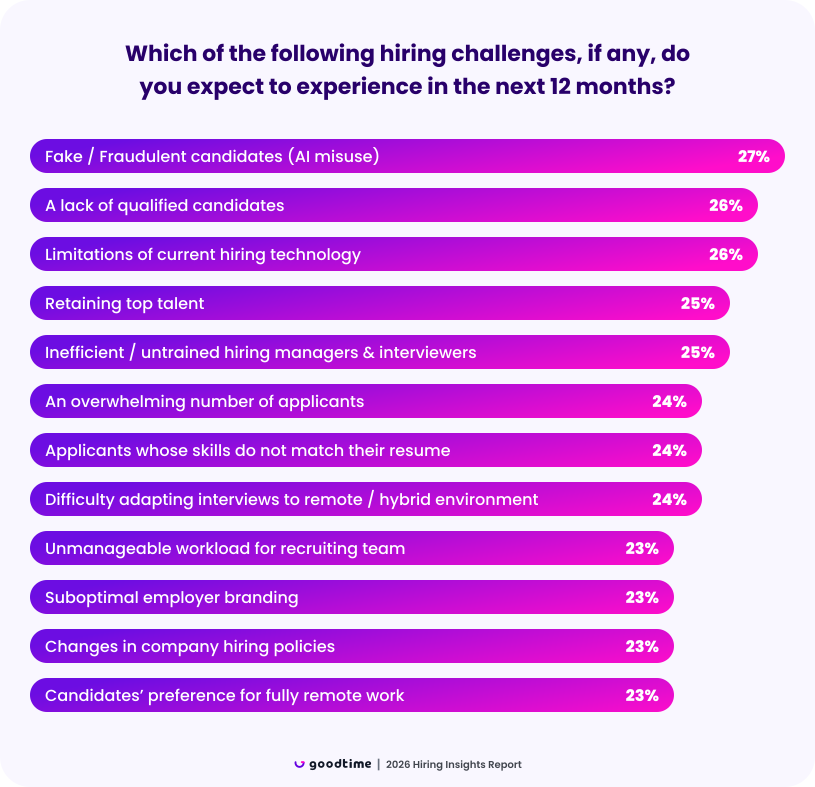
For the first time, TA leaders say fake or AI-misrepresented candidates pose the single biggest threat to hiring this year. 27% expect fraudulent candidates to be a top challenge, narrowly edging out the 26% who cite a lack of qualified talent.

This shift signals a profound change in the hiring environment. As generative AI raises the floor of resume quality and candidate presentation, teams must increase their focus on skill validation, structured interviews, and identity assurance. The challenge is no longer just finding talent—it’s confirming authenticity.

“Resumes, answers to application questions, even online portfolios—core data points in assessing candidate quality not so long ago —have all lost value in the era of GenAI. It’s one of the most urgent tasks of TA teams today to find methods of assessment which are suitable for this era. We’re seeing much greater use of synchronous assessments for skills, traits and behaviours, as well as (somewhat ironically) the return of in-person interviews.”
-Hung Lee, Founder, Recruiting Brainfood

Why tech limitations persist despite widespread adoption

Despite near-universal adoption of hiring technology, 26% of leaders still expect tech limitations to be a major barrier in the coming year. The issue isn’t access to tools—it’s how those tools function in practice.

Many organizations now rely on fragmented tech stacks made up of point solutions that don’t work together cleanly. Instead of reducing effort, these systems introduce more handoffs, data silos, and manual coordination. Automation often exists in pieces, but recruiters are still left to connect workflows, manage scheduling, chase feedback, and maintain candidate communication across platforms.

Compounding this, limited visibility into bottlenecks makes it harder to diagnose and fix delays before they escalate. When technology doesn’t clearly surface where hiring slows down, teams end up reacting to problems rather than preventing them.

In short, tech becomes a constraint when it adds complexity instead of removing it, especially as hiring speed and candidate expectations continue to rise.

“To successfully leverage AI, you need individuals who dare to disrupt and challenge your existing hiring processes. You can no longer achieve great results by adhering to rigid legacy processes — you need innovators who understand the rules well enough to know how to break them.”
-Anastasia Pshegodskaya, Global Director, Talent Acquisition, Remote

Rising candidate expectations and dropout risks intensify

Candidates expect immediate responses, flexible scheduling, and mobile-friendly communication. When teams fall behind, dropout rates spike. Leaders anticipate these pressures increasing, making responsiveness and process clarity key differentiators in 2026.

Recruiter turnover threatens continuity

Turnover within TA teams is expected to disrupt candidate flow and reduce operational stability. As workloads fluctuate and hiring needs rise, teams must build systems that maintain consistency even when people transition.

TA leaders anticipate uneven hiring conditions in 2026

One of the clearest signals in the 2026 data is not consensus, but contextual divergence in how hiring conditions are expected to evolve.

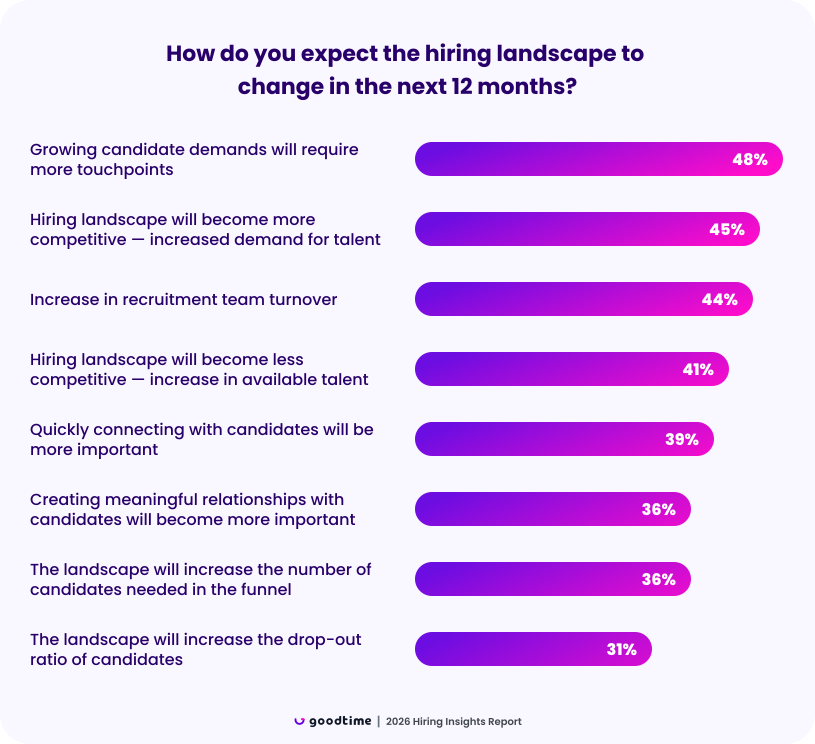
While 45% of TA leaders expect the hiring landscape to become more competitive due to increased demand for talent, nearly as many (41%) believe it will become less competitive as talent availability increases. Rather than signaling confusion or contradiction, this split reflects the reality that hiring conditions are increasingly uneven across roles, skills, and labor pools.

In practice, this suggests that competition in 2026 will be more situational than universal. Some teams, particularly those hiring for scarce, high-impact, or specialized roles, are likely to face intense competition and sustained pressure on speed. Others will contend with larger candidate pools that still require careful screening, faster decision-making, and stronger process discipline to convert interest into hires.

The takeaway is not that the hiring market is moving in two directions at once, but that there is no single hiring market anymore. Conditions will vary meaningfully depending on what roles organizations are hiring for, where those roles sit, and how efficiently teams can move candidates through the process.

As a result, speed, clarity, and execution discipline matter regardless of whether talent is scarce or abundant. Teams that move slowly or inconsistently risk losing candidates either to faster competitors or to disengagement.

What TA teams are prioritizingin 2026

The priorities for the year ahead reveal a discipline-focused mindset. Leaders are no longer trying to “add more candidates” to the top of the funnel. Instead, they are focused on fixing the entire system.

Improving efficiency is the top priority

Organizations overwhelmingly cite efficiency as their top focus for 2026. Speed is no longer just a metric; it’s a core capability. The teams that move fast are the ones that will win candidates who often hold multiple offers.

Upgrading hiring technology

With 91% planning new tech investments, modernization is accelerating. Teams are prioritizing:

  • Automated scheduling
  • Centralized communication
  • Analytics and bottleneck detection

In other words, the age of patchwork workflows is ending and end-to-end connected systems will take their place.

“When you think about how we translate that hospitality mindset into our candidate interviewing, having a really rock-solid scheduling platform and tools is really important to deliver the experience we’re looking for.”
-Jeff Moore
VP of TA Operations and Workspaces, Toast

Elevating the candidate experience through speed and flexibility

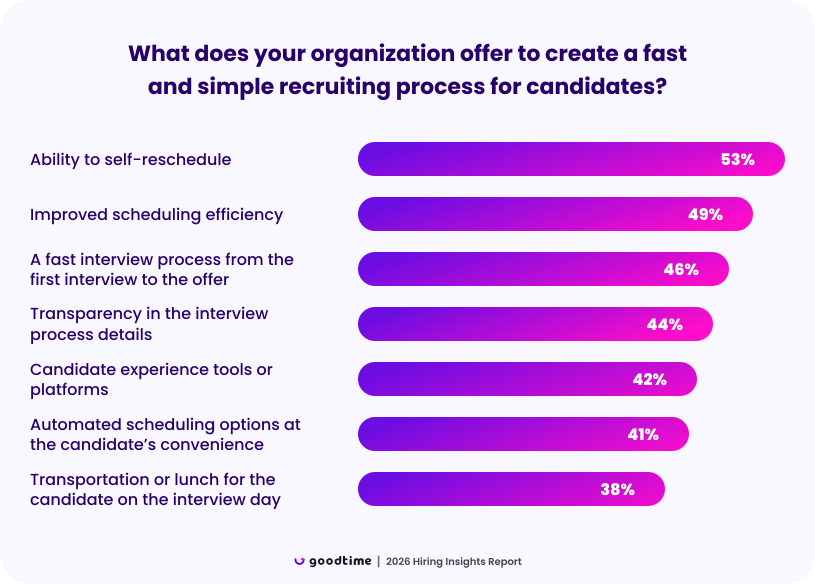
Candidate experience has evolved. Personal touches matter, but not as much as frictionless movement through the process. The top features companies offered to improve the candidate experience included:

  • Self-scheduling and self-rescheduling
  • Transparent, automated updates
  • Fast interview-to-offer timelines
  • Mobile-first communication

Today’s candidates judge employers largely on whether the hiring process feels modern, predictable, and respectful of their time.

Speed becomes the primary differentiator

Fast interview-to-offer processes are now one of the strongest predictors of acceptance. Teams that can move candidates forward without delay create a competitive advantage.

Self-service scheduling becomes standard

With 53% offering self-rescheduling and 41% using automated scheduling, candidates expect flexibility and control. These capabilities reduce friction and lower dropout rates across the funnel.

Transparency drives trust

More than ever, candidates expect real-time visibility into where they stand. Automated updates reduce uncertainty—and demonstrate operational maturity.

Mobile-first communication is universal

Texting and WhatsApp are now part of every team’s communication toolkit. What differentiates organizations is whether those channels are centralized, compliant, and consistent.

AI’s ever-expanding role in talent acquisition

One of the more interesting signals in the data is where AI adoption has concentrated, and where it hasn’t.

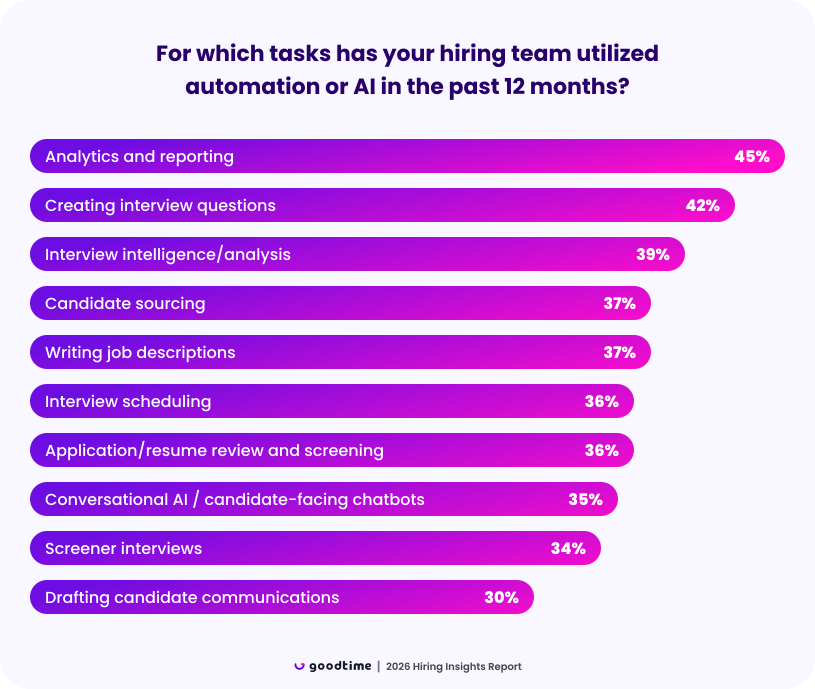
TA teams are most likely to apply AI to tasks where value is clear, risk is low, and outputs are easy to validate. Analytics and reporting (45%), interview question generation (42%), and interview intelligence (39%) all rank at the top, use cases where AI augments decision-making without replacing human judgment.

By contrast, even some of the most operationally straightforward uses of AI remain under-adopted. Interview scheduling stands out as the clearest missed opportunity: it’s widely understood, low-risk, and directly tied to the biggest bottlenecks teams face today. Scheduling is often the best place to start with automation because it delivers immediate efficiency gains without introducing new decision-making risk.

“AI agents handle orchestration, not just execution — leveraging data and insights to make more informed decisions. We’ve been able to cut our scheduling time from 30 minutes to five.”
-Tiffany Clark, Head of HR Strategy & Shared Services, S&P Global

The pattern is telling: teams are embracing AI fastest where it provides insight without requiring structural change, and moving more cautiously where adoption would force deeper workflow redesign. As AI becomes infrastructure rather than experimentation, the next wave of differentiation will come from teams willing to rebuild processes, not just layer intelligence on top of them.

AI-powered scheduling gains strategic importance

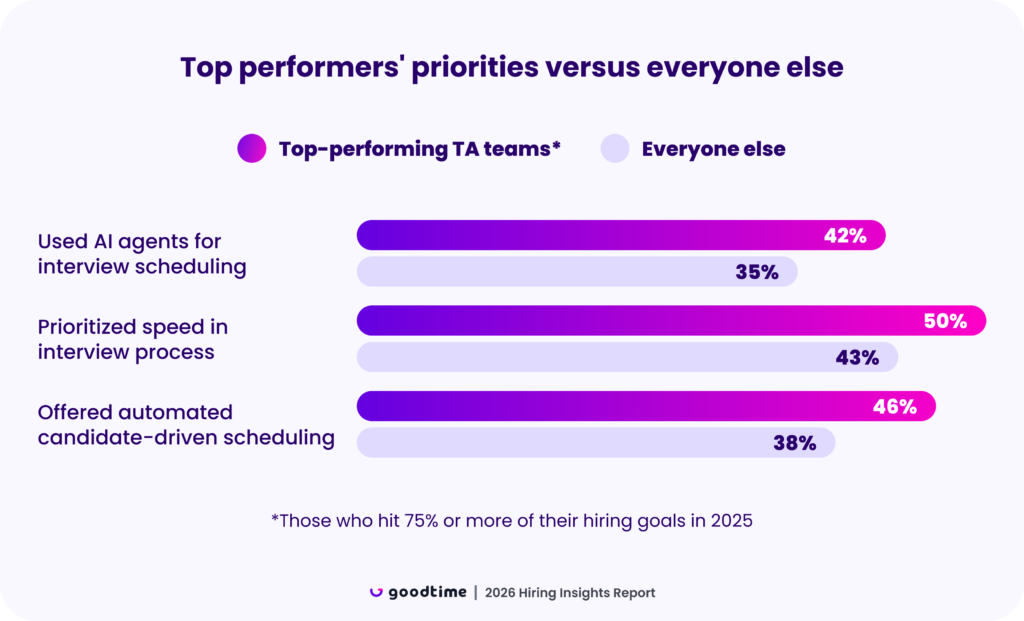
With scheduling still the largest operational tax in hiring, AI-powered coordination continues to differentiate faster teams from slower ones. Automated scheduling (already a strong predictor of higher goal attainment) is becoming a core mechanism for reducing delays, protecting candidate engagement, and supporting faster interview-to-offer decisions in the year ahead.

“Recruiters aren’t slow—scheduling is. Until companies adopt systems that absorb complexity instead of pushing it onto humans, scheduling will remain the single biggest bottleneck in hiring.”
-Shelby Wolpa, Founder, Shelby Wolpa Consulting

The metrics that matter in 2026

Upgrade your hiring journey with AI

GoodTime’s AI agents orchestrate the entire hiring journey — screening, scheduling, messaging, and more — so talent teams hire faster with a better candidate experience.

Quality of hire leads all metrics

Quality of hire is now the most tracked metric at 42%, and the most prioritized, with 22% naming it their top measure of success. As candidate authenticity becomes harder to assess, quality signals become more vital.

“The real competitive advantage will be applying AI in ways that drive quality: quality of process and hire. By quality of hire, we mean improving the rigor of our assessment, accuracy of our decision making, and ultimately, the success of the hires that we make relative to historical benchmarks.”
-Ben Sesser, Co-Founder, BrightHire

Efficiency metrics gain momentum

Teams are still prioritizing key efficiency measures:

  • Time-to-hire (37%)
  • Offer acceptance rate (36%)
  • Application completion rate (38%)

These metrics give leaders earlier warnings and clearer insight into when slowdowns or gaps begin to form.

The bottom line: How teams will win talent in 2026

The data reveals a clear blueprint for success:

1. Build AI-first workflows

AI should orchestrate scheduling, detect delays, surface insights, and simplify complexity throughout the hiring process.

2. Modernize scheduling and remove manual coordination

Automation must replace back-and-forth messaging, fragmented calendars, and human bottlenecks.

3. Strengthen verification and assessment

With fake candidates on the rise, structured interviews, skills tests, and identity protocols are essential.

4. Standardize processes for consistency and scale

Standardization reduces confusion, speeds decision-making, and improves measurement.

5. Redesign TA roles to maximize human value

Free teams from administrative burden and shift focus toward relationships, advisory work, and better hiring decisions.

The takeaway

Winning top talent in 2026 requires precision, speed, and a new level of operational discipline. As candidate authenticity becomes harder to evaluate and expectations rise across the funnel, competitive advantage shifts toward teams that automate intelligently, measure what matters, and eliminate friction at every step.

Organizations that modernize now—adopting AI-driven workflows, upgrading communication systems, and prioritizing quality of hire—will be the ones best positioned to hire confidently in a challenging and rapidly evolving hiring landscape.

8 Recruitment Ideas to Build Your Pipeline and Hit Your Goals in 2026

The talent market has changed significantly in recent years, with hybrid and remote work options giving candidates a wide range of options and benefits. Today’s market requires companies to be innovative and strategic to stand out from the crowd and attract specialized talent.

Using low-cost and innovative recruiting ideas will help companies make a meaningful first connection with talent that resonates and aligns with the company’s values.

Unlock 2026’s top hiring strategies: Insights from 500+ TA leaders

Be the first to uncover deep hiring insights specific to your sector — straight from the highest-performing TA teams.

Innovative recruitment ideas

It’s time to stop using the same old, outdated methods to attract talent. People aren’t responding to traditional strategies and companies will need to think of new ways that capture the attention of their audience and position them as an authority.

Using social media for talent attraction

Social media recruiting has introduced a new wave of tools recruiters can use to attract talent in specific age groups. Global data group Kepios discovered that 5.22 billion people use social media worldwide, equating to about 63% of the world’s population.

Using channels like Instagram and TikTok opens up a vast pool of younger and more diverse audiences including gen Z and millennials, who are tech-savvy and engaged. LinkedIn caters to a more mature audience with dedicated professionals looking to broaden their network.

Produce consistent social media content to reach new candidates. Consider a “Day in the Life” series that highlights work culture and builds genuine, organic connections with talent. Social media platforms also offer paid ad opportunities to target specific demographics and get your content in front of viewers immediately.

Hosting virtual recruiting events or career fairs.

Traditional job fairs and recruiting events are restricted to a single physical location, and only a limited number of people can attend. About 24% of recruiters felt a lack of candidates was one of their biggest challenges.

Virtual events transform the model by offering more flexibility, reach, and cost-effectiveness. People from all over the world can attend, extending the talent pool and connecting companies with more prospects.

Thanks to video chats, real-time Q&A sessions, and interactive chat features, candidates can interact fully with virtual events. Companies can even integrate breakout sessions, which create short meetings with smaller groups within the larger event to discuss job details and network.

Leveraging employee referral programs with unique incentives

Turn employees into brand ambassadors by creating a referral program that offers unique incentives. Employees have firsthand insights into the company’s work and culture, leading to an authentic and inside perspective that builds more trust among potential talent.

People are more likely to trust a recommendation from someone they know, and a referral program is a cost-effective way to boost recruitment efforts since you won’t pay as much as advertisements.

Here are some unique incentives to offer employees who successfully refer a candidate:

  • Charitable donations: Employees who align with altruistic incentives will appreciate a company that makes a donation to a charity of their choice for every referral.
  • Referral lottery: Each successful referral earns an entry into a monthly or quarterly drawing for a larger prize like a tech gadget or travel voucher.
  • Exclusive experiences: Unique experiences like a lunch with the CEO or access to premium parking spots can make referrals feel valued and appreciated.

Encouraging employee referrals not only strengthens the candidate pool with trustworthy recommendations but also fosters a sense of community and ownership within the workforce.

Gamification in recruitment

To foster healthy competition and excitement within a team, turn the hiring and interview process into a fun, engaging game experience that boosts motivation. Recruitment challenges or competitions can bring a team together with a common goal, encouraging employees to participate and making them feel more invested.

The first step to gamification is creating challenges that are tied to recruitment milestones. For example, create a top recruiter leaderboard where employees earn points for each candidate referred. Extra points are offered for referred candidates who get an interview or job offer.

Another approach is to break the recruitment department into teams that work together and offer prizes like a paid team lunch or social outing. Sharing regular updates will help sustain motivation and excitement for the program.

Partnering with educational institutions to create talent pipelines

Instead of spending all the effort and money to find and attract talent, companies may streamline the process by partnering with a local educational institution. This gives organizations access to emerging professionals before they hit the open market and become harder to attract.

Collaborate with universities, technical schools, or even high schools to develop internship programs and mentorships that introduce students to the industry and company culture. Students will be more familiar with the organization and more likely to choose the company if they enjoy its culture.

IBM and Northeastern University partnered together to offer students a pathway into data science and AI. The company shaped the curriculum and provided internships and mentorships to create clear pathways for students to get experience and enter the industry.

Low-cost recruitment ideas

Finding the best talent in the world doesn’t have to cost an entire budget. Companies can fill the positions they need without overspending on advertising campaigns. These low-cost recruitment ideas pull the right talent and save money.

Engaging passive candidates through personalized outreach

Sometimes, the best hires don’t come from active campaigns but through passive, creative recruiting ideas that attract talented people who may not be currently job-hunting but are still open to the right opportunity.

To reach these individuals, companies need to do their research by searching through LinkedIn to find candidates and look into their backgrounds. The more information you gather, the more you can tailor messages that speak to specific career goals or experiences.

There are more opportunities to invite potential candidates to virtual coffee meetings or in-person chats to discuss future possibilities. The key is to create personalized messaging like “I was impressed by your recent project on [specific detail] and believe your expertise could contribute to [specific company goal].”

Creating and sharing thought leadership content

Thought leadership content inherently builds authority and trust from a reader’s perspective. The content acts as more than just education — it resonates with individuals who are passionate about the field and want to work with the leader in their industry. These types of content can include:

  • Blog articles
  • Whitepapers
  • LinkedIn posts
  • Webinars

Let’s assume a tech company promotes green practices in manufacturing. When they post articles giving their perspective on the future of the industry, candidates who have an interest in green business practices will become interested. The readers feel a connection to organizations that champion issues they care about.

Companies should have leaders from different departments sharing their insights to maximize the impact. This gives the impression that the entire organization comprises driven experts and forward-thinkers.

Reaching out to niche communities or job boards

Niche communities are digital spaces where people from all over the world can congregate and discuss industry-specific tools, techniques, and innovations. Companies can find these communities in places like Reddit forums, LinkedIn Groups, Facebook Groups, GitHub, and Dribble. An organization looking for specialized skills can build a strong presence by actively participating in these spaces and sharing valuable content.

Email newsletters have always been a successful outreach model, but now they are becoming central ways for talent to find job opportunities. Industry-focused communities send out regular emails every week with new job postings to dedicated audiences. Adding a sponsorship or contributing content can put your job posting directly in front of a specific audience.

Send personalized messages that talk directly to the community you are engaging with or host a session within the group that answers common questions about the industry or the company-specific goals and culture. Establishing authority in these spaces can help create relationships with groups that are highly specialized.

Leveraging technology and tools

Competing in 2026 depends on the company’s ability to leverage technology and tools to attract talent and build a recruiting pipeline. AI tools streamline the entire process by automating the repetitive and manual tasks traditionally done by employees. A recruiter no longer has to manually perform daily tasks like scheduling and can focus on building meaningful connections with candidates.

For example, an AI-powered application tracking system screens hundreds of resumes and shortlists qualified candidates based on the company’s criteria. This reduces the time spent manually screening applications significantly, and recruiters can move top candidates through the hiring funnel faster.

Beyond automation, technology also opens up creative ways to engage candidates and enhance their experience:

  • Video job preview: Create mini video snippets outlining what a candidate can expect from working at the company and the type of culture it represents.
  • Virtual reality office tours: Give candidates a real look at the perks of working in the office and what type of spaces they will work in.
  • AI-driven recruiting assistants: AI recruiting tools are useful for candidate questions, scheduling an interview, and providing real-time notifications or important steps to offer candidates a seamless and responsive experience.

Leveraging a tech-forward approach enhances efficiency and makes the process more engaging and memorable for candidates.

Creating a full recruitment pipeline in 2026

Recruitment in 2026 demands an innovative and low-cost approach to keep up with a competitive market where candidates have higher expectations and more choices. Companies need to make an impact in the places where these candidates are spending their time to build their recruitment pipeline.

Take these simple ideas and start implementing and experimenting with them. Each small step may lead to big rewards in finding the right fit for the team and driving recruitment goals forward.

Hiring Teams Face Mounting Pressure in 2026, but Top Performers Scale with AI

January 27, 2026 — SAN FRANCISCO

Today, GoodTime released its fifth annual Hiring Insights Report, a comprehensive analysis based on an independent study of more than 500 U.S. talent acquisition (TA) leaders. The report reveals a hiring market under unprecedented strain. 

90% of companies failed to meet their hiring goals, but a small group of top-performing organizations has pulled ahead by embracing AI to scale hiring without adding or reducing headcount.  Instead, they are scaling through automation, AI-driven scheduling, and standardized workflows, achieving better outcomes with the same or fewer resources.

Key findings from the 2026 Hiring Insights Report include:

  • A hiring system under strain: 90% of companies missed their hiring goals, and 1 in 3 missed by a wide margin.
  • Top performers scale without headcount growth: High-performing TA teams (those who achieved 75% goal attainment or more) are significantly less likely to increase headcount, relying instead on automation and AI-orchestrated workflows to improve efficiency.
  • Scheduling is breaking hiring: Recruiters spend 38% of their time scheduling interviews—the single biggest operational tax measured.
  • AI is no longer optional: 99.8% of TA teams use, pilot, or plan to use AI agents, making AI effectively mandatory.
  • Time-to-hire continues to worsen: 60% of organizations saw time-to-hire increase, while only 1 in 9 managed to hire faster.
  • Fraud becomes the top threat: Fraudulent or AI-assisted candidates are now the #1 anticipated hiring challenge in 2026, surpassing lack of qualified talent.
Top performing talent teams

Talent leaders confront a new reality in 2026

“The hiring challenge in 2026 isn’t about adding more people or cutting teams. It’s about redesigning how hiring work gets done,” said Ahryun Moon, CEO and Co-Founder of GoodTime. “The teams that are outperforming everyone else aren’t increasing or reducing headcount. They’ve restructured their organizations around an AI-enabled future, where automation handles coordination and complexity so humans keep their focus on judgment, relationships, and the moments that truly require a human touch.”

The report shows that while nearly all TA teams have adopted AI, how AI is used (not whether it’s used) is what separates top performers from everyone else. Leading teams have reorganized roles and workflows around AI-powered scheduling, analytics, and orchestration, rather than adding recruiters or relying on top-of-funnel automation. This approach allows them to move faster, surface better signals, protect candidate experience, and improve quality-of-hire—without growing their teams.

How top-performing teams are adapting for 2026

The 2026 Hiring Insights Report highlights several strategies top-performing TA teams are using to succeed despite mounting pressure:

Redesigning roles around an AI-enabled operating model

Rather than adding recruiters or coordinators, leaders are reorganizing responsibilities so AI handles coordination, scheduling, and operational complexity—freeing humans to focus on judgment, candidate relationships, and hiring decisions that require context and nuance.

Replacing manual coordination with automated scheduling

Scheduling remains the single biggest operational bottleneck in hiring. Teams using automated or AI-driven interview scheduling are 1.6 times more likely to achieve near-perfect hiring goal attainment, directly tying scheduling modernization to measurable performance gains.

Using AI for insight—not just automation

Top performers prioritize AI-powered analytics and reporting to identify bottlenecks, monitor funnel health, and guide decision-making. This shift from task automation to workflow intelligence enables faster, more consistent execution without increasing team size.

Standardizing communication to protect candidate experience

High-performing teams have also centralized candidate communication and provide self-scheduling and self-rescheduling, reducing delays while delivering the speed, transparency, and flexibility candidates now expect.

A fragmented hiring market and a clearer path forward

The report finds that TA leaders are divided on whether hiring conditions will become more or less competitive in 2026, reflecting a fragmented market shaped by role-specific demand and uneven adoption of modern hiring infrastructure.

But one conclusion is consistent: teams that rely on manual coordination (and attempt to keep pace with growth by adding hiring headcount) are falling behind, while those that redesign hiring around AI-enabled systems are pulling ahead. The path forward is clear: build scalable, disciplined hiring operations where AI absorbs coordination and complexity, automates execution, surfaces insight, and enables humans to focus on judgment, relationships, and high-value decision-making.

The 2026 Hiring Insights Report offers in-depth analysis and actionable guidance for talent leaders navigating this new era of AI-driven hiring, rising fraud risk, and persistent operational strain. The full report is available at goodtime.io.

About GoodTime

GoodTime is the leader in complex interview scheduling automation for enterprise talent teams. Built for scale, our platform handles the complexity others can’t—automating every type of interview, from multi-day panels across time zones to high-volume hiring events, with unmatched speed and precision. Behind every seamless schedule is our digital workforce of AI agents that eliminate delays, surface insights, and keep hiring teams perfectly in sync. Leaders at companies like Databricks, Aon, HubSpot, and HelloFresh trust GoodTime to orchestrate smarter, faster, people-first hiring experiences for their candidates, interviewers, and talent teams.

GoodTime.io

Media Contact

For more information or to arrange an interview with Ahryun Moon, please contact:

Jake Link

press@goodtime.io

GoodTime Product Updates: What’s New from January 2026

The start of 2026 brought a major set of GoodTime product updates designed to help talent teams hire with more speed, reliability, and control. From expanded scheduling automation and an active Job Pipeline to smarter workflows, embedded Orchestra intelligence, and deeper insights, these enhancements focus on reducing manual work while making it easier to scale hiring with confidence.

Whether you’re keeping interviews on track with end-to-end scheduling automation, actively moving the right candidates forward through automated workflows, improving interview quality with built-in training and intelligence, or gaining clearer visibility into what’s slowing hiring, these updates are built to support modern talent teams facing growing workloads and tighter resources — without sacrificing experience or control.

Let’s dive into what’s new — and why it matters.

Watch the full January 2026 GoodTime product updates webinar or keep scrolling for highlights

Scheduling Automation

In 2025, we automated interview scheduling with auto-confirm, auto-hold, auto-replace, real-time availability, and queue balancing to reduce failures and manual coordination.

Why this is awesome: Fewer breakdowns, faster interviews, less coordinator work.

Job Pipeline

We turned Job Pipeline into an active recruiter workflow with real-time updates, stage-based automation, scorecards, and AI evaluation that moves well qualified candidates forward automatically.

Why this is awesome: Recruiters manage flow, not tools.

Workflow Automation

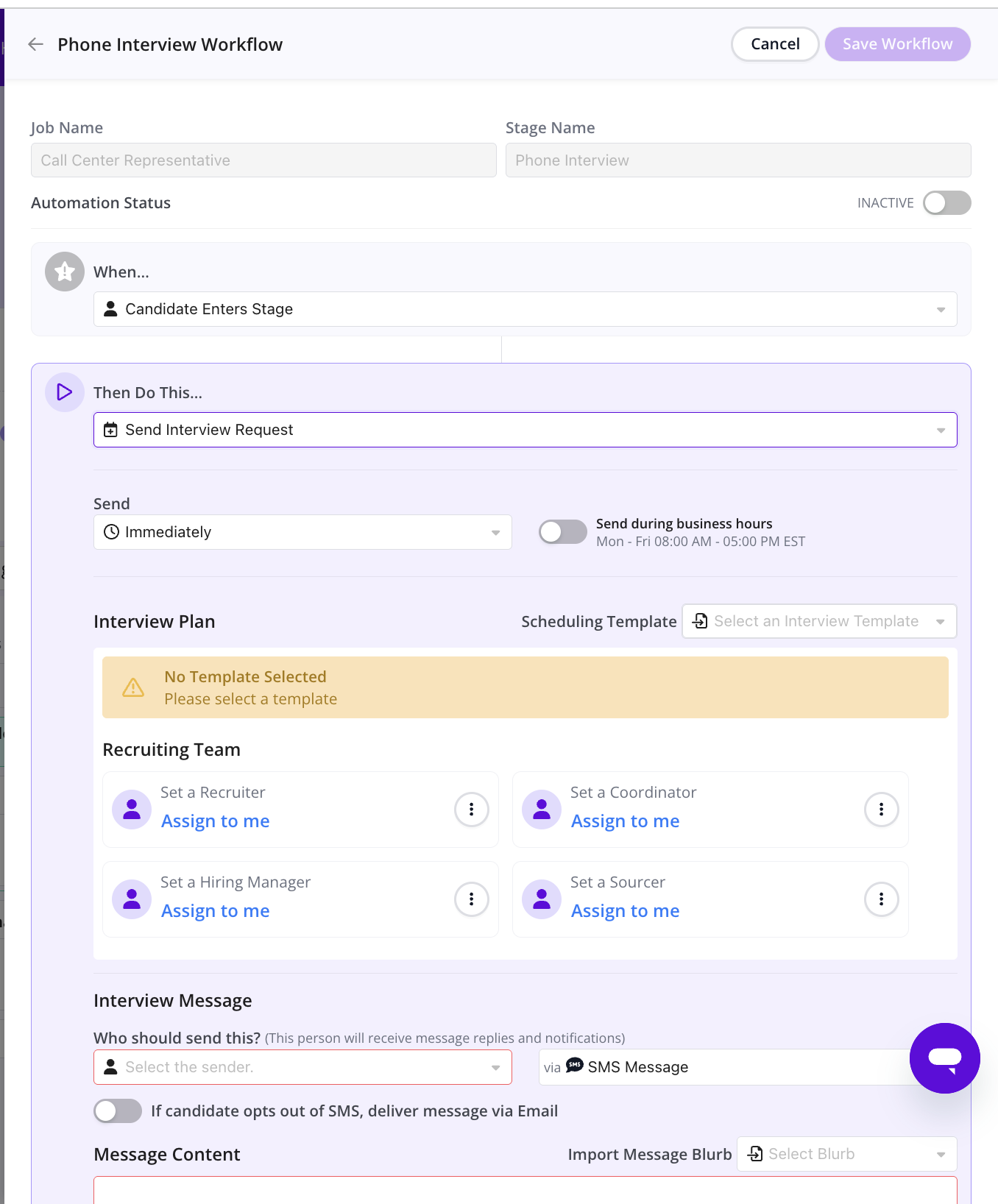
We introduced a new workflow builder with conditional logic and escalation handling, enabling teams to automate complex hiring processes while maintaining visibility, safety, and control.

Why this is awesome: Powerful automation that scale to thousands of candidates.

Orchestra Agent

We launched the Orchestra AI Agent to review applications, prioritize candidates with matching skills, and answer candidate FAQs, embedding consistent intelligence directly into high-volume recruiting workflows.

Why this is awesome: Faster decisions with consistent signals.

Interviewer Training

Interview training evolved with reading classes, on-the-fly enrollment, training KPIs, and feedback loops that connect interviewer readiness directly to interview execution.

Why this is awesome: Better interviews, less manual follow up and coaching.

Insights & Reporting

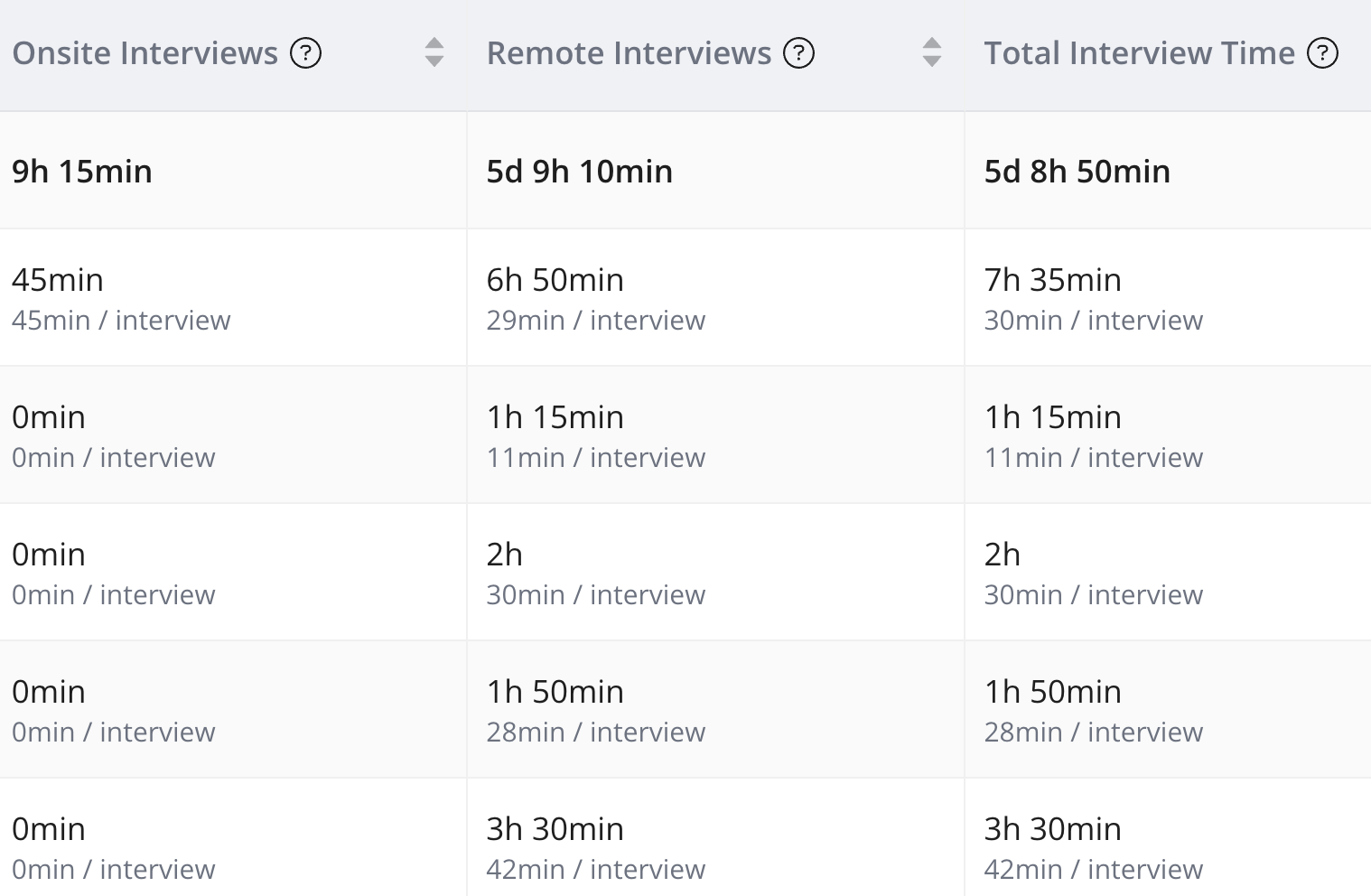
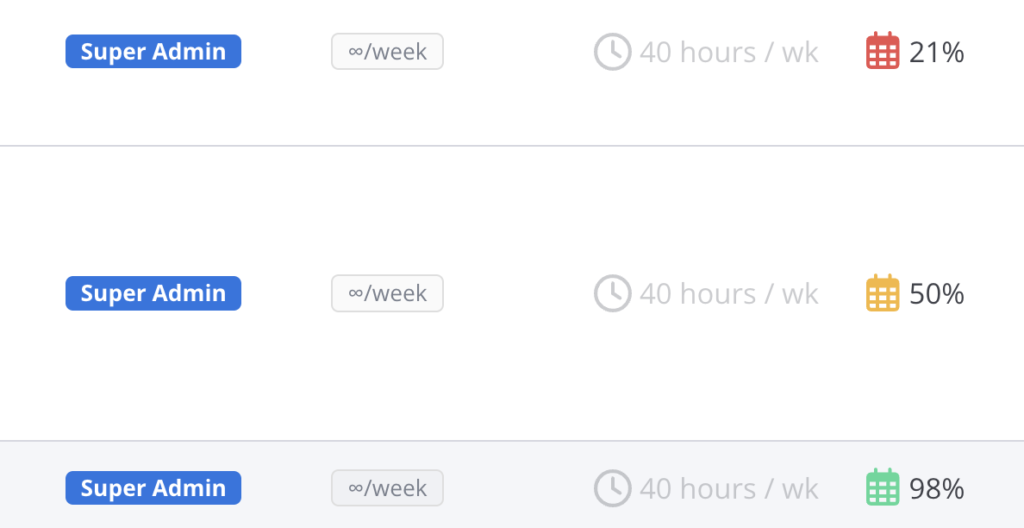
We expanded insights with Interview Time, Load Balance, Capacity Planning, cNPS benchmarking, and Bias Audit reports to give teams actionable, decision-grade visibility.

Why this is awesome: Clear visibility into what slows hiring

Orchestra Agent

Throughout the year, Orchestra Agent will mature from an intern level assistant to a capable member of your team to help automate repetitive tasks and eventually manage complex scenarios with minimum oversight.

Why this is awesome: Directly addresses the growing workload demands and shrinking resources of modern talent teams

Enterprise Essentials

Enterprise Essentials strengthen GoodTime’s foundation with secure access, reliable integrations, and consistent core systems that large organizations depend on at scale.

Why this is awesome: Enterprise reliability, security, and compliance without operational overhead.

Interview Intelligence

Interview Intelligence records, transcribes, and structures interviews so insights improve consistency, reduce bias, save recruiter time, and flow directly into GoodTime’s automation and workflows.

Why this is awesome: Better decisions, less busywork, no extra tools

Start using the latest GoodTime features!

We want to help you evolve and take full advantage of the latest upgrades and improvements to our platform. Check out the GoodTime support center for tutorials and tips to help you stress less and get more done!

The 5 Best Interview Scheduling Software in 2026

In today’s competitive hiring landscape, interview scheduling tools have become essential for keeping recruiting teams fast, efficient, and candidate-centric. Whether you’re a small business managing a handful of roles or a global enterprise coordinating thousands of interviews a month, choosing the right platform can make or break your hiring process.

Here’s a look at the top five interview scheduling platforms leading the way in 2026 — and how they compare.

1. GoodTime — the leader in complex interview scheduling automation

What it does:
GoodTime is the market leader in automating even the most complex interview scheduling workflows. From multi-day panels to global coordination across time zones, GoodTime handles it all — seamlessly syncing people, calendars, and data to keep hiring fast, human, and efficient.

Unique advantages:
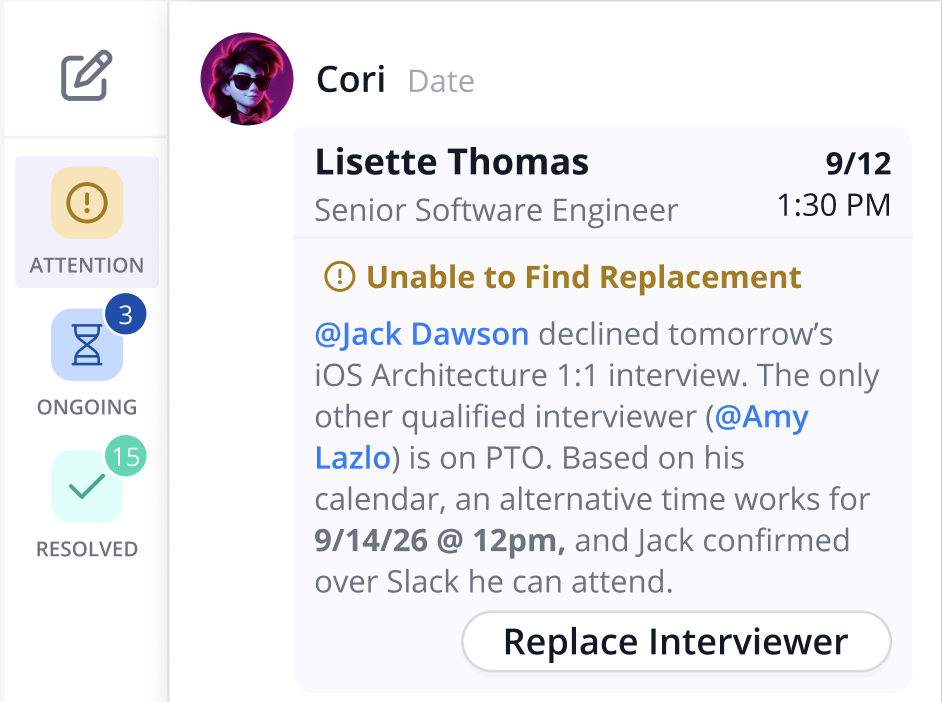
Powered by GoodTime’s digital workforce of AI agents, the platform goes far beyond simple booking links. These intelligent agents proactively coordinate interviews, auto-replace interviewers as needed, detect bottlenecks, and surface real-time recommendations. Every action is transparent and configurable, giving recruiters full control while cutting scheduling time by up to 90%.

GoodTime is also proven to drive ROI in enterprise hiring, boasting the “Best Estimated ROI” according to G2, and with an established customer list that includes Databricks, Aon, HubSpot, and HelloFresh.

Best for:
Enterprise talent acquisition teams managing complex or high-volume hiring across multiple departments or regions.

Best interview scheduling for complexity: GoodTime

Pros:

  • Automates even multi-day and panel interviews
  • AI agents act autonomously to fix issues before they cause delays
  • Seamless integration with major ATSs (Workday, Greenhouse, Lever, and more)
  • Built for both corporate and high-volume hiring
  • Enterprise-grade security, including ISO/IEC 42001,  world’s first international standard for Artificial Intelligence Management Systems (AIMS)

Cons:

  • More feature-rich (and priced accordingly) than lightweight SMB tools
  • May be more advanced than small teams need

2. Zoho Recruit — for SMBs that want basic scheduling inside an ATS

What it does: An all-in-one ATS with built-in interview scheduling, candidate tracking, and job distribution — convenient for small to midsize teams that prefer a single vendor.

Unique advantages:

Its simplicity and strong integration with other Zoho tools make it ideal for growing teams that need a straightforward system without the overhead of enterprise-scale automation.

  • Part of the Zoho suite — handy if you already use Zoho apps
  • Simple self-scheduling for straightforward, simple interviews

Best for: 

Small businesses or early-stage teams running mostly 1:1 or simple panel interviews.

Pros

  • Affordable, consolidated toolset
  • Easy setup and day-to-day use

Cons 

  • Scheduling features are better for simple flows than complex, multi-day loops
  • Automation and insights are lighter by design

3. Breezy HR — for small startups that prioritize ease and speed

What it does: A user-friendly ATS with interview scheduling, Kanban pipelines, and collaboration tools that help lean teams move quickly. It supports basic self-scheduling links and calendar integrations through Google and Outlook.

Unique advantages:

Breezy’s drag-and-drop pipelines and interview scorecards make it great for teams that want a visually collaborative hiring process.

  • Intuitive candidate pipelines with quick scheduling actions
  • Self-service links work well for common scenarios

Best for: 

Startups and SMBs that prioritize simplicity over deep scheduling automation.

Pros

  • Fast to learn and run
  • Solid basics for coordinating 1:1s and small panels

Cons

  • Lacks advanced automation and analytics
  • Limited for high-volume or global scheduling

4. Interviewer.AI — for teams that want screening + basic scheduling

What it does: Combines AI-assisted screening and video assessments with basic interview booking — useful for triage before interviews begin.

Unique advantages:

It’s designed for companies that want to save recruiter time by automating early-stage candidate assessments.

  • Automated candidate screening and structured video responses
  • Time savings up front for high applicant volumes

Best for: 

Small teams that need help narrowing the funnel, then booking straightforward interviews.

Pros

  • Accelerates first-round screening
  • Streamlines handoff into initial interviews

Cons 

  • Scheduling features are basic
  • Less suitable for complex or multi-day interview coordination

5. Doodle — best for ad-hoc, lightweight coordination

What it does: A classic and somewhat free meeting-polling and booking tool that makes it easy to find a time with individuals or small groups.

Unique advantages:

Its simple interface and low cost make it perfect for organizations with minimal hiring volume that need a quick, no-frills scheduling solution.

  • Extremely simple for ad-hoc availability collection
  • Works well outside a hiring context for general meetings

Best for: 

Freelancers, consultants, or very small businesses managing a handful of interviews.

Pros

  • Familiar, quick, and inexpensive
  • Great for one-off time finding

Cons 

  • Not tailored to recruiting workflows or ATS ecosystems
  • Lacks automation for complex interview orchestration

Why GoodTime leads in interview scheduling

If you hire at scale, complexity is where time is lost — and candidate experience suffers. GoodTime leads by fully automating complex scheduling while keeping people in control, and by backing talent teams with proactive AI agents that keep interviews moving — from first touch to final loop. That’s why enterprise TA teams choose it when simpler tools can’t keep up.

The 7 Talent Acquisition Trends You Can’t Ignore in 2026

In 2026, hiring is about so much more than filling open roles—it’s about creating the exceptional hiring experiences that continuously grow a world-class workforce. 

We surveyed over 500 TA, HR, and recruitment leaders to get the real scoop on what’s working and what’s not. You can find all of our findings and the experts’ advice in the 2026 Hiring Insights Report, but in case you’re short on time, I’ve got the seven of 2026’s talent acquisition trends that you can’t miss if you want to hit hiring goals in the coming year.

Unlock 2026’s top hiring strategies: Insights from 500+ TA leaders

Be the first to uncover deep hiring insights specific to your sector — straight from the highest-performing TA teams.

2025 Hiring Trends

1. AI adoption is surging, with 93% of TA leaders planning additional technology investments in 2026

99% of talent acquisition teams use automation or AI

99% of the leaders we surveyed said their teams used some form of automation or AI in the past 12 months. And most did so with the goal of limiting ‘administrivia’, as Jonathon Wall calls it. Jonathon is the Founder of Cassillon.AI and a seasoned recruiting leader with over two decades of experience. More recently, he has focused on helping companies use automation and AI to hit their goals.

“We should be leveraging automation and AI to do those things that aren’t fun,” he tells us. “Recruiting is a very defined process and a lot of what I call ‘administrivia,’ it’s the stuff that recruiters don’t like… They kind of keep us from doing the things that really are our superpowers. We’re people people. The message I would give is to leverage all of those tools so that you can have higher-quality human interactions.”

2. Tech investment leads to higher goal achievement

For our report, we analyzed top-performing TA teams — those who hit 75% or more of their hiring goals over the last 12 months — to see what they did differently and what their focus areas are for 2026.

Top performing talent acquisition teams were more likely to upgrade hiring technology

Compared to everyone else, the highest-achieving recruitment teams were 40% more likely to focus on upgrading their hiring technology. 

Drilling into specific tech, top performers were:

  • 28% more likely to adopt automated, candidate-driven interview scheduling
  • 25% more likely to use AI-powered interview scheduling tools
  • 28% more likely to use AI-powered analytics and reporting

3. Texting candidates the right way

In 2023, nearly every company reported that their talent aquisition teams embraced text recruiting in the past year.

Talent acquisition trend: text recruitment.

And most companies (52%) are doing so through a centralized platform or text recruiting software. That’s good news because when recruiters text candidates from personal cell phones, or even from a company-provided phone, major compliance risks and process inefficiencies enter the chat.

Risks of texting candidates with a phone instead of a centralized platform:

  • Lack of visibility: You can’t see what your recruiters are communicating to candidates.
  • Non-standardization: Going off-script and outside of company systems leads to disconnected, inconsistent candidate experiences.
  • Inefficient handoff: If a recruiter has something come up or takes time off, there’s no way for someone else on the TA team to seamlessly pick up the conversation with a candidate.
  • Security and compliance risks: Personal phone use leaves organizations more vulnerable to data breaches, unauthorized access to sensitive information, and noncompliance with laws regulating unsolicited text messages.

4. The end of manual interview scheduling

As of the end of 2023, over half (51%) of companies were automating interview scheduling, contributing to the significant reduction we saw in the amount of time recruitment teams spent scheduling this year (from 42% in 2022 to 35% in 2023). 

Let’s examine this talent acquisition trend against data from our platform, GoodTime, which automates all aspects of interview scheduling, from candidate communication and availability collection to new interviewer training, performance tracking, and reporting.

GoodTime users taking advantage of the platform’s auto confirm feature achieved an average time-to-schedule of just six days in 2023, which helped them realize an up to 86% reduction in time spent scheduling and a 50% reduction in time-to-hire.

And that time savings can make a major impact on a team’s ability to achieve their goals.

TA teams that automated interview scheduling saw a 13% lift in hiring goal attainment in 2023 versus those that didn’t.

5. Talent retention becomes a shared responsibility

Talent retention broke out far and away as the top hiring challenge of 2023, cited by 34% of TA leaders. With 24% also observing a shortage of qualified candidates, the opportunity cost of replacing employees rises significantly. Not only must organizations invest more to recruit and train new hires, but they also face the added challenge of sourcing candidates who can meet the increasingly complex demands of today’s roles.

But to what extent are TA leaders actually responsible for employee retention? Manjuri Sinha, Global Director of Talent Success & DEI at OLX, thinks TA leaders absolutely share in that responsibility, as it starts with being authentic and realistic in the hiring process.

“I think selling great things about an organization just to get that hire —  those days are gone. Today, we have to be really realistic about things,” she tells us. “People would ask you questions or say, ‘We heard last year you had 15 percent layoffs.’ If that’s the case, be very honest about it.”

In addition, she says TA teams can bolster talent retention by making sure to hire the right managers, who have a major influence on the employee experience. In the current high-pressure market, she says it’s also key to prioritize candidates who can clearly demonstrate adaptability and resilience.

6. Measuring quality of hire

2024 talent acquisition metrics

The only way TA teams can know if they are hitting their goals is if they’re measuring their performance properly. We asked which recruitment metrics they’ve got their eye on in 2026.

Far and away, quality of hire was the most important, with a quarter of companies saying it’s their number one performance metric. And while surely every TA leader would say that quality of hire is important, it’s not as straightforward to measure as, say, application completion rate.

So how do you measure quality of hire? Craig Pyke, Director of Talent Acquisition at Rivian, recommends starting simple with data you already have: “You can look at attrition within the first 90 days as one indicator of quality of hire,” he shares. “And when you combine exit survey data of why that they’re leaving with the factor of them attriting within 90 days, you can really start to pinpoint if that’s a TA challenge or if that’s a challenge somewhere within the business. That’s super, super important.”

We like that Craig’s approach measures quality of hire as a function of talent retention, addressing the top challenge TA leaders pointed to in 2023. After all, the right hires will certainly stick around past their probationary period, and the wrong hires will churn and leave your team back at square one.

But what about the other metrics? Skyla Lambeth, Recruiting Operations Manager for Collective Health, laid out a simple starting point to help reveal efficiency gaps from your current data: “It’s crucial to monitor time-to-hire data. Pay close attention to pass-through rates, understanding how many candidates are required at the top of the funnel to make a job offer. Additionally, it’s vital to assess how many candidates successfully progress from the on-site stage or panel interview, especially when multiple people are involved in the interview process.”

7. Candidates are still king

One thing leaders from every sector (mostly) agreed on: The hiring landscape will become even more competitive in 2026 and candidate experience will become increasingly important.

To create a candidate experience that lands top talent in 2026, TA teams think they’ll need to focus on:

  • Quickly connecting with candidates (46%)
  • Spending more time building meaningful relationships with candidates (45%)
  • Increasing the number of candidate touchpoints in their process (42%)

And all of this needs to be done with leaner teams, with 45% anticipating challenges due to recruitment team turnover. Providing a stellar, but sustainable candidate experience requires focusing on the highest-value perks and touchpoints you can offer — the ones that will make a huge difference for candidates, but won’t wear heavily on your recruiting team’s limited resources.

“I would challenge every recruiter to apply to a job on their website and then apply to a job on their competitor’s website. Just spend the time going through and understand what your process is already and you will immediately find ways to improve your candidate experience.”

Amanda Richardson, CEO and Head of People | CoderPad

Another way to ensure you’re making the most of your team? Establishing a reliable and realistic recruiter capacity model.

Talent acquisition action items for 2025

So how do we put these talent acquisition trends into action? Of course, it will depend on the needs of your specific organization, but you can’t go wrong with a dual approach of embracing new tech and optimizing your processes. Here are three key themes to put on sticky notes:

  • Embrace automation and tech to hit more of your hiring goals. Top-performing TA teams were 40% more likely to focus on upgrading hiring technology.
  • Renew your commitment to understanding candidates — and addressing their evolving preferences and needs.
  • Take it back to basics and enforce standardized processes to support efficiency efforts as well as eliminate unconscious biases.

GoodTime Product Updates: What’s New from December 2025

December brought a powerful set of product updates designed to give talent teams deeper insight, faster coordination, and smarter automation across the interview lifecycle. From a fully revamped Interview Time Report to real-time interviewer availability and expanded workflow automation, these enhancements are all about helping teams move faster — with more clarity and control.

Whether you’re analyzing how interview time is distributed across roles and teams, nudging interviewers to respond and submit scorecards directly in Microsoft Teams, planning interviews with real-time calendar accuracy, or building sophisticated, decision-based automations that reflect how your process actually runs, these updates are built to eliminate busywork and elevate the experience for coordinators, interviewers, and candidates alike.

Let’s dive into what’s new — and why it’s awesome.

Watch the full December 2025 GoodTime product updates webinar or keep scrolling for highlights

Interview Time Report

The legacy Interview Time report has been revamped in a new format that loads wider date range with more dimensions and more information.

Why this is awesome: The number of interviews only paints part of the picture. Being able to accurately report on how much time each person or tag spends completes it. It’s also an excellent way to see how much time has been spent on various jobs or departments.

MS Teams Chat Integration

The highly popular Reminder & Chat Integration is now available for Microsoft Teams customers. This integration automates and ensures that interviewers are reminded to respond to interviews and fill out their scorecards.

Why this is awesome: This feature automates dreary coordinator tasks AND increases response & scorecard submission rates, which are both critical for high-performance hiring.

Real Time Interviewer Availability

The calendar availability for interviewers, tags & templates now updates in real time when the calendar of your interviewers are updated.

Why this is awesome: Real-time availability empowers coordinators to do more accurate planning, but also get faster results when searching for interview times or replacing interviewers.

New Automated Workflow Builder

You can now create multiple automated workflows per stage, with a cleaner, more intuitive builder that makes it easy to manage complex automation across the interview lifecycle.

Why this is awesome: Creating and managing complex automations is easier than ever!

Conditional Logic for Automated Workflows

Automations can now trigger actions based on conditional logic, like scorecard outcomes, enabling smarter decisions such as progressing candidates or canceling roundups.

Why this is awesome: This unlocks a whole new class of sophisticated, decision-based automations that mirror how your process actually operates

Start using the latest GoodTime features!

We want to help you evolve and take full advantage of the latest upgrades and improvements to our platform. Check out the GoodTime support center for tutorials and tips to help you stress less and get more done!