Hiring More Recruiting Coordinators? Buy Recruitment Tech Instead.

Picture this: you’re struggling to secure quality candidates for your team’s open reqs, and getting candidates to a “yes” takes too long. You’re contemplating hiring more recruiting coordinators to optimize your talent acquisition process— because that’s the logical fix, right? Not so fast. Consider investing in recruitment tech instead.

You can hire all the recruiting coordinators that you want, but if you’re bogged down by inefficient operations and processes, your problems are sure to persist.

Instead of funneling more employees into a broken system, get to the root of the problem and patch up the holes in your hiring process. Establishing the right recruitment tech is the solution.

Why Recruitment Tech Is a Worthwhile Investment

1. Modern-day Hiring Requires Automation

Think you can succeed in hiring without the help of automation? Think again. Automation is an absolute necessity in the fast-paced hiring landscape. The competition for quality candidates isn’t going anywhere. That means that companies must act quickly to secure the best talent. 

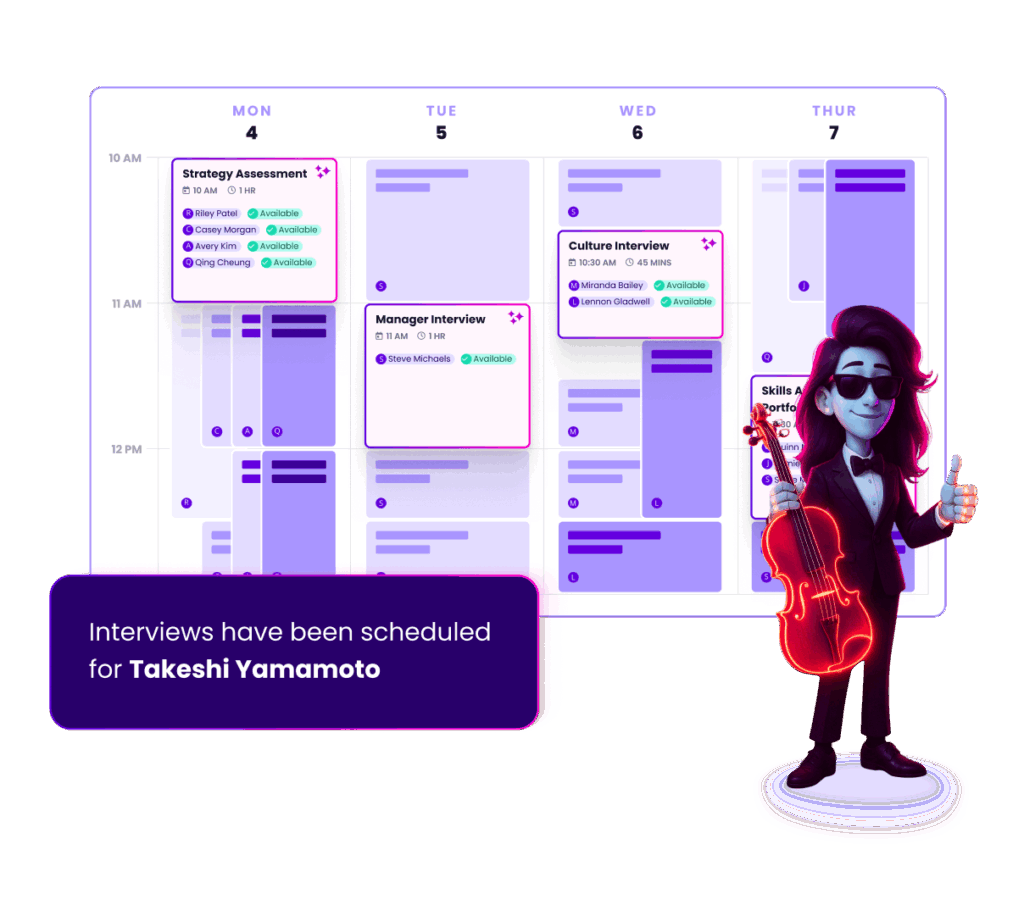
But repetitive tasks like interview scheduling can lengthen a hiring process—and cause teams to miss out on candidates. That’s why using tech to automate interview scheduling is the way to go.

Automation accelerates the time it takes to schedule, choose interviewers, and communicate with candidates. Combine all of these advantages, and you have a decreasing time-to-hire. 

Upgrade your hiring journey with AI

GoodTime’s AI agents orchestrate the entire hiring journey — screening, scheduling, messaging, and more — so talent teams hire faster with a better candidate experience.
2. Enhance Recruiting Coordinators’ Candidate Relationships 

We’re still in the middle of a candidate’s market. There are two jobs for every available worker—a number that’s in the range of historic highs. Since candidates have the upper hand, talent teams must deliver a hiring experience that exceeds expectations. 

One of the best ways to stand out from other companies is by prioritizing candidate relationships. If a candidate doesn’t feel a bond with your team and your brand, it’ll be difficult to get an offer acceptance. That’s where recruitment tech comes in. 

Tech unlocks a multitude of ways to create personal candidate relationships. From identifying the most convenient interview time for a candidate’s schedule, to adding personalization to automated messages, a tech platform’s functionalities can do wonders in enhancing your bonds.

3. Data-driven Hiring Processes Succeed

The best talent acquisition teams keep tabs on their hiring data. Without a sense of your past and present metrics, it’s difficult to effectively optimize your process and spot issues.

Data-driven recruiting is viewed as an approach to recruiting, but here’s the truth: all recruiting should be data-driven. Luckily, many talent acquisition teams already know this. Our 2022 Hiring Insights Report shows that 35% of TA professionals reference their hiring data on a weekly basis, and 32% reference their data monthly.

How are they accessing this stream of data? More likely than not, they’re leveraging their tech stack. Robust HR tech can help you keep tabs on the number of RC schedules, interviewer declines, and the time that it takes to interview for a role.

4. Free Up Bandwidth for Recruiting Coordinators

No matter the industry or company size, recruiting coordinators know the pain of manual interview scheduling. When you have your head stuck in calendars, it’s difficult to make time for high-value projects that will make real improvements to your process.

That’s the beauty of recruitment tech. It takes care of the tedious tasks—like finding calendar availability and selecting interviewers—so that RC’s can focus on what really matters. With this newfound bandwidth, recruiting coordinators can connect with candidates, dive into their data, and give DEIB initiatives a facelift. 

And No, Tech Can’t Replace Recruiting Coordinators

Don’t worry, we’re not advocating for robots to replace recruiting coordinators (that’d be a bit jarring to say the least). There are many elements that recruiting coordinators can deliver that technology can’t—like empathy and trust, which are both so important to candidates. 

Talent teams need a marriage between technology and recruiting coordinators so that they can reap the benefits of both. Without skilled RC’s, a hiring process feels robotic and impersonal. Yet without technology, tasks become tedious and a hiring process becomes inefficient.

The way forward is clear: leverage technology and equip your recruiting coordinators with the knowledge that they need to use it to its full potential. Then, watch the quality of your hiring process soar.

Amp Up Your Recruitment Tech Stack Today

Continuously increasing your talent team’s headcount isn’t a sustainable way to fix your problems. The right tech stack can enhance your process and enable a talent team of five to operate like a team of 50. So, you’re probably wondering: “Which recruitment tech is right for me?”

For starters, you need an ATS in your arsenal. The ATS that you choose depends on the needs and size of your talent team and company. If you find it difficult to decide on one, we recommend the following: Greenhouse, iCIMS, Jobvite, SmartRecruiters, Workday, and Lever. 

But while an ATS is essential, an ATS just can’t deliver on all of the features that you need for success. GoodTime Hire fills those gaps.

Hire automates coordination, improves your relationships with candidates, and provides actionable insights to continuously optimize the entire hiring process.

Learn more about how GoodTime Hire’s interview scheduling software can transform your talent acquisition process

5 Ways Talent Acquisition Teams in Tech Can Do More With Less

Have you been asked to “do more with less” recently? If you’re a talent acquisition professional in tech, it’s incredibly likely. 

Amid these tumultuous times in the tech industry and the greater economic landscape, a myriad of tech talent teams must maximize what they have. Whether this means grappling with cutbacks in budget or team resources, the pressure is on.

But with many tech companies continuing hiring in some capacity, TA teams must still deliver the high-caliber hiring experience that candidates expect…just now with less budget and/or resources.

This isn’t an impossible feat. Talent teams just need to reevaluate their current hiring operations and strategies. (And we’re here to help.)

Here are five ways talent acquisition teams can address tech’s hiring challenges and actually do more with less.

Unlock tech’s top hiring strategies in 2025

Our study of 100 tech TA leaders reveals how to hit your hiring goals in a challenging market.

1. Amp up Your Internal Mobility Strategy

We analyzed top tech hiring trends by surveying over 100 TA leaders in the industry. When asked to optimize what they have, the opportunity that too many teams overlook is considering their current employees. That’s right; we’re talking about boosting your internal mobility strategy. 

There’s a multitude of reasons you should consider current employees for new roles. For one, companies that prioritize internal hiring have a 41% longer employee tenure than those that don’t. 

Not to mention that it’s faster and cheaper to hire from within. In times of “doing more with less,” this advantage grows even more important. 

If you’re wondering exactly how to enhance your internal mobility strategy, we’ve created a handy internal mobility guide to get you started. (Hint: it starts by getting leadership on the same page, emphasizing good ole L&D, and providing managers with the support that they need.)

2. Emphasize Continuous Candidate Engagement

Typically, a candidate’s journey ends when you reject them or extend an offer. Following this talent acquisition model requires you to start from scratch every time you must fill a role. That wastes a lot of bandwidth and resources—which many talent acquisition teams in tech can’t afford to lose.

Practicing continuous candidate engagement means engaging and re-engaging candidates before, during, and after the hiring process. This creates a high-quality pool of engaged, pre-vetted candidates to consider for opportunities. 

With a loyal community of talent to pull from, you’ll be able to conserve time and money that would’ve been spent on sourcing new talent.

3. Make Hiring Analytics Your Best Friend

Do you find yourself wasting resources running in circles, trying yet failing to understand why there’s bottlenecks scattered throughout your hiring process? If so, let your hiring data guide you towards clarity.

By analyzing your hiring metrics, you can pinpoint problems and identify the appropriate solutions—and avoid investing money into a solution that you’re not even sure will be the real fix. 

If you need help getting started, our Co-founder and Head of Product recently sat down with some of our partners to discuss how to masterfully evaluate your hiring metrics.

All in all, data is truly the gift that keeps on giving. Keep a firm pulse on your analytics dashboard, and you’ll have all the answers that you need already at your fingertips.

 4. Don’t Forget About Employee Referrals

When you need to maximize your budget and resources, gathering employee referrals just makes sense. Similar to the benefits of internal hiring, employee referrals can reduce time-to-hire and costs.

Out of employers surveyed, 82% rated employee referrals above all other sources for generating the best ROI. As an added bonus, 88% of employers said that referrals generated the highest quality new hires.  

Needless to say, if you don’t have a formal employee referral program, it’s time to spin one up. An employee referral program turns every single employee at your company into a mini recruiter. What better way to make the most of what you currently have?

5. Establish the Right HR Technology

A robust HR tech stack ensures that there’s no need to hire extra recruiters. With the right technology in place, your team of five will operate like a team of 50. 

HR technology not only allows you to maximize your resources during this current industry-wide hiring downturn, but also allows you to scale later when the industry inevitably revs up again.

Does interview scheduling automation make sense for my team?

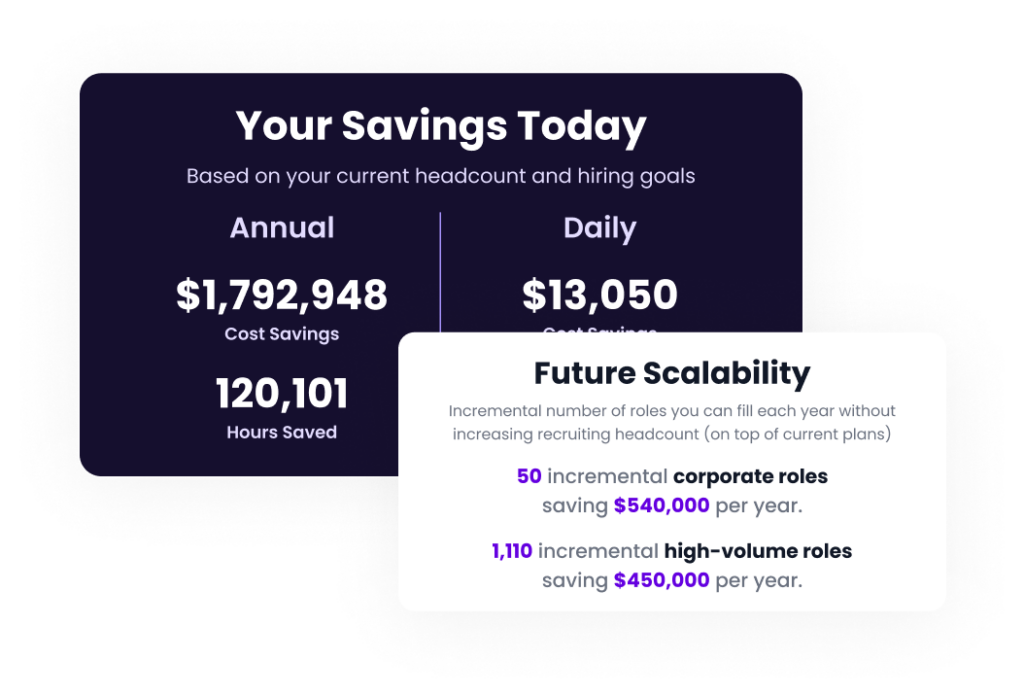
ROI is key. This is not a time to invest in software that won’t bring you immediate value. So let’s eliminate the guesswork with our free ROI calculator.

Making the case for new HR tech during budget cuts

So you’re convinced that new tech can help you solve the “do more with less” problem, but how are you supposed to acquire new software while budgets are being slashed? We spoke with Valeria Stanga, a leading Senior Talent Acquisition Partner at HelloFresh, about how teams should approach seeking new technology, and how to craft a compelling argument that will win over your finance team.

For starters, operating without an ATS is a major no-no. The ATS that you implement depends on the needs and size of your talent team and company. Can’t decide which one is right for you? We recommend the following: Greenhouse, iCIMS, Jobvite, SmartRecruiters, Workday, and Lever. 

While an ATS is undoubtedly an essential, there’s some features that an ATS just can’t deliver. GoodTime Hire fills those gaps.

Hire offers a custom-branded, seamless, fully automated interviewing experience that’s driven by those that matter most: the candidates. It automates coordination, builds genuine connections with talent, and gathers actionable data to optimize the entire process.


Schedule a demo to learn more about how Hire can transform your talent acquisition process.

Upgrade your hiring journey with AI

GoodTime’s AI agents orchestrate the entire hiring journey — screening, scheduling, messaging, and more — so talent teams hire faster with a better candidate experience.

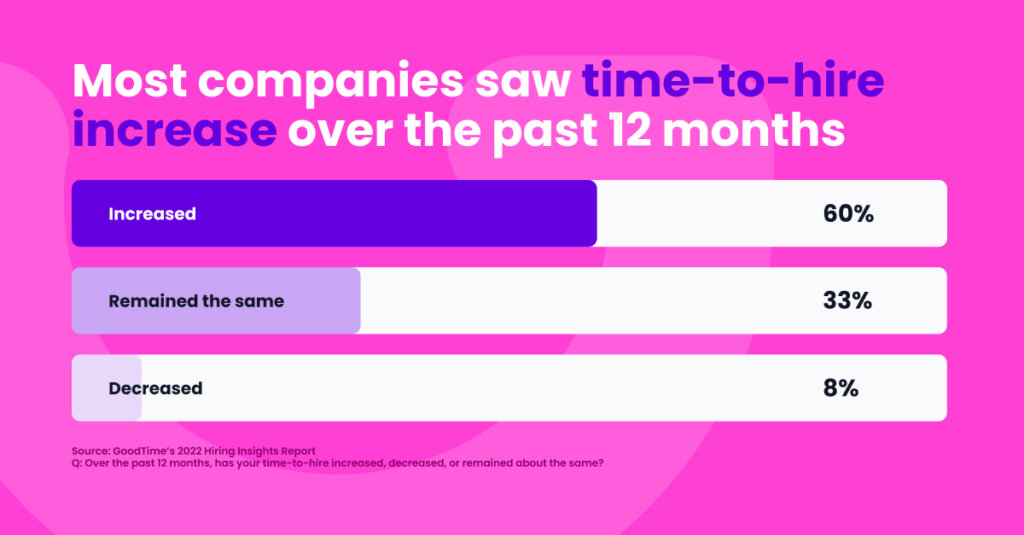
60% Of Companies Say Their Time-to-Hire Increased. Here’s Why.

Seeing time-to-hire decrease warms the heart of every talent acquisition professional out there. Sadly, our data shows that few TA teams experienced this joy in the past year.

Our 2022 Hiring Insights Report surveyed 560 HR and talent decision makers to understand the most pressing challenges facing their teams, and what should be done to reel in top candidates.

Out of the companies surveyed, 60% said their time-to-hire increased in 2021. If alarms aren’t going off inside your head, they should be.

Even within less competitive hiring markets, time-to-hire is a critical KPI. The competition for the best candidates will stay consistent, no matter the current hiring volume. This makes maintaining hiring efficiency crucial.

So, why have talent teams seen their time-to-hire skyrocket? Let’s dive into the data and examine how teams can attain success.

Burdened by Interview Scheduling

HR teams from our report spend more than one-third (37.3%) of their total work hours scheduling interviews. It’s no wonder that companies saw their time-to-hire rise; a time-consuming scheduling process deals a major blow to hiring efficiency. 

This statistic was consistent regardless of company size. The smallest companies (50-100 employees) spent 33.5% of their time scheduling interviews, and the largest companies (1,001-5,000 employees) spent 35.1% of their time doing so.

How To Fix This

Recruiting coordinators in companies of all shapes and sizes know the pain of manual interview scheduling. When you have your head stuck in calendars, you can expect an influx of hiring delays and bottlenecks.

Automating your interview scheduling logistics is the way forward. You’ll fill roles at the speed of light and no longer lose precious time to juggling schedules and drafting emails.

Does interview scheduling automation make sense for my team?

ROI is key. This is not a time to invest in software that won’t bring you immediate value. So let’s eliminate the guesswork with our free ROI calculator.

Mismanaged Connections With Candidates

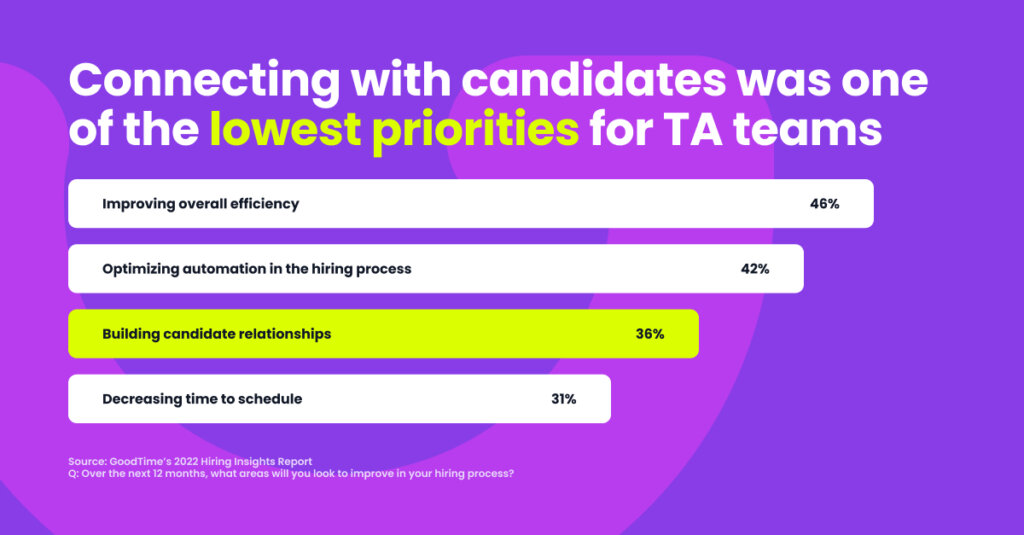
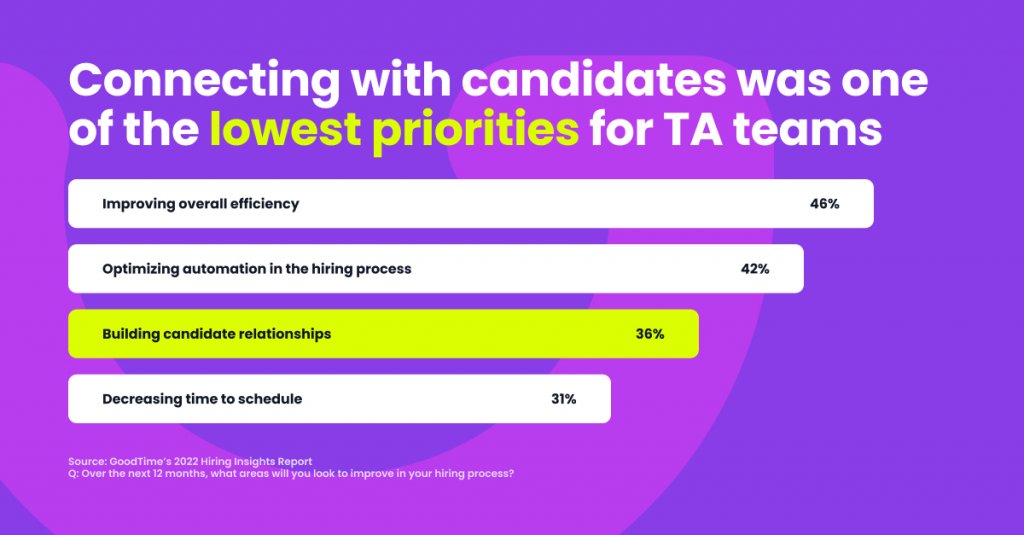
Even though 46% of respondents agreed that creating relationships with candidates has become more important than ever, just 36% looked to build better relationships in the past year.

When you neglect your relationships with candidates, the holistic quality of your hiring process goes downhill—and that includes your time-to-hire. 

If a candidate doesn’t feel a notable bond with your talent team, it’ll be much harder to get them to a “yes” in a timely manner when you extend an offer. You can say bye-bye to any chance of shortening your time-to-hire.

How To Fix This

Healthy candidate relationships consist of four key pillars. Check off these pillars, and you have yourself some quality connections.

  1. Genuine Connection: Candidates want to know if they align with a company’s mission, culture, and DEIB beliefs. To understand an employer’s stance on those elements, candidates want to build a genuine connection with them.
  2. Transparency: Candidates want a transparent hiring process. They won’t tolerate ghosting, that’s for sure. Candidates want open and frequent communication from employers.
  3. Adaptability: Your hiring process must adapt to the needs of your candidates. They want to schedule interviews at times that best fit their schedule, as opposed to sitting through an inconvenient all-day interview. 
  4. Candidate Well-being: On the topic of well-being, candidates want to gain an understanding for where companies stand on mental health support and any other related benefits.

Inefficient Recruitment Data Collection

The best talent acquisition teams are fiercely data-driven. Digging into your hiring process’s data allows you to identify potential blockages that are lengthening your time-to-hire. 

However, problems arise when you don’t have a firm pulse on your analytics. If you go too long without examining your data, you can’t stop bottlenecks before they arise.

The good news is that most of the teams from our report check their analytics frequently. Thirty-five percent utilize their hiring data on a weekly basis. But this wasn’t the case for all  respondents. Seventeen percent use their data quarterly and 7% consult their data yearly. 

How To Fix This

The 35% of companies that leverage their recruitment data every week are on the right track. There’s always something to learn from your metrics. The more often you reference them, the more optimized your hiring process will be. 

If you’re stuck on how exactly to evaluate your hiring data to boost critical KPIs like time-to-hire, we’ve put together a handy guide for you.

Want the Latest Insights? Read the 2023 Hiring Insights Report

History doesn’t have to repeat itself. Talent teams might’ve struggled with their time-to-hire in the past year, but there’s several surefire ways for them to decrease it in the months to come.

Automating interview scheduling, improving candidate relationships, and zeroing in on hiring analytics is the way forward. 

Want to catch up on the latest hiring trends? Get excited: our 2023 Hiring Insights Report is now available. 500+ HR leaders, 1,000s of real findings, 1 industry-leading report. Read the report today.

13 HR Thought Leaders You Need To Follow on LinkedIn

Let’s give our HR thought leaders a round of applause. Amid the ever-evolving nature of the HR industry, they arm us with the knowledge that’s needed to stay ahead of the curve.

From recruitment tactics, to company culture, to DE&I, these 13 HR thought leaders provide invaluable insights into the landscape. Check them out; they’re definitely worth a LinkedIn follow. 

1. Jason Averbook

As a trail-blazing analyst, thought leader, and consultant, Jason Averbook has made a name for himself in the world of human resources. This seasoned leader has more than 25 years of experience in the HR and technology industries. His ultimate goal: help organizations unlock the full value of their workforce.

As the CEO and Co-founder of Leapgen—a digital transformation company—Jason has assisted countless organizations in creating a digital workforce experience with significant business outcomes.

2. Mawulom Nenonene 

Mawulom Nenonene’s expertise comes from his background as a recruiter, startup advisor, and belonging advocate. He’s a talent professional with experience in building inclusive, diverse teams and effective hiring processes.

Mawulom is an advisor for Point, Virtuosity Partners, and Build to Last. In the past, he’s lent his thought leadership to us at GoodTime in a webinar about creating a winning hiring strategy founded on diversity (it’s a good one—check it out).

3. Elaine Orler

For over 25 years, Elaine Orler has designed and executed talent acquisition and recruiting solutions. She’s helped organizations optimize complex talent acquisition strategies with her technology-driven recruitment practices. 

Elaine is the Managing Director of Consulting at Cielo Talent, a leading talent acquisition partner. She’s also the Co-founder of TalVista, a company with the goal of creating a diverse and inclusive workforce by increasing candidate pool diversity and decreasing unconscious bias.

4. Hung Lee

Hung Lee is the Editor of Recruiting Brainfood, a leading newsletter in the recruiting field. Between the newsletter and The Recruiting Brainfood Podcast, he’s made over 160 episodes and 300 newsletter issues on the talent industry. Recruiting Brainfood covers recruiting and HR-related topics such as culture, the future of work, and tech hiring.

 Throughout his more than 15 years of experience in the recruitment industry, he’s brought his expertise to a variety of positions, from serving as an agency recruiter to a recruitment trainer. 

5. William Tincup 

William Tincup has studied all things HR and talent acquisition for over 20 years. He’s the President and Editor of RecruitingDaily, an industry-leading media resource for the recruitment world. William acts as a spokesman for RecruitingDaily, sharing his thought leadership at conferences and webinars.

He’s also no stranger to the HR podcast world. In fact, he has three different ones: The RecruitingDaily Podcast, The Use Case Podcast, and The William Tincup Experience. 

6. Madeline Laurano

Madeline Laurano is the founder of Aptitude Research, a human capital management (HCM) research and advisory firm. Aptitude provides a rich library of HCM research, helping HR leaders understand the HCM technology landscape.

Madeline’s research allows HR leaders to cultivate an acute understanding of talent acquisition and engagement. Her work with HR technology helps organizations optimize and refine the ways they attract talent.

7. Lars Schmidt

Lars Schmidt founded Amplify back in 2013. Amplify is a boutique agency, HR leader development platform, and community all rolled into one. In short, Amplify helps business and HR leaders navigate the new world of work through HR executive search and continuous learning.

His mission is to supercharge innovation in HR. Lars is also a contributing writer at Fast Company, as well as an author of the best-selling book, “Redefining HR.”

8. Debbie McGrath 

As the founder of HR.com, Debbie McGrath has made a big name for herself as one of our HR thought leaders. HR.com is the largest global social networking and resource site for HR professionals. It’s the destination for over 1 million people in HR.

HR.com engages HR executives through collaboration, training, certifications, community, and best practices. The website maximizes the potential of HR professionals by holding over 4,000 webcasts and 80 virtual events.

9. George LaRocque

George LaRocque is the founder of WorkTech. In a nutshell, WorkTech helps cultivate understanding between HR leaders that use HR technology and HR tech providers. WorkTech accomplishes this by offering advisory services focused on tech strategy, and by developing reports and content rich in research.

He’s the host of the HR Market Watch Podcast on the HR Happy Hour Network, where he explores the latest and greatest trends in HR. Not only that, but he’s also an excellent interviewer; you can check out George’s interview with our Co-founder, Ahryun Moon, right here.

Does interview scheduling automation make sense for my team?

ROI is key. This is not a time to invest in software that won’t bring you immediate value. So let’s eliminate the guesswork with our free ROI calculator.

10. Yvette Cameron

HCM tech executive, tech founder, and board advisor. That’s Yvette Cameron. Yvette is the current SVP of Global HCM Product Strategy at Oracle. She’s also the Co-founder and Board Advisor of Velocity Career Labs, an organization determined to reinvent the way career records are shared.

On top of that, Yvette is an international keynote speaker on innovations in HCM technology and the future of work. 

11. Ed Newman

In his over 25 years of experience in the talent acquisition and management industry, Ed Newman has worked in a variety of roles. From serving as a human resources practitioner, manager, executive, consultant, entrepreneur, and chief executive, he’s done it all.

He’s the Founder and CEO of talentEXP, a specialized consulting firm focused on helping corporations reach their goals with talent experience initiatives.

12. Jeanne Achille 

Jeanne Achille has played an instrumental role in launching and promoting many new tech products, services, and companies. Back in 1994, she founded Devon, one of the longest-standing independent tech PR firms. The firm’s practice areas include HR technology, big data and analytics, cybersecurity, and fintech.

In her career as one of our HR thought leaders, Jeanne has also chaired the Select HR Tech Conference and the Women in HR Tech Summit.

13. Jennifer Benz 

Jennifer Benz is an HR and benefits communications leader, speaker, and advisor. At Segal Benz, she’s the current SVP and Communications Leader. In this venture, Jennifer helps organizations engage their workforce and drive meaningful business results through effective communication.

She’s also a notable voice in the employee benefits industry. You can find her quotes in the Wall Street Journal, CNBC, and HR Magazine. 

Leverage the HR Tech You Need to Succeed

In the fast-paced, ever-changing talent acquisition industry, it pays to have the right tech by your side. If you want to smash your goals, you need GoodTime Hire.

Hire automates coordination, improves your relationships with candidates, and provides actionable insights to continuously optimize the entire hiring process.


Learn more about how GoodTime Hire’s interview scheduling software can supercharge your talent acquisition team to win top talent.

Don’t Hire With Your Gut: Here’s How to Reduce Interviewer Bias

Facts are facts: all of us have biases. Not every bias is harmful, yet some certainly are. The true harm arises when people neglect to recognize their negative bias. This becomes especially problematic when the bias in question is interviewer bias.

Interviewers make nearly 5% of hiring decisions within the very first minute of an interview. They make 25% of decisions within the first five minutes. When interviewers make snap decisions like this, they often chalk it up to a “gut instinct.” Yet more often than not, this “instinct” is really just unconscious bias in disguise.

An interviewer’s unconscious bias prompts them to make decisions in favor of one person or group while leaving others at a disadvantage. When left unchecked, unconscious bias not only degrades the authenticity of your hiring process, but also the diversity of your company.

Less diversity means bad news all around. Diverse companies enjoy 2.3 times higher cash flow for every employee. Most importantly, a diverse company culture contributes to a welcoming and innovative workplace.

If you want to chip away at your own interviewer bias, the first step is recognizing what bias you might have. Here are four of the most common types of interviewer bias—and how you can reduce them.

1. The Contrast Effect

What Is It?

The contrast effect takes away your sense of objectivity and makes you pit candidates against each other based on non-meritorious factors. Comparing candidates muddles your ability to see them for their true nature. 

Example

Let’s say that you have back-to-back interviews lined up. You decide that the easiest way to evaluate the candidates is to rank them against one another.

The first candidate that you interview doesn’t perform too well, to say the least. You measure the rest of the interviews against the first candidate’s performance. Suddenly, all of the other interviews seem a lot better than they actually are.

How To Reduce This Bias

Three words: assess candidates individually. Compare candidates against the job description, not against each other. You might find it helpful to imagine that each candidate that you interview is the first candidate that you’ve spoken to. This way, you’ll listen to them with fresh ears.

Another effective technique is to standardize your evaluation of the candidates throughout the hiring process. Assess candidates based on concrete factors, such as skills and experience. 

Looking for tips on how to standardize? Jenny Jongejan, a deeply experienced recruiting consultant, shares her four-step framework for a standardized recruitment process in the clip below. She also shares why standardization is key in recruitment and how it drives better hires.

2. Confirmation Bias 

What Is It?

Possibly the most widespread type of interviewer bias out there, confirmation bias is the tendency to look for information that lines up with your pre-existing beliefs. Confirmation bias leads you to ask questions that would confirm your existing ideas about a candidate, whether positive or negative.

Example

This bias is highly evident in conversations about candidate “red flags.” This is when an interviewer has a preconceived notion that a person with a specific attribute is undesirable based on previous interactions with people who have the trait. 

Driven by a desire to sniff out their red flags, the interviewer aims to prove their suspicions by looking for negative attributes while ignoring the positive ones.

How To Reduce This Bias

Interviews are no place for preconceived judgment. To reduce your confirmation bias, rely on interview questions that gauge skills and traits that are relevant to the role. This forces you to evaluate candidates on predetermined questions that are pertinent to their success at your company.

But don’t just use interviews to form your judgments. Consider their resume and hiring assessments when crafting your opinion.

3. The Halo Effect

What Is It?

You could define the halo effect as the starting point of confirmation bias. It represents the positive feeling that you have about a certain candidate based on your overall impression.

If you’re projecting the halo effect, then seeing one particularly impressive trait in a candidate defines your entire impression of them. Suddenly, you forget all about their negative attributes, clouded by their positive element. 

Example

Perhaps you’re in awe whenever you interview a candidate with an Ivy League background. However, an education received at a prestigious university doesn’t necessarily mean that a candidate is the right fit for a role, right?

How To Reduce This Bias

For every candidate that makes it into the interviewing stage, make sure that several people from diverse backgrounds get to speak with them. Incorporating multiple perspectives—specifically multiple differing perspectives—is the key to reducing this interviewer bias.

4. The Horn Effect

What Is It?

The horn effect is the halo effect’s not-so-starry-eyed sibling. While the halo effect is all about having an overly positive impression of a candidate, the horn effect is when you just can’t shake that negative feeling.

Example

We’ve all heard stories that encapsulate the horn effect. Perhaps an interviewer passed on a candidate because they spilled tea on their suit. Or, maybe their suit wasn’t “nice looking” to begin with. One small negative aspect surfaces, and suddenly the candidate has no chance to impress at all.

How To Reduce This Bias

Watch any of the popular talent shows on TV, and you’ll see a contestant come into an audition and fail miserably. The judges will shake their heads in unison, but one will see a spark in the contestant and give them an opportunity to come back again. Then, they amaze everyone with their ability.

Give each candidate a chance to shine, regardless of a singular flaw. That flaw may not be the red flag that you think it is. No one is perfect, right?

Reduce Interviewer Bias With Advanced Interviewer Training

The best way to reduce all kinds of bias—and increase offer acceptance rates in the process—is to implement interviewer training. When interviewers receive proper training, they’re able to make fair hiring decisions.

GoodTime Hire elevates your team’s interviewing skills with interviewer training paths that broaden your pool of interviewers and reduce each person’s load.


Schedule a demo to learn more about how Hire can transform your talent acquisition process.

Internal Mobility: Your Secret Weapon During a Hiring Slowdown

“Do more with less.” You’re sure to hear this phrase whenever uncertain economic conditions arise. Amid the current economic and hiring downturn, there’s a growing pressure in the talent community to maximize resources. However, the one opportunity that far too many talent teams brush aside is optimizing internal mobility.

The majority of employers (38%) say that they don’t market job opportunities to their own employees. It’s time to change that. Internal recruiting leverages existing talent to mold your hiring team into an agile unit, able to withstand anything that the landscape throws at them. It’s the epitome of “doing more with less.”

Better yet, with the lower cost of internal candidates, hiring from within allows you to fill crucial talent gaps when economic conditions make external recruiting less feasible. 

Here are six ways to enhance your internal mobility strategy and stay afloat while recruiting in a potential recession.

1. Get Leadership on Board

Uplifting internal mobility is an undertaking that talent acquisition can’t do alone. Getting firm buy-in from leadership is crucial to an internal mobility strategy’s success. This buy-in allows for a culture of mobility to truly flourish throughout an organization.

When presenting this strategy to leadership, remember that leadership speaks in dollar signs and metrics. Ensure that you’re armed with solid statistics on why hiring internal candidates is a smart move for the company’s bottom line—especially considering current economic and hiring conditions.

Once you secure their endorsement, it’s time for leadership to lay the groundwork for your new mobility culture. They should inform employees that they are welcome to search for new career opportunities internally, and encourage managers to vocalize this same sentiment to their direct reports. 

2. Emphasize Learning and Development

Don’t expect for employees to apply to internal positions right out the gate. You need to do a bit of extra work to prepare employees for potential internal moves, and that means uplifting learning and development (L&D).

Making L&D accessible to employees allows them to gain the training and skills that are needed for specific internal roles that they desire. L&D can take a wide variety of forms, but mentorships and job shadowing are both great ways to prepare employees for any role changes.

3. Support Your Organization’s Managers

Seventy percent of talent acquisition professionals say that the biggest obstacle to internal recruiting is a manager who doesn’t want to let go of talent. We get it; it’s logical to not want to lose your best employees. 

However, an employee switching roles shouldn’t be viewed as a loss for a manager, but a win for a company. It’s crucial to educate managers on the value of internal mobility, such as improved cross-department collaboration and higher retention. 

Not all managers are resistant to internal mobility; some managers simply don’t know how to contribute to such an initiative. That’s why managers need sufficient support and training so that they know how to uplift their direct reports and prepare them for career changes.

4. Help Define Career Paths for Employees

So, you have employees who are interested in making internal moves, but they’re not sure which options are available to them—or how to move internally to begin with. That’s where the importance of defining career paths comes in.

Fostering transparency surrounding career paths makes internal mobility all the more accessible. To kick-start the process of defining career paths, empower managers to work alongside their direct reports and carve out custom paths and goals.

5. Shed Light on Lateral Mobility

A common misconception of internal mobility is that it always means climbing up the career ladder. However, that’s just not the case. Internal mobility encompasses both vertical and lateral moves. It’s important to clarify career opportunities for both.

Lateral mobility is commonly referred to as “role-to-role mobility,” where an employee moves to a new internal position with little (if any) changes to their compensation or career level. 

There’s just as much value in lateral mobility as there is in vertical mobility. Encouraging lateral moves enhances collaboration across departments and keeps employees continuously engaged in your organization’s opportunities.

6. Elevate Internal Mobility With Tech

No matter if you’re hiring internally or externally, candidates should experience an efficient and meaningful hiring process. The best way to live up to a candidate’s expectations and deliver a noteworthy hiring experience is by enlisting the help of your tech stack. Ever heard of GoodTime Hire?

Hire harnesses Candidate Relationship Intelligence to automate coordination, build relationships during interviews, and provide actionable insights to continuously improve your connections with candidates.


Schedule a demo to learn more about how Hire can transform your talent acquisition process.

5 Easy Ways Recruiters Can Improve Candidate Well-Being

Let’s cut to the chase: many hiring teams struggle to prioritize candidate well-being (and we have the data to back this up).

Even though teams recognize the importance of employee well-being, most neglect to focus on the well-being of future employees—AKA, candidates. Our Hiring Insights Report makes this fact as clear as day. 

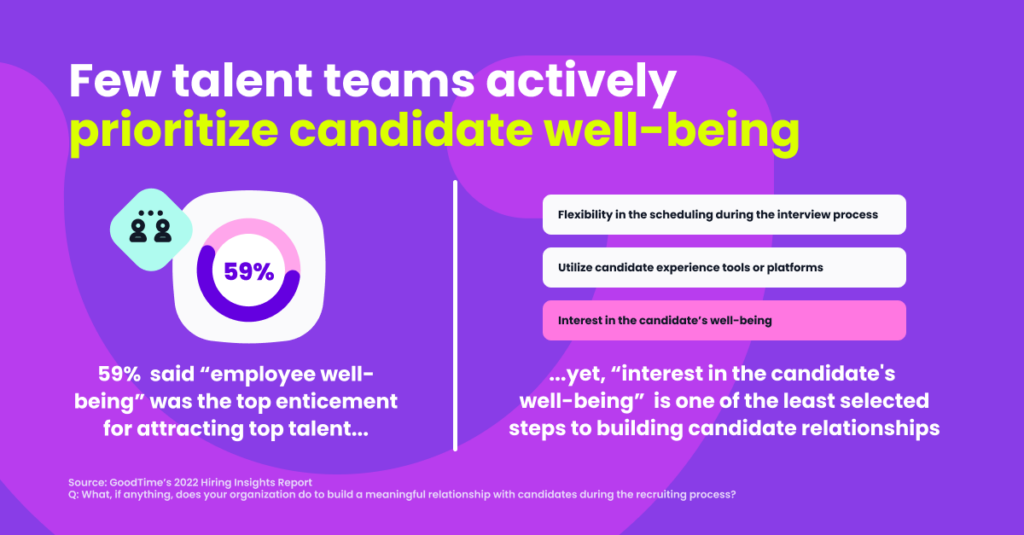
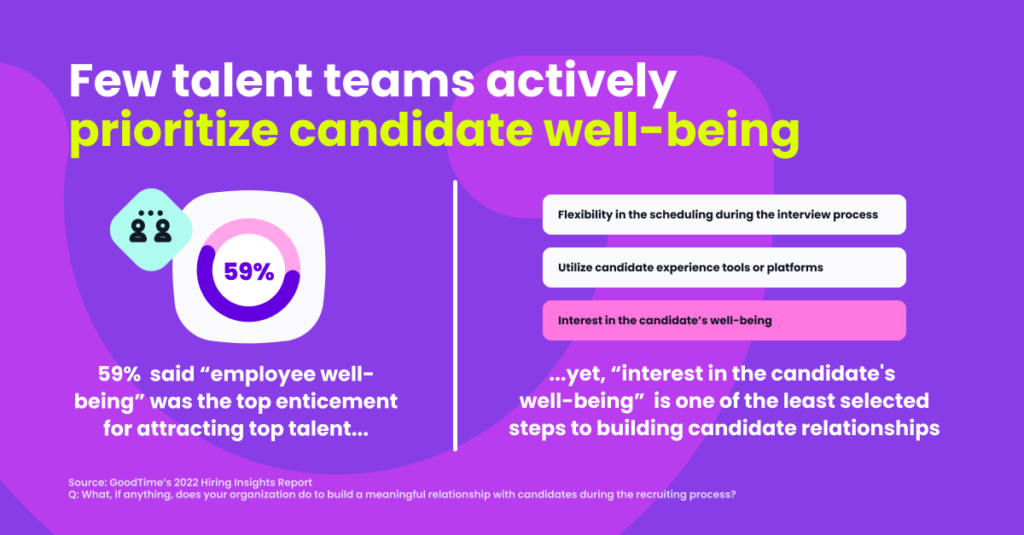
Fifty-nine percent of HR and talent leaders from our report consider “employee well-being” to be the top enticement for attracting candidates. However, when asked what they do to build relationships with candidates during the recruiting process, “interest in candidate’s well-being” came in as the third least selected response.

The way that candidates are treated in the hiring process alludes to how they’d be treated as employees. If a hiring team tells talent that they support their employees’ well-being, yet they don’t show the same support to candidates, then candidates likely won’t believe them.

Actions speak louder than words. It’s cliché, but oh so true. So, to help recruiters actively improve candidate well-being, we’ve put together this handy list of ways to make the well-being of candidates a top priority.

1. Never Leave a Candidate Hanging

Sometimes candidates ghost recruiters, and other times recruiters ghost candidates. We get it; getting caught up in balancing schedules and chasing down interviewers can cause things to slip through the cracks.

But still, you have to maintain consistent communication with candidates. Interviewing can be a high-stress ordeal for candidates, and dropping contact with them out of nowhere can kick their stress into overdrive. And yes, you guessed it; ghosting candidates significantly hinders their well-being.

If locking down interviewers to set up a second interview takes you longer than expected, give candidates a quick status update to show that you haven’t forgotten about them. Not only will this prove that you value their time, but it’ll also dissuade them from brushing your company aside and looking for opportunities elsewhere.

2. Remember: DE&I Is Part of Candidate Well-being

Promoting candidate well-being means uplifting it for all candidates, and that means candidates from underrepresented groups. A hiring team isn’t truly considering the well-being of diverse candidates if their commitment to DE&I is last in line.

Proving your commitment to DE&I doesn’t have to mean enacting time-consuming, costly initiatives. It can be as simple as ensuring that diverse individuals make up your interview panels. If a candidate sees themselves represented in an interview panel, they’re more likely to feel that they’d be represented and cared for at a company.

3. Collect Candidate Feedback to Squash Any Misconduct

Imagine having one of your interviewers treat a candidate unfairly. Terrible, right? It can be hard to sniff out instances of misconduct against candidates without asking the candidates themselves.

So…why not do exactly that? Collecting candidate feedback through surveys helps guarantee that candidates are treated the way that they deserve. Better yet, surveys also allow you to continuously reengineer your hiring process to meet the expectations of talent.

And if you need any more convincing, consider this: 68% of candidates would like to provide feedback after an interview. However, 75% report rarely or never being asked for their opinion. Pass the mic to your candidates!

4. Train, Train, Train Your Interviewers

Interviewers can make or break a candidate’s experience with your company. Well-trained interviewers ensure that candidates feel valued, heard, and appropriately challenged. When you add all of that up, you get an interviewing experience that’ll leave candidates smiling.  Why wouldn’t you train your interviewers?

The best way to learn is through experience, which is why we recommend establishing a process where new interviewers shadow seasoned interviewers. During the shadowing stage, new interviewers should learn the best questions to ask and the most impactful ways to connect with candidates.

5. Don’t Underestimate the Value of Small Talk

Small talk gets a bad rap, but there’s actually science behind its positive effects on mood. When interviewing candidates, engaging in small talk is the way to go. Diving head-first into your interview questions without a bit of light chitchat can make the interviewing experience feel robotic and impersonal. Small talk does wonders in easing a candidate’s stress.

And believe us—there’s likely at least an ounce of stress on the candidate’s side. No matter how many interviews a candidate’s sat through, interviewing is a holistically nerve-wracking experience. By starting off with some light small talk, you’ll not only alleviate any anxiety, but will also help candidates feel confident that your company cares about them as a human—not just a potential new hire.

Upgrade your candidate experience without sacrificing your time

The number one way to improve your candidate experience is by respecting their time, moving quickly, and automatically collecting insights to understand and improve your processes. GoodTime makes all of that a cinch!

Upgrade your hiring journey with AI

GoodTime’s AI agents orchestrate the entire hiring journey — screening, scheduling, messaging, and more — so talent teams hire faster with a better candidate experience.

Then, Now, and Beyond: What Matters Most in Talent Acquisition

In a fast-paced field like talent acquisition, the name of the game is simple: evolve or die. Talent teams can either keep pace with the ever-changing rules for hiring, or get left in the dust. 

The worldwide events from the past few years (COVID-19, anyone?) have revolutionized the ways that companies snag top talent. But here’s the question of the hour: amid all of the commotion in the talent acquisition industry, what really matters right now? And what will matter for talent teams in the future? 

We sat down with our Head of People Strategy, Jenn Oswald, to hear her thoughts on how we found ourselves at this current moment in the industry, where talent teams should focus their attention, and where the future of talent acquisition is heading.

Then: How Talent Teams Reached This Moment

Before we dive into the current state of the talent acquisition industry, let’s take a stroll down memory lane, shall we? 

The Pre-COVID Hiring Era

Jenn recounts how before the pandemic, the well-known, large companies typically had a major leg up on the talent competition, garnering a plethora of applicants. The vast majority of these organizations conducted company-driven hiring processes. 

“Their focus on talent was, ‘We’re going to put you through these processes, and we’re going to decide if you deserve to be here,’” Jenn said. “Candidates were at the whim of these processes; processes tended to take much longer.”

Research shows that getting hired in the U.S. took twice as long in 2014 as it did in 2010. The length of hiring processes—and their complexities—continued to increase from there.

However, as time went on, companies started to change their tune. Employers recognized their difficulties with filling certain roles and resolved to clean up their drawn-out, company-centric processes.

COVID’s Impact on Talent Acquisition

Bam. COVID hit, and hiring screeched to a halt. Fast-forward a bit, and companies slowly revved up their hiring processes again—except things were far from business as usual. Remote work surged in popularity, and soon hiring surged as well.

But beyond the rapid changes happening on the employer side, the mindsets of candidates began to evolve as well. 

“There was definitely a mental shift of people examining what’s really important to them,” Jenn said. “Companies had to drastically start looking at things that they never thought of before, like their hiring philosophy. And, ‘Do we follow our values? How do we talk about our values?’”

Company-driven hiring processes were out, and candidate-driven hiring processes were in. And with a shortage of candidates and an abundance of open roles, companies raced to hire the best talent in the fastest time. 

Now: What Matters in Talent Acquisition

Here we are in the present day—and things are a bit shaky. Companies have started to break into a cold sweat, worrying that they’ve overhired and overpaid what the market can bear (queue the layoffs and hiring freezes). 

Now that we’ve entered this new phase, where should talent teams concentrate their efforts so that they can rise to the top and snag the best talent? 

What matters most right now?

Balance Quality and Speed

With hiring slowdowns and freezes popping up left and right, now is the perfect time to get serious about optimization. Delivering a high-quality hiring process as fast as possible is key to standing out among the talent competition. 

But, before teams optimize their operations for speed and quality, Jenn recommends for them to do some inspecting.

“What matters most is first understanding what your current state is,” she said. “Analyze your data, look at your current process, map out where things work and where things maybe don’t work.” 

Then, once teams understand their process, they can double down on eliminating any bottlenecks that wreck the interviewing experience. 

Does interview scheduling automation make sense for my team?

ROI is key. This is not a time to invest in software that won’t bring you immediate value. So let’s eliminate the guesswork with our free ROI calculator.

Convey Mission & Vision

“People want to work for a company that is mission and vision-based,” Jenn remarked. “Make sure that your company walks the talk.”

The number’s don’t lie: a survey found that 79% of adults would consider a company’s mission and purpose before applying. 

In many cases, culture—another important element for job hunters—goes hand in hand with mission and vision. Candidates seek out companies with a culture of practicing what they preach in their mission/vision statements.

Emphasize Flexibility

For candidates, flexibility is top of mind—and that’s not changing anytime soon. Yes, this can mean offering remote work arrangements, but that’s not the only way to emphasize organizational flexibility.

Many candidates simply want their future employer to promote work-life integration. They want the freedom to coordinate their schedules in and out of the office to best fit their lives.

Jenn hopes that we’ll see more companies adopt flexible results-driven environments. These types of workplaces possess a strong focus on each employee’s outcomes, rather than just the number of hours that they clock in.

Demonstrate DE&I

“Candidates are asking companies to be more transparent about their DE&I numbers and achievements,” Jenn said. 

She adds that this can be a particularly difficult task for startups, since it takes a while to gather meaningful DE&I-based statistics.

Nevertheless, there’s a multitude of ways for companies to prove that their commitment to DE&I isn’t just lip service. Ensuring that their interviewer panels are diverse and inclusive is a great start.

Beyond: What Will Matter in the Future of the Industry

Now, it’s time to peer into our crystal ball and see what’s on the horizon for the talent acquisition industry. It can be difficult to predict what will matter in the future, but lucky for us, Jenn has some thoughts.

Establish the Core Purpose

From a macro level, Jenn says that establishing the purpose behind the hiring process—from both the candidate’s perspective and the hiring team’s perspective—will likely be of utmost importance.

“If you don’t have the core purpose of why you’re hiring, and if the candidate doesn’t have the core purpose of why they’re talking to you, then without those two things, it’s really not an interview,” Jenn said. 

Then, Weave Key Elements Into the Hiring Process

Once the hiring team’s purpose and the candidate’s purpose unite, teams can shift their energy towards building up the important micro pieces of their operations.

These pieces include several elements that hold significance in the current talent landscape: DE&I, the candidate relationship, interviewer training, and employer branding, to name a few.

But yet again, if hiring teams neglect to align with their candidate’s purpose, then no supplemental elements can truly give their interviews substance.

Optimize Your Hiring for Whatever the Future Holds

Leveraging the right talent acquisition technology is essential when preparing for whatever the industry has in store.

And the key to building a robust tech stack? Adding GoodTime Hire into the mix.

Hire automates coordination, improves your relationships with candidates, and provides actionable insights to continuously optimize the entire hiring process. 


Learn more about how Hire can supercharge your talent acquisition team to win top talent.

Time To Walk the Walk: Data Shows HR Has Good Intentions, Bad Execution

HR teams have their hearts in the right place—no doubt about it. They’re dead set on improving their hiring processes by uplifting the components that candidates truly care about. But their execution…? That’s a different story.

Our 2022 Hiring Insights Report surveyed 560 HR and talent decision makers to understand the most pressing challenges facing their teams, and what should be done to reel in top talent. 

We found one striking pattern: many productive conversations surrounding what matters most in hiring, yet not as much action.

These conversations include the importance of emphasizing well-being, DEIB (diversity, equity, inclusion, & belonging), candidate relationships, and company culture within the hiring process.

And as a result? Talent teams are missing their goals. In fact, teams fell 50% short of their hiring goals last year. They need to start walking the walk.

Let’s dig into the data.

Candidate Well-being Takes a Back Seat

Shock of the century: candidates want to work at companies that value their well-being. Who woulda thought?

Hiring teams are certainly aware of that fact. Fifty-nine percent of respondents from our report said “employee well-being” was the top enticement for attracting talent. Happy candidates tend to become happy employees, so it’s only logical that teams would see prioritizing well-being as a great way to reel in talent.

But…are teams actually prioritizing well-being when handling candidates? The data isn’t hopeful.

When asked what their organization does to build relationships with candidates during the recruiting process, “interest in candidate’s well-being” was the third least selected response (35%).

The way that candidates are treated in the hiring process clues them in on how they’d be treated as new hires. If a hiring team vocalizes that they support their employees’ well-being, yet they don’t show the same support to candidates, they cannot expect candidates to believe their claims. 

Little Action Taken on DEIB

We hear you: for companies with limited resources and people to get the job done, emphasizing DEIB can turn into a big undertaking. 

Even so, there’s a variety of low-lift DEIB strategies that teams can take action on. Above all, neglecting DEIB deters diverse talent. Many BIPOC candidates need to see that DEIB is prioritized before they can envision themselves at a company.

At first, it seems that hiring teams understand the importance of having a DEIB-centric process. Companies from our report said that “diversity of candidates” is the second most important hiring metric to measure.

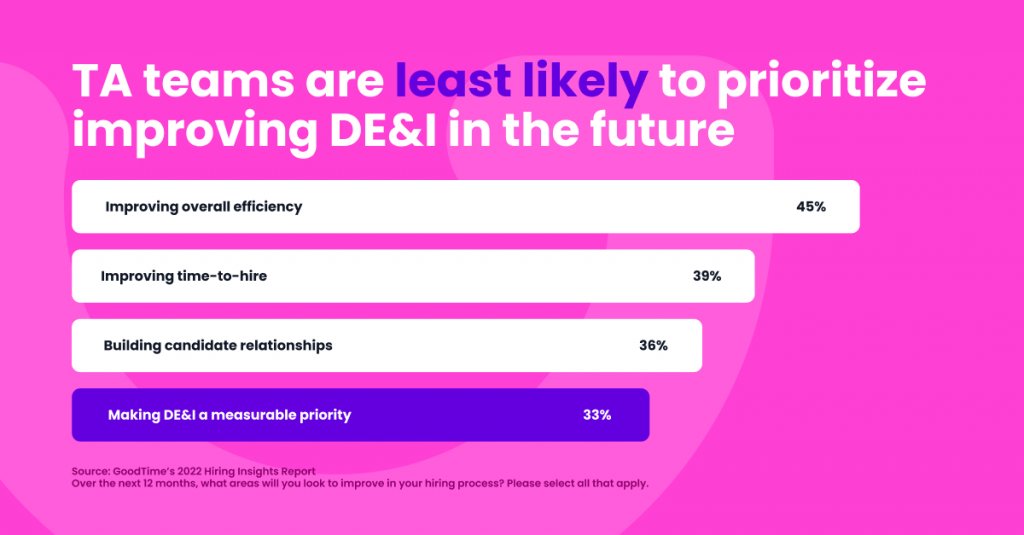
But the positives stop there. Only 31% of respondents made DEIB a measurable priority in the past 12 months. In the coming months, just 33% of respondents plan to focus on DEIB.

When teams leave DEIB on the back burner, they not only deflect diverse talent, but also tarnish their business. Diverse teams produce 19% higher revenue. Actioning on DEIB just makes sense. 

Candidate Relationships Fall to the Wayside

To snag the best talent, investing energy into candidate relationships is non-negotiable. Building an authentic connection with talent throughout the hiring process maintains their interest amid a sea of other offers.

On the bright side, 46% of respondents said that forming genuine connections with candidates is more important than ever. 

Yet despite this consensus, just 36% of respondents looked to build better candidate relationships in the past 12 months, and the same percentage plan on improving these relationships in the future. Once again: good intentions, not-so-good execution.

Candidates are interviewing you as much as you’re interviewing them. They expect their recruiters to put in the work to form a connection.

Company Culture Remains Unexpressed

In any hiring process, there’s a very high chance that candidates will ask the classic question, “How would you describe your company culture?” 

With 72% of candidates rejecting job offers because they don’t feel connected to the company culture, this is of utmost importance to talent.

It’s not lost on TA teams that job seekers deeply care about culture. Nearly all (90%) companies from our report said they designed their interview process to reflect their culture.

The problem? Just 53% communicate their company culture to candidates in the hiring process. In a nutshell, 47% of companies don’t convey an element that is crucial to candidates—and risk losing out on applicants due to this disregard.

Candidates want to know whether a company’s mission, values, and culture align with their own beliefs. They’re quick to turn down an offer if they don’t see this alignment.

Want the Latest Insights? Read the 2023 Hiring Insights Report

Good intentions, bad execution doesn’t bode well for teams’ hiring goals. But all hope is not lost. The first step in winning top talent is recognizing the most high-value elements that attract candidates. Hiring teams know what these are, so they’ve already done half the work.

The talent leaders from our survey possess the right mindset to succeed in today’s industry. Now, they must turn their intentions into actions.

Want to catch up on the latest hiring trends? Get excited: our 2023 Hiring Insights Report is now available. 500+ HR leaders, 1,000s of real findings, 1 industry-leading report. Read the report today.

Does interview scheduling automation make sense for my team?

ROI is key. This is not a time to invest in software that won’t bring you immediate value. So let’s eliminate the guesswork with our free ROI calculator.

Use These 6 Types of Meetings for Productive Conversations

If you’ve ever sat in a pointless meeting, then you know how painful they can be. Time is a precious resource in the workplace, and no one likes wasting it in unproductive conversations. While there’s a number of reasons why a specific meeting zaps the life out of attendees, sometimes it’s because the meeting’s format and structure are off. 

Choosing the proper type of meetings for your team is a crucial component of transforming your meetings into smart meetings. In a smart meeting, attendees make more meaningful accomplishments, progress, and connections than ever before. What’s better than that?

Lucky for you, we’re here to help. Here’s six types of productive smart meetings to incorporate into your schedule.

1. Huddles

For quick status reports, holding daily team huddles is the way to go. Huddles are normally 10 or 15 minutes long. They keep your team aligned throughout the week on their priorities. 

Attendees provide updates and talk through any obstacles. To keep your huddles within the confines of a 10-15 minute length, set expectations for how many minutes each person is allotted to discuss what’s going on in their world. 

However, as with any meeting, the number of attendees greatly impacts its effectiveness. If you have a large team, the short and sweet structure of a huddle might not be the best choice for you. 

Alternatively, you could hold huddles for smaller subsections within your team, such as huddles that consist of managers and their direct reports.

2. Kickoff Meetings

Have a project that’s in the works? Time to set up a kickoff meeting. During a kickoff meeting, stakeholders gather to align on several key components of a project to ensure everything runs smoothly.

For instance, stakeholders can discuss long-term and short-term goals (make sure that they’re SMART goals!), roles and responsibilities, and the project’s timeline and milestones. Be sure to discuss which tools you’ll use for project management and data tracking.

Once everyone reaches an agreement on these elements, log everything into a document or a platform so that the stakeholders have a single source of truth to reference at any time.

Most importantly, don’t conclude the meeting without establishing the next steps!

3. Retrospective Meetings

Once a project reaches the finish line, the stakeholders should reunite to discuss the end results in a retrospective meeting. 

These meetings are just as important as kickoff meetings; they play an instrumental role in ensuring that each project is carried out in a more streamlined and strategic fashion than the last.

Start off the meeting by reminding everyone of the project’s initial goals. Then, dive into the data and if the goals were met. Identify as a group what went well and what didn’t go well. Based on the learnings gathered from the project, select several best practices to keep top of mind when diving into the next project.

4. L10 Meetings

Feeling like your initiatives tend to remain stagnant, or progress at a sluggish pace? It might be time to establish Level 10 (L10) meetings. 

L10s zero in on your team’s to-do list, check the status of projects, and prioritize and tackle outstanding priorities.

This type of meeting takes place at the same time and day every week. These meetings are tight; they must start and end on time every time. It’s recommended for these meetings to last around 90 minutes, yet the length will depend on your team’s needs.

Conclude your L10 by asking each teammate to rate the meeting. If the L10 is done right, each attendee should be able to candidly rate your meeting a “10″ (ah—so that’s why it’s called an L10).

5. (Modified) Brainstorming Meetings

Let’s be clear: there’s a right and a wrong way to hold a brainstorming session. Despite popular belief, research shows that teams that hold traditional brainstorming meetings come up with fewer ideas than they would have if they brainstormed by themselves. 

To counteract this and get the most out of your brainstorming meetings (because they certainly hold value), establish a modified version.

Start by setting the expectation that before the meeting, teammates should generate their own ideas individually. Create an “idea think tank” document or repository for people to jot down their thoughts. 

Then, once the meeting rolls around, discuss the ideas collectively. See if anything sticks, or if any ideas could be modified or refined to make them work. There’s a good chance that new ideas will arise as well.

6. OKR Check-in Meetings

So, you’ve set a few OKRs for the quarter. One of the best ways to keep everything on track is by holding OKR check-in meetings. These meetings assist in aligning all the key players, reviewing progress, overcoming obstacles as a team, and sniffing out which strategies will and won’t move the needle. 

OKR meetings are highly effective when they’re held on a weekly basis. You likely won’t need more than 30 minutes to do an overview of the OKR’s top priorities. Above all, everyone should leave the meeting with a sharpened understanding of the next step that they must take to contribute to the OKR.

Create Smart Meetings With Ease Using GoodTime

In a sea of pointless meetings, GoodTime is here to make smart meetings come to life. GoodTime’s meeting scheduling software is free to start and automates scheduling, puts the right people in the room, and generates actionable insights to meet smarter every single time. 

From interviews, to sales calls, to customer meetings, you’ll hit your goals faster than ever before.


Learn more about how GoodTime can transform the way you meet.