Then, Now, and Beyond: What Matters Most in Talent Acquisition

In a fast-paced field like talent acquisition, the name of the game is simple: evolve or die. Talent teams can either keep pace with the ever-changing rules for hiring, or get left in the dust. 

The worldwide events from the past few years (COVID-19, anyone?) have revolutionized the ways that companies snag top talent. But here’s the question of the hour: amid all of the commotion in the talent acquisition industry, what really matters right now? And what will matter for talent teams in the future? 

We sat down with our Head of People Strategy, Jenn Oswald, to hear her thoughts on how we found ourselves at this current moment in the industry, where talent teams should focus their attention, and where the future of talent acquisition is heading.

Then: How Talent Teams Reached This Moment

Before we dive into the current state of the talent acquisition industry, let’s take a stroll down memory lane, shall we? 

The Pre-COVID Hiring Era

Jenn recounts how before the pandemic, the well-known, large companies typically had a major leg up on the talent competition, garnering a plethora of applicants. The vast majority of these organizations conducted company-driven hiring processes. 

“Their focus on talent was, ‘We’re going to put you through these processes, and we’re going to decide if you deserve to be here,’” Jenn said. “Candidates were at the whim of these processes; processes tended to take much longer.”

Research shows that getting hired in the U.S. took twice as long in 2014 as it did in 2010. The length of hiring processes—and their complexities—continued to increase from there.

However, as time went on, companies started to change their tune. Employers recognized their difficulties with filling certain roles and resolved to clean up their drawn-out, company-centric processes.

COVID’s Impact on Talent Acquisition

Bam. COVID hit, and hiring screeched to a halt. Fast-forward a bit, and companies slowly revved up their hiring processes again—except things were far from business as usual. Remote work surged in popularity, and soon hiring surged as well.

But beyond the rapid changes happening on the employer side, the mindsets of candidates began to evolve as well. 

“There was definitely a mental shift of people examining what’s really important to them,” Jenn said. “Companies had to drastically start looking at things that they never thought of before, like their hiring philosophy. And, ‘Do we follow our values? How do we talk about our values?’”

Company-driven hiring processes were out, and candidate-driven hiring processes were in. And with a shortage of candidates and an abundance of open roles, companies raced to hire the best talent in the fastest time. 

Now: What Matters in Talent Acquisition

Here we are in the present day—and things are a bit shaky. Companies have started to break into a cold sweat, worrying that they’ve overhired and overpaid what the market can bear (queue the layoffs and hiring freezes). 

Now that we’ve entered this new phase, where should talent teams concentrate their efforts so that they can rise to the top and snag the best talent? 

What matters most right now?

Balance Quality and Speed

With hiring slowdowns and freezes popping up left and right, now is the perfect time to get serious about optimization. Delivering a high-quality hiring process as fast as possible is key to standing out among the talent competition. 

But, before teams optimize their operations for speed and quality, Jenn recommends for them to do some inspecting.

“What matters most is first understanding what your current state is,” she said. “Analyze your data, look at your current process, map out where things work and where things maybe don’t work.” 

Then, once teams understand their process, they can double down on eliminating any bottlenecks that wreck the interviewing experience. 

Does interview scheduling automation make sense for my team?

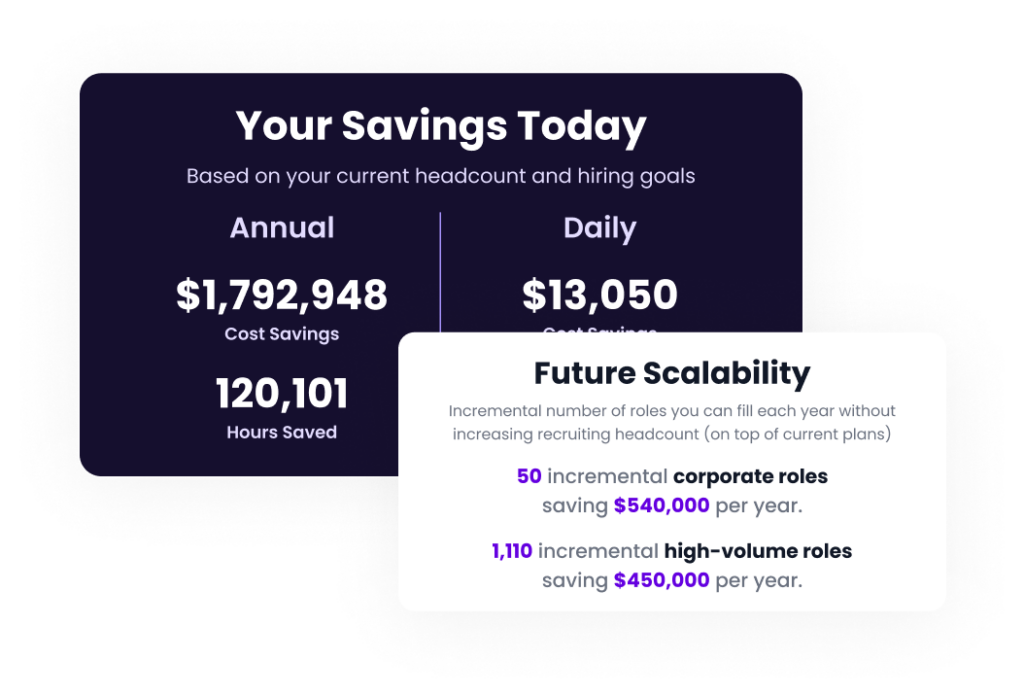
ROI is key. This is not a time to invest in software that won’t bring you immediate value. So let’s eliminate the guesswork with our free ROI calculator.
Convey Mission & Vision

“People want to work for a company that is mission and vision-based,” Jenn remarked. “Make sure that your company walks the talk.”

The number’s don’t lie: a survey found that 79% of adults would consider a company’s mission and purpose before applying. 

In many cases, culture—another important element for job hunters—goes hand in hand with mission and vision. Candidates seek out companies with a culture of practicing what they preach in their mission/vision statements.

Emphasize Flexibility

For candidates, flexibility is top of mind—and that’s not changing anytime soon. Yes, this can mean offering remote work arrangements, but that’s not the only way to emphasize organizational flexibility.

Many candidates simply want their future employer to promote work-life integration. They want the freedom to coordinate their schedules in and out of the office to best fit their lives.

Jenn hopes that we’ll see more companies adopt flexible results-driven environments. These types of workplaces possess a strong focus on each employee’s outcomes, rather than just the number of hours that they clock in.

Demonstrate DE&I

“Candidates are asking companies to be more transparent about their DE&I numbers and achievements,” Jenn said. 

She adds that this can be a particularly difficult task for startups, since it takes a while to gather meaningful DE&I-based statistics.

Nevertheless, there’s a multitude of ways for companies to prove that their commitment to DE&I isn’t just lip service. Ensuring that their interviewer panels are diverse and inclusive is a great start.

Beyond: What Will Matter in the Future of the Industry

Now, it’s time to peer into our crystal ball and see what’s on the horizon for the talent acquisition industry. It can be difficult to predict what will matter in the future, but lucky for us, Jenn has some thoughts.

Establish the Core Purpose

From a macro level, Jenn says that establishing the purpose behind the hiring process—from both the candidate’s perspective and the hiring team’s perspective—will likely be of utmost importance.

“If you don’t have the core purpose of why you’re hiring, and if the candidate doesn’t have the core purpose of why they’re talking to you, then without those two things, it’s really not an interview,” Jenn said. 

Then, Weave Key Elements Into the Hiring Process

Once the hiring team’s purpose and the candidate’s purpose unite, teams can shift their energy towards building up the important micro pieces of their operations.

These pieces include several elements that hold significance in the current talent landscape: DE&I, the candidate relationship, interviewer training, and employer branding, to name a few.

But yet again, if hiring teams neglect to align with their candidate’s purpose, then no supplemental elements can truly give their interviews substance.

Optimize Your Hiring for Whatever the Future Holds

Leveraging the right talent acquisition technology is essential when preparing for whatever the industry has in store.

And the key to building a robust tech stack? Adding GoodTime Hire into the mix.

Hire automates coordination, improves your relationships with candidates, and provides actionable insights to continuously optimize the entire hiring process. 


Learn more about how Hire can supercharge your talent acquisition team to win top talent.

Time To Walk the Walk: Data Shows HR Has Good Intentions, Bad Execution

HR teams have their hearts in the right place—no doubt about it. They’re dead set on improving their hiring processes by uplifting the components that candidates truly care about. But their execution…? That’s a different story.

Our 2022 Hiring Insights Report surveyed 560 HR and talent decision makers to understand the most pressing challenges facing their teams, and what should be done to reel in top talent. 

We found one striking pattern: many productive conversations surrounding what matters most in hiring, yet not as much action.

These conversations include the importance of emphasizing well-being, DEIB (diversity, equity, inclusion, & belonging), candidate relationships, and company culture within the hiring process.

And as a result? Talent teams are missing their goals. In fact, teams fell 50% short of their hiring goals last year. They need to start walking the walk.

Let’s dig into the data.

Candidate Well-being Takes a Back Seat

Shock of the century: candidates want to work at companies that value their well-being. Who woulda thought?

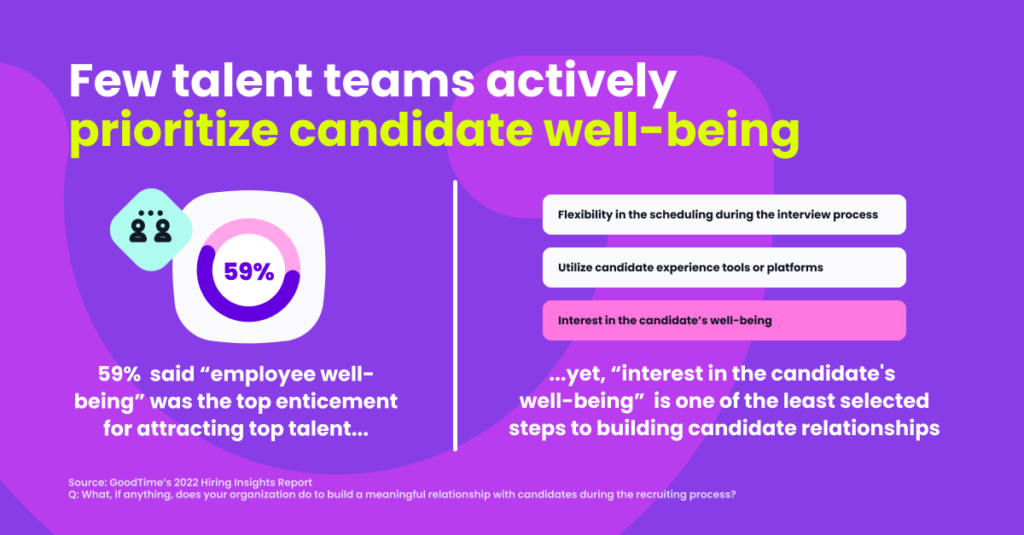
Hiring teams are certainly aware of that fact. Fifty-nine percent of respondents from our report said “employee well-being” was the top enticement for attracting talent. Happy candidates tend to become happy employees, so it’s only logical that teams would see prioritizing well-being as a great way to reel in talent.

But…are teams actually prioritizing well-being when handling candidates? The data isn’t hopeful.

When asked what their organization does to build relationships with candidates during the recruiting process, “interest in candidate’s well-being” was the third least selected response (35%).

The way that candidates are treated in the hiring process clues them in on how they’d be treated as new hires. If a hiring team vocalizes that they support their employees’ well-being, yet they don’t show the same support to candidates, they cannot expect candidates to believe their claims. 

Little Action Taken on DEIB

We hear you: for companies with limited resources and people to get the job done, emphasizing DEIB can turn into a big undertaking. 

Even so, there’s a variety of low-lift DEIB strategies that teams can take action on. Above all, neglecting DEIB deters diverse talent. Many BIPOC candidates need to see that DEIB is prioritized before they can envision themselves at a company.

At first, it seems that hiring teams understand the importance of having a DEIB-centric process. Companies from our report said that “diversity of candidates” is the second most important hiring metric to measure.

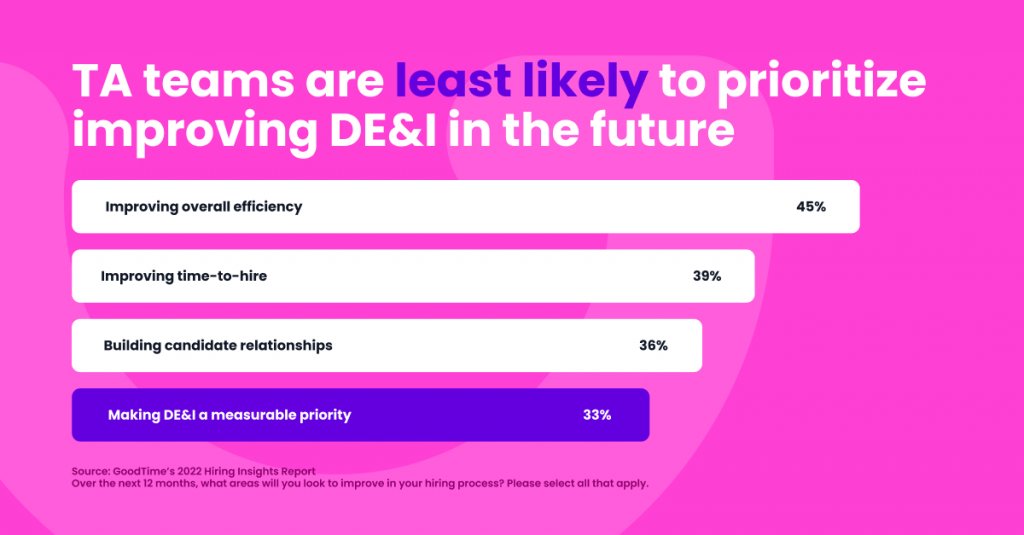
But the positives stop there. Only 31% of respondents made DEIB a measurable priority in the past 12 months. In the coming months, just 33% of respondents plan to focus on DEIB.

When teams leave DEIB on the back burner, they not only deflect diverse talent, but also tarnish their business. Diverse teams produce 19% higher revenue. Actioning on DEIB just makes sense. 

Candidate Relationships Fall to the Wayside

To snag the best talent, investing energy into candidate relationships is non-negotiable. Building an authentic connection with talent throughout the hiring process maintains their interest amid a sea of other offers.

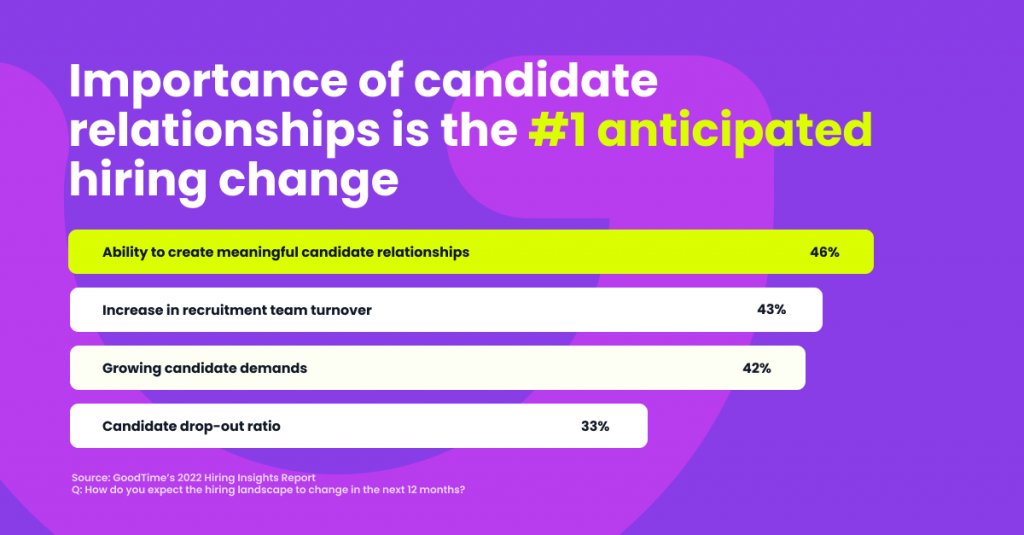
On the bright side, 46% of respondents said that forming genuine connections with candidates is more important than ever. 

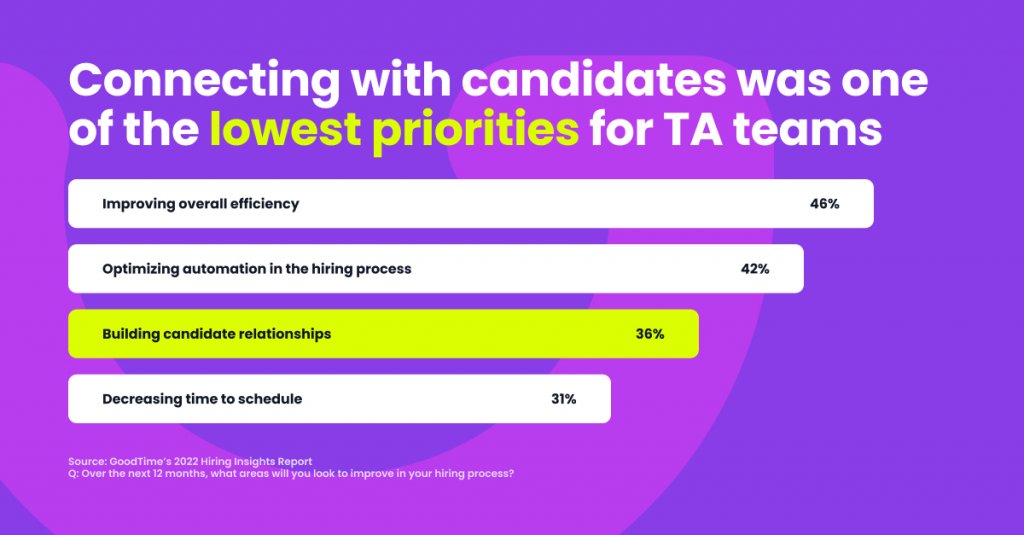
Yet despite this consensus, just 36% of respondents looked to build better candidate relationships in the past 12 months, and the same percentage plan on improving these relationships in the future. Once again: good intentions, not-so-good execution.

Candidates are interviewing you as much as you’re interviewing them. They expect their recruiters to put in the work to form a connection.

Company Culture Remains Unexpressed

In any hiring process, there’s a very high chance that candidates will ask the classic question, “How would you describe your company culture?” 

With 72% of candidates rejecting job offers because they don’t feel connected to the company culture, this is of utmost importance to talent.

It’s not lost on TA teams that job seekers deeply care about culture. Nearly all (90%) companies from our report said they designed their interview process to reflect their culture.

The problem? Just 53% communicate their company culture to candidates in the hiring process. In a nutshell, 47% of companies don’t convey an element that is crucial to candidates—and risk losing out on applicants due to this disregard.

Candidates want to know whether a company’s mission, values, and culture align with their own beliefs. They’re quick to turn down an offer if they don’t see this alignment.

Want the Latest Insights? Read the 2023 Hiring Insights Report

Good intentions, bad execution doesn’t bode well for teams’ hiring goals. But all hope is not lost. The first step in winning top talent is recognizing the most high-value elements that attract candidates. Hiring teams know what these are, so they’ve already done half the work.

The talent leaders from our survey possess the right mindset to succeed in today’s industry. Now, they must turn their intentions into actions.

Want to catch up on the latest hiring trends? Get excited: our 2023 Hiring Insights Report is now available. 500+ HR leaders, 1,000s of real findings, 1 industry-leading report. Read the report today.

Does interview scheduling automation make sense for my team?

ROI is key. This is not a time to invest in software that won’t bring you immediate value. So let’s eliminate the guesswork with our free ROI calculator.

Use These 6 Types of Meetings for Productive Conversations

If you’ve ever sat in a pointless meeting, then you know how painful they can be. Time is a precious resource in the workplace, and no one likes wasting it in unproductive conversations. While there’s a number of reasons why a specific meeting zaps the life out of attendees, sometimes it’s because the meeting’s format and structure are off. 

Choosing the proper type of meetings for your team is a crucial component of transforming your meetings into smart meetings. In a smart meeting, attendees make more meaningful accomplishments, progress, and connections than ever before. What’s better than that?

Lucky for you, we’re here to help. Here’s six types of productive smart meetings to incorporate into your schedule.

1. Huddles

For quick status reports, holding daily team huddles is the way to go. Huddles are normally 10 or 15 minutes long. They keep your team aligned throughout the week on their priorities. 

Attendees provide updates and talk through any obstacles. To keep your huddles within the confines of a 10-15 minute length, set expectations for how many minutes each person is allotted to discuss what’s going on in their world. 

However, as with any meeting, the number of attendees greatly impacts its effectiveness. If you have a large team, the short and sweet structure of a huddle might not be the best choice for you. 

Alternatively, you could hold huddles for smaller subsections within your team, such as huddles that consist of managers and their direct reports.

2. Kickoff Meetings

Have a project that’s in the works? Time to set up a kickoff meeting. During a kickoff meeting, stakeholders gather to align on several key components of a project to ensure everything runs smoothly.

For instance, stakeholders can discuss long-term and short-term goals (make sure that they’re SMART goals!), roles and responsibilities, and the project’s timeline and milestones. Be sure to discuss which tools you’ll use for project management and data tracking.

Once everyone reaches an agreement on these elements, log everything into a document or a platform so that the stakeholders have a single source of truth to reference at any time.

Most importantly, don’t conclude the meeting without establishing the next steps!

3. Retrospective Meetings

Once a project reaches the finish line, the stakeholders should reunite to discuss the end results in a retrospective meeting. 

These meetings are just as important as kickoff meetings; they play an instrumental role in ensuring that each project is carried out in a more streamlined and strategic fashion than the last.

Start off the meeting by reminding everyone of the project’s initial goals. Then, dive into the data and if the goals were met. Identify as a group what went well and what didn’t go well. Based on the learnings gathered from the project, select several best practices to keep top of mind when diving into the next project.

4. L10 Meetings

Feeling like your initiatives tend to remain stagnant, or progress at a sluggish pace? It might be time to establish Level 10 (L10) meetings. 

L10s zero in on your team’s to-do list, check the status of projects, and prioritize and tackle outstanding priorities.

This type of meeting takes place at the same time and day every week. These meetings are tight; they must start and end on time every time. It’s recommended for these meetings to last around 90 minutes, yet the length will depend on your team’s needs.

Conclude your L10 by asking each teammate to rate the meeting. If the L10 is done right, each attendee should be able to candidly rate your meeting a “10″ (ah—so that’s why it’s called an L10).

5. (Modified) Brainstorming Meetings

Let’s be clear: there’s a right and a wrong way to hold a brainstorming session. Despite popular belief, research shows that teams that hold traditional brainstorming meetings come up with fewer ideas than they would have if they brainstormed by themselves. 

To counteract this and get the most out of your brainstorming meetings (because they certainly hold value), establish a modified version.

Start by setting the expectation that before the meeting, teammates should generate their own ideas individually. Create an “idea think tank” document or repository for people to jot down their thoughts. 

Then, once the meeting rolls around, discuss the ideas collectively. See if anything sticks, or if any ideas could be modified or refined to make them work. There’s a good chance that new ideas will arise as well.

6. OKR Check-in Meetings

So, you’ve set a few OKRs for the quarter. One of the best ways to keep everything on track is by holding OKR check-in meetings. These meetings assist in aligning all the key players, reviewing progress, overcoming obstacles as a team, and sniffing out which strategies will and won’t move the needle. 

OKR meetings are highly effective when they’re held on a weekly basis. You likely won’t need more than 30 minutes to do an overview of the OKR’s top priorities. Above all, everyone should leave the meeting with a sharpened understanding of the next step that they must take to contribute to the OKR.

Create Smart Meetings With Ease Using GoodTime

In a sea of pointless meetings, GoodTime is here to make smart meetings come to life. GoodTime’s meeting scheduling software is free to start and automates scheduling, puts the right people in the room, and generates actionable insights to meet smarter every single time. 

From interviews, to sales calls, to customer meetings, you’ll hit your goals faster than ever before.


Learn more about how GoodTime can transform the way you meet.

How HR Leaders Expect the Talent Acquisition Landscape To Evolve

Resignations and remote work policies and layoffs, oh my! The ever-changing talent acquisition landscape is enough to make anyone’s head spin. In order to stay afloat, talent teams must get comfortable with change. 

So, what does the future of the talent acquisition landscape look like? We went on the hunt for answers.

Our 2022 Hiring Insights Report surveyed 560 HR, talent, and recruiting decision makers across the U.S. We uncovered their perceptions on the most pressing challenges facing their teams, and how to succeed in the future of the hiring landscape.

The findings? Leaders expect for retaining talent, meaningfully connecting with candidates, and improving hiring efficiency to define the future of talent acquisition. Let’s dig into the data.

Candidate Relationships Grow in Importance

We asked respondents how they would describe the changes they’ve observed in the hiring landscape over the past 12 months. The majority (47%) said that the landscape has become more competitive due to an increased demand for talent. Trailing closely behind, 46% said that creating genuine relationships with candidates has become crucial.

Looking to the future, talent leaders agreed that connecting with candidates will remain of utmost importance. The ability to create meaningful candidate relationships topped the list of how HR leaders expect the landscape to change in the next 12 months.

The takeaways? If recruiting teams want to compete with the talent landscape, they must invest time and energy into forming a bond with candidates. For instance, instead of spending all of your energy on learning what candidates can offer your company, spend a little bit more time learning what candidates look for in a role.

Challenges With Talent Retention on the Horizon

When asked which hiring challenges they’ve faced in the past 12 months, talent leaders ranked “retaining top talent” as their biggest obstacle. In 2021, a whopping 47 million Americans quit their jobs as part of the Great Resignation. Needless to say, our report’s finding comes as no surprise.

Our respondents expect talent retention to remain their biggest challenge in the next 12 months as well. Here’s where things get interesting. Talent leaders agree that connecting with candidates will remain a key component of a successful hiring process. Yet creating candidate relationships isn’t just important for talent acquisition. It’s also crucial for talent retention.

So, if you want to master talent retention, know this: retaining talent starts from the first moment that a candidate speaks to a recruiter. Cultivating genuine connections with potential new hires sets the stage for a meaningful experience at your company—and higher retention down the line.

Improving Hiring Efficiency Remains Paramount

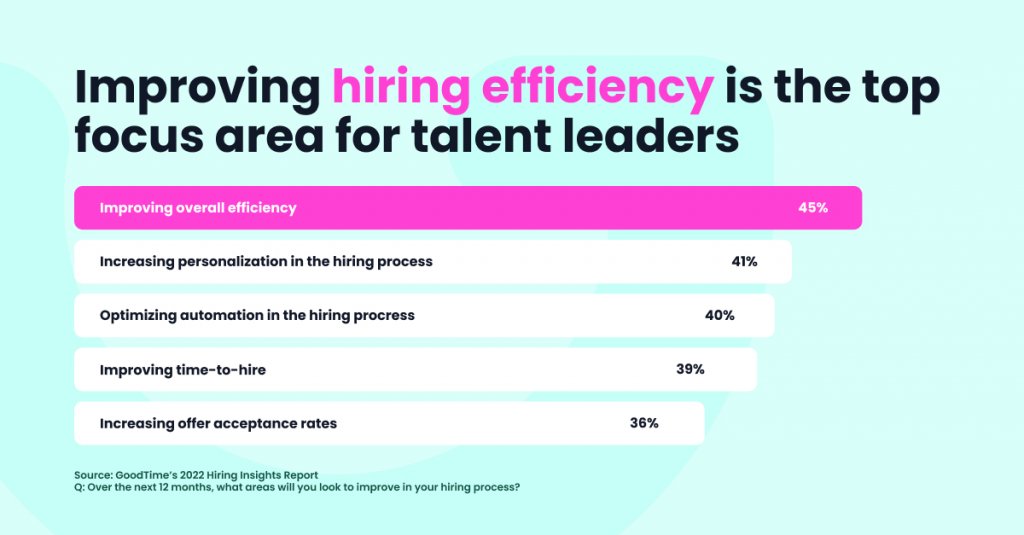
The majority of talent leaders (46%) said that in the past 12 months, their main concern when refining their hiring process was boosting their overall efficiency. Hiring efficiency proved to be absolutely essential amid 2021’s tight labor market, as teams scrambled to backfill roles.

Likewise, the majority of respondents agreed that improving efficiency is still their biggest focus area when diving into the future of the talent landscape. This isn’t the least bit shocking; enhancing hiring efficiency will never go out of style. 

To remain agile within the constantly changing landscape, teams must put the proper systems in place so that they can boost efficiency, do more with less, and remain prepared for anything that the talent world throws their way.

Does interview scheduling automation make sense for my team?

ROI is key. This is not a time to invest in software that won’t bring you immediate value. So let’s eliminate the guesswork with our free ROI calculator.

How To Succeed in the Talent Acquisition Landscape

So, you want to know how to prepare for the future of talent acquisition? Well, here’s the answer, tied up in a neat little bow, straight from the minds of the U.S.’s talent leaders.

Focus your attention on improving hiring efficiency, boosting talent retention, and improving candidate relationships, and you have yourself a masterful talent acquisition strategy.

If you lay the groundwork for an efficient hiring process, you create more space to connect with candidates. Strong candidate relationships give rise to lasting new hires. These lasting new hires result in better talent retention. Boom.

Keep Up With the Latest HR Trends

In a tumultuous environment like talent acquisition, it pays to have a pulse on the latest happenings in the landscape. If you’re looking to gain a better understanding of the challenges facing hiring teams and best practices for refining your strategies, you came to the right place.


Download our 2022 Hiring Insights Report today to learn more about the state of hiring, and what must be done to win over candidates.

5 Mistakes Recruiting Coordinators Make (And How To Avoid Them)

Recruiting coordinators make the talent world go ‘round. As the unsung heroes of the hiring process, recruiting coordinators act as a candidate’s first impression of a company. RC’s juggle multiple tasks at once to keep this impression pristine and move the hiring process along. Yep, it’s a pretty big role.

However, as with any job—especially ones that involve a high workload (and stress)—mistakes happen. No matter if you slip up when emailing candidates, or stumble when coordinating interviews, the most important thing you can do is evaluate what went wrong and steer clear of it in the future.

Here are five common mistakes recruiting coordinators make, and how to avoid them to create an extraordinary hiring experience.

1. Sending Candidates Lackluster Communications

When sending message after message to candidates, it can be easy to go on autopilot and phone it in. We get it—coordinating interviews isn’t the most exciting task. 

But truth be told, the communication between RC’s and candidates plays a pivotal role in the hiring process. The last thing you want to do is send a robotic email riddled with errors. Even quick text exchanges with candidates should be scrutinized for high quality.

These messages inform candidates of your company’s tone of voice and can either increase or decrease their excitement for their upcoming interview.

How Recruiting Coordinators Can Avoid This

Whether you’re sending a message to gather a candidate’s availability or to confirm their upcoming interview, there’s several steps you should take to refine this communication.

To add a layer of empathy to your communications, direct candidates to an email and/or phone number to reach out to if they have any questions. You never know what’s going on inside a candidate’s head.

Above all, always review your responses for the ABC’s of communication: accuracy, brevity, and clarity. That way, your messages will contain the most important information, will be an appropriate length, and will be abundantly easy to digest. Now, your response is ready to be sent out into the world.

2. Failing to Give Candidates Scheduling Flexibility

Flexibility is a growing priority for those in the world of work. In fact, 96% of US professionals say they require flexibility. 

Asking candidates to adapt to your hiring team’s schedule, or to make themselves available within a narrow time frame, conveys that flexibility is not a priority for your organization.

How Recruiting Coordinators Can Avoid This

Make your hiring process flexibility-focused by putting candidates in the driver’s seat. Instead of expecting candidates to move their schedules around for your company, ask for their availability. Show that you respect their time by letting them schedule their interviews for whenever works best for them.  

At the end of the day, your candidates are likely chatting with multiple other companies. They’re more likely to remember and value your interview process—and you as an RC—if you act with flexibility and understanding.

Does interview scheduling automation make sense for my team?

ROI is key. This is not a time to invest in software that won’t bring you immediate value. So let’s eliminate the guesswork with our free ROI calculator.

3. Coordinating Interviews Manually

If you’re still manually scheduling and coordinating interviews, you’re doing something wrong. (Too harsh?) Daily recruiting coordinator tasks become highly tedious and inefficient when they’re done without the help of technology. And when your head is stuck in calendars and spreadsheets, you have even less time to spend on high-value tasks that will actually move the needle.

Today’s candidates have little patience for clunky hiring processes that rely on manual operations. An inefficient process does nothing but degrade the candidate experience and weigh down your hiring metrics.

How Recruiting Coordinators Can Avoid This

The best way to keep up with candidate expectations and remain competitive in the talent landscape is by leveraging a tech solution that offers recruitment automation. Speed is crucial to a hiring process; automation gives you an edge by allowing you to coordinate in minutes, not hours. (Plus, your team will save major time and money.)

Leveraging an automated hiring solution creates a quick and easy hiring experience. This sends the message that you value your candidate’s time. With less bandwidth spent on scheduling and coordination, you’ll have more bandwidth to focus on what matters: better connecting with candidates.

4. Treating Candidate Relationships as Transactional

RC’s who have a transactional mindset interact with candidates with the sole purpose of turning them into new hires to fill open reqs and boost their hiring stats. Too many recruiting coordinators operate this way, and it’s a problem. 

Candidates don’t want to be viewed as just a number. They want to form a genuine connection with your recruitment team built on trust, transparency, and flexibility. Navigating with this transactional mindset is sure to push them away.

How Recruiting Coordinators Can Avoid This

Nurture the recruiting coordinator-candidate relationship. Spend some time learning what candidates look for when interacting with a hiring team, and apply those insights to your daily RC involvements.

Here’s an insight to start off with: 62% of employees cite well-being support as their top priority in their job hunt. Checking up on candidates and offering yourself as a resource if they have any concerns are both excellent, low-effort ways to show that you care about their well-being. 

You could also block off time to brainstorm what’s missing from the hiring process that could boost your team’s candidate relationships. For instance, if you don’t collect feedback from candidates, now is the time to do so. Let candidates speak their minds and remind them that you value their opinions.

5. Neglecting to Prioritize Upskilling

The life of a recruiting coordinator is sometimes downright overwhelming. With all of the tasks on your plate, making time to progress your skills and learnings can seem practically impossible. Or, you might even feel guilty at the thought of putting aside the tasks on your to-do list to focus on your own career development.

How Recruiting Coordinators Can Avoid This

If any of this resonates with you, know this: you must always fill your own cup. A hiring team that truly supports the success of their teammates understands that it’s crucial for everyone to invest in their own skills and knowledge once in a while.

Block off time on your calendar, notify your team that you’ll be heads-down and focused on upskilling, and ask your teammates if they could help out with any urgent tasks while you work on career development, if necessary.

There’s a variety of online classes and certifications for recruiting coordinators. Some of the popular ones include LinkedIn Learning, The Recruitment Education Institute, Alison, and Recruiting Toolbox.

Hey, RCs—Ready To Elevate Your Hiring Process?

Hundreds of companies have leveled up their recruitment process to stand out in the talent landscape. Patreon reduced their time-to-hire by 50%, Box reduced their time spent scheduling by 40%, and Deliveroo hired 700+ employees.

How’d these talent acquisition teams do it? Simple: they used GoodTime. And you can, too.

GoodTime Hire automates interview scheduling, builds relationships during interviews, and provides actionable insights to continuously improve your hiring process. 


If you want to take your recruitment process to the next level, learn more about Hire’s advanced interview scheduling software.

How to Get Actionable Candidate Feedback (And Actually Use It)

It’s a candidate’s world, we’re all just living in it. Candidates now hold more power in the hiring process than ever before. Applicants don’t just want a hiring process that creates strong candidate relationships, they actively expect it.

With the pressure to create meaningful candidate relationships, recruitment teams commonly hold discussions on how to optimize their hiring for happier candidates. But where most teams falter is neglecting to loop candidates in on these conversations. No one can better speak to the quality of your hiring process than those who experience it first-hand. 

Sending candidate experience surveys to applicants allows you to know exactly what aspects of your hiring process help and hurt the candidate relationship. But gathering candidate feedback is one thing, and taking action on that feedback is another.

Read on to learn how to use your candidate experience surveys to evaluate four aspects of the hiring process that are integral to the candidate relationship—⁠and how to turn insights into action.

Performance of Your Interviewers

Your interviewers can make or break the candidate relationship. Interviewers act as the candidate’s first impression of your company’s employees, providing a window into what it’s like to work there. That means your interviewers need to be on their A-game, or you can expect disappointing candidate feedback. 

Candidate Feedback You Can Gather

Consider gathering feedback on the following topics related to your interviewers: 

  • The preparedness and professionalism of the interviewers.
  • The knowledge that interviewers displayed when answering questions.
  • How attentive the interviewers acted towards candidates.

How to Take Action

So you ask for candidate feedback on your interviewers, and you find that improvements are needed. Maybe you hear that your interviewers are doing a less-than-desirable job at answering questions. Or, maybe they’re not up to par when it comes to professionalism. Critiques on interviewer performance means that it’s time to get serious about interviewer training.

Inadequately trained interviewers sour the candidate relationship and lead to bad hiring decisions. By instituting an interviewer training program where interviewer newbies shadow your seasoned interviewers, you’ll be able to not only prevent negative candidate relationships, but also the wasted time, energy, and money that results from a bad hire.

Interviewer trainees should be made aware of critiques gathered from your candidate experience surveys so that past mistakes are not repeated. If a candidate was disappointed with how an interviewer answered their questions, all trainees should know this so that they pay extra attention to the thoroughness that seasoned interviewers use when providing responses.

Quality of Your Recruiting Tech Tools

The quality of your tech significantly impacts the quality of both your recruitment methods and your candidate relationships. In fact, of the recruiters and talent managers that reportedly use some form of recruiting and/or applicant tracking software, 94% say that their tech has improved their hiring process (Capterra). 

Candidate Feedback You Can Gather

Consider gathering feedback on the following topics related to your tech: 

  • The experience of using your hiring/ATS software.
  • The experience of using your video conferencing tech (if interviewing remotely).
  • The impact of your tech stack on the overall hiring experience.

How to Take Action

In the scenario where candidates express a dislike for your tech stack, take time to assess your tech for pitfalls. For instance, If your video conferencing tech is tripping candidates up, evaluate if you’re really setting all candidates up for success when using this software.

With the widespread use of tech like Zoom, it’s easy to forget that some candidates might be less familiar with how to use these tools, or might not have interviewed virtually before (the digital divide is a very real thing). To level the playing field and create a clear-cut experience for all, provide candidates with a best practices sheet on how to use your video conferencing tech.

If you only use an ATS, consider integrating your ATS with a Meeting Optimization Engine. With this extra technological boost, you’ll drive even more impactful hiring results and cultivate compelling candidate relationships—every single time.

Clarity of Your Company Culture and Values

The importance of clearly conveying your company culture and values is undeniable. Don’t believe me? Ask the candidates: studies show that the number one reason candidates choose one job over another is because of a better company culture. Candidates want their hiring experience to affirm that your culture and values align with what truly matters to them.

Candidate Feedback You Can Gather

Consider gathering feedback on the following topics related to your company culture and values: 

  • Any confusion on how to define the company culture.
  • If the hiring process cultivated excitement to join the company culture.
  • If the hiring process helped candidates understand company values.

How to Take Action

Failing to properly convey your culture and values doesn’t bode well for the candidate relationship. If your candidates express that the hiring process didn’t enhance their understanding of your culture and/or values, or if they didn’t find your culture to be compelling, your recruitment team has work to do.

One way to address their concerns is to gather everyone involved in the hiring process and align on how company culture and values are to be highlighted at every touch point. This way, you can ensure that everyone delivers a cohesive, engaging message that properly speaks to what it’s like to be an employee at your workplace.

This is also the time to check for any inconsistencies or improvements to be made in culture and value messaging on candidate-facing platforms, such as your company’s website. When it comes to cultivating a defined cultural image, it’s crucial that every material that candidates may come across enriches and unifies their understanding of your company.

Efficiency of Your Recruitment Process

Above all, the candidate relationship relies on a quick and easy hiring experience. Interviewing is nerve-wracking enough as it is, and having to go through a clunky hiring process only magnifies this stress.

Candidate Feedback You Can Gather

Consider gathering feedback on the following topics related to your recruitment efficiency: 

  • Whether candidates felt that you valued their time.
  • The ease of navigation of the recruitment process.
  • The quickness of the recruitment process.

How to Take Action

If your candidate experience surveys reveal that candidates are displeased with your hiring efficiency, leveling up your tech stack is once again the most helpful action you can take to supercharge your hiring. And with the tech-driven lifestyles that the majority of your candidates lead, advancing your tech tools may be just the thing that impresses candidates enough to win them over.

Another route to take is starting a dialogue among key players in the hiring process regarding expectations on communication and goals for your time-to-hire. If your team doesn’t schedule intake meetings at the beginning of each hiring process, this is your sign to start. 

In intake meetings, recruiters and hiring managers meet to align on topics such as goals for the recruitment process. By setting expectations early on, intake meetings eliminate any confusion down the road that may prolong the process and waste a candidate’s time.

Does interview scheduling automation make sense for my team?

ROI is key. This is not a time to invest in software that won’t bring you immediate value. So let’s eliminate the guesswork with our free ROI calculator.

Start Collecting Candidate Feedback Today

Even if your candidate experience surveys generate nothing but praise from candidates, don’t just sit back and relax. The expectations of candidates shift all the time, and this makes cultivating connections with candidates a never-ending process of adjusting to match these expectations.


If you want to double down on your candidate relationships, you need GoodTime Hire’s Candidate Pulse. Our newest feature collects input from applicants at every step of the hiring process, allowing you to fine-tune your operations and create recruiter-candidate bonds like never before.

Learn more about Candidate Pulse today.

15 Essential Candidate Experience Survey Questions

The foundation of every successful relationship is clear communication, and recruiter-candidate relationships are no different. If you’re not asking candidates for feedback, you’re relying on guesswork when it comes to connecting with candidates in a meaningful way. That’s the magic of candidate experience survey questions.

These surveys take the ambiguity out of creating candidate relationships by allowing you to gather feedback on your hiring efforts. Armed with genuine input straight from the most reliable source—the candidates—you’ll be able to fine-tune your recruiting to ensure each and every candidate has a winning candidate experience.

When constructing your surveys, making them anonymous is the best way to encourage honest opinions. Candidates want to secure a job, and a lack of anonymity pressures them into designing responses that provide a better shot at an offer.

Ready to create a stronger connection with candidates? Here are 15 candidate experience survey questions to inform your efforts in crafting compelling candidate relationships.

Unlock 2026’s top hiring strategies: Insights from 500+ TA leaders

Be the first to uncover deep hiring insights specific to your sector — straight from the highest-performing TA teams.

Open-Ended Candidate Experience Survey Questions

With open-ended questions, candidates can express their opinions in as much detail as they want. While the qualitative nature of this candidate feedback is a bit difficult to structurally analyze, the richness in responses is a significant positive.

Candidates can respond to your questions in their own way, allowing for an endless range of answers. Because of the infinite possibilities of open-ended questions, you’ll receive candidate feedback on unexpected aspects of the candidate relationship that you hadn’t previously considered.

Be cognizant of how many open-ended questions you include in each of your candidate experience surveys. Including too many questions creates surveys that are much too time-consuming for candidates to complete.

Examples of Open-Ended Questions

  1. How well were you able to connect with your interviewers? Please describe.
  2. How would you describe the overall experience with your interviewers?
  3. How would you describe the speed and efficiency of our hiring process?
  4. What are two things we could do to improve our hiring process?
  5. What were your two favorite aspects of our hiring process?
  6. Would you consider applying for a job at [your organization] again? Why or why not?
  7. Based on your experience, is [your organization] a place you would like to work? Why or why not?

Likert Scale Candidate Experience Survey Questions

Likert scale questions provide a bit more structure to data gathering and analysis. These questions ask candidates to evaluate their attitudes on a statement and select a rating on a scale from one extreme to another. Typically, “strongly disagree” to “strongly agree” are at opposite ends of the likert scale.

Based on the sentiment that candidates select for each statement, hiring teams can assess the candidate feedback and zero in on problematic and successful areas of the candidate relationship.  

While open-ended questions generate rich insights, most candidates won’t want to spend time on a survey where all of the questions require typed-out responses. If you add a healthy dose of likert scale questions into the mix, your survey completion rates are bound to increase.

Examples of Likert Scale Questions

  1. My interviewers were knowledgeable.
  2. My interviews made me feel comfortable.
  3. I felt represented in my interviewer panel.
  4. The hiring process gave me a thorough understanding of [your organization]’s culture.
  5. I knew what to expect at each stage of the hiring process.
  6. The hiring process was quick.
  7. Recruiters communicated with me in a timely manner.
  8. Based on my experience, [your organization] is a company I would like to work for.

Join a community just for talent pros

GoodTime Talent Innovators is an online community for TA professionals to engage in discussions, network with one another, and discover exclusive events.

Do You Really Know How Candidates Feel?

When it comes to cultivating strong relationships with candidates, putting effort into creating positive experiences is only half the battle. Candidates must also feel that they’ve formed a connection with your brand and your hiring team, or else you’ve created no candidate relationship at all.

Stop making assumptions about your relationships with candidates and start gathering genuine insights with candidate experience surveys. (Your candidates will thank you for it.)

If you want to understand the ins and outs of each candidate’s experience, GoodTime’s interview scheduling software’s got you covered.

Learn how Hire’s new feature, Candidate Pulse, gathers invaluable candidate insights to take the candidate relationship to the next level.

Tech Companies Hit Less Than 50% Of Their Hiring Goals. Here’s Why.

For many job seekers, tech is where they want to be. Tech industry jobs commonly promise good pay, a decent work-life balance, and attractive career progression. Yet despite this allure, the majority of hiring teams in tech haven’t been doing too hot.

In fact, the tech companies surveyed in our 2022 Hiring Insights Report hit just 46% of their hiring goals in 2021. 

Why has tech taken a tumble? Is the industry losing its sparkle? Or are hiring teams tripping up?

We dug deeper into our report’s data and found the answers.

Unlock tech’s top hiring strategies in 2025

Our study of 100 tech TA leaders reveals how to hit your hiring goals in a challenging market.

Dropping the Ball on Candidate Relationships

Today’s candidates expect to feel a mutual bond with your hiring team and your company. If they don’t feel a connection, then they won’t join. Neglecting to prioritize your relationships with candidates means bad news for your hiring goal attainment. In this sense, it’s no wonder that hiring teams in tech missed the mark on their goals. 

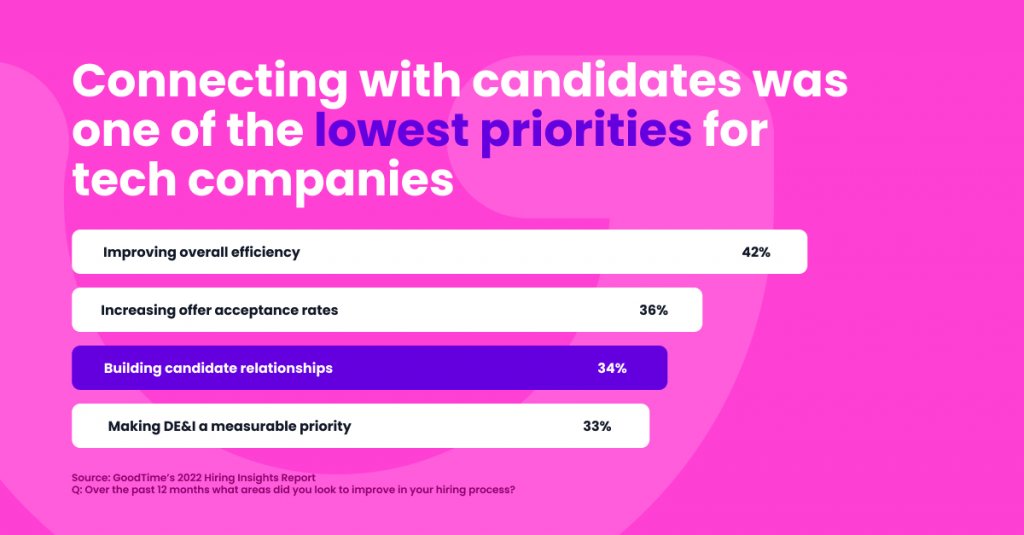
To start on a positive note, 47% of tech companies agree that in the past 12 months, meaningfully connecting with candidates has become crucial. Likewise, 45% agree that this will remain a priority in the coming months.

But here’s the catch: only 34% of respondents looked to build better candidate relationships in the past 12 months, and just 35% plan on improving these relationships in the coming months.

When it comes to connecting with candidates, tech companies have great intentions but struggle with the execution. And yet, it’s not just tech companies that are struggling; this problem remained evident across all companies that we surveyed. The importance of candidate relationships is increasingly widely known. Now, it’s time to take action.

Lack of Focus on DEIB

It’s no secret that tech hasn’t always been the most welcoming industry for underrepresented groups. Female, Black, and Hispanic workers have historically made up just a small fraction of the tech workforce. But with the increased buzz surrounding DEIB in hiring over the last couple of years, one would think that tech would’ve made great strides…right? Our data isn’t hopeful.

When asked which aspects of their hiring process they looked to improve over the past 12 months, making DEIB a measurable priority was the lowest response (33%). The next 12 months don’t look promising: prioritizing DEIB was the second lowest response at 34%.

Yet at the same time, tech companies say that the diversity of candidates is the second most important metric to measure in the hiring process. Is it just us, or is something not adding up?

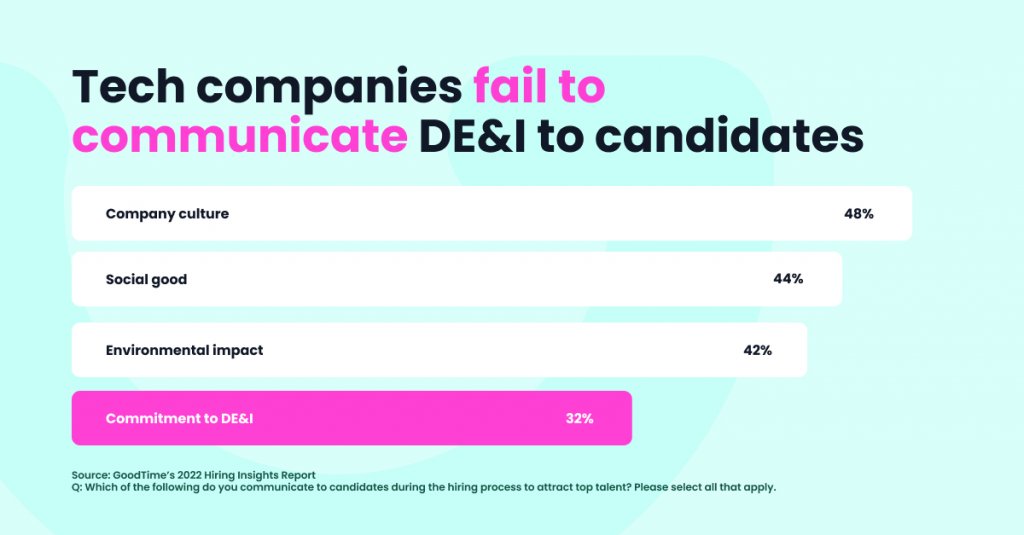
To make matters worse, when asked, “Which of the following do you communicate to candidates during the hiring process to attract top talent?” only 32% of tech companies said that they convey a commitment to DEIB.

Today’s Distance Economy opens the talent pool to a wide range of diverse candidates. Those candidates don’t just want to see an emphasis on DEIB in the hiring process—they expect it. And if tech companies don’t deliver? Candidates will run the opposite way, and hiring goal attainment will falter.

Hiring Efficiency Needs Improvements

In today’s competitive job market, efficiency is everything and hiring fast is essential. While a streamlined interview process is sure to wow candidates, a clunky experience can prompt them to turn down an otherwise desirable offer.

The more efficient your hiring process is, the shorter your time-to-hire will be. Unfortunately for tech companies, 58% said that their time-to-hire increased over the past 12 months. On top of that, 52% of tech respondents rated their talent acquisition process as just “somewhat efficient.”

Meanwhile, HR leadership at tech companies possess skewed perceptions on efficiency. Sixty-five percent of C-suite execs said their hiring process is very efficient, and just 33% of directors said the same. Directors have closer connections to daily recruitment operations than the C-suite, so it’s no wonder that their views reflect the reality of tech’s increasing time-to-hire.

None of this bodes well for tech companies’ hiring goals. The best candidates disappear from the market in just 10 days. If you don’t hire swiftly and efficiently, you can bid top talent good-bye.

Does interview scheduling automation make sense for my team?

ROI is key. This is not a time to invest in software that won’t bring you immediate value. So let’s eliminate the guesswork with our free ROI calculator.

Interested in Tech Hiring Tips from the Experts?

A short supply of recruiter-candidate relationships, sparse DEIB efforts, and inadequate levels of efficiency create a perfect storm for low hiring goal attainment. Needless to say, hiring teams in tech have some work to do if they want to stay ahead of the competition.

Read what high-performing tech TA leaders recommend doing today to address tech hiring challenges.

3 Ways to Elevate the Candidate Relationship with Interview Feedback

There’s no way around it. If your recruitment team does not focus on the candidate relationship, you will lose out on top talent. Recruiting is no small feat, and the hours upon hours that you spend fine-tuning your hiring process will all be for nothing if you don’t meaningfully connect with applicants.

But the frustrating reality is that you can take active steps to cultivate the candidate relationship, turn your hiring process on its head to deliver a high-caliber experience . . . and still see little results. How do you know if your efforts in cultivating this all-important relationship actually translate?

By sending candidate experience surveys to gather genuine feedback, you can get a leg up on the talent competition and understand what candidates really think about your process, from the highs to the lows. What better group of people to speak on the candidate relationship than the candidates themselves?

Despite the 68% of candidates that would like to provide feedback after an interview, 75% report rarely or never being asked for feedback.

Talentegy, State of Candidate Experience Report

And your candidates? They’re ready to be heard. Despite the 68% of candidates that would like to provide feedback after an interview, 75% report rarely or never being asked for feedback. Candidates have opinions on your hiring methods no matter what. If you don’t ask for their opinion in candidate experience surveys, they’ll gladly air their grievances on company review websites. 

Here are three ways to stay accountable for your candidate relationships by collecting candidate feedback in your hiring process.

1. Evaluate DEIB Initiatives

More and more candidates—three out of four, to be precise—cite DEIB as one of the top values they look for. A hiring process that promotes DEIB cultivates an experience for candidates where they feel comfortable throughout the recruitment process and can tell that you’ve fostered a culture where differences are celebrated.

Yet creating DEIB strategies that actually leave an impact is easier said than done. Promoting DEIB in recruiting is a continuous process that requires regular evaluations on if your efforts properly translate and improve the candidate relationship. 

Luckily, candidate experience surveys are a great way to gather metrics to endlessly improve DEIB in your hiring process and stay accountable for your goals. Consider asking for candidate feedback on how comfortable and inclusive each interview felt, and if candidates felt represented in their interviewer panels.

2. Check if Company Culture Translated

For most people, it’s easiest to understand a workplace’s culture through experience. Touring an office and shaking hands with potential coworkers makes the intangible concept of company culture incredibly tangible.

Yet with the rise of remote interviewing, recruiting teams grapple with conveying culture through a Zoom screen. Recruiters must now take an even more thoughtful approach to sharing company culture—a difficult task, but certainly not impossible.

As 46% of job seekers claim that company culture plays a crucial role when considering job offers, clearly communicating organizational culture—and checking if your efforts actually provide candidates with proper understanding—may be just the thing that enriches a candidate’s connection to your company and wins them over.

To check if your company culture properly translated to candidates, include questions regarding cultural understanding in your candidate experience surveys. Collect feedback on if the interview process gave candidates a clear understanding of your culture, or if they were left with an image that’s cloudy at best.

3. Assess Dissonance in Mission and Values

Conveying your company’s mission and values is just as important as conveying company culture. Across both the United States and Europe, 79% of candidates consider a company’s mission before applying, and 73% wouldn’t even apply to a company unless its values aligned with their own.

Candidates want to finish the hiring process feeling even more affirmed that your company aligns with what they care about most. This means that all aspects of recruiting, from the language in the job posting to the discussions in the interviews, must speak to your mission and values.

Imagine a candidate reads all about your company’s mission and values on your website, yet the discussions in the interview stage entirely conflict with what they read online. By asking for candidate feedback on how coherently your hiring process conveyed your mission and values, you avoid losing talent due to an inconsistent message.

Hold Yourself Accountable for the Candidate Relationship

Cultivating candidate relationships becomes even harder without a way to gauge if your efforts actually make a difference. That’s where candidate experience surveys come in.

When hiring teams collect ongoing feedback, everyone wins: candidates enjoy their hiring journey and feel that their opinions are valued, and recruiters stand out with a high-quality recruitment process backed by reliable insights.


Interested in taking your candidate relationships to the next level? You’re in luck. GoodTime Hire’s new feature, Candidate Pulse, collects feedback from candidates at every step to continuously improve your interview process—and your candidate relationships.

Learn more about Candidate Pulse here.

Here’s How To Turn the Great Resignation Into the Great Retention

By now, we’re all familiar with the Great Resignation (shoutout to the internet’s endless think pieces). Don’t worry—we’re not here to talk your ear off about how employees are leaving companies in droves. Instead, we’re here to discuss how HR teams can transform this pivotal moment, and make lemons into lemonade. To ensure that their employees want to stick around, organizations must turn the Great Resignation into the Great Retention.

But this doesn’t mean that HR teams should throw retention strategies at the wall and see what sticks. In order to retain their people and make the Great Retention the next big phenomenon, companies need to study exactly why the vast majority of employees leave for greener pastures, and then strategize accordingly.

Here are several ways to boost retention in your organization, backed by the data behind why employees resign in the first place.

Make Employee Well-being Paramount

Key Stat: 40% of employees cited burnout as their top reason for leaving their jobs in 2021.

How to Respond: Employees experience burnout when a high workload and a high amount of stress combine with a low level of organizational support. HR teams must prioritize the well-being of employees to successfully combat burnout. This starts by making sure employees have access to the proper organizational support and resources. 

Remind employees of the resources that are available to them—such as Employee Assistance Programs—and think about which resources are missing or need improvements. For instance, perhaps you have a generous PTO policy, yet employees are having to jump through hoops to get their time off approved. Some organizations—wink wink, like GoodTime—also allow employees to take a day off each quarter for company-wide mental health days.

Emphasizing connection across your organization is another way to boost well-being and squash burnout. Consider planning virtual or in-person, get togethers for employees to bond.

Improve Opportunities for Advancement

Key Stat: 33% of people said no opportunities for advancement was a major reason why they quit their job in 2021.

How to Respond: Your HR team’s ability to support the career advancement of employees heavily influences whether they stay or leave. Ensure that your organization provides team members with a clear roadmap for career progression so that employees aren’t left wondering what they’re working towards.

Whether it’s a designated mentor or their team leader, employees will benefit from having someone that they can meet with on a regular basis to discuss their career goals and ensure that they’re set up for success.

Reimbursing employees for learning opportunities that they would like to take on, whether it’s a certification course or educational books, is another great way to support their goals.

Pay Employees What They Deserve

Key Stat: 37% of people said low pay was a major reason why they quit their job in 2021.

How to Respond: Yes, employees want to work at a place with flexibility and a good work/life balance, but they still have to pay their bills. Yet fulfilling requests for higher pay isn’t always an option for companies. Still, there’s steps you can take to ensure that your employees earn what they deserve.

A major way to move the Great Retention full steam ahead is to give employees retention bonuses. That way, employees have a worthwhile reason to stay at your company. Alternatively, set up a bonus plan where employees are compensated whenever your company reaches certain attainable milestones. With that option, employees will get to celebrate your company’s success and be rewarded for their contributions.

Above all, make sure that your company champions pay equity. Every single employee should receive equal and just compensation for their experience and tenure. 

Boost Work Flexibility

Key Stat: 21% of Americans who plan to resign want more flexible/remote work options.

How to Respond: For every company that doesn’t promote flexibility in work arrangements, there’s a handful that will—and those are the companies that your employees will flock to. The proof is in the headlines: we’ve already seen swarms of employees quitting over RTO policies.

Even if the nature of your organization/industry requires all or certain employees to spend time in the office, considering at least a hybrid work policy is sure to make a big impact on employee retention. 

If you don’t know where to start, learn from the companies that are excelling in this new world of work. We’ve compiled a list of four organizations with stellar flexible work policies.

Most Importantly: Listen to Your Employees 

The importance of gathering feedback from your employees cannot be overstated. Ask for their thoughts on how you can improve their experience at your organization. Listen to them with an open mind and be prepared to acknowledge any faults.

Transparent communication is crucial to a healthy company. Thoughtfully analyzing your periodic eNPS (Employer Net Promoter Score), a measure of employee satisfaction and loyalty, is a great way to understand how employees feel and take action on their feedback. 

And if you haven’t held exit interviews before, now is the time to do so. Facilitating candid discussions with employees who want to resign helps you identify patterns that cause team members to leave.

Give Your HR Team a Leg up With Goodtime Hire

Turning the Great Resignation into the Great Retention all boils down to acting in the best interest of your employees. But let’s not forget about your future employees. Talent retention and acquisition are two sides of the same coin; when you successfully cater to candidates, you create new hires that are eager to stay with your company for the long haul.

And the key to exceeding the expectations of candidates? Leveraging GoodTime Hire.

Hire automates coordination, builds relationships during interviews, and provides actionable insights to continuously improve your connections with applicants.

Interested in learning all about how Hire can supercharge your talent acquisition process? Come right this way.