Recruiters in Tech Have a Time-to-Hire Problem. Here’s How To Fix It.

In the war for talent, no tech recruiting team wants to be left in the dust. Decreasing your time-to-hire is a reliable way to outpace the competition. Yet based on the data from our 2022 Hiring Insights Report: Technology Industry, few recruiters in tech have seen their time-to-hire decline.

If alarms aren’t going off in your head, they should be. A long, inefficient hiring process is a candidate-repellant (and recruiting tech talent is already hard enough). 

Recruiters in tech should take proactive steps to decrease their time-to-hire—and we’re here to help them do that.
Unlock tech’s top hiring strategies in 2025

Our study of 100 tech TA leaders reveals how to hit your hiring goals in a challenging market.

What is Time-to-Hire?

First, let’s get back to the basics. Average time-to-hire refers to the time that passes from when a candidate submits their application to when the candidate accepts a job offer.

Note: this isn’t the same as time-to-fill, but they’re often confused with each other. The interval for time-to-fill begins before time-to-hire; it measures the time from when a job requisition is posted to when a candidate accepts an offer.

What’s a “good” time-to-hire for a tech company recruiter? It’s hard to say. Average time-to-hire ebbs and flows with economic and market conditions, the seasons, and requisition loads. 

Even company size matters. The average time-to-hire for smaller tech companies is 29 days, while larger tech companies see an average of 43 days. Smaller tech companies tend to have fewer hoops to jump through to bring on new hires, which decreases time-to-hire. 

The State of Tech Recruiting’s Time-to-Hire

How did tech companies stack up in 2021? We conducted our 2022 Hiring Insights Report: Technology Industry to find out. After surveying 409 talent leaders across the tech industry in the U.S., we saw that the industry’s time-to-hire isn’t a pretty picture.
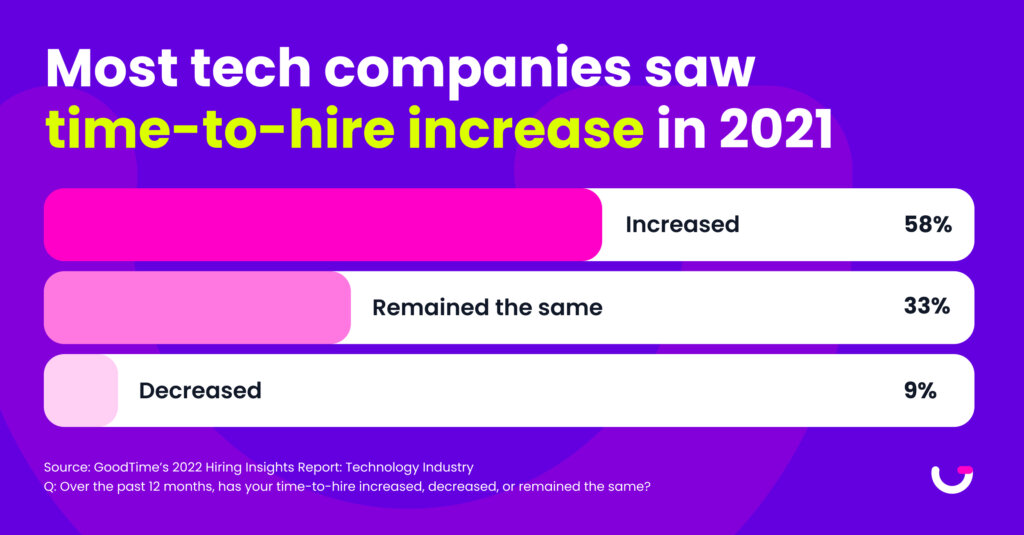
The majority of talent teams in tech—58%—said that their time-to-hire increased. Only 9% saw it decrease. 

But not everything from our survey is doom and gloom. Talent leaders said that improving hiring efficiency is currently their biggest focus area for the future (41%). With the current condition of their time-to-hire, hiring efficiency needs all of the focus that it can get. 

Why Does This Matter?

There are innumerable benefits to keeping a firm pulse on your time-to-hire and taking active steps to decrease it. Here are a few reasons why time-to-hire matters:

  • Slow processes kill a candidate’s interest. A short time-to-hire keeps candidates engaged.
  • Hiring fast increases the chance that you’ll win the most qualified candidates before your competition.
  • Time-to-hire illuminates the bottlenecks in your hiring process, and your holistic ability to compete in the market.
  • Agile recruiting provides candidates with a smooth hiring experience and boosts your employer brand.
  • Lengthy hiring processes that leave positions unfilled negatively impact company revenue.

The tech industry’s increasing time-to-hire is concerning. Even as hiring slowdowns and fears of a tech recession ricochet across the industry, time-to-hire is still a critical KPI. 

Regardless of hiring volume, hiring with speed is of utmost importance. If your company is hiring at its normal volume, you’ll face the challenge of finding and winning enough qualified candidates. If your company is hiring to a lesser degree, you’ll need to hire fewer but higher quality people. 

No matter what group you reside in, establishing an efficient hiring process to decrease your time-to-hire is the key to securing the best talent. 

How to Fix Tech’s Time-to-Hire Problem

From implementing automation to keeping candidates engaged, recruiters in tech must institute the right processes to get talent in the door faster while still delivering the high-quality hiring experience that candidates expect.

1. Let Your Hiring Data Be Your Guide

There’s always something to learn from your data, especially when identifying and resolving efficiency gaps. Use the data on your hiring process to diagnose what’s helping and hurting your time-to-hire. Then, you can make adjustments accordingly. 

For example, what does your response rate look like? Are candidates more receptive to correspondence via email or text? And what about your time between stages? Are you keeping your talented candidates waiting days and days before moving them on to the next interview?

2. Get Real With Your Hiring Manager

We’ve said it once, and we’ll say it again: the “perfect candidate” doesn’t exist. Your picky hiring manager with a laundry list of requirements, searching for their purple unicorn candidate, is in for a rude awakening once their role sits open for months. 

The importance of creating alignment between hiring managers and recruiters in tech early on cannot be overstated. Hold an intake meeting to discuss what a realistic ideal candidate looks like, and what touchpoints are necessary to hire this person. 

Here are several other topics to cover in your intake meetings:

  • Ideal candidate profile
  • Hiring process objectives
  • Job requirements
  • Title & salary
  • Hiring process stages
  • Sourcing strategies

When done correctly, the alignment from intake meetings ensures that the hiring process moves along at a steady pace and onboards the right person in a timely manner.

3. Say Goodbye to Manual Interview Scheduling

No matter the industry or company, all recruiting coordinators know the pain of sifting through calendars to find the perfect interview time. Manual scheduling invites hiring delays and bottlenecks—and nobody wants that. 

And what about when one of your interviewers cancels last minute? (Because yes, you know it’s going to happen.) Then suddenly you’re back to square one, up to your eyeballs in calendars, looking for an alternate interviewer with a free afternoon to speak to your candidate.

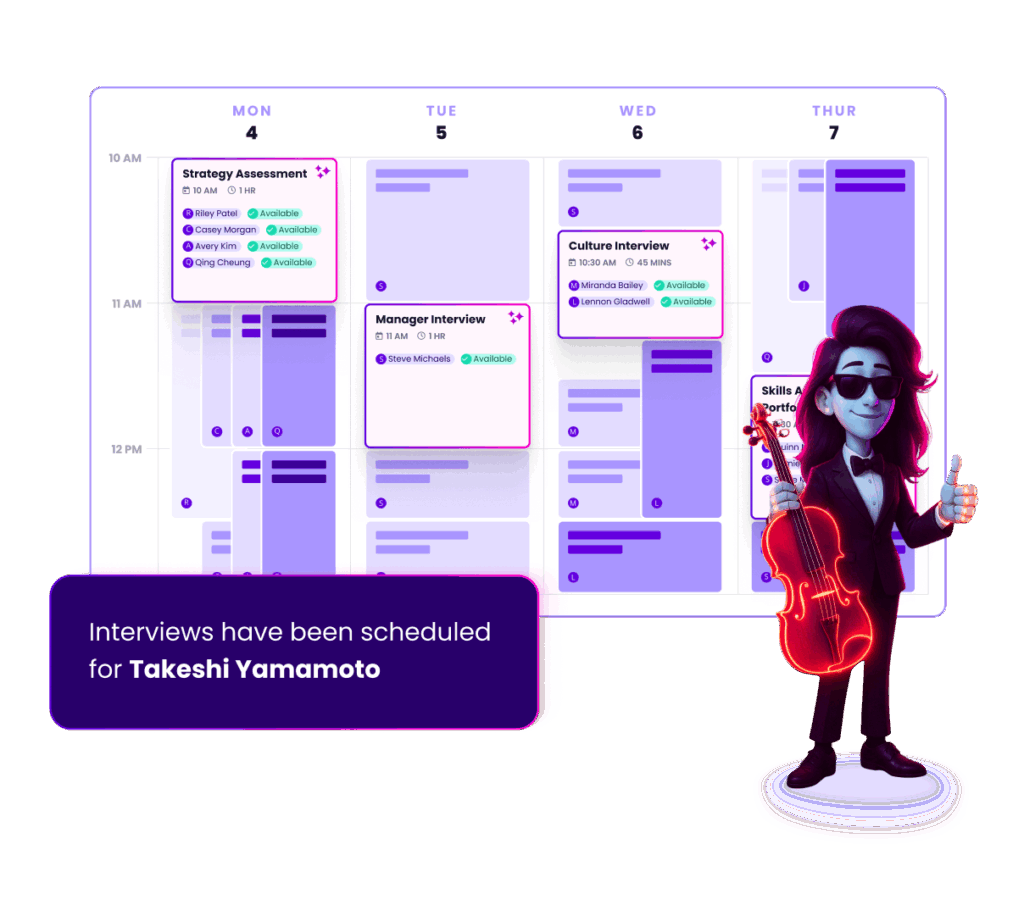
Automation is the solution to your interview scheduling headaches. By leveraging the right tech to automate your scheduling process, you’ll get a meeting on the books within seconds. Don’t believe us? Check out the difference that automation made for HubSpot’s talent team. 

Upgrade your hiring journey with AI

GoodTime’s AI agents orchestrate the entire hiring journey — screening, scheduling, messaging, and more — so talent teams hire faster with a better candidate experience.
4. Capture Your Candidate’s Attention

If you struggle to get talent to say “yes” to offers, or if candidates drop out left and right, then you have a candidate engagement problem—and this means bad news for your time-to-hire.

Every touchpoint in your hiring process should engage candidates and nurture your candidate relationships. If candidates don’t feel connected to your talent team, your company will quickly fade into the background amid competing opportunities (that’s right, your candidates are most certainly shopping around).

The secret sauce to cultivating impactful candidate relationships consists of four pillars:

  • Genuine Connection: Candidates want to have meaningful conversations about your company’s mission, culture, and DEIB beliefs. They want to uncover if they align with what your company stands for. 
  • Transparency: Candidates expect a transparent hiring process. Candidates want open communication from employers. Most recently, at the top of their wish list is pay transparency.
  • Adaptability: Your hiring process must adapt to the calendars of your candidates. They want to schedule interviews at times that best fit their everyday lives.
  • Candidate Well-being: Candidates want to understand how your company proactively supports employee mental health, and learn about any related benefits that are offered.  

Hey Recruiters in Tech: Want Future-Proof Solutions to Your Challenges?

Don’t let a skyrocketing time-to-hire bring your hiring process down. To keep your time-to-hire in check, get into the habit of identifying bottlenecks and optimizing your process for speed and efficiency.

And for more tips, check out what our experts had to say about how they’re solving today’s tech hiring challenges.


Neurodiversity Hiring: The Essential Guide

A diverse workforce is invaluable to a company’s innovation, creativity, and holistic success. In fact, diverse teams produce 19% higher revenue (no joke). But while talent acquisition professionals have turned their attention to attracting and supporting candidates from diverse backgrounds, neurodiversity hiring is still overlooked.

Neurodiversity refers to variations in the way that people’s brains work. The term is often used in reference to people with autism, ADHD, dyslexia, and other neurological conditions. 

Despite the benefits of a diverse workplace, the hiring process often leaves neurodiverse candidates at a disadvantage. Traditional recruitment methods favor neurotypical candidates (people with “typical” neurological development or functioning). This makes it incredibly hard for neurodiverse individuals to land roles; one in five adults with autism is unemployed.

It’s time to close the neurodiversity hiring gap. Here’s how to make your hiring process inclusive and supportive of neurodiverse candidates.

1. Recruit With the Right Mindset: Differences, Not Deficits

Neurodiversity represents differences in cognitive functioning, not deficits. Take this sentiment and make it the foundation of your neurodiversity hiring efforts. Viewing neurodiverse candidates as less adept than their neurotypical counterparts is harmful and completely incorrect.

Neurodiversity brings fresh perspectives and out-of-the-box thinking to the workplace. Neurodiverse talent deserve an equal shot at employment, just as all candidates do. 

2. Partner with Experts in Neurodiversity Hiring

Supporting and hiring neurodiverse candidates might feel like uncharted territory. If you’re questioning whether you have enough knowledge to implement effective initiatives, reach out to expert organizations for help.

For instance, the non-profit organization Specialisterne helped Goldman Sachs shape its Neurodiversity Hiring Initiative internship program. Neurodiversity in the Workplace, another non-profit organization specializing in supporting neurodiverse candidates, has partnered with Dell and VMware to set up their neurodiversity hiring programs.

3. Make Your Job Adverts Inclusive of Neurodiversity

Convoluted, exclusionary job adverts can dissuade neurodiverse talent from applying to your organization. Even if you think your job adverts are inclusive, give them another glance and analyze them from a neurodiverse applicant’s perspective.

Part of using inclusive language involves using concise, plain words and phrases that could be understood by any applicant, regardless of their cognitive differences. Are your adverts straightforward? Or do they include unnecessary corporate jargon? 

Candidates from underrepresented groups (URGs), like neurodiverse candidates, have a tendency to self-eliminate from the hiring process if they don’t meet all of the requirements. As one of our many inclusive recruiting best practices, remove any requirements that aren’t directly conducive to success in a position. 

If you don’t already have one, draft up a diversity and inclusion statement for all of your adverts. SHRM has provided a template to use. State your willingness to make reasonable accommodations in the application and/or hiring process; this will go a long way in making neurodiverse talent feel confident enough to apply.

4. Schedule Interviews Across Multiple Days

Some neurodiverse candidates practice masking when they interview, a method where they hide certain traits and behaviors to pass as a neurotypical person. Now, imagine having to do that for hours on end in back-to-back interviews—yeah, it’s rough.

All-day interviews can feel like an inconvenience to neurotypical candidates and an incredibly exhausting ordeal to neurodiverse candidates. Luckily, there’s an easy solution: break up the interviews into chunks across multiple days. This gives neurodiverse candidates time to decompress and prepare themselves for the next meeting.

And if there was ever a time to ditch all-day interviews, the time is now. With the rise of remote work and remote recruiting, the traditional all-day, onsite interview is quickly becoming an outdated practice. Our thoughts? Good riddance. (What, too harsh?)

5. Interviewing Neurodiverse Candidates: Prioritize Training

Whether your candidate is neurodiverse or neurotypical, training your interviewers and modifying your interviewing tactics for inclusivity benefits all candidates. (Need a guide on all-things interviewer training? Check this out.)

Here are several quick tips for interviewing neurodiverse talent:

  • Select questions about a candidate’s work experience and skill set; avoid hypotheticals.
  • Be direct with your questions. Don’t be vague.
  • Neurodiverse candidates might struggle to make eye contact or fidget. Don’t let body language influence your decisions.
  • Patience is a virtue: allow candidates time to gather their thoughts, and don’t interrupt.

6. Ask for Candidate Feedback—and Use It

Did you know that 75% of candidates report rarely or never being asked their opinions, even though 68% want to provide feedback after an interview? Talk about a missed opportunity.

Collecting feedback from neurodiverse candidates gives you insight into the quality of your hiring process. You’ll find out if your process is really as inclusive as you think it is, and learn how you can improve the interviewing experience for future candidates. 

If you’re questioning whether you have the bandwidth to kickstart a feedback collection initiative, the answer is yes. You just need the right tech tools to automate the process.

Keep Inclusivity at the Center of Your Hiring Process

Neurodiversity hiring doesn’t have to be complicated. It begins with putting yourself in your candidates’ shoes and fine-tuning your hiring process. Celebrating neurodiversity is the right thing to do, and it gives your team an edge over the talent competition.

With GoodTime Hire, you can start the hiring process on the right foot by creating diverse and inclusive interview panels.

Hire’s self-identification tagging system allows you to group interviewers based on characteristics—such as “nerdette” for female engineers—to create panels that represent the diverse perspectives at your company.


Learn more about how Hire can help elevate DE&I in your hiring process today.

The Remote Interview Era: How Scheduling Must Evolve

Anyone else still have whiplash from these past few years? The remote work era—and the changes that came with it—sent shockwaves throughout the hiring landscape. Four in five companies now offer remote or hybrid work, and 82% of employers now opt for a remote interview when speaking with candidates. 

Recruitment teams have had to alter their practices to adapt to this new normal, including their interview scheduling methods. How exactly has interview scheduling changed? One word: flexibility

As the rigid all-day onsite interview format fades away, flexible scheduling capabilities in your tech are no longer a nice-to-have—they’re a requirement. You can’t successfully coordinate a complex remote interview without incorporating flexibility into your scheduling.

But first, let’s examine how we even reached this current moment in time. 

The New Normal for Interview Scheduling: How Did We Get Here?

The way that recruiters hire people, the frequency of meetings, and the degree of candidate availability are now wildly different. These changes have introduced levels of complexity to the interview process that no team—without the proper tools—can manage effectively. Here’s what’s changed in the hiring landscape:

The Death of the Onsite Interview

Remember when employers would routinely fly candidates out to their companies for a packed day of onsite meetings and office tours? With the surge in remote work and remote recruiting, the onsite interview is now a thing of the past (hello, remote interview). 

In-person interviewing allowed panels of employees to swap in and out for multi-stage, all-day interviews with candidates. Now, remote hiring has laid in-person interviewing to rest. 

A New Meeting Culture

If you find yourself sitting in meetings more often than ever before, you’re not alone. Remote work created a culture of constant meetings; professionals spend up to a third of their workweek in meetings. 

Blocking off a full day to have large groups meet with candidates is now almost impossible. Interview scheduling becomes even harder when you have employees based across the globe, a reality that is increasingly common in the distance economy. 

Difficulties With Engaging Candidates

Candidates aren’t easy to come by; there are two jobs for every available worker. Many are passive candidates who are already employed, which makes it difficult to fit a complex series of interviews into their workday. 

Not all passive candidates can afford to take a day off of work to interview in an all-day session—and they certainly can’t show up in person. 

Interview Scheduling Must Now Be Flexible

Now, are we all caught up to speed? Due to the changes prompted by the remote work era, scheduling all-day onsite interviews is increasingly less common. 

The new norm of scheduling is evolving to look like this: scheduling a series of remote interviews spread out over several days.

Scheduling complex multi-day interviews comes with several challenges that didn’t exist with the all-day onsite interview. It multiplies the number of meetings to coordinate, broadens the interview timeline to keep tabs on, makes it difficult to reschedule or adjust specific meeting times, and more. 

This interview format isn’t easy to schedule—unless your scheduling tool has the right capabilities. Coordinating these remote interviews calls for a heightened level of flexibility. Here are several reasons why flexible scheduling is a requirement for today’s recruiting teams and candidates:

From Your Recruiting Team’s Perspective

With calendars more jam-packed than ever (on both the interviewer and candidate side), interviews must be spread out over several days. Without this flexibility, it’s incredibly difficult to find available times when key interviewers can get together with a candidate.

Working across teams and time zones makes calendar coordination all the more complex, once again prompting recruiting coordinators to schedule over the span of a few days to locate availability. Long story short: it’s tough to get an interview on the books without flexibility in scheduling.

From Your Candidate’s Perspective

Remember how we said that many candidates are already employed? With their limited availability, these candidates need to book their interviews over their lunch hour, in between meetings, or during any other free moment in their workday.

If you want them to go through a series of panel interviews, you’ll need to break it up over several days to make their participation possible. 

Above all, today’s candidates need to be accommodated if you want to attract and win the best of the bunch (it is a candidate’s market, after all). That requires talent acquisition tech that can adeptly schedule beyond the confines of the one-day interview structure.

Does interview scheduling automation make sense for my team?

ROI is key. This is not a time to invest in software that won’t bring you immediate value. So let’s eliminate the guesswork with our free ROI calculator.

Effortlessly Schedule Your Next Remote Interview

As the norms of scheduling interviews evolve, your recruiting tech stack must evolve with them. Recruiting teams now face a new remote recruiting reality, with new interview scheduling challenges requiring new tech. 

You need a tool with scheduling flexibility that can coordinate complex panels of interviews fast enough to keep candidates engaged. And as the cherry on top, you must provide a holistically compelling hiring experience. 

No existing tools can provide this—until now. GoodTime Hire delivers the flexibility that’s missing from your HR tech stack. Recruiting teams can schedule interviews over one or multiple days; they have complete control over meeting event times, dates, breaks, attendees, and priority.

Learn more about how interview scheduling software can revolutionize the way that you coordinate interviews.

Losing Candidates? Subpar Scheduling Automation May Be the Culprit

Are you consistently losing candidates, even though your hiring process seems to be in great shape? You may be overlooking one significant culprit: low-quality scheduling automation.

As talent acquisition teams juggle multiple calendars, time zones, and interviewer loads, leveraging scheduling automation is an absolute necessity to coordinate fast and intelligently. Automation is invaluable to the scheduling process…until it isn’t.

With some interview management systems, the promise of automation doesn’t deliver. Not all tools can navigate the twists and turns of modern-day interview scheduling. Subpar scheduling automation makes a recruiter’s job harder and degrades a candidate’s hiring experience. 

What Does Subpar Scheduling Automation Look Like?

If your scheduling automation can’t handle the complexity of everyday scheduling, then you have low-quality automation. This type of automation presents suboptimal scheduling decisions as the “best fit.” It doesn’t think like a recruiting coordinator would.

Subpar automation can’t handle the turbulence of the recruiting landscape, where interviewer availability can shift at a moment’s notice. If you can’t trust your system to adapt to changes and make the best scheduling decisions, then is your automation really saving you time?

How Lackluster Automation Deters Candidates

Candidates expect a fast-moving, frictionless hiring process that positively connects them to your culture and team. Lackluster automation delivers the exact opposite experience. Here’s how:

Candidates Are Picky—and Poor Automation Is a Turnoff

Today’s record-low unemployment rate makes finding stellar talent a challenge. To ramp up the pressure, candidates are increasingly selective when vetting job offers. Nearly half (49%) of candidates have turned down an offer due to a bad recruiting experience. Candidates have high expectations of your process—and you better live up to them. 

Recruiting teams need to be on their A-game to impress picky candidates, and that means leveraging intelligent HR technology. Poor scheduling automation creates a clunky process filled with bottlenecks. That’s a major turnoff.

Top Candidates Lose Enthusiasm When There Are Delays

Put yourself in the shoes of a candidate. A recruiter approaches you for a phone screen—success! You give them your availability, but then a week goes by without any communication. Did they just ghost you? Ouch.

Suddenly, the recruiter reaches back out: your interview is scheduled. It’s about time. You complete the interview, yet then the cycle of delayed communication starts once again. Time to apply to other companies.

Doesn’t sound like a pleasant hiring experience, does it? It certainly doesn’t match up with expectations; 55% of candidates believe that it should take one to two weeks from the first interview to receive an offer. When scheduling automation creates delays, candidates steadily lose enthusiasm and opt out of your process.

Candidates Flock to Companies With Refined Automation

Almost all candidates have multiple companies vying for their attention. If you don’t hire with polished automation, another company will. (Hint: that’s the company that candidates will run to.)

A tech solution that doesn’t create a compelling hiring experience or cultivate bonds with candidates drives talent straight into the arms of competitors.

What Does Intelligent Scheduling Automation Look Like?

Intelligent scheduling automation revolutionizes the hiring process. It knows just as much (or more) about your interview team and workflow as you do. High-quality automation can be just the thing that makes your hiring process impress top talent.

Upgrade your hiring journey with AI

GoodTime’s AI agents orchestrate the entire hiring journey — screening, scheduling, messaging, and more — so talent teams hire faster with a better candidate experience.

Intelligent automation possesses advanced calendar awareness. It’s able to schedule for both speed and “best fit.” Intelligent automation is also agile; it can handle a request to change or reschedule an interview in a matter of seconds. Overall, this automation considers the nuances of your company’s calendar so that it truly thinks like a recruiter.

How Smart Automation Engages Candidates

While smart automation makes a recruiter’s job easier, it also enhances a candidate’s experience with your team and your company.  Here’s how:

Caters to Your Candidate’s Schedule

It’s a candidate’s market; talent teams must schedule to accommodate their candidate’s calendar, not just their own. Intelligent automation puts this in motion.

Perhaps an interviewer’s first available time slot is too far into the future, and you don’t want to keep your candidate waiting too long. (They’ll either lose interest in you, or another company will scoop them up!) Have no fear: intelligent automation knows how to ignore certain scheduling restrictions to schedule the interview sooner.

Yet sometimes, getting a candidate in front of your team as soon as possible isn’t the priority. Maybe you’d rather schedule a time when interviewers with the most relevant skills can speak to the candidate. (This is a surefire way to improve the candidate’s interview experience!) In this case, smart automation can schedule a meeting time that’s a “best fit” for this factor.

Enriches the Hiring Experience With Personalization

Personalization makes people feel special, and the same applies to candidates. It’s why you always see personalized name keychains in gift shops; people love a personal touch. It’s only human nature.

Sending automated, personalized meeting reminders adds a human element to the hiring process. This fosters meaningful connections with candidates and makes the scheduling process feel less “robotic.” When it comes to enhancing a candidate’s hiring experience, the best automation to use is the kind that feels a little less automated and a little more human.

Eliminates Delays and Keep Candidates Interested

If you‘ve ever had interviewers bow out or change their availability, you know how many bottlenecks that can cause. To make matters worse, candidates lose interest when they’re met with scheduling delays. Luckily, the right scheduling automation can eliminate this problem. 

Smart automation sorts through countless scheduling options to identify the top choice. Even if an interviewer or a candidate’s availability changes, smart automation adapts to display the best options. No bottlenecks mean happy candidates.

Schedule Smarter and Win More Talent Today

If you’re thinking, “There’s no way that a software can handle the complexity of our scheduling process,” think again. Start scheduling smarter today with GoodTime. 

GoodTime Hire’s new Flexible Scheduling delivers scheduling automation that you won’t need to second-guess. Recruiters who use Hire’s Flexible Scheduling know they can trust the solution to make the right interview scheduling decisions, no matter the complexity.

Learn more about how Hire’s Flexible Scheduling can revolutionize the way that you schedule.

Remote Hiring 101: How to Convey Company Culture

In any hiring process, there’s a fair chance that candidates will ask, “How would you describe the company culture?” Candidates deeply care about company culture; 72% would reject an offer because they feel disconnected from the culture. Yet in a remote hiring process, culture can get lost in translation.

Touring an office and shaking hands with employees makes the intangible concept of company culture incredibly tangible. But with remote hiring now the norm, recruiting teams grapple with conveying culture through a Zoom screen.

Recruiters must take a thoughtful approach to sharing company culture—a difficult task, but not impossible. Read on for our top tips on how to communicate culture when hiring remotely.

Before the Remote Interviewing Stage

While most hiring teams focus on conveying culture during interviews, you shouldn’t ignore the pre-interview stage. First impressions matter; it’s important to communicate your culture before candidates even walk through the (virtual) door.

Optimize Your Careers Page

The careers page is much more than a place to display job openings. With the proper optimization, your careers page can act as a gateway into your company culture.

Our friends at Greenhouse gathered several examples of careers pages done right. Here are some elements from those pages that make company culture stand out:

  • Clearly defined mission and values
  • Company story
  • Quotes from employees
  • Videos/photos of employees collaborating
  • Engaging interactive features
  • Strong brand voice and tone

Fine-tune Your Interview Scheduling

Don’t underestimate the significance of the interview scheduling stage. The way that you navigate this stage reflects your company culture. To communicate a culture of understanding and empathy, you need to show it through your scheduling.

For instance, accommodating a candidate’s schedule conveys that you value their time. Be sure to ask for your candidate’s availability upfront. 

Another way to communicate an empathetic, flexible culture is by straying away from all-day interviews. Scheduling all-day interviews suggests that your company doesn’t value a work-life balance. Most candidates would much rather interview in chunks across several days. 

Does interview scheduling automation make sense for my team?

ROI is key. This is not a time to invest in software that won’t bring you immediate value. So let’s eliminate the guesswork with our free ROI calculator.

During the Remote Interviewing Stage

Once you reach the interview stage, it’s time for all systems go. This is the prime opportunity to relay what your company culture is like. 

Nearly all (90%) of the companies from our 2022 Hiring Insights Report said that they designed their interview process to reflect their culture. However, 47% said that they don’t actually communicate their culture to candidates. 

Don’t be like those companies. Here’s how to make your culture loud and clear.

Train, Train, Train Your Interviewers

Your interviewers are your company’s spokespeople. Their interactions with candidates should align with your culture. That’s why it’s essential to have each interviewer participate in interviewer training. 

Interviewers should learn how to speak about company culture in a vivid, true-to-life manner. This doesn’t mean listing a jumble of different adjectives. (What does having a “fun” culture even mean?) Instead, interviewers should share concrete, specific examples that paint a picture of your company.

Emphasize Diversity in Interview Panels

Remote hiring opens the door to a broader talent pool—and more diverse candidates. These candidates want to know that DE&I is vital to your company culture. But they don’t want to be told that your company cares about DE&I—they want to see that your company cares about DE&I.

One of the best ways to show that DE&I is crucial to your culture is by increasing the diversity in your interview panels. Candidates from underrepresented groups want to be interviewed by diverse interviewers with whom they share traits. Seeing employees similar to them makes candidates feel represented by their potential employer.

After the Remote Interviewing Stage

The post-interview stage can be a nerve-wracking period for candidates. “Did the interviewers like me? Did I interview the best that I could?” How you approach this stage says a lot about your organization and company culture.

Keep Consistent Communication with Candidates

Is there anything worse than a recruiter who ghosts candidates? Interviewing can be a high-stress ordeal for candidates, and dropping contact with them out of nowhere can kick their stress into overdrive. 

Ghosting reflects incredibly poorly on your culture; if candidates feel mistreated before joining your company, how can they expect it to be any different as an employee?

Be sure to maintain consistent communication with candidates. If setting up a second interview takes you longer than expected, give candidates a quick update to show that you haven’t forgotten about them. Not only will this reflect positively on your culture, but it’ll also dissuade candidates from looking for opportunities elsewhere.

If Rejecting Candidates, Do it With Tact

No one likes to deliver bad news—especially when it’s employment-related. Rejecting candidates is an unfortunate yet necessary part of being a recruiter, and there’s a right and wrong way to do it.

The way that you reject candidates says a lot about your culture. Tactfully rejecting candidates sends the message that your company has a heart. A personalized email with thoughtful wording breaks the news in a considerate manner. 

And remember: delivering bad news is better than providing no news. A survey found that a whopping 75% of candidates never hear back from an employer. Receiving no response after trying your hardest in an interview deals a significant blow to your self-esteem; deliver the rejection as soon as possible so that candidates can move on and discover the job that’s right for them.

Level Up Your Remote Hiring Process Today

Amid your recruiting tasks, never lose sight of your company culture. It should permeate every corner of your remote hiring process (and it’s much easier to convey than you think). Successfully communicating your culture can be just the thing that gets candidates to a “yes” when it’s time to deliver offers.

To cultivate a remote process that’s head and shoulders above the competition, you need some extra firepower in your corner. You need GoodTime Hire.

Hire harnesses Candidate Relationship Intelligence to automate coordination, build relationships during interviews, and provide actionable insights to continuously improve your hiring process.

Learn more about how Hire’s interview scheduling software can transform your talent acquisition process.

Ada Lovelace Day: GoodTime Celebrates Women in STEM

Women in STEM make the world go ‘round. That’s why we’re excited for Ada Lovelace Day, an international celebration of the achievements of women in STEM. 

The STEM gap is all too real: women make up nearly half of the U.S. workforce, yet just 27% of STEM workers. Ada Lovelace Day aims to close this gap by uplifting women in STEM and inspiring the next generation.

We’re endlessly proud of the women in STEM at GoodTime, and we’re eager to spotlight their talents. From our CEO to our engineers, we wouldn’t be where we are today without them.

Our CEO’s Programming Journey

Ahryun Moon went from working as a financial analyst, to transitioning into engineering, to ultimately becoming the CEO and Co-founder of GoodTime. Ahryun’s path to GoodTime was a winding road, and her experience in programming helped get her here.

Back in her financial analyst days, Ahryun wondered if it was possible to automate her job’s tedious tasks. Determined to make this happen, she learned the coding language Python. Within a few months, she built software that automated much of her work.

Soon enough, everyone in her finance department adopted her software. It saved the team about a month of work per quarter and allowed them to bring financial results to the business division a month earlier every quarter.

Her success led to a meeting with the CFO. Ahryun recalls her conversation with him: “He sat me down and was like, ‘Be selfish and tell me what you want to do. Do you want to be on a track to become a CFO like me?’”

“I thought about it and told him, ‘No. In fact, I want to quit my job to move to San Francisco and pursue engineering,’” she said. “And I did.”

So, how did GoodTime come into the picture? After spending years leveling up her engineering skills, Ahryun learned that—much like her financial analyst job—recruiters spend so much time on tedious tasks that they don’t have time to recruit. She wanted to bring automation to recruiters. Then, GoodTime was born.

The advice that Ahryun would give to her younger self: try STEM.  “Programming was never recommended to me, but it should have been,” she said. “Why are we still being limited? Women absolutely thrive in STEM.” 

The Brilliant Minds of Our Female Engineers 

Before Emily Pancake, one of GoodTime’s software engineers, started on her current career path, she received an inside look into the life of an engineer. She was part of a team that worked alongside many of them—all men.

“I remember thinking to myself, ‘These guys get to sit around and solve puzzles with each other all day long and everyone thinks they’re magic, and I’m smarter than most of them; I can do that!’” she said. 

At that moment, Emily decided to join the ranks of software engineers. Yet when she started her first engineering role, she faced a reality that is all too familiar for women in STEM: her team consisted of 18 men and just one woman.

Emily loved writing code, yet she began to feel discouraged after getting assigned trivial tasks that didn’t make much of an impact.

“In some of the more frustrating moments in that role, I often wondered if people would take me more seriously if I was male,” Emily said. 

Fortunately, Emily remarks, she has gained enough credibility and confidence to join more inclusive and welcoming teams, finally making her way to GoodTime.

“Tech teams are intensely eager to find—and keep—good female engineers,” Emily said. “This gives us a lot of power and it makes the journey very worthwhile.”

Interview Scheduling vs. Speed Dating: Strangely Similar?

Do you have your eye on a fantastic job candidate? If you want to win their heart, consider taking inspiration from the speed dating world. (Yes, you read that right.)  

On the surface, speed dating and interview scheduling couldn’t seem more different. Yet these two spheres are strikingly alike, and there’s a lot that they can teach each other. 

Especially amid today’s hot talent market, where there are two jobs for every available worker, recruiters should borrow this crucial lesson from speed dating: success comes from moving fast. 

The faster a recruiter gets their talent team in front of candidates, the better their chances of landing a great new hire before another company secures them. 

The major common denominator in successful speed dating and interview scheduling is speed. How else are recruiters similar to singles looking to mingle—and what can recruiters learn from them? 

Learning #1: Prompt Scheduling Creates a Great First Impression

You’re gazing across the room, and there they are: someone who might be “the one.” You can feel it. You can’t wait until they rotate to your table for a quick one-on-one; you simply can’t leave without speaking with them. 

Time is of the essence when you see that special someone, and the same applies when you’re a recruiter sifting through applications. That’s why talent teams have no time to waste when they come across a compelling job applicant. Getting an interview on the books as soon as possible is the name of the game.

Acting with a sense of urgency gives a great first impression. It lets the other party know that your interest in them is serious. And when your goal is to create a genuine connection, first impressions are everything. 

In fact, a survey found that 48% of candidates are deterred from applying for jobs after poor first impressions. Set the right tone with candidates from the get-go by reaching out for an interview the moment that you realize they’d be a superb new hire.

Learning #2: You’re Not Your Candidate’s Only Admirer

You’re speaking to someone and you’re really hitting it off. You get swept up in the moment…but then the bell rings and it’s time to switch tables. You watch as they move on to talk to another person, and it looks like they’re also hitting it off. Ouch.

There are plenty of fish in the sea, plenty of singles at speed dating events, and plenty of companies in the world (and remote hiring has only increased the number of employers vying for your candidate). In other words, you’re probably not the only one that your candidate has their eyes on.

The average number of applications that job seekers send is 13. With candidates interested in such a variety of roles, talent teams need to differentiate themselves if they want to stand out from the competition.

To get a leg up on other companies, go the extra mile for your candidates. When communicating with them, respond to their concerns in a timely manner. But don’t forget to come prepared for the interview; you need to know your stuff when they ask questions! Fast interview scheduling isn’t impressive if the interview itself is shabby.

Does interview scheduling automation make sense for my team?

ROI is key. This is not a time to invest in software that won’t bring you immediate value. So let’s eliminate the guesswork with our free ROI calculator.

Learning #3: The Post-interview Follow-up Is Crucial

You’ve conversed with a few interesting people, yet no real stunners. Then suddenly, you meet the perfect match! But tread lightly: your next few actions are just as important as your first encounter with them. 

After you interview a star candidate, take a page out of the speed dating world’s book and immediately act on the next step: the post-interview follow-up. If you’re really interested in a candidate and want to keep them engaged, you have to show it. 

And if you don’t? They’ll flock to the other options that they have on the table. Nearly one-quarter of workers lose interest in an employer if they don’t hear back from them within one week after the first interview, and 46% lose interest if they don’t receive communication within one-to-two weeks post-interview.

Keep the enthusiasm going by getting the next meeting scheduled as quickly as you can. By minimizing the wait time in between interviews, your company will remain top of mind for candidates, and you’ll reduce your candidate drop-off rate. They’ll be just as engaged in the second interview as they were in the first.

Woo Your Candidates With Agile Interview Scheduling

In the recruiting world, the pressure to impress and win candidates is at an all-time high. If you don’t act fast enough, another employer will sweep them off their feet.

But by scheduling each interview with a healthy dose of speed, you’ll spark a connection with talent and make a lasting impression on them before the competition can even get a word in.

GoodTime Hire’s new Flexible Scheduling intelligently optimizes interviews across teams, tools, and timezones in seconds, saving time and getting you in front of candidates faster with an incredible experience, no matter the complexity.

Learn more about how Hire’s Flexible Scheduling can revolutionize the way you schedule.

10 Essential Ways to Use Inclusive Language When Recruiting

Do you use inclusive language when recruiting? Or is your unconscious bias roaming free? For some recruiting teams, ensuring that all language is inclusive isn’t top of mind. But it should be.

Research consistently proves that a job description’s exclusionary language can prevent subsections of candidates—specifically underrepresented groups (URGs)—from applying.

It’s crucial to use inclusive language at all touchpoints in the recruitment process, from job descriptions to interview conversations. Inclusivity helps level the playing field for underrepresented applicants, effectively making them feel welcome.

If you’re not sure where to start, we’re here to help. Here are 10 important ways to use inclusive language in your recruiting efforts.

1. Steer Clear of Gendered Language

Do your job descriptions include words like “rockstar” or “ninja”? That’s a red flag. Gender-biased words like these skew masculine and can reduce the number of women that apply to a role.

If that sounds far-fetched, then check out this investigation. HR specialists learned that the reason that their company received less than 2% female candidates for their developer jobs was because of the word “hacker” in the job titles.

When in doubt, opt for clear, gender-neutral language. If you’re looking for an account executive, just plainly say that.

2. Swap Out “Culture Fit” for “Culture Add”

If job descriptions or recruiting materials say that you’re looking for someone who will be a good “culture fit,” consider swapping that phrase out for “culture add.” In some cases, hiring for culture fit turns into hiring for homogeneity, as recruiters seek out candidates similar to them or similar to what already exists in the company.

In this sense, culture fit creates a workforce that recruits people who think and look the same. On the flip side, saying that you’re looking for a culture add conveys that you want a new hire who could enrich the company culture with their diverse experiences and ideas.

3. Highlight the Salary Range

Data on the uncontrolled gender pay gap shows that American Indian and Native Alaskan women, along with Hispanic women, have the widest pay gaps. When analyzing the controlled gender pay gap, Black women have the widest pay gap.

Fostering salary transparency wields a real impact on the gender pay gap. Women who feel that they are paid transparently reportedly do as well or better than men for every $1 they earn. 

Setting the precedent that the salary range will always be included in your organization’s job descriptions lays the groundwork for an inclusive, pay-transparent organization.

4. Spotlight Your Commitment to DE&I

If your company diligently champions DE&I, allude to this in the job description. Most organizations reference this in an “equal opportunity employer” blurb, yet going the extra mile to elaborate on your commitment and convey it in your own words is worthwhile.

Once applicants make it to the interviewing stage, ensure that you’re prepared to expand on exactly how your company uplifts DE&I. Eighty-six percent of candidates globally say that DE&I in the workplace is important to them. More likely than not, they want to hear how you’re reaching your DE&I goals!

5. Underscore Inclusive Benefits

For certain applicants, employee benefits like childcare subsidies, paid family leave, and paid parental leave aren’t just perks—they’re must-haves. Be sure to emphasize these types of inclusive benefits in the job description. 

Yes, not every employee will utilize them. But for applicants with families and those who are starting families, having these benefits will make all the difference.

6. Don’t Assume. Ask for Pronouns.

Unless stated in their cover letter, resume, or any other materials that they’ve submitted in their application, don’t assume a candidate’s pronouns. Misgendering a candidate is harmful and undoubtedly starts the candidate relationship on the wrong foot. 

When interviewing a candidate, ask for their pronouns early on in the conversation. Ensure that this is noted as a best practice in your organization’s interviewer training.

7. Narrow Down the “Must-haves”

When a hiring manager comes to your recruiting team with a laundry list of “must-haves,” set realistic expectations with them. An excessive list of requirements deters certain applicants from applying.

A study shows that while women commonly only apply for jobs where they meet 100% of the requirements, men typically apply if they meet just 60% of them. If a requirement isn’t directly conducive to success in a role, it’s not crucial to include it in the job description.

8. Remove Any and All Racially Biased Language

It shouldn’t have to be said, yet it needs to be said: the vast majority of job descriptions have no reason to include racially or culturally explicit phrases. The only exception is if it’s directly connected to the position in some way.

There’s cases where common phrases can inadvertently exclude applicants of a specific racial or cultural background. For instance, when job posts say they’re looking for a “native English speaker,” this excludes speakers who are fully fluent in English, yet aren’t native speakers.

9. Eliminate the Corporate Jargon

If an applicant isn’t familiar with a certain acronym, it doesn’t mean that they aren’t skilled in their field. Their previous companies might’ve not used the term, or used a different term in its place. 

Using too much corporate jargon in a job description can deter promising candidates from applying—especially candidates from different regions of the globe, or candidates whose first language isn’t English. Plain language is better.

10. Watch Out for Ageism

Have your recruiting materials ever said that you’re looking for a “digital native”? This phrase identifies people who were brought up during the information age. Phrases like that deter older workers, as they imply that younger applicants are preferred. 

A company with a wide variety of age groups benefits from diverse perspectives. Examine your job descriptions and careers page for any words that favor specific ages. 

Keep DE&I at the Center of Your Recruiting Process

The importance of inclusivity in the recruiting process cannot be overstated. Using inclusive language when recruiting is essential to leaving applicants with a sense of belonging, yet there’s so many more ways to commit to DE&I.

With GoodTime, you can start the interview process on the right foot by creating diverse and inclusive interview panels.

GoodTime’s self-identification tagging system allows you to group interviewers based on characteristics, such as “nerdette” for female engineers, to create panels that are truly representative of the diverse and wide-ranging perspectives at your company.


Learn more about how GoodTime can help supercharge DE&I in your hiring process today.

Reverse Recruiting: Everything You Need to Know

The world keeps on turning and the recruiting landscape keeps on changing. With new approaches to talent acquisition popping up all the time, it can be difficult to keep pace with the latest trends. Here’s one new approach you should add to your vocabulary: ever heard of reverse recruiting?

What Is Reverse Recruiting?

Reverse recruiting flips the traditional roles of candidates and recruiters. Instead of candidates applying to companies, companies apply to candidates. 

In order for reverse recruiting to work, companies need to provide candidates with more detailed information in their first encounter than they normally would. This information includes compensation and benefits attached to the role.

After candidates sift through their potential job opportunities, they decide which recruiters they’d like to meet for an interview.

Unlock 2026’s top hiring strategies: Insights from 500+ TA leaders

Be the first to uncover deep hiring insights specific to your sector — straight from the highest-performing TA teams.

Why Should You Care About Reverse Recruiting?

Reverse recruiting’s advantages are far and wide. If you’re not convinced that reverse recruiting matters, check out its benefits below.

Adapt to the Evolving Hiring Landscape

It’s still a candidate’s market; there are two jobs for every available worker. More likely than not, these candidates have a variety of job opportunities to choose from. To adapt to today’s market, talent teams must evolve their hiring methods. 

Posting job openings on LinkedIn may be a popular approach to finding talent, but with candidates being inundated by opportunities on job boards, it’s not always the best way to stand out. 

By applying to candidates, companies differentiate themselves from other organizations by making their interest in a candidate incredibly apparent.

Better Chance of Winning Coveted Talent

Reverse recruiting proves to be especially useful when recruiting for in-demand roles, such as software engineers. The U.S. Bureau of Labor Statistics estimates a 25% growth in software development jobs from 2021 to 2023.

Directly conveying to a candidate that you’re interested in them effectively captures their attention and increases your chances of filling the in-demand role.

Increase Your Candidate Pool Diversity

If one of your recruitment team’s goals is to boost the diversity among candidates, reverse recruiting is a proactive way to do it. Revere recruiting puts all of the power in your hands to seek out and uplift diverse, underrepresented talent.

Identify Talent With a Perfect Skill Set Match

If you have trouble finding applicants who match the hiring manager’s wish list of skills, reverse recruiting can solve this problem. Applying to talent allows companies to connect with just the candidates who possess the desired skills.

This also eliminates the amount of time spent sifting through applications upon applications that just don’t contain what the hiring manager is looking for.

How To Prepare for Reverse Recruiting

We’ve covered the basics of what reverse recruiting is…but how should recruiters put reverse recruiting into action? Before reaching out to candidates, follow the steps below to guarantee the highest success rate.

Carve Out Your Candidate Profile

The first step of reverse recruiting involves considering your ideal candidate profile. What experience is required? Is a specific skill set or mindset most important for this position? 

This step shouldn’t feel unfamiliar; it’s a pivotal action item for practically all types of recruiting. However, your candidate profile is especially important when reverse recruiting. You’ll leverage it when explaining to a candidate how they would be a great fit for a specific role. 

Establish the “Why”

“What’s in it for me?” That’s one of the first questions a candidate asks themself when approached by a recruiter. It’s important to get clear on the “why” behind your reverse recruiting efforts. Why would a candidate want to work for your company? Why would they enjoy the role? 

Identify the compensation, benefits, and perks of working for your organization so that you can effectively relay them to your candidate.

Refine Your Employer Brand

Your company’s reputation as an employer can be discovered in just a few clicks. Tidying up your employer brand before you reach out to candidates is a must. 

In fact, organizations that invest in their employer brand are three times more likely to hire quality candidates.

There are countless ways to improve your employer brand. From boosting your careers page (and ensuring that you actually follow through on the page’s promises), to nailing down your employee value proposition, to committing to DE&I, the choice is yours.

Supercharge Your Recruiting Methods Today

Whether or not reverse recruiting is ideal for your talent team to employ, there’s one opportunity that your team simply shouldn’t pass up on: leveling up your recruitment tech stack.

GoodTime Hire automates coordination, builds genuine connections with talent, and gathers actionable data to optimize the entire process. (Plus, you’ll save major time and money along the way).

Discover how GoodTime Hire’s interview scheduling software can take your recruiting to the next level.

Join a community just for talent pros

GoodTime Talent Innovators is an online community for TA professionals to engage in discussions, network with one another, and discover exclusive events.

5 Things Candidates Wish They Could Tell Your Recruiting Team

Do you ever wonder what’s going on inside a candidate’s head? You should. In today’s hiring landscape, it’s crucial for your recruiting team to put themselves in your candidates’ shoes. 

We’re still in the thick of a candidate’s market; there are two jobs for every available worker. With candidate’s having the upper hand, the smartest talent teams try to channel a candidate’s perspective when evaluating their hiring process. 

Your candidates might start each interview with a beaming smile, but behind that smile, candidates are carefully examining your hiring methods, forming their own brutally honest thoughts on your team and organization.

Here are five things candidates wish they could say to your recruiting team.

1. “My time is precious. Please respect it.”

Don’t expect candidates to move their schedules around to accommodate your interviewers’ calendars. It’s a candidate’s market, remember? Candidates want to schedule interviews at times that best fit their calendar. Ask for their availability upfront.

And don’t even get us started on scheduling all-day interviews. The expectation in the past might’ve been that candidates should block out their full day to speak with your company’s employees, but the past is the past. Now, candidates would much rather interview in chunks across several days. 

Above all, remember: your candidates are most definitely interviewing for roles at other companies. They’re more likely to remember and appreciate your interview process if you schedule their interviews with flexibility and understanding.

Upgrade your hiring journey with AI

GoodTime’s AI agents orchestrate the entire hiring journey — screening, scheduling, messaging, and more — so talent teams hire faster with a better candidate experience.

2. “Salary and benefits: be honest upfront.”

Transparency is top of mind for candidates. The Pay Transparency Pulse Report shows that 79% of employees want some form of pay transparency, and 32% want full transparency. To add to that, 68% of respondents said they would switch employers for greater pay transparency, even if compensation was the same. 

It’s common for companies to try to get leverage by waiting until the last moment to disclose the position’s true salary and employee benefits. This is a practice that recruiting teams need to leave behind.

Displaying transparency not only makes a workplace more appealing to candidates, but is also holistically practical from a recruitment perspective. Waiting until the last minute to learn that a candidate’s expectations don’t match up with a role wastes everyone’s time. Smart hiring teams are transparent from the get-go.

3. “What do you really mean by ‘work-life balance’?”

“A great work-life balance” is a phrase that companies love to throw into the “perks” section of job posts. But what do they really mean when they say work-life balance? That’s a question that an increasing number of candidates have for hiring teams.

Does offering a great work-life balance mean that a company allows employees to set their own hours? Does it mean that the position is remote or hybrid? Job seekers care about the specifics. Candidates ranked work-life balance as more important than compensation, culture, and benefits. 

Interviewers should clearly describe how their company provides employees with the flexibility that creates a healthy work-life balance. In doing so, interviewers will open the door for a greater diversity of candidates, such as working parents, who cannot compromise on a lack of a work-life balance.

4. “Your company celebrates DE&I? These interviews don’t show it.”

Candidates from underrepresented groups want to be interviewed by a diverse array of interviewers with whom they share similar traits. Seeing employees that are similar to them makes candidates feel represented by their potential employer. Candidates will notice if a panel lacks diversity—trust us.

Besides creating diverse interview panels, another way that your recruiting team can uplift DE&I is by having all interviewers undergo bias training. Everyone relies on unconscious bias from time to time. But with the proper interviewer training, it’s entirely possible to reduce bias and create an objective interview process.

All in all, conveying a commitment to DE&I in hiring not only attracts candidates, but also benefits your bottom line. Diverse teams produce 19% higher revenue. Focusing on DE&I just makes sense.

5. “I’m not just a job candidate—I’m human, too.”

Candidates don’t want to be viewed as just a number. They want to be seen for who they really are: a human above all else. Within this, candidates want to feel a genuine, personal connection to your recruiting team. 

Take time to nurture your relationships with candidates. Here’s an insight to jump off of: 62% of employees say that well-being support is their top priority in the job hunt. Offering yourself as a resource if candidates have any concerns is a great way to show that you care about their well-being, and improve your relationship with them.

Make the connection between you and your candidates as mutual as possible. Find out what candidates want in a role—not just what they can offer your organization. After all, you want new hires to feel engaged in their jobs. 

Supercharge Your Recruitment Process Today

Now that you’ve gotten a glimpse into what candidates wish they could say to you, it’s time to put these insights into action and level up your recruitment process. 

If you want to stand out among other companies, you need recruitment tech that truly prioritizes candidates. Look no further than GoodTime Hire.

GoodTime Hire harnesses Candidate Relationship Intelligence to automate coordination, build relationships during interviews, and provide actionable insights to continuously improve your hiring process.


If you want to take your recruitment process to the next level, learn more about Hire today.